
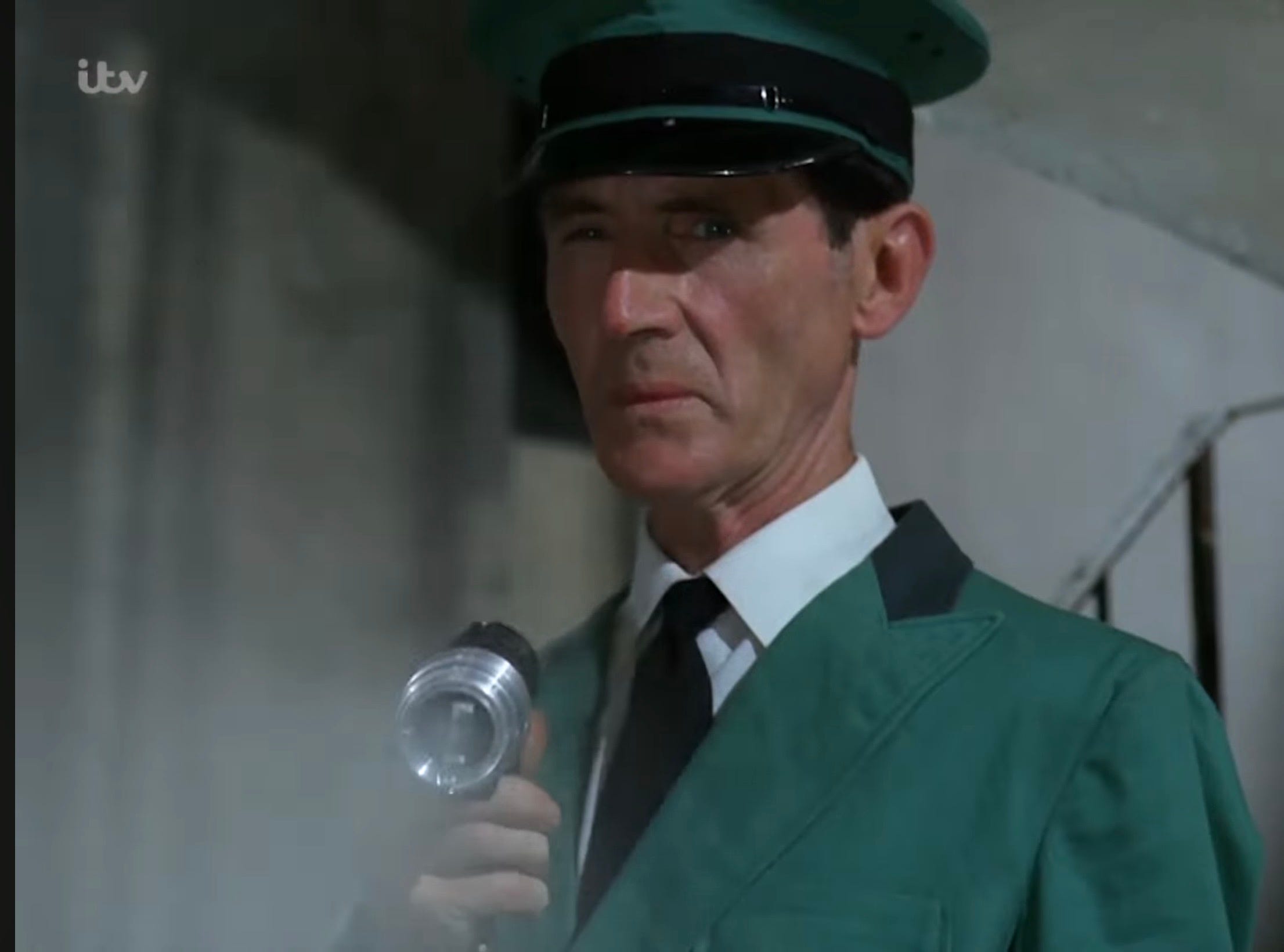
Before I get stuck in to this episode - which I shall refer to henceforth as ‘Darling’, both for convenience, and because it makes me laugh - it’s time for a spot of admin. Literal admin!
I must say a big thank you to punter Martin, who has very kindly shared with me a wealth of original documents from the production of the ‘second series’ of The Prisoner. These include location movement orders, call sheets, shooting schedules, script amendments … and also things like requisition receipts for stationery! I’ll be peppering the choicest discoveries throughout the following episodes.
The first document in Martin’s haul is the minutes of the preproduction meeting for Episodes 14-17 held on Thursday August 17th 1967. The shoot was due to begin on the following Monday, the 21st.
This meeting was convened to discuss the entirety of the ‘second series’. But it contains the ominous sentence ‘Episode 14 only would be discussed at this meeting, as information for the remainder of the series was not available at this time.’ Oh dear.
Another ironically optimistic sentence follows soon after, under the heading SCHEDULE. ‘Approximately 10 weeks overall for the four episodes. It was anticipated that each episode would take 11 days to shoot, with the exception of Episode 14 which would run into 12 days due to the Bank Holiday.’
By comparing this plan to what actually happened, we can get a clearer picture of the shoot and how it slipped the moorings of this bullish prediction. We should remember that the previous block of thirteen episodes kept to the standard ITC eleven day turnaround, more or less. The standing sets of the Village - upstairs and ‘backstage’ - helped to keep things on track. One of the reasons for Don Chaffey’s departure from the lot was his slowness at getting minutes in the can, and he ran over merely a couple of days.
If the second series schedule had run as anticipated, the shoot would have wrapped on about October 30th. The final day of the shoot was actually November 20th. An overrun of three weeks doesn’t sound so bad, but for an expensive film series which requires intensive post-production (for its time) and which is rapidly approaching its due transmission dates, it is very hairy indeed.
Here’s what happened.
‘Darling’ - 21 August/5 September. This episode comes in on schedule, hurrah. McGoohan returns from Hollywood on the final day.
‘Living In Harmony’ - The plan was to shoot from the 7th to 21st September. This one was the first big delay, overrunning by ten days. (I’ll look at reasons why this happened when I get to the episode, but here I will mention that it is a very lavish and cinematic piece of work. And that as McGoohan was now personally paying for the series, he was answerable only to himself for the mounting bills.) This pushed completion and delivery dates back, which led to the series taking a disastrous fortnight’s break in its original ITV transmission. Not helped by …
‘The Girl Who Was Death’ - this starts shooting 2nd October. Interestingly, the shoot is planned, from the outset, to last till October 27th. The idea of the 11 day schedule is long gone. Again, it is a very technically accomplished episode. Perhaps there was a feeling at this stage to make these episodes as mini-movies? Note the high number of complex and unusual bespoke sets, some (the tunnel of love, the record shop, the boxing ring, the sauna) for scenes lasting mere seconds. Matters are not helped by McGoohan being called back to Hollywood for pickups on Zebra.
‘Fall Out’ - This is shot from the 1st to 20th November. You will notice that it reuses the big sets from the previous episode, along with other props and costumes immediately to hand; the control room seesaw, the Seltzman machine.
Time to examine the first of those four episodes. Oh boy.
Do Not Forsake Me Oh My Darling - General Observations
This episode, I’m afraid to say, is in many ways an abomination. I would dearly love for it not to exist. It is badly made nonsense, yes, but unfortunately it’s worse than that. Nonsense would be ok. We can live with nonsense. It can even be fun. But ‘Darling’ is not only rotten as an episode of The Prisoner and as a piece of work in itself. It presents us with things that make nonsense of some of the key elements of the rest of the series as a whole.
The general feeling about ‘Darling’ is that is an odd misfire, like a bad episode of The Champions. But no, it’s far worse than that. It is pedestrian in every department. With McGoohan absent, everyone falls into bad ITC habits. But the most ho-hum episodes of The Baron are better. And they don’t piss over their own patch.
The etiology of this episode curses it from the outset. What is the point of it? To fill a necessary slot. That’s it. McGoohan’s absence in Hollywood filming Ice Station Zebra necessitates an episode without McGoohan, and without the Village. (It’s unclear, but the Borehamwood Village sets were probably scrapped over the summer; writer Vincent Tilsley was told he couldn’t have the Village exteriors at all, but the Living Space and P’s house were retained.) There must be four extra episodes to fulfil the minimum contracted guarantee for CBS. So there absolutely has to be one sans McGoohan. As Tilsley observed, this brief was ludicrous.
Now that might not necessarily have been a disaster. (At the end of my annotations, I’ll even try to vaunt some other ideas to meet the challenge.) Production exigencies can spark creative wonders. Not this time, sadly.
The plot is inane. A body swap story should be fun, in the manner of Freaky Friday or The Avengers’ contemporaneous ‘Who’s Who???’ episode (filmed in April 1967.) This one is hobbled because what we’d really like to see is another character in P’s body. (Steed biting the ends off cigars, Mrs Peel chewing gum ...) Instead we get only the dull half. And because this is a show with one character who has no relationships, we can’t get any of the reactions from others that normally make such stories enjoyable.
The idea of the mind-swap is no dafter than a lot of what we see elsewhere in The Prisoner, but the process is made pedestrian precisely because it is explained to us in such a clodhopping, literal way. The mystery and magic that cushion the barmy premises of ‘The Schizoid Man’ or ‘A, B & C’ are exchanged here for parched exposition that In its clubfooted attempt to sell us its madness only makes it seem positively humdrum. It is B-movie spy-fi hokum, but worse it is no fun.
It is pony and phoney. A Germanic mad professor with a barmy machine is a corny cliché that P himself will roll out as the storyteller of ‘The Girl’, but here it is presented straight.
The following episodes of the shoot, ‘Harmony’ and ‘The Girl’, both turn out to be unreal, different kinds of shaggy dog story. But ‘Darling’ is actually far more peculiar, and far less convincing. It would indeed be a relief to find out at the end that it was all an illusion. If I was the kind of person who dreamt up crazy fan theories, I would posit that ‘Darling’ is another fever dream scenario induced in P by the Village to disorient his mind. And that Janet, Sir Charles, Selzman, Nigel Stock and the whole boiling lot do not actually exist.
But we have to take this episode on its own terms. So here goes.
First things first. Let’s get it out of the way, the plot point that even small children scoff and jeer at on first contact with this farrago.
Comments
Nothing yet. Say the first thing.
Sign in to join the conversation.