
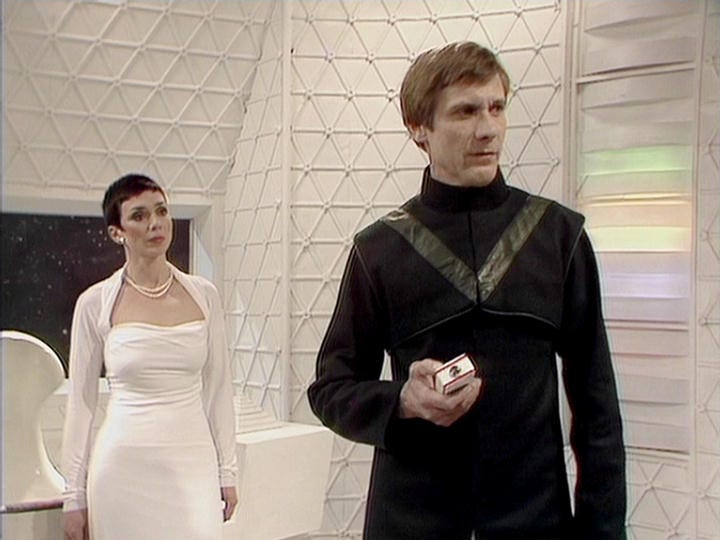
Straight in this time! With annotations galore on the final episode of our show to be transmitted under a Labour government. Britain and the Federation are about to be run by iron ladies.
Annotations
The Nova Queen meets its fiery fate, in an unusual and rather startling opening scene that throws the viewer slightly off track for a minute or so. It seems to be leading into a different story altogether, and is an intriguing angle to bring us to the problems at Star One. (Amusingly, when this sequence was run on kids chat show Ask Aspel, in the edition featuring Paul Darrow as guest, host Michael Aspel seemed genuinely appalled at the loss of life, shaking his head sadly; ‘Four thousand people …’)

This scene also - casually and suggestively - humanises the Federation, in a way that’s never happened before. We usually see the Federation doing horrible things - slave labour, exploitation, corruption, abusing its citizens etc. But here we have a luxury passenger liner carrying 4000 people to a highly populated city, the Queen Mary of space, with Keldon City standing in for Manhattan. The impact of the Federation falling, and what that would actually mean for billions of people, is questioned explicitly for the first time here.
Note also the mention of the consumption and export of tropical fruit. Both cruise holidays and pineapple chunks are a far cry from the bleak concrete installations and drugged domes we normally hear about, or even from the squalid underside of Space City.
It may not be liberty in the classical sense, but the Federation’s rule is suddenly not a brutal dictatorship with no redeeming qualities. Pleasure and convenience, affluence and consumerism, are being enjoyed by Federation citizens.
This is new. When, for example, Blake blew to bits the base on Saurian Major - which with its position as a nerve centre for relaying communications is a kind of baby Central Control/Star One - we were not made aware of any such consequences, or encouraged to mull over them. In Series A, Blake’s crusade was A Good Thing. Series B is not so sure … and suddenly this week, it’s very unsure.
I’ve scoffed here before at the commercial and practical logic of exporting fruit across interstellar distances. (A practice we will hear about again in ‘Gold’.) Putting those considerations aside for a moment, what this trade - and the Nova Queen - tell us about the Federation is interesting. This is certainly not entirely a war economy of austerity and brutality. There is a certain amount of high living, which means that there must be a certain amount of the settled society that allows for leisure and plenty.
In the twentieth century, this combination in the Federation - of rigid state/military control and mass consumerist affluence - seemed a little odder, a little more unlikely, than it does today. Twenty-first century China is the obvious difference. The Federation, in fact, reminds me more and more of the modern CCCP. Or is it the other way around?
A throwaway line in ‘Stardrive’ perhaps gives us a key here. We will learn then that the Federation ‘banned all leisure transport’ and confined such vehicles to ‘transport museums’. The very same episode, however, tells us that it’s a common practice for a citizen to own (or run, anyway) a personal ‘ground car’. What I think this must mean is that the Federation permits some of the fripperies of life, but under their strict monitoring and control. How does this fit in with the ‘banking system’, commercial cartels, and market manipulation that we also hear about? That’s a bigger topic for another day.
What’s significant here is that the failure of the Star One systems is presented to us - and to Servalan - as something which is affecting the lives of ordinary Federation citizens. Up to now, we’ve assumed the downtrodden masses will be happy to see the end of the Federation, and to cheer Blake on as their hero.
The man doing the presenting is Durkim. Durkim is a real, though very rare, surname. It inevitably brings to mind the French social theorist, and inventor of sociology as a discipline, Émile Durkheim, who was also fond of entering the offices of politicians carrying big sheafs of surveys and stacks of stats.
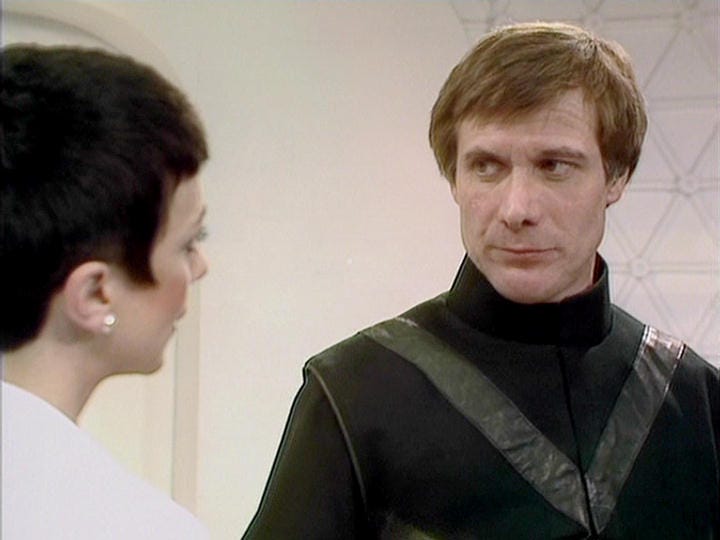
Durkim is played by John Bown (1934-2017), perhaps familiar to you as the cowardly Thal Antodus in the first Dalek movie in 1965. He was also both the writer and director of 1970 softcore sex comedy Monique, which starred his wife Sybilla Kay as a bisexual au pair, who has it off with both her male and female employers. The film was apparently conceived entirely to test out the sensibilities of the new censor at the BBFC.
Bown, I think, is very good here, matching Jacqueline Pearce in a genuinely considered performance. Of all her post-Travis cronies, of which he is the first, Durkim is the most interesting - intelligent and urbane, with a sardonic wit. His reaction to being frisked - ‘I find that just a little disconcerting’ - is pure Avon on paper, but he gives it a very different twist in the acting.
Durkim tells Servalan that the systems have been playing up for sixty days. So there’s been two months of this chaos; but, as I observed last time, it certainly hasn’t been sixty days since Travis left Goth.
The bigger question now. Why has it taken so long for people like Durkim to raise the alarm upstairs? There are some cut lines in the rehearsal script which try to explain this, not entirely convincingly. Here you go.
Comments
Nothing yet. Say the first thing.
Sign in to join the conversation.