
Welcome to the Midlife Field Guide.
One year.
Two Gen X friends.
Countless personal life experiments.
Can they figure out the meaning of midlife?
Subscribe for free!
I have a complicated relationship to dancing.
I remember the first time I really let loose and danced. Sure, I had moved my body to music before this, but this was the first time I felt immersed in it.
I was thirteen years old at a friend’s backyard birthday party. He had dragged his bulky stereo system outside, and a gaggle of preteens had gathered around it, moving to the best that 80s pop had to offer us.
It was nighttime, with very low lighting. Something about the darkness helped me feel less self-conscious and I found myself moving to the beat in a way I never had before. I felt free, feeling the music in my body and then letting myself go with it. Even now, those memories carry a sense of liberation.
The next day, I told a friend about it. About how free I had felt and how much fun I’d had. Her response would linger longer than I expected.
“You know,” she said, “you dance funny.”
“What do you mean?” I asked.
“You didn’t once move your hips.”
It’s one of those moments that may have been intended as constructive criticism, or at least as constructive as a thirteen-year-old can manage, but it certainly didn’t land that way. The fact that I remember that conversation so clearly tells me how impactful it was. It was deflating. From that point on whenever I dance, I am deeply self-conscious, particularly about whether or not I am moving my hips.
A couple of weeks ago, I wrote about trying things that I hate. After decades of being immersed in a story about how much I hate yoga, I went to a yoga class. And you know what? I didn’t hate it. I also shared that I’m traditionally not a joiner. Going to a one-off yoga class is one thing, but signing up for something that requires showing up every week is something else entirely.
So a few months ago, when my wife and I started imagining something fun we could do together as a couple, a dance class was not high on my list. But given my current experiment of challenging the things I think I hate, I was willing to try. A few nights later, we were browsing the website of a dance studio near our house.
I had walked past this studio countless times while walking my dog at night, but I had never been inside. My eyes were always drawn to the floor-to-ceiling windows facing the street. At night, they turned the studio into a kind of dance class fishbowl, where anyone passing by could see exactly what was happening inside the brightly lit rooms. How would I feel being one of the dancers on display? I wasn’t sure. But the convenience of the studio outweighed my fear of public awkwardness.
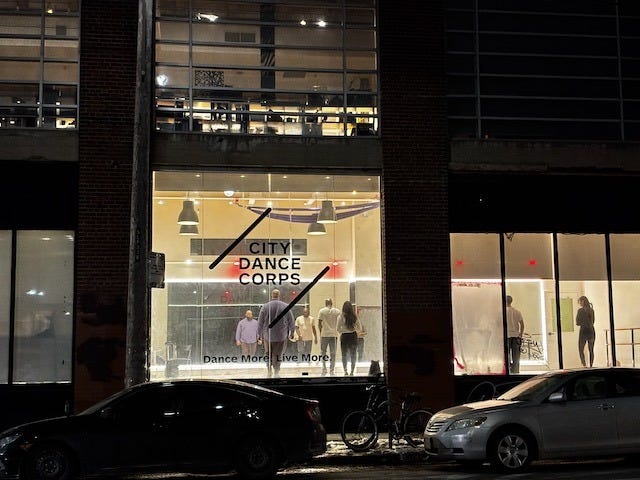
The studio offers many styles of dance classes, but aside from salsa, I hadn’t heard of any of them. After some Googling, we signed up for a Bachata class because, according to Google, Bachata is good for beginners, easier to learn than salsa, and generally considered sexier. All of which sounded great to me. 🙂
A few weeks later, we were taking off our boots, slipping on our running shoes, and walking into the studio. The giant street-facing windows mercifully had their shades drawn. I was quietly relieved.
The instructor, a trim and friendly man in his fifties, had us line up facing the mirror and showed us a few very basic steps. Three steps to the left and a tap. Three steps to the right and a tap. I fixated on the instructor’s hips, which flowed easily, and then on my own reflection, which did not. I glanced around and saw that I was not alone in my clunkiness.
With the instructor’s encouragement, we learned a few more steps on our own and then partnered up. Bachata is a traditionally gendered dance with clearly defined leader and follower roles. We were not expected to identify in any traditionally gendered way, but still there needed to be a lead and a follow. I was assigned the traditional lead role, and my wife explored the role of follower.
As the class went on, we began rotating partners. It felt good to dance with people who were clearly much more experienced at this dance form than I was, as well as some who, like me, were beginners. With practice, I felt competent with beginner movements and connected to my body. It simply felt good to move. When the class ended, I was surprised that I was now looking forward to next week.
During the next week, I practiced the steps we had learned at home. It was still a very self-conscious process. I stood in front of the mirror staring at my hips as I counted each step carefully, making sure everything was perfect. By the time the next class rolled around, I was ready.
We learned more steps in the second class and danced with our partners and others from the group. Bachata still felt foreign to me, but I was starting to understand the basics. Even when I couldn’t nail the moves, I at least knew what I was doing wrong. That week I went home and practiced again, counting carefully and making sure my feet matched the numbers in my head.
By the end of the third class, I was feeling pretty good about my Bachata skills. I wasn’t the best in the room, but I also wasn’t the worst. As my wife and I walked home, I shared my growing confidence. She listened and then said, “I’m glad you’re feeling that way, but what I’d really love to see is Bachata Geoff.”
I didn’t understand what she meant. She explained that I was dancing in a very self-conscious way, and that she would love to see me stop trying to dance perfectly and actually embody the movements.
I was suddenly back in that backyard at thirteen. I had felt free in my body, only to be told I was doing it “wrong”. Once again, in a moment where I thought everything was connecting for me, rather than praise, I was being told that I was a bad dancer.
I replayed that conversation in my head all week. Why would she say that? With only one class left in our month of Bachata, I was not looking forward to going back.
On Tuesday night, we tied our boots anyway and headed up the street with a dark cloud hanging over me. Her comment was still very much echoing in my head.
When we arrived, I noticed something new. This time, the shades covering the large street-facing windows were raised, exposing our dancing to anyone passing by. “Great, now everyone can see what a terrible Bachata dancer I am,” I thought. But the class was only an hour long, and it was our last one. Once it was over, I never had to take another Bachata class in my life. So I resigned myself to just getting through it.
By this point, we had learned all the basic movements, and this class was about stringing them together. After a quick review, the instructor played music and called out patterns. No matter who I danced with, my wife or anyone else, I felt stiff and wooden. Where was “Bachata Geoff”? Maybe all those comments were right. Maybe I really was a bad dancer.
And then something shifted. I realized that I didn’t need to do this. I chose to do this. And whether I ever danced Bachata perfectly actually didn’t matter.
I began to experience the negative voices in my head differently, questioning the way I had first interpreted them. Was being told I didn’t move my hips actually helpful? Would moving from my hips help me drop more fully into the flow of the dance? And maybe finding “Bachata Geoff” was actually an invitation to enter into a state where my body could respond to the music, rather than simply moving robotically, counting steps, and chasing perfection.
As we rotated partners, I stopped comparing myself to others. I focused on the music and the sensation of movement. I may not have executed the steps exactly as taught, but it didn’t matter. I was leading, and my partners, including my wife, were happy to follow. It felt freeing.
By the end of the class, I felt good. I wasn’t suddenly a great dancer, but I was present in my body, moving without overthinking every step. I had shown up, stayed with the discomfort, and let myself be in the experience. With the windows open, anyone passing by could see my wife and I moving freely across the dance floor and I welcomed it.
Beyond the classes, I haven’t yet tested my Bachata skills in the wild, and I’m not sure if I ever will. But being challenged to find “Bachata Geoff” was transformational. It was an invitation to fully embody whatever practice I am engaged in. To let it move through my body, into my heart, and out into the rest of my life.
Testing the stories I carry about the things I think I hate, or think I’m no good at, has opened me up in unexpected ways. Are there more Geoff’s living dormant inside me waiting to be discovered? Stay tuned…
XOXOXO,
Geoff
Thanks for reading The Midlife Field Guide! This post is public so feel free to share it with anyone and everyone you know!:)
Comments
Nothing yet. Say the first thing.
Sign in to join the conversation.