
Welcome to the Midlife Field Guide.
One year.
Two Gen X friends.
Countless personal midlife experiments.
Subscribe for free!
Hello fellow midlife adventurers!
At first, this experiment is going to seem contradictory.
I have celebrated 2026 so far as a period of “No Measurement.” It’s now June and I still haven’t returned to wearing an Apple Watch, an Oura Ring, or a heart rate monitor. I’m still not posting workouts on Strava. It all continues to feel great.
BUT… especially as I am now firmly in “middle age,” and I know that my body is changing and that a not insignificant number of people around me are discovering serious medical issues, I don’t want to bury my head in the sand and suddenly end up with a health condition that was entirely preventable or manageable.
So I got a barrage of midlife medical testing. I’m so glad I did it, because after a couple of very surprising results, I’m being forced to eat a little bit of crow around not measuring things related to my health.
Here’s how it went down…
My physio friend, Renata Szado, told me about a company called Georgia Healthcare Centre, a private clinic in Vancouver focused on preventive health assessments. Renata offered to introduce me to Ehsan Malaki, the founder. I set up a meeting to find out more and get a tour.
Ehsan used to work in Silicon Valley and it shows. He’s built a company that is focused on prevention instead of reaction, and he’s assembled a team of private healthcare professionals and cutting edge technology to do it.
I told him about the Midlife Field Guide, and wanted to know what tests I should do at this age and stage. Ehsan very kindly offered to give me a ton of tests so that I could share what I learned with all of you in the Midlife Field Guide community.
(Disclosure: Georgia Healthcare Centre provided this assessment to me at no cost so I could write about the experience. They did not pay me, and this piece reflects my own experience and opinions.)
I arrive at the clinic early morning, with no breakfast or coffee. Not gonna lie, I’m a bit nervous, because at this age, you start wondering if there’s something bad going on inside you that you don’t know about.
First up, the body composition scan. I did a DEXA scan a number of years ago and it was a big contraption that involved lying down on a raising platform while a big scanner moved back and forth across my body.
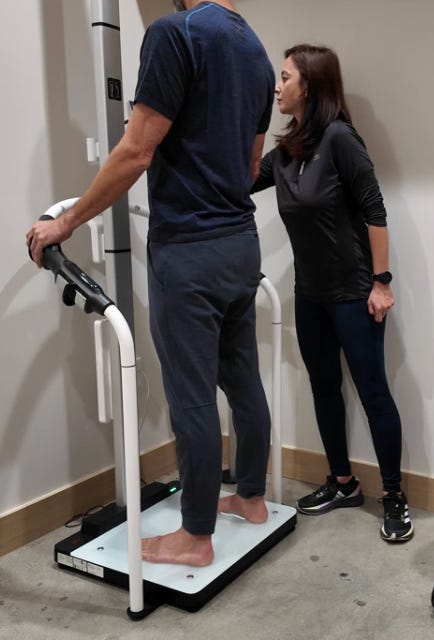
Here, however, I walk into the room and see this vertical device with a small footprint that looks like one of those scales that can also measure your height. I hop on, grab the handles on the side-rails, and prepare to be there for a while as it scans me. It is over before I know it. The whole process takes about two minutes, and yet, as I will find out, it captured OODLES of data about my body.
Next up is the full physical exam with Dr. Payman Nabai. This is decidedly anti-tech. It feels like a throwback to a previous era of seeing a family doctor, when the doctor could take time to ask lots of questions, get to know you, and also do a THOROUGH physical exam. Like… THOROUGH.
It is SO thorough that at one point, it gets awkward and uncomfortable. Dr. Nabai kindly assumes (hopes?) that I am under 50 and when I inform him that I am 54, he regrettably informs me that I might want to consider a prostate exam. I ask him what is recommended. If you’re over 50, the recommendation is that you should get a prostate exam. We both kind of shrug, realize that neither of us really wants to do this, but that it is the right thing to do.
So I curl up in a ball, pull down my pants, and lube up. Thankfully, he is gentle.
As it turns out, I have a slightly enlarged prostate, which is normal for this phase of life. The impact? I can expect occasional difficulty fully emptying my bladder, reduced stream wattage, and more frequent night urination. ✅✅✅
It’s a strange phase of life when you come to accept that you are deteriorating and that some things are not ever going to go back to the way they were in your prime. I don’t really want to imagine what ongoing deterioration of my prostate will mean.
Dr. Nabai and I both clean up, and I am off to the next set of tests.
Back into the tech-zone, where I meet Negin, the medical technician. I have three tests done in a relatively small room that on first glance, appears to have no medical testing equipment in it. It’s just an office with a desk and a couple of chairs.
For my vision test, I expect the giant eye-testing machine at the optometrist and I’m surprised when Negin gives me an Oculus Rift to put on. I have a full eye exam done on a VR headset and it is much more like playing an immersive video game than being in a doctor’s office.
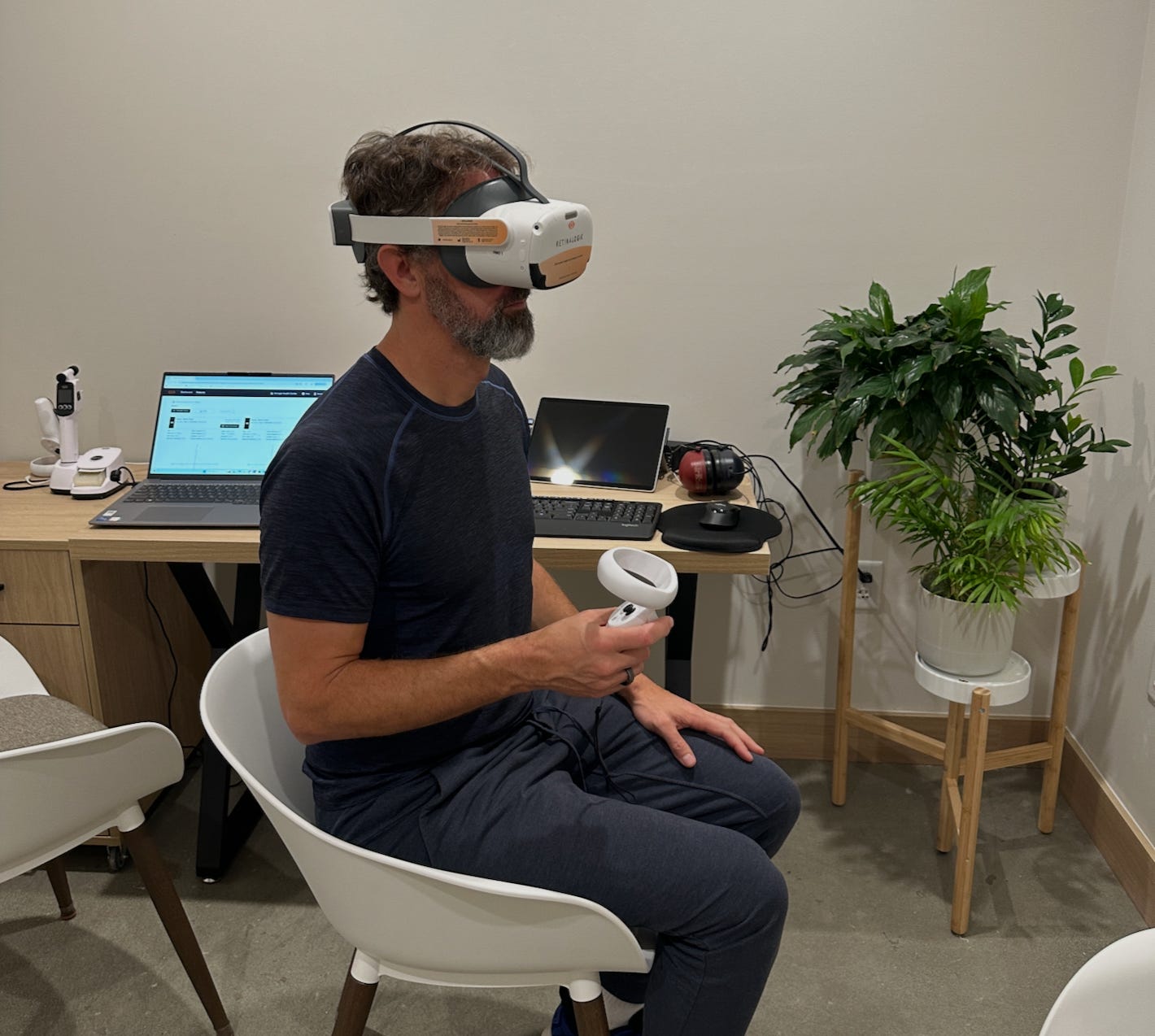
Then Negin gives me a tiny tube plugged into her laptop via USB. I blow into it a couple of times and get a full spirometry breathing test in minutes.
Finally, I have a hearing exam, which is done entirely on an iPad with headphones.
All this feels like the medical equivalent of replacing your 1970s hi-fi stereo system and speakers with an iPod and AirPods.
While I definitely have some age-related deterioration, eyes, ears, and spirometry tests turn up nothing worrisome.
I am ushered into another office next door, where I meet Olya Voikin, the team dietician. We have an extended conversation, where she asks me a lot about what I eat and drink, how much I eat and drink, and my general lifestyle.
I learn a TON in a short period of time. Olya instantly recognizes that I am having way too much sugar (thanks, oat milk and Ben & Jerry’s Tonight Dough ice cream!). Sugar is the first of several massive red flags for me.
Olya made me laugh when she told me:
”A Clif bar is 20 grams of sugar. It has that cliffhanger picture on the bar because it’s for somebody doing intense physical activity. It’s not for the regular person sitting in an office.”
On the flip side, I am also not getting enough protein. For my age, height and weight, I should be having somewhere between 100-150g of protein every day. That feels like a LOT, but as we age, our muscles begin to deteriorate. She tells me that not only do we need to eat more protein, we also need to lift more heavy weights more often. (This foreshadows my next red flag…)
So it’s not even mid-morning and I’ve already got a significant lifestyle change on the menu… a menu full of protein and with much less sugar.
I leave Olya’s office and go to the next door down. Here I meet Dr. Neda Khaledi, the kinesiologist and exercise physiologist, where I get a full fitness and mobility assessment.
Much like the physical, Neda spends a lot of time with me, asking all sorts of questions about my activities, my lifestyle, my past injuries and surgeries, and more. (As I get older, I feel like I could fill a keynote speaking slot with the list of everything that has gone wrong with my body…)
Then Dr. Khaledi takes me through a complete functional movement assessment, which includes a variety of different challenges, from balancing on a single leg to single leg lunges, and from squats while holding a bar above your head to single leg lifts. We wrap with an extended plank and a grip strength test, which end up being the only tests I crushed today. I plank for over 3 minutes (thanks, pilates!) and my grip strength means I should be able to open any tight jar lid for the foreseeable future. BRING ME YOUR STICKY JAM JARS! (Oddly, grip strength is an indicator of longevity because according to research by Harvard Medical School via JTECH Medical, an 11-pound drop in grip strength correlates with a 17% increased risk of dying from heart disease.)
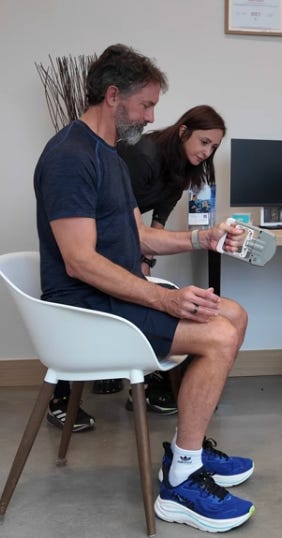
Otherwise, I have some mild issues with an ankle and a shoulder, but nothing major. I’m feeling pretty good about the state of my body at this point!
Dr. Khaledi then walks me through the results from my earlier body composition scan. I am somewhat of a beanpole: I’m 6 feet tall and my weight generally sticks around the 170-175 pound range. The waist on my pants is generally 31 or 32 inches. I have always considered myself pretty trim and healthy. I exercise a lot, play lots of tennis, do weekly pilates and weight training, and even started running (poorly) in 2025. So I expect a full green light and gold star on my body composition scan. I do not get it.
I am SHOCKED.
I am at the high end of normal for fat! I am at the high end of normal for weight. I am at the high end of normal for BMI. My visceral fat is at the high end of normal.
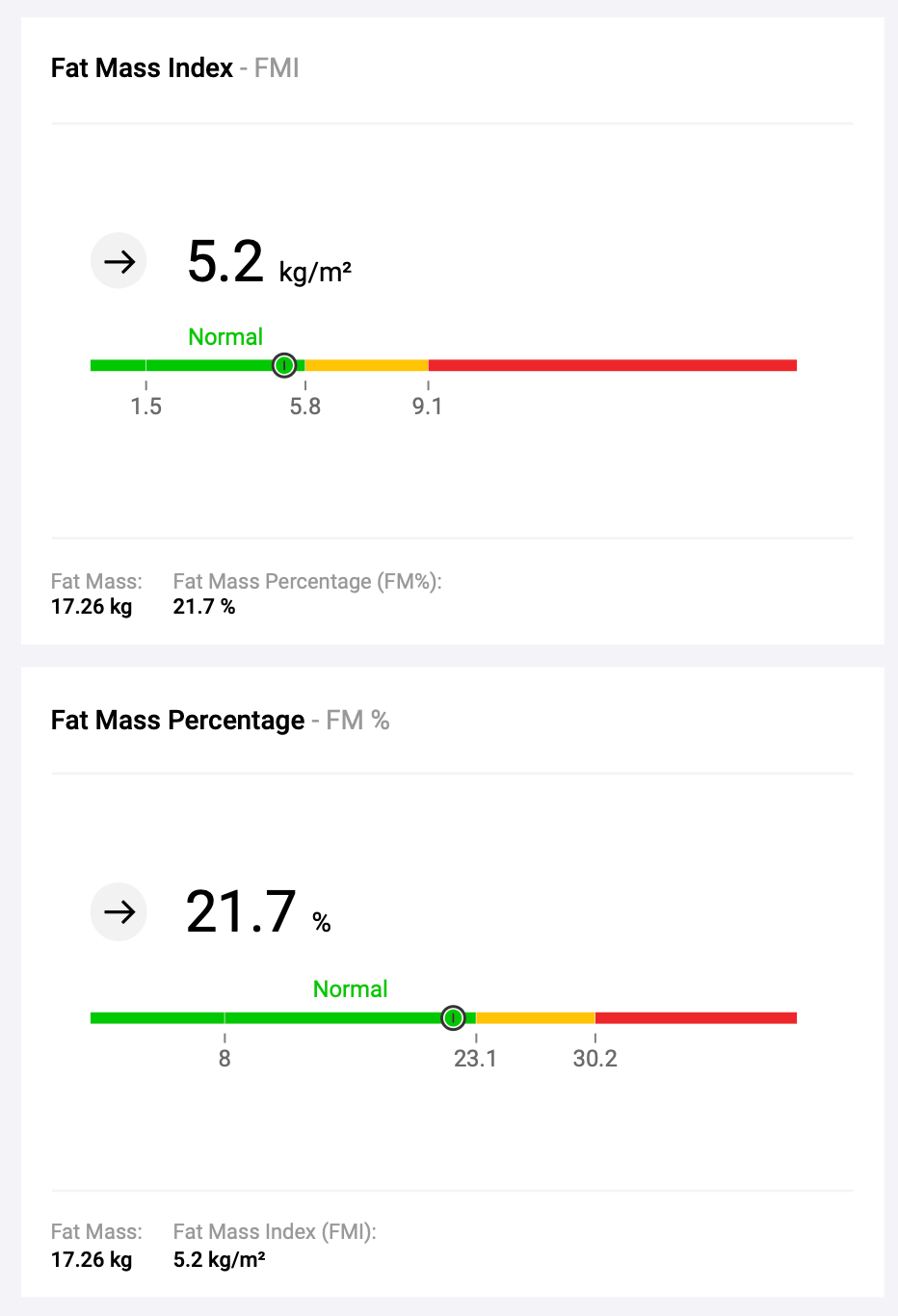
Apparently my body frame masks the fat I’m carrying, which mostly gathers around organs (visceral). This is bad. It turns out “skinny” and “healthy” aren’t the same thing.
To make matters worse and more humiliating, I am way below average for muscle mass. Another red flag!
Dr. Khaledi tells me ”in your age population, you’re at the 20th percentile—maybe 80% of your population has more muscle.”
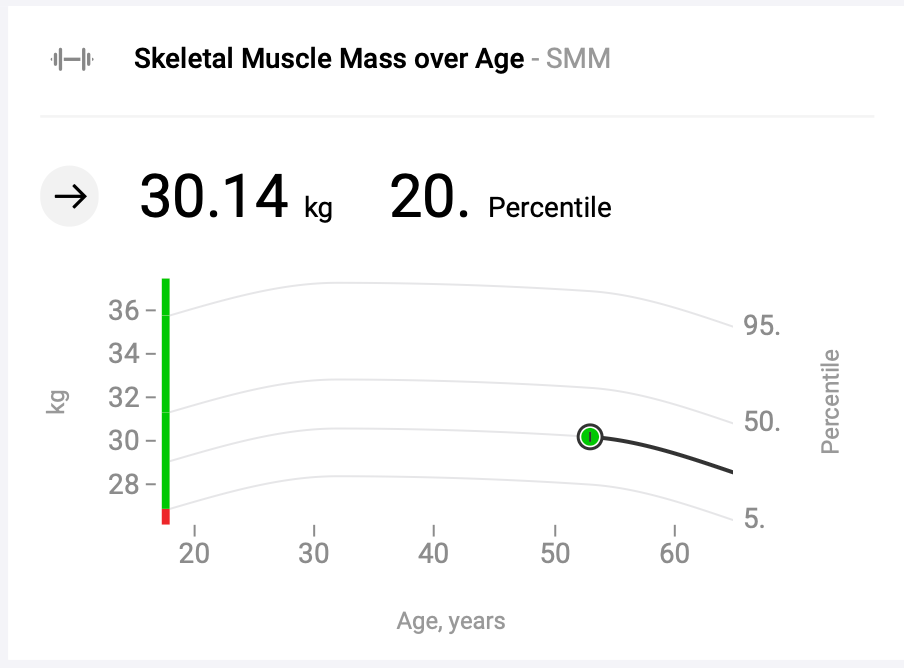
WTF???
While activities like tennis or running are great for your cardiovascular system, they don’t build muscle. And your muscle starts wasting away at midlife and accelerates as you get older. (Hence the protein issue highlighted by Olya…)
I am 100% going to have to do more strength training coming out of this.
UGH.
In the same room, I then have an ECG test, which is a recording of how your heart is working, and a stress test that involves hopping on a treadmill while connected to a bunch of wires. It starts off at a snail’s pace and gradually increases in speed and elevation. You only do the test until you reach 85% of a heart rate threshold. Your heart, blood pressure, and blood oxygen level are all being monitored throughout. I briefly worry about falling off the treadmill connected to all the wires and ripping all the testing equipment down onto the floor, but I stay calm and carry on.
The results of these cardiology tests get sent to Dr. Majid Pourmand, who I meet with later. (Dr. Pourmand is also Instagram-famous - 191k followers!) Yet again, I have an extended, non-rushed conversation with him about my health. After a physical examination, he opens up what looks like a 1990s era laptop, but is actually a portable medical testing device that does an ultrasound of my heart in his office.
The results? A normal ECG, a negative stress test, and a lower-than-average resting heart rate. Dr. Pourmand basically told me to keep doing what I’m doing, which is a huge relief after my body composition surprise.
Ehsan also tells me about two specialized sets of tests that they can conduct, a gut microbiome shotgun test, and genetic testing.
Genetic testing is apparently not for everyone, because it will tell you if you are genetically predisposed to certain types of cancer or other illnesses. Some people want that information and like to know. Some people find it anxiety-inducing to know. I am in the latter camp and decide not to find out.
During COVID, I discovered a small growth on my thyroid and had to wait a few weeks to get a biopsy of it. It was benign, which is great, but I did not sleep well while I was waiting for it. I feel like if I found out I was predisposed to some type of illness and I couldn’t do much about it, I would never sleep or relax, and would likely spend most of my waking hours trying to get AI to find a preventative cure.
However, I do decide to do the gut microbiome test, which will tell me which bacteria, viruses, fungi, and parasites are living inside me and whether there are any changes I should make to my diet or lifestyle as a result. I have a lot of random night itching that I have never been able to figure out. So much that I basically trim my fingernails down to nothing so I don’t claw myself in my sleep. Maybe this will help me figure out what’s causing it?
So I go home and poop on a swab, put it into a little bottle of liquid, and return it for shipment to a gut microbiome lab for testing.
When I get the results, another shock: my microbiome scored 36.4 out of 100, which they politely file under “Not Good!” Here are the highlights of what was found:
My good bacteria are running low. One key probiotic strain is almost non-existent.
I have early signs of antibiotic resistance.
I have a bacterial signature that basically screams “too much fat, not enough plants.”
As a result, I am going to start ingesting a lot more fermented foods. (Not like RFK Jr and his “ferments” obsession though…)
A week later, I’m back in Dr. Khaledi’s office. Even though I’m apparently overweight and under-muscled, I still cling to the idea of myself as an athlete. I am curious about the VO₂ max test. VO₂ max is the maximum amount of oxygen your body can use per minute, per kilo of bodyweight (mL/kg/min), measured at peak effort.
This measurement keeps coming up as a marker for long-term health and as something that you can improve with concerted effort. As someone who had childhood asthma and has trouble with endurance sports, I am worried that this is going to be another big red flag about my midlife health.
I strap on headgear that covers my nose and mouth with a tight seal. It’s like something a deranged orthodontist invented in his basement. Also… I look a LOT like Bane from the Dark Knight and instantly have the urge to start talking in a menacing growl like Tom Hardy. It is a teeny bit claustrophobic, but then again… I’m also pretty brave.
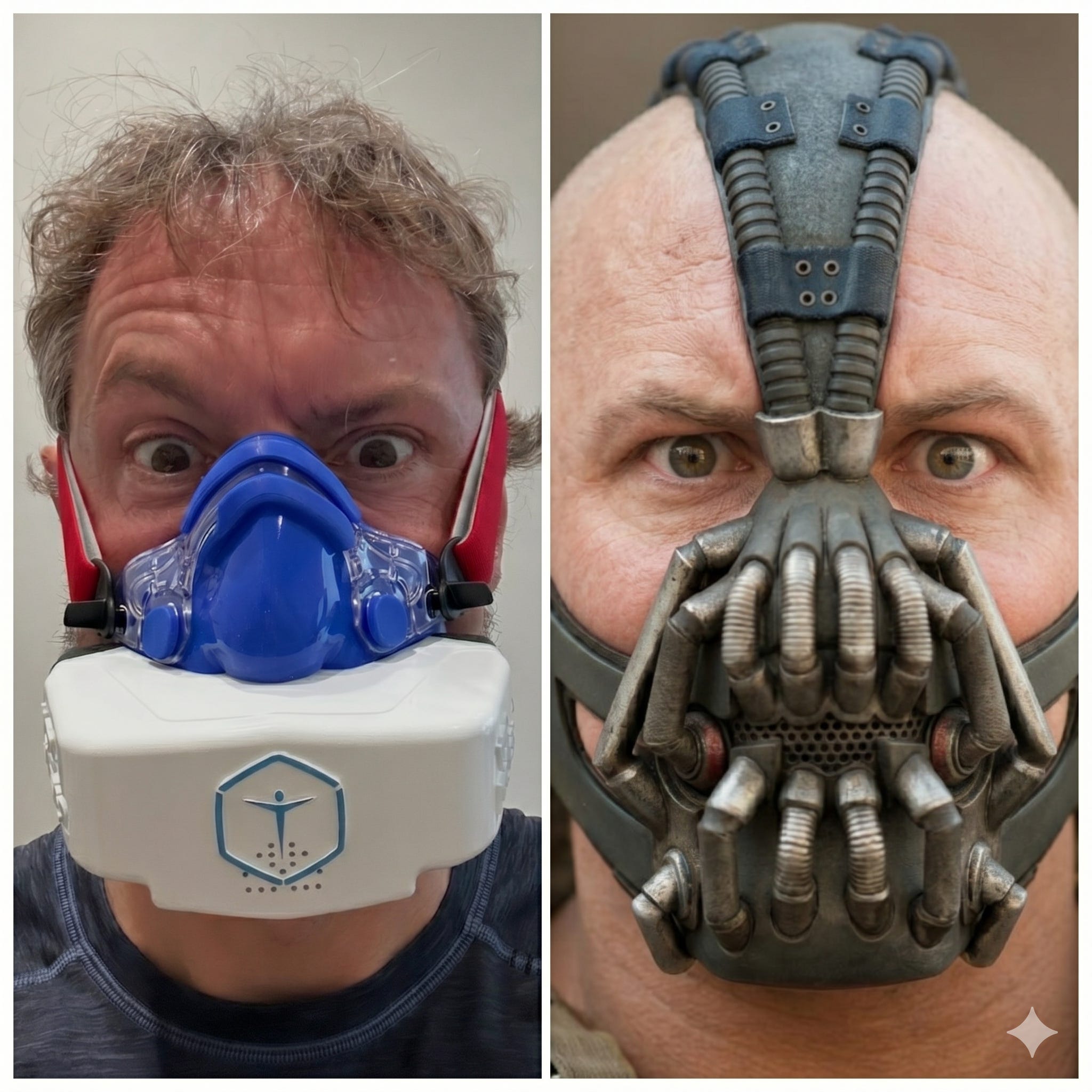
Once everything is connected, I hop on the treadmill.
It starts off with a breezy walking pace. I pass the five minutes of walking by looking out the window and staring out at people watching TV in a neighbouring condo. I hope they don’t look over and see my Bane-like figure observing them and call the police.
At the end of five minutes, Neda asks me for a fatigue level from 1 to 10. I’m at a 1.
Next, we begin a series of stages that last three minutes each. Each stage gets faster and includes an increasing incline on the treadmill.
My fatigue level rises to 2 out of 10.
Then, next stage, a 3.5 out of 10. Next stage, moving to jogging speed, a 6 out of 10.
Faster jogging with increased incline, and I’m at 8 out of 10. By the end of the three minutes, I’m breathing hard and my heart rate is skyrocketing. I look at Neda and decide to stop the test.
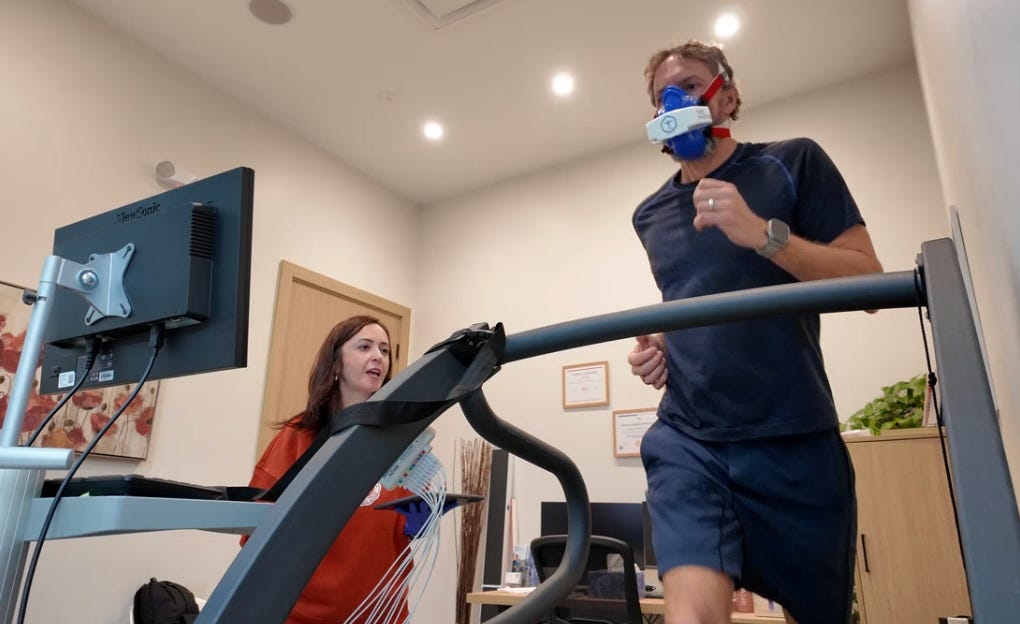
First impression? That escalated quickly! I thought I was going to be on the treadmill for 45 minutes or an hour, but the combination of the increasing incline and the speed really hit me hard and fast. I feel like I kinda failed at this test.
However, in a pleasant surprise, my VO₂ max landed at 54.2, which puts me in the 91st percentile for my age (!!!). The childhood-asthma kid who’s terrible at endurance sports is, apparently, fitter than 9 out of 10 men his age. I did not see that coming!
What strikes me about my two days of testing is that everyone here has a different perspective relative to the traditional medical system, which primarily deals with medical problems occurring right now. At Georgia Healthcare Centre, though, the team is clearly focused on prevention and longevity. They want to find out what problems might happen or are likely to happen… and address them before they become problems.
It’s the difference between being proactive and reactive. In an ideal world, you’d do both, especially for your health.
And being proactive instead of reactive brings me back to measurement. An Oura Ring and Apple Watch could not have told me about my higher than expected visceral fat, my wimpy lack of muscles, my crappy microbiome, or my overconsumption of sugar and underconsumption of protein.
For my issues, the Oura and Apple Watch were noise, and these tests were true signal.
There is a huge difference between constant measurement and meaningful measurement.
Dr. Nabai nailed it when he said this to me during my physical exam:
“People know they have to have a healthy lifestyle, but if they don’t see the assessment, they won’t be motivated. If they do a blood test and see their vitamin D shows red, they realize: it really is low, and I have to do something about it. It sticks in their mind. The general recommendation is just ‘take your vitamin D.’ But how many of you are taking vitamin D on a regular basis?”
I now know what I should worry about, and what I shouldn’t worry about. And at this stage of life, and when I think about what “Future Steve” would counsel me to do, I don’t think I can afford not to make the necessary lifestyle changes.
An unexpectedly big part of the Midlife Field Guide so far has involved committing to doing things that I didn’t really want to do, because they’re either unpleasant (see “running”), giving up something that I enjoy (see “booze” and “phone”), or forcing me to change the way I think (see “no measurement”). And yet, every time I make these changes, I’m very happy I did.
So these medical tests have provided me with the next wave of changes to bring into my life. Sugar reduction. Protein packing. Microbiome rebuilding. Lifting more weights. I’ll report back when I have some results!
How about you? Have you been avoiding a physical health exam? What would you want to know, and what would you not want to know?
One huge caveat to everything I’ve shared here. Georgia Healthcare Centre is a private healthcare company. I live in Canada, where we have one of the better public healthcare systems on the planet. This type of proactive testing is not offered for free to Canadians. I need to acknowledge how very fortunate I am to have been able to get all these tests done, because they are expensive and I’m conscious that not everyone can afford to do them.
Thanks for reading.
Steve
Thanks for reading The Midlife Field Guide! This post is public so feel free to share it.
Comments
Nothing yet. Say the first thing.
Sign in to join the conversation.