
A
Abolition: As Ruth Wilson Gilmore writes in Abolition Geography, abolition’s “goal is to change how we interact with each other and the planet by putting people before profits, welfare before warfare, and life over death.”
B
Baby Bonds: A program where every child born into poverty receives a publicly funded trust account at birth. This “start-up capital” allows young adults to access education, home ownership, and entrepreneurship, enabling them to build wealth and lead lives that are hopeful, fulfilling, productive, prosperous, and self-directed (The New School). This is an example of what abolition calls for: divestment from prisons and punishment, and investment in safe, whole, resourced families.
C
Care: The official definition of care is “the provision of what is necessary for the health, welfare, maintenance, and protection of someone or something, often involving responsibility, attentiveness, and emotional concern.” However, when I think of care, I also think of accountability, for all, by all. When I say I believe we need to move away from punishment and towards care, that doesn’t mean harm will not exist or that people will not be held accountable. It means that we know prisons and punishment are passive and disconnected, and that we can build systems of care that still acknowledge and repair harm, in a more effective, human way.
D
Decarceration: Abolition is a long-term struggle. I am not working towards a single day where everything is switched, prisons are closed, and families are free. There will need to be a hospice system in place—a large, collaborative process where we guide the remnants of the dying system, like guards who will have to find new, dignified jobs, and usher in new modes of care, accountability, and safety. That’s where decarceration comes in: decarceration is a tactic focused on decreasing the number of people imprisoned, as well as the number of charges and lengths of imprisonment. For instance, a new report found that youth incarceration declined by 74% over the past two years. That’s decarceration.
E
Endowment: An endowment is a pool of assets—a portion of which is made available for charitable purposes annually. The remaining assets and investment returns are retained in the endowment to provide for the growth of the endowment over time (Community Foundation for Southeast Michigan).
F
Family Policing: “The so-called ‘child welfare’ system operates to punish parents and families, not to advance child well-being. Following the lead of impacted families and organizers, we reject the terms' child protection’ and ‘child welfare’ and instead refer to this system as the ‘family policing’ system.” -Movement for Family Power
G
Gatesville State School for Boys: In 1889, the Texas legislature created the state’s first youth prison—the House of Correction and Reformatory, later known as Gatesville State School for Boys. This was the first youth prison in the Southern United States and influenced future youth punishment system—gaining a reputation for ruthlessness and operating as a labor camp. Today, if you were to travel to the grounds of Gatesville, you would come upon a cemetery where 16 young boys, ranging from 10 to 20 years old, are buried.
H
Housing: A ProPublica and WABE investigation found that Georgia reported inadequate housing as the sole reason for taking a child into foster care in more than 700 cases over five years, even though it would be less disruptive and less expensive to help families get housing instead. This is not an anomaly. Across the country, families are being criminalized for being poor.
I
Incarceration: Incarceration is the detention of a person, often in a correctional or psychiatric facility. With nearly two million people behind bars at any given time, the United States has the highest incarceration rate of any country in the world (Prison Policy Initiative).
J
Just Transition: The Just Transition framework is a vision-led, unifying, and place-based set of principles, processes, and practices that build economic and political power to shift from an extractive economy to a regenerative economy. For my work, the just transition framework helps understand the hospice era that will have to come to get to abolition—i.e., the processes taking us from policing & prisons, to a world free of punishment. For instance, there will need to be a process for transitioning the jobs people have in the dying system (guards, system leaders, prison builders) to new, dignified ones. Put simply, the just transition framework is how we pragmatically plan for abolition.
K
Keep Families Together: A campaign led by the National Housing Law Project (NHLP) and Protecting Immigrant Families (PIF). Through advocacy, organizing, legal analysis, research, and narrative change, the Keep Families Together campaign is protecting immigrants and tenants and keeping families whole and housed.
L
Liberation theology: “Mainly a theology that sees God as concerned with the poor and the weak.” -Rev. James Cone.
M
Mandated Support: JMacforFamilies, led by families directly impacted by the family policing system, coined the term “mandated support” to describe a shift from mandatory reporting that triggers unnecessary investigation and separation, toward mandatory support that connects families with resources before crises develop. Learn more here.
N
Neighborhood violence interrupters: Sometimes referred to as violence interrupters, community safety monitors, etc. Neighborhood Street teams are an example of a new mode of caring for each other. Cities like Baltimore, Philadelphia, Chicago, and other localities that have invested in neighborhood street teams are seeing the impact of removing police from responding to every conflict or problem that arises. In Baltimore, the Safe Streets team has mediated over 1,100 conflicts since 2025 that could have resulted in gun violence, but did not. The City of Philadelphia has created a Peacekeepers Institute to train violence interrupters who are working to keep their neighborhoods safe, without calling the police.
O
Operation Stop CPS: Amanda Wallace founded Operation Stop CPS in May of 2021, a grassroots organization that works with families and community partners to resist local child welfare agencies. Operation Stop CPS has assisted in campaigns that have seen the return of over 20 children to their communities. Before launching Operation Stop CPS, Amanda had a 10-year career as a Child Abuse Investigator and worked throughout several counties in North Carolina. Armed with this insider knowledge, Amanda co-authored the Respond in Power Guide, a guide parents and caretakers can use when engaging with the system. Amanda also co-chairs the Black Mothers March on the White House coalition, which held its first mobilization in Washington, D.C. in 2022. Amanda is also a member of the African National Women’s Organization.
P
Punishment: Mariame Kaba defines punishment as “inflicting suffering on others in response to an experience of harm/violence/wrongdoing.”
Q
Qualified immunity: Qualified immunity is a court-created rule that limits victims of police violence and misconduct from holding officers accountable when they violate a person’s constitutional rights. More from EJI.
R
Restorative Justice: Restorative justice brings together those directly impacted by an act of harm to address the impact of the crime, hold the person who did it accountable, and make things as right as possible for those harmed. It gives survivors an opportunity to be heard, to have their pain recognized, to shape the outcome of what happened to them, and to develop a sense of safety—all things that are proven to increase their wellbeing in the short and long term, including decreasing symptoms of post-traumatic stress. Most survivors who offered restorative justice options choose them, and an extremely high proportion (90% overall) report being more satisfied with those processes than with standard court proceedings.
School Resource Officers (also known as School Police): There are currently between 14,000 and 20,000 School Resource Officers (SROs) nationwide. This statistic does not include security guards, street cops, and other members of law enforcement responsible for patrolling public schools. The presence of these officers has had violent consequences for many Brown and Black students of all grade levels, and yet, their numbers continue to increase (see Institutionalization of School Police in We Came to Learn).
T
Trust-based philanthropy: Trust-based philanthropy advances a just and equitable society by alleviating the inherent power imbalances between funders, nonprofits, and communities. With a commitment to shifting power, advancing equity, and building mutually accountable relationships, trust-based philanthropy positions funders as collaborators working alongside nonprofits to meet the needs and dreams of communities who are most removed from conventional power structures.
U
Unions: Unions have historically been a powerful way for the working class to organize together, win material negotiations, and advance safety and dignity in their fields. However, not all unions are created equally. Police unions, for instance, or police frats, have been at the forefront of lobbying for more police power, less accountability, and bigger budgets. Learn more via Community Resource Hub
V
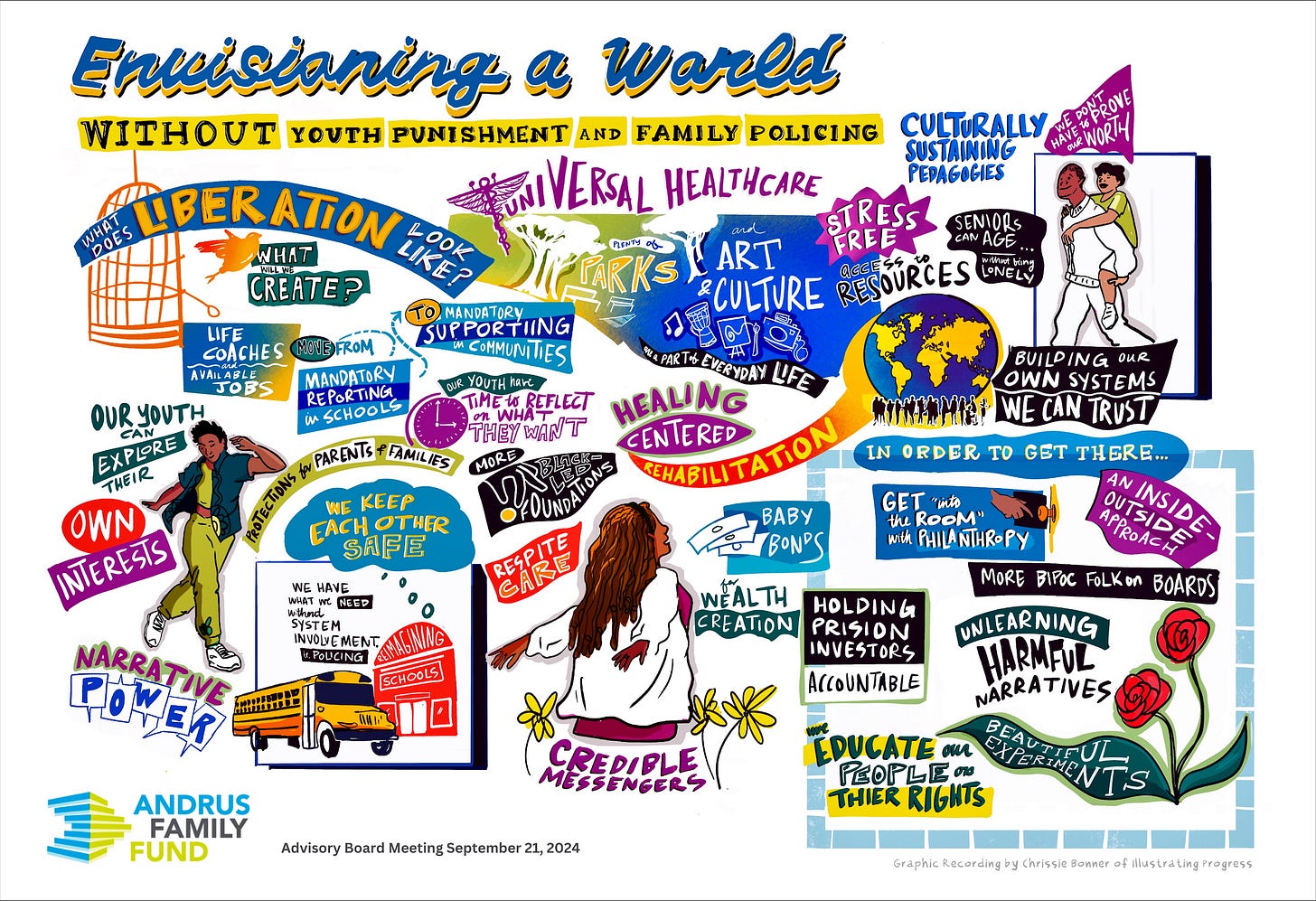
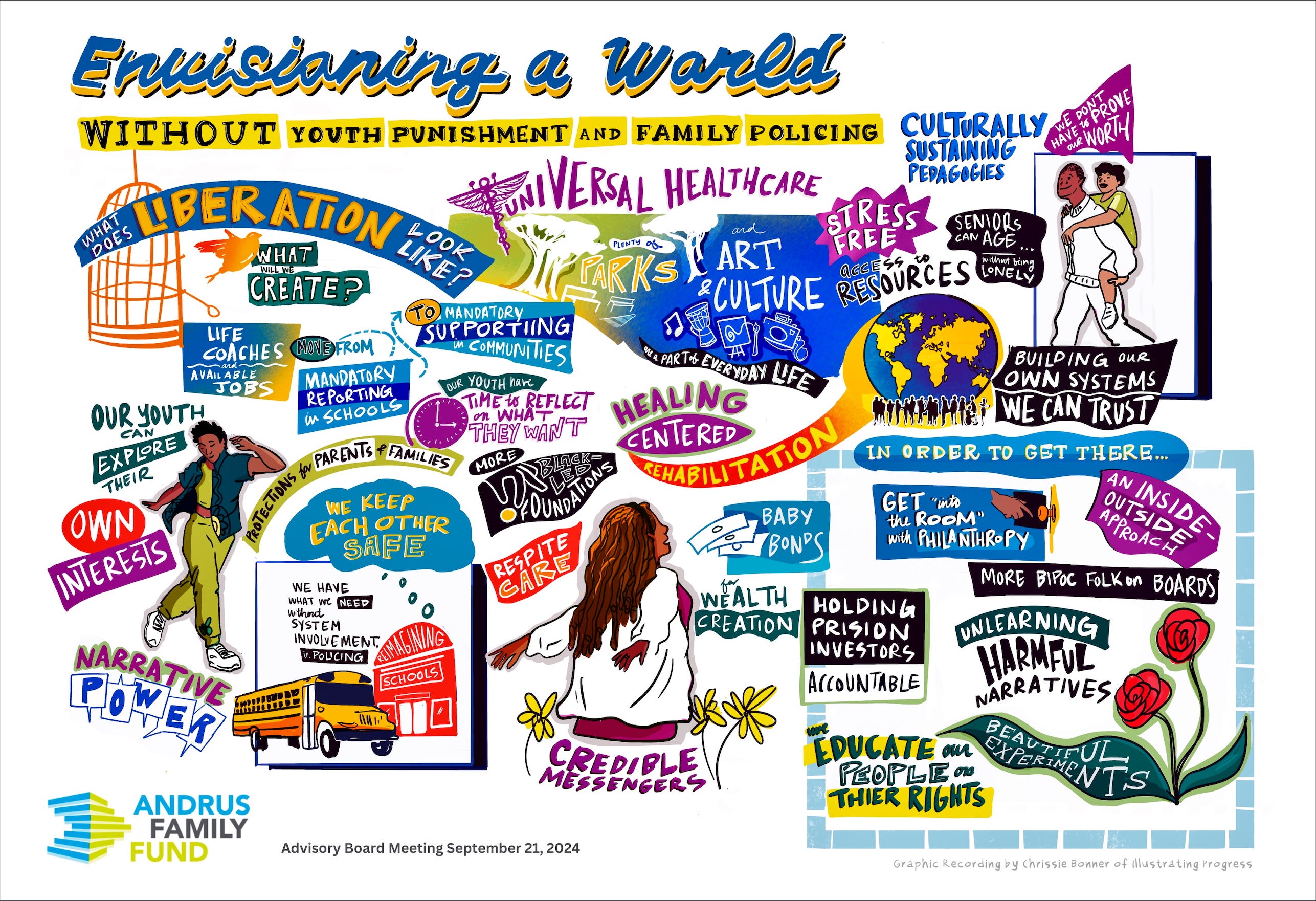
Vision: A world without youth punishment and family policing.
W
Wealth hoarding: “Right now, some $1.2 trillion in wealth is warehoused in private foundations and donor-advised funds — whose wealthy donors got huge tax write-offs.” Learn more via ProPublica.
X
Xenophobia: Xenophobia refers to the irrational fear or dislike of people from different countries or cultures, often resulting in discrimination and social exclusion. -UNESCO
Y
Youth punishment: I use the term youth punishment to encompass all of the systems, policies, and institutions that criminalize and punish young people, including: youth prisons, police in schools, probation, alternative schools, youth curfews, etc.
Z
Zealous.us: For decades, lawmakers and the media have overlooked or intentionally disregarded the perspective, voice, and expertise of those closest to issues of health, safety, housing, education, poverty, and the criminal legal system. The result: The public and those in power continue to lack the imagination to call for something different, be too susceptible to sensationalism and fearmongering, and make decisions based on fear, not reason. Zealous aims to right this historic imbalance.
No posts
Comments
Nothing yet. Say the first thing.
Sign in to join the conversation.