
When you’re researching something, it really helps to know what that something is.
You might think this is so obvious that it’s foolish to even bring it up at all. But I promise, it isn’t, and it’s not.
For one, a lot of research is exploratory. It’s intended to find out what something is. It’s like exploratory surgery; if you knew exactly what you were going to find, you wouldn’t need to do it in the first place.
However, the matter of “What is it exactly that you’re researching?” has been a source of some controversy for research in the past. For instance, the replication crisis in psychology.
To explain the origins of this crisis, it’s important to remember that science is very much a society-wide collaborative effort, and current research is built on previous research. Major discoveries and breakthroughs, they inform the whole direction off a science, and are taught to the later generations who will continue the work down the line.
That’s the theory, at least.
If an experiment produces a groundbreaking result, one that shapes the discipline for years to come, you’d logically assume that if you did the experiment again, in the same way, you’d get the same result, just like how if someone said they’d discovered a new country, and you followed their directions to it, you’d expect to end up in that country.
Because if you didn’t, that means the original discovery was just a mistake, or a fluke. Like, maybe they’d seen a mirage? Or perhaps it was just Skegness, viewed from an unusual angle?
Unfortunately, genuine attempts to replicate important psychology experiments did indeed not get the same results, implying that those important discoveries… weren’t. Meaning that many established psychological principles and practices were built on much shakier foundations than had long been believed.
The replication crisis led to a lot of introspection in the field, which resulted in efforts to improve research standards, to make them more robust and reliable, to ensure that this wouldn’t happen in future. Which appears to have been successful, according to the available data.
One of the more notable approaches to increasing the robustness of research was preregistration. This is where researchers register the details of an experiment (the hypothesis it’s based on, the methods that will be used etc.), before conducting it.
It’s one of those things where you think “Isn’t that what they were doing anyway?” but indeed they weren’t. It was pretty much standard practice in psychology, and research in general, to explain the details of your experiment once you’d completed it and were looking to publish the findings.
But what this meant in practice, is that it gave researchers scope to alter and tweak the details of their experiments, to increase the likelihood of significant, positive results.

You run an experiment, and it doesn’t support your hypothesis, what do you do? You can either devise a whole new experiment, with all the time and cost that involves… or you can change your hypothesis, so that it does fit the data you produced.
Or, if the data you produce doesn’t match your hypothesis, maybe you can change the data? Statistical analysis and research parameters actually provide a lot of flexibility here. Run your data through one type of assessment, and it’s doesn’t give you good results. Run it through another, less-stringent type, and it does.
Or maybe you can change your parameters? Your results say your hypothesis is wrong, but if you exclude these particular subjects and he data they contribute, then your results do support your hypothesis. So, all you need do is come up with a plausible reason for excluding those subjects, and your research is a success!
As you might expect, this sort of retroactive altering of your experiment to get the outcomes you want, makes it much harder for anyone attempting to replicate your experiment to get the same result. Technically, you didn’t get that result, so how is anyone else meant to?
To borrow Ben Goldacre’s excellent analogy, it’s like firing a machine gun at a wall, finding a spot where the most bullets are grouped together, drawing a bullseye around that, then claiming to be an expert marksman. And if your example is used to teach others how to shoot accurately, then you get a replication crisis.
And you can do all these things, change the analysis to get a result you want (known as Data dredging, or p-hacking), or change your hypothesis to one that matches your data (known as hypothesising after results are known, HARKing), because nobody else knows what your original hypothesis or analytical methods were going to be, because you publish them all at once, after everything’s been dealt with.
Preregistration prevents this. When you’ve officially committed to a hypothesis and specific type of analysis, you can’t randomly change it on a whim without people calling you on it, and reducing your odds of getting you research accepted and published.
And at this point, you might be wondering why I’m mentioning this at all?

All that stuff about preregistration and replication underscores just how important it is, scientifically, to be completely open and transparent about your methods, and the parameters you’re using. This helps ensure your data is robust, reliable, and meaningful.
But when it comes to the data and evidence gathered for the UK Social Media ban for under-16s, the government has clearly adopted a more… ‘relaxed’ approach.
In the previous post, we saw how the contributions to the survey were rather varied, and those who filled in dozens of complex questions in a lengthy survey were potentially counted as worth the same as those who put their name on a pre-written email. But if you wanted to stack the deck in favour of a desired outcome, this would be a good way to do it
Alternatively, perhaps those emailing weren’t given the same weight as those who filled in a full survey. Maybe every email was only counted as 10% of a submission? That would be arguably fairer. We’ll see in time when the full analysis is published (assuming that happens, given how chaotic politics is by default now).
However, another issue is that, in a survey about people’s attitudes to social media, you’d assume it would be made clear, from the get-go, what social media is.

Because it’s another question that isn’t as straightforward as you might think. I mean, I’m old enough to immediately think ‘Facebook’ when someone mentions social media, while a young person may default to ‘TikTok’. Both are regarded as social media platforms, but both a very different in format and output.
And how would one define social media? Maybe “An online platform that allows individuals to create accounts and profiles, and share information with others”? That sounds about right. But then, pretty much every site allows you to do that now. This would mean Wikipedia, Airbnb, Uber, and WhatsApp would count as social media. Which few would agree with.
You could make it a bit easier and list the specific sites that you count as social media. But remember, this data is meant to be the foundation of a law concerning social media access. And no list is going to be exhaustive forever. If this consultation were conducted 15-20 years ago, it would likely end up with teens being banned from Facebook, and Bebo. Which would be completely meaningless now.
Basically, the issue of defining social media is a confusing, but important one, especially when introducing laws around it.
And it’s an issue the UK government have dealt with by… ignoring it altogether.
Consider this in the instructions to those who took part in the consultation.
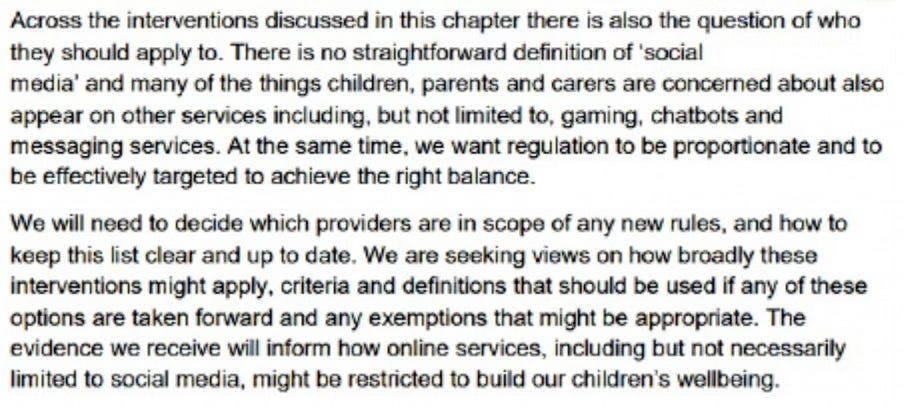
In one sense, you can sort of see the rationale here. As stated, defining social media is hard, and technology advances and changes so quickly that what’s the go-to platform now may be yesterday’s news by the time legislation is ready and in place. So, keeping a more flexible, adjustable framework could be useful here.
However, there’s flexibility, and there’s… whatever this is.
Near as I can work out, the message in this consultation is “We don’t really know what social media is, so why don’t you tell us what you don’t like about the internet in general, and we’ll use that to decide what is subjected to the ban, as and when we see fit”.

There are just so many issues with this. How can you use the results of this consultation to say “People are in favour of a social media ban” when social media isn’t even defined, and people are just asked for things they don’t like?
And the “We’ll apply the restrictions as we see fit” stuff (paraphrased, admittedly), this would give this or any future government an unprecedented amount of control over the online world. They could arbitrarily decide that young people are harmed by any particular site that they find sufficiently bothersome, effectively shutting out young people from potentially crucial resources.
And let’s not pretend that’s far-fetched. We’re already seeing significant pushback against Transgender and LGBTQ+ inclusion and associated projects and events, despite there being no good evidence for these things. Should those behind such efforts gain more legislative control, sites offering information and support to vulnerable children experiencing such things could easily be restricted, in the name of “protecting children’s wellbeing”. The ultimate irony.
It may be reassuring to think that surely the government wouldn’t do something so harmful without considering the evidence. But if that was the case, you wouldn’t be reading this right now.
Heck, the ability to ban sites for being ‘harmful to children’ could so easily become a powerful, versatile censorship tool. I said Wikipedia could be argued to be a social media platform, and a lot of far-right types don’t like Wikipedia. So…
Hanlon’s Razor says, “Never attribute to malice that which is adequately explained by stupidity.” If we take stupidity to include incompetence, or thoughtlessness, I would argue that’s a much more likely explanation for the sloppy nature of this consultation, and the ban it’s supposedly justifying.
But sometimes incompetence and malice produce the same results, so someone ends up suffering regardless. And what starts with incompetence can easily be used for malice, by those inclined to do so.
Even now, many will still insist a ban is necessary, to protect children. They probably mean it 100% sincerely, so it would be fair to say they have good intentions. This whole ban journey seems to be based entirely on good intentions.
But there’s another old saying, about journeys based upon good intentions, and where they tend to end up…
Dean Burnett and Dr Sarah Turner will now be doing a live panel about this issue at the 2026 Latitude Festival in The Cosmic Shambles Forest.
Dean Burnet will be doing more posts on the issues he’s found with the Government’s consultation on the social media ban as and when time allows. In the interim, why not read his kids book about this exact subject, Why Your Parents Are Hung-Up on Your Phone and What To Do About It.
You can also catch Dean in the new docuseries, For the Record: An Incomplete History of Music talking about the neuroscience of why we enjoy music.
No posts
Comments
Nothing yet. Say the first thing.
Sign in to join the conversation.