
From Bathurst to the west, Queens Quay to the south, Bloor to the north, and Sherbourne to the east, that is what I consider to be the core of Toronto. And while I was born and raised in Scarborough, for the last few years I’ve been living right in the centre of that core, steps away from Sankofa square at Yonge and Dundas.
I could talk about how the core was never this bad, and list all of the reasons why it was so much better years ago, but what is the point of that? What relevance does that serve today, let alone tomorrow? What I think is far more important is honestly acknowledging just how much the core is rotting, and why.
While the factors behind its rotting are complex and extensive, the main reasons are – in my opinion at least – simple. The core of Toronto has rotted for the same reasons most things rot: neglect, and the acceptance of that neglect, which just leads to further neglect.
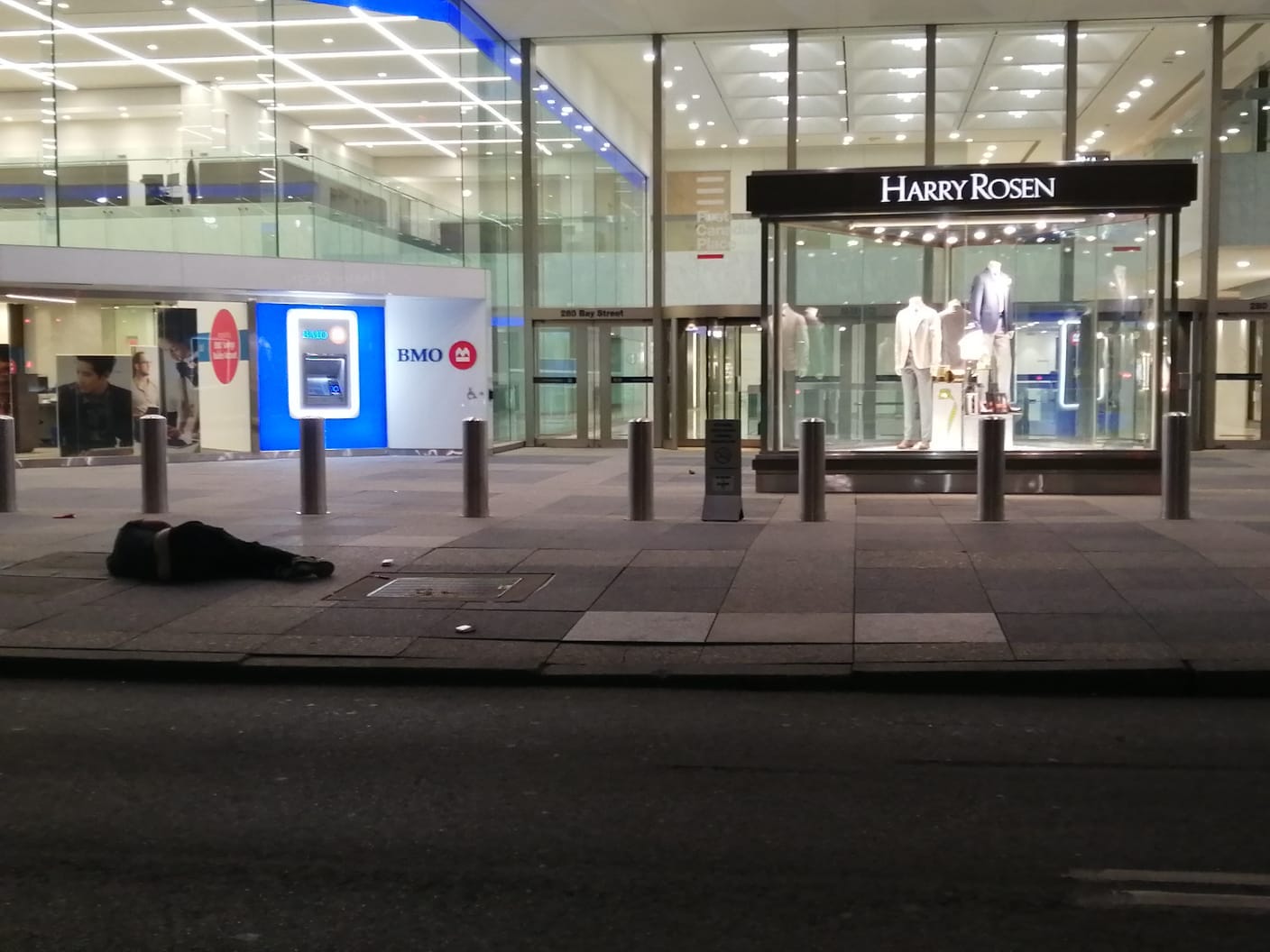
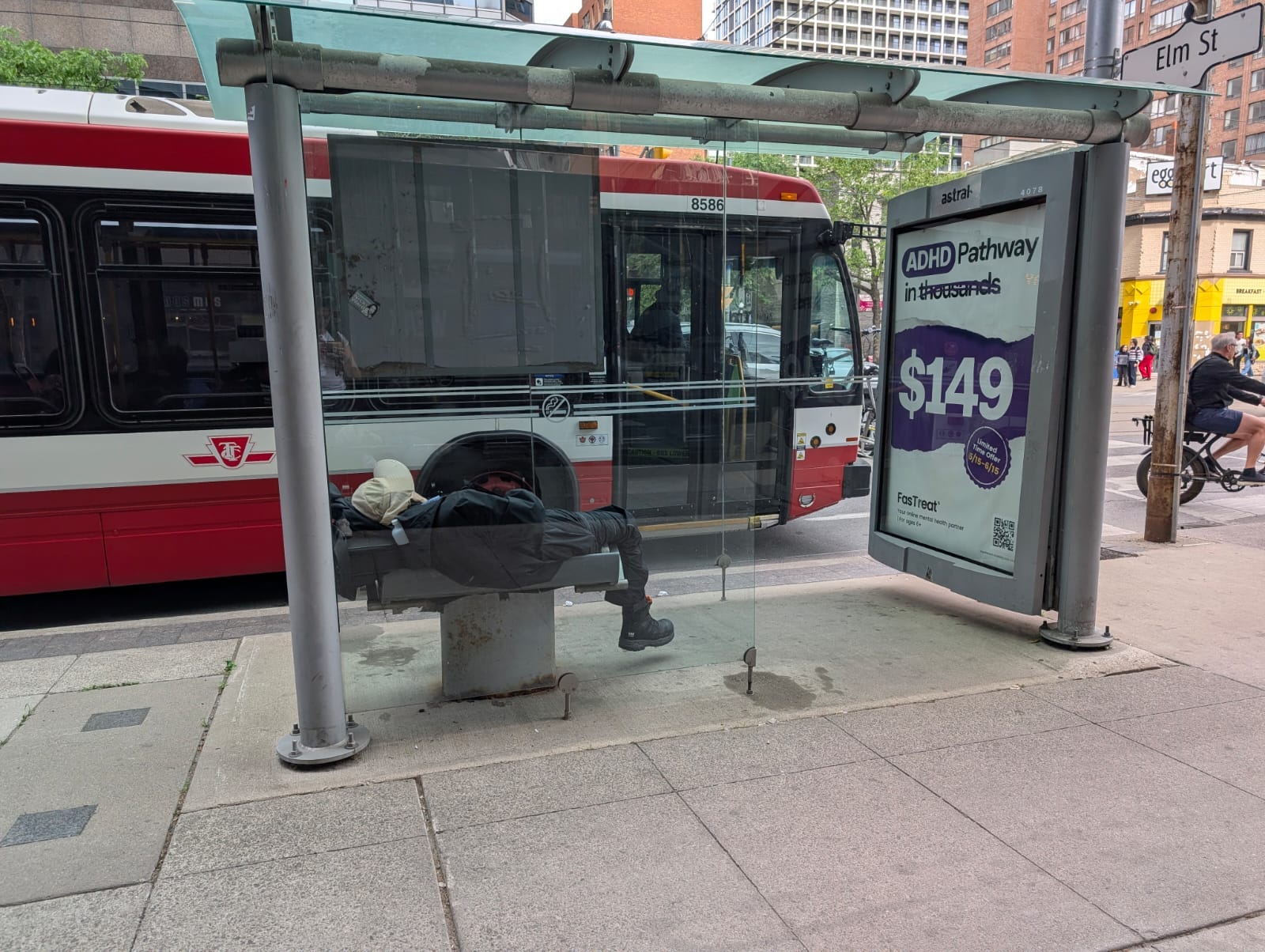
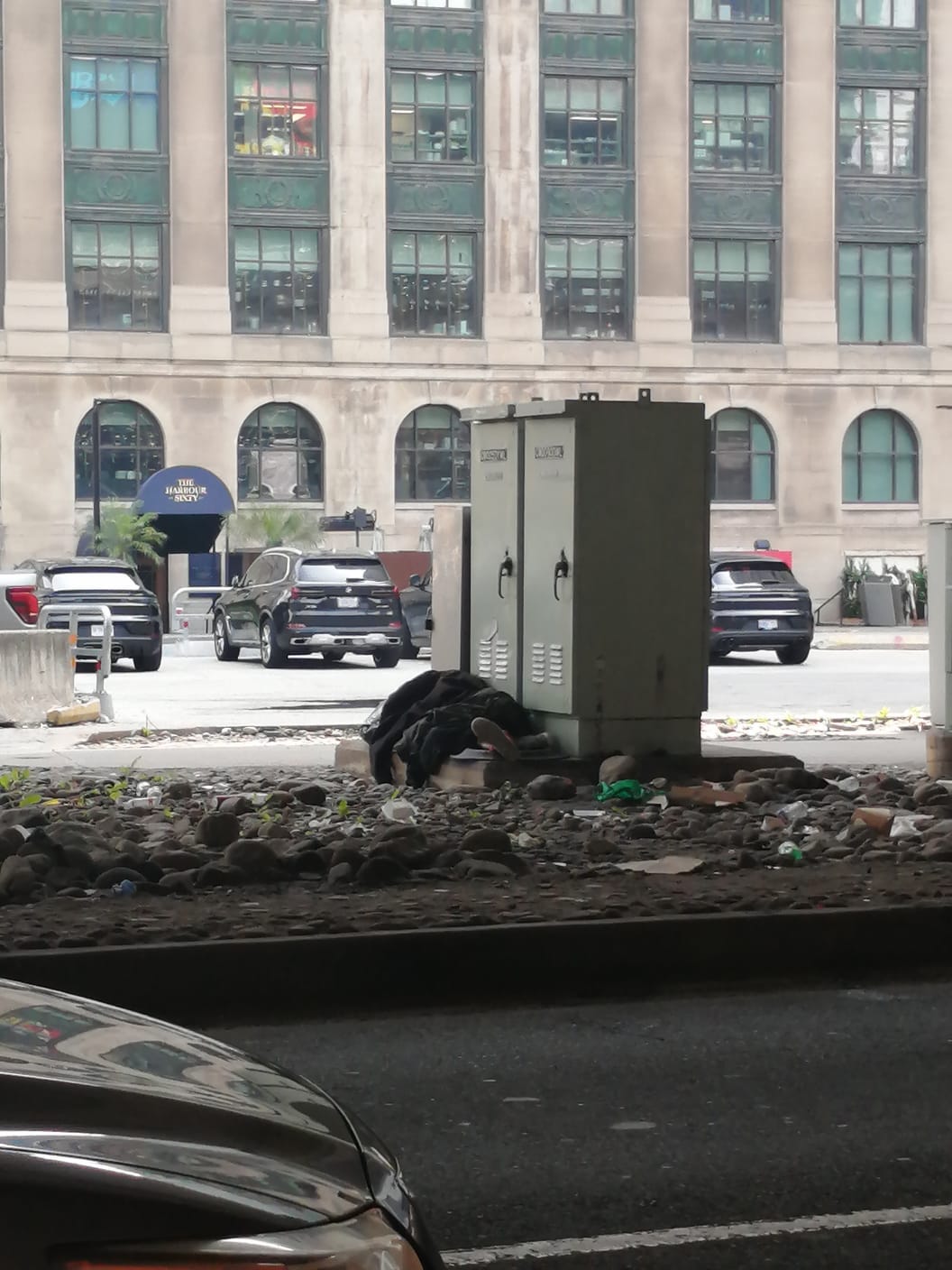
The neglect is as clear as day, especially at night. Every single evening I walk around the core I see at least one of the following: a stricken man’s exposed penis, a homeless person sleeping, or just keeping warm, on a steaming vent, an obviously mentally unstable person screaming at people who aren’t there, a drunk or high person walking erratically on the sidewalk or street, oblivious to pedestrians and cars alike, a TTC bus shelter converted into somebody’s makeshift home, the back seat of a lumbering streetcar occupied by somebody curled up and sleeping with half of their ass crack exposed for all to see, a single person, or several in a group, smoking an array of drugs on a glass pipe. I say that I see at least one of those things because it is rare to not see two, three, four, or five of those things in a given night. And when I say I see these things every night, I am not generalizing, nor being hyperbolic, I mean every single night.
The frustration from witnessing the utter disregard for the core, and the vulnerable people occupying it, reached a boiling point one night in the final days of April. My partner and I were walking north on Yonge, passing Queen, where construction on a new subway line (that not a single Torontonian is confident will finish on budget or on time) is taking place. Behind us was a group of young women. Trailing these women was a man. He was either drunk, high, or dealing with obvious mental issues that required medical supervision. He was screaming threats, while waving his arms violently. As he approached the women, they huddled closer together. Their fear was palpable, unsure what the man was going to do when he reached them. However, just before he got to them, the man abruptly veered onto Yonge and was suddenly staring at a Mack truck that had to slam the brakes to prevent running him over.
It was not just myself, my partner, the young women, and scores of other people who saw this happen, but also several orange vested construction workers, and a single police officer standing across the street who, like everybody else, watched the scene unfold. The man, after barely avoiding the truck, continued on his way, waving his arms, screaming at the top of his lungs, terrifying anybody he came within a few metres of. Angry at the lack of concern for what just happened, I waved my arm for the cop to see, and pointed at the man, loudly questioning why a police officer tasked with protecting and serving seemed uninterested in doing either one. I then shouted directly at the cop telling him to do something about what was going on right in front of his face. Meanwhile, one of the construction workers said, “What are you going to do? This is Toronto.”
The police officer aggressively shouted for me to come over and say what I was shouting from afar directly to his face. I immediately crossed the street to do so. Heated at the apathy shown not just by him, but what felt like the city itself, I asked why he wasn’t doing anything. In a calm tone that immediately diminished my hostility, the police officer said, “What do you want me to do, arrest him? For what, being drunk, high, or crazy? Do you think me dragging him to jail is going to help him, or anybody else?”
I thought about those questions, but before I could respond, the cop added, “He didn’t hurt anybody. He wasn’t threatening anybody.”
The hostility returned and I shot back, “So you do nothing until the man lashes out at somebody or gets hits by that truck?”
Sensing my anger, the still calm cop responded, “I get what you’re saying, but my hands are tied. We can’t arrest somebody for what they might do, or for what might happen. Also, I’ve been seeing this guy walking up and down Yonge all night. We all have (he pointed at some of the construction workers who all nodded in agreement). It’s the end of the month. He probably got his check. It’s always crazier at this time. What can I really do about it? I’m not a social worker or mental health worker. I’m a cop. I can only stop something when it’s a threat to the public.”
I didn’t want to empathize with the cop’s position. I was upset and wanted some sort of practical solution offered, but I could see that he was just as frustrated at what we had both seen as I was.
I told him that my partner and I live in the core, and before I could elaborate, he added, “So you get it.”
I nodded, and said, “I call 311 whenever I see people sleeping outside in the cold, or see people who are in an obvious precarious situation, but I have no idea who comes, or when, or if they even bother coming at all because the next night I usually see the same people in the same place.”
He shook his head.
“I know,” he said.
“And with summer coming,” I said, “there is going to be even more, and nowhere for them to go, and no help for them to turn to. Nothing is being done.”
And then he said it – almost word for word – just as dismissively as the construction worker a few minutes earlier, “What can we do? This is Toronto.”
And then he added, “I don’t even want to talk about the government.”
I didn’t bring up the government, let alone initiate a conversation about the government, but his statement of not wanting to talk about the government said all he needed to say about the government.
I appreciated the cop for taking the time to talk with me the way he did. It could have gone a different way. I was obviously upset, and so was he after I shouted at him from across the street for all to see and hear. A screaming match that most likely would have escalated to something more serious could have easily occurred. Yet, when we spoke face to face, there was an immediate understanding that our anger was not personal but rooted in frustration at what we both saw in the core night after night.
The phrase the construction worker and cop uttered, and the tone from which they said it, could easily be misinterpreted for indifference, but that wasn’t the case. I could see they cared about what was happening but just felt powerless to do anything about it. That isn’t indifference. It’s acceptance.
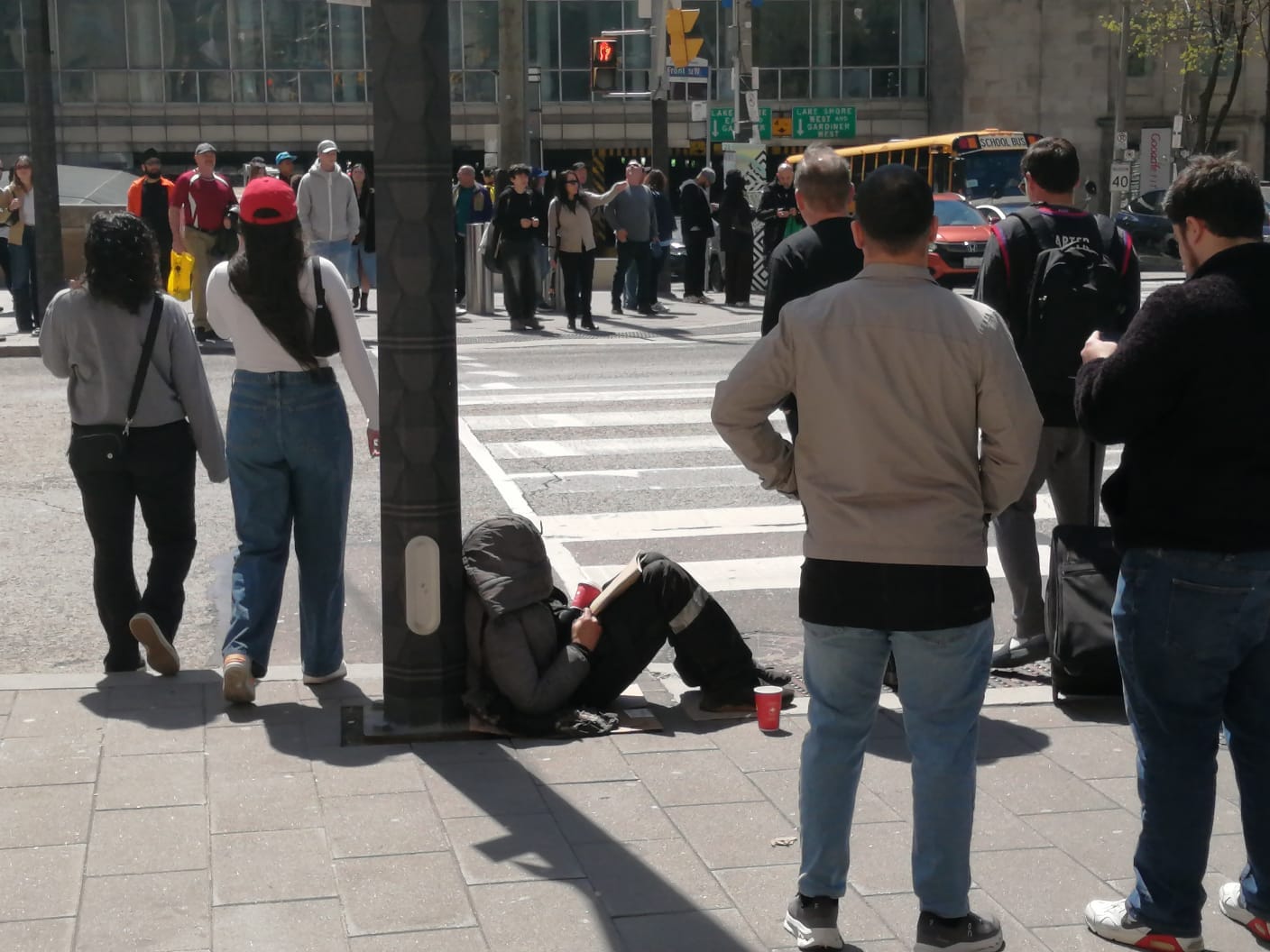
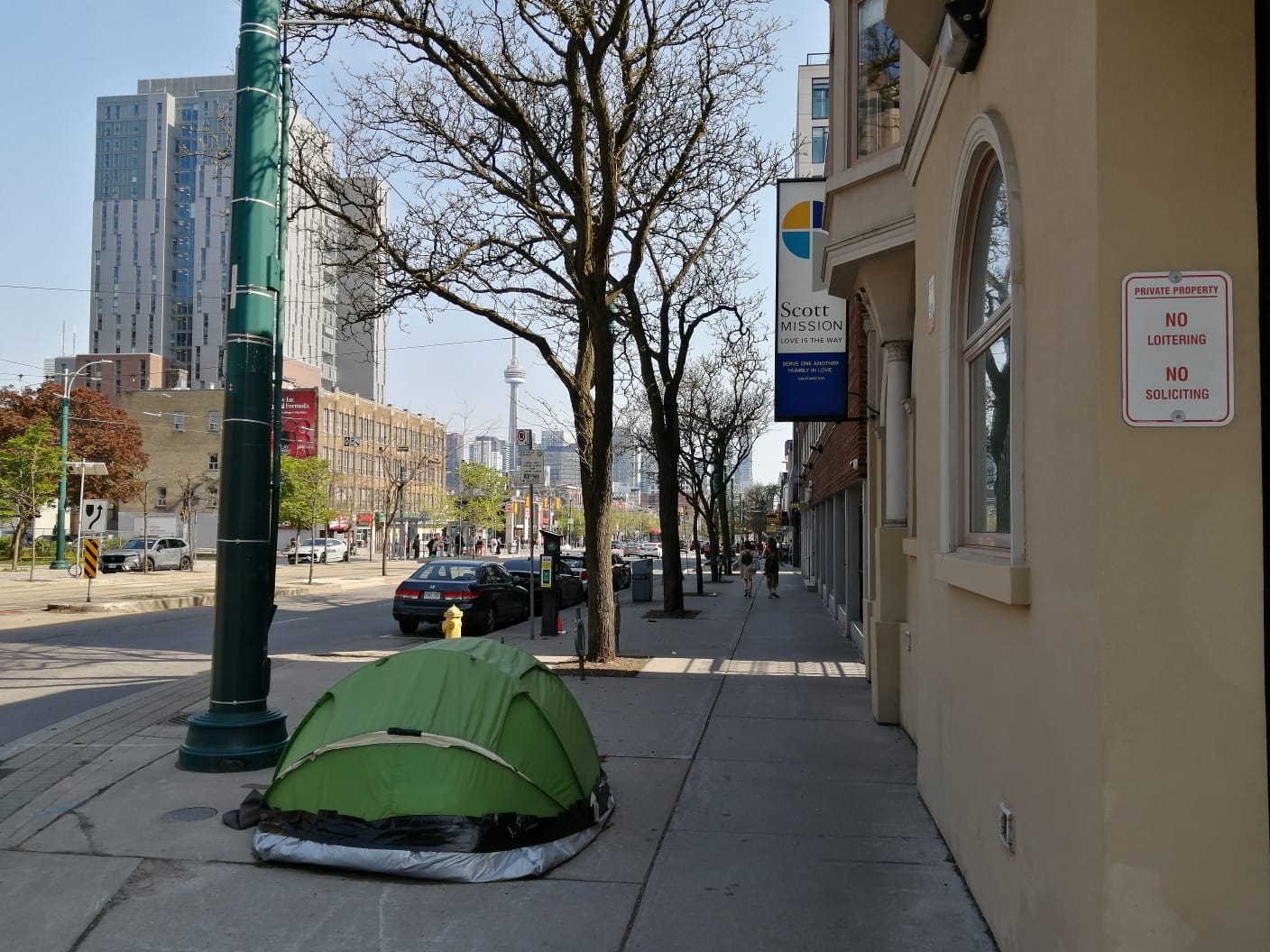
With more homeless, more drug addicted, and more mentally unstable people forced to roam the streets of the core because they have nowhere else to go due to lack of affordable housing combined with less shelters and mental health institutions to assist them, the rotting of the core is only getting worse. Meanwhile, those within the core, from police officers and construction workers to visitors and residents, have reached a point of acceptance that despite the frustration and reluctance accompanying it, is acceptance, nonetheless. And while it may not seem so on the surface, acceptance is far worse than indifference because the cynicism usually associated with indifference often leads to a breaking point that even the most lazy or apathetic cannot avoid. Acceptance, however, provides zero motivation for anybody to do anything. Nobody fixes something that everybody seems okay with leaving broken.
This is Toronto.
* * *
On Mutual and Dundas, in the early evening on a beautiful early June day, I saw a man unconscious on the sidewalk. People just walked around him. The only person who came to his aid was a man in an animal services uniform. Was he pulling double duty? He stood over the unresponsive man, helpless, while awaiting paramedics and police, who came shortly after.
A week later, I was waking south on Palmerston, passing trendy homes under the peaceful green canopy of trees. It was sunset. Beautiful. But when I reached Dundas, I saw a severely strung-out man writhing on the pavement, moving in ways that would have made a Cirque du Soleil performer jealous. We were both surrounded by patios, and people sitting, drinking, laughing, looking at their phones, while other people walked by the man, most of whom also looking at their phones. But what could I do? Call 311? Animal services?
I walked east on Dundas and saw much of the same. At Bathurst. At Denison. At Augusta. At Spadina, and beyond.
Visit Nathan Phillips Square after midnight. Walk along Sherbourne. Go to Queen and Jarvis, day or night, and you’ll see the same stories in real time.
Whether it is vulnerable people suffering to the point of disturbing contortion or doing the increasingly common Fenty Lean, they are on the streets for all to see and none to acknowledge, just to avoid with hopes the sight is never remembered. It feels surreal to see so many of these similar scenes, day after night, but it’s real, and these people need help. Now.
I know solutions can’t be implemented immediately. Only a fool would think otherwise. But a realistic and effective long-term plan can be created and presented by those whose jobs it is to do so, and yet no such plan has been created or presented. Whether or not the new Homelessness and Addictions Recovery Treatment (HART) hubs that are replacing the supervised drug consumption sites constitute an actual plan or is just another example of swapping out one Band-Aid for another remains to be seen. In either case, the lack of sustainable plans presented to a public forced to live in a constant state of uncertainty about what is going to happen is unacceptable. And only a fool would think otherwise.
I struggle on an almost daily basis as to why Torontonians aren’t angry enough to actually disturb the status quo of the core. I’m not talking about more marches and protests. We have enough of those, and the results they yield are debateable. Nor am I talking about reckless violence or acts of furious belligerence, since that just empowers authorities to be more authoritative. What I am talking about is an undeniable expression of sincere outrage at the state of their, my, our city. Have we not reached a breaking point? Does one even exist? The vulnerable shouldn’t be tasked with fighting for their lives. They are too tired, too hurt, too vulnerable. It is on those less vulnerable to fight for them, but I see no such fight. And those who do demonstrate it – including an assortment of organizations, groups, and individuals – can’t keep up with the soaring demand for their compassion.
At least we get to enjoy six FIFA World Cup games that few people in the city can afford attending and cost us all hundreds of millions of dollars. And with those games came the all too familiar FIFA “clean-up” of vulnerable people that every country does prior to the event, just like the Olympics. It took place prominently at Union Station, and other spots around the city, just to show the world what the government wants them to believe Toronto is.
Here a few quotes from people outraged by, and personally experiencing, this “clean-up”:
David Roberts, director of Urban Studies at the University of Toronto, said host cities often chase the image of a “world-class city” while pushing poverty out of sight rather than addressing it.
“We get there through displacement, through harassment, through hiding the problems that actually exist,” Roberts said. “We don’t get there through investment in shelters and supports that people actually need.”
“What we are seeing is an increase in policing to push people out and away from the gaze of the media and tourists… this is completely shameful.”
“Union Station isn’t a safe consumption site, but it is a safe place for us to be together, to look out for one another,” said Crystofur, an unhoused Toronto resident who declined to use his last name.
In a post shared to the popular Facebook group ‘Weird Toronto,’ Crystofur wrote that “It feels like the city is trying to scrub the unhoused population out of sight,” adding that it has become increasingly difficult to find safe spaces and that he is struggling to get by.
“By FIFA coming and them trying to hide us, just for the image of the city, they’re taking away the safety we put in each other.”
“I’m 100 per cent sure that the day FIFA gets here, there will not be a homeless person at Union Station,” he said before pausing.
“I don’t know what to do.”[1]
* * *
In Toronto, we have a mayor who smiles for pictures, jokes with other politicians, and talks about unity, solidarity, and other buzz words that seem to placate enough people to prevent her from stopping, but shows zero passion or real anger about the problems we all see. She would make a great mayor for a reasonably sized town, but not a metropolis like Toronto that has big city problems that she just doesn’t seem capable or even interested in seriously tackling. She needs to stop casually saying that she is in our corner and actually start doing something to prove it. She needs to take a walk in the core at midnight and see the city she’s supposed to be leading for what it is, not what she believes it to be.
We have a premier that cares more about turning Toronto into a world class city that can generate as much money as possible, while stressing how much we need to build, build, build, while making little effort to build what the vulnerable can call home or get help in. He doesn’t care about those who are in a lower tax bracket than himself, and his actions, or more specifically, lack thereof, proves that. Moreover, anybody who issues the pathetic “pull up your bootstraps” slogan, or any similarly worded – equally ignorant – declaration, when addressing the struggles of the vulnerable have obviously never had to endure a precarious life, making it impossible for them to understand, let alone empathize, with those who are. Thinking he will help those he has no interest in even understanding is delusional. This is the same man who purchased a private jet just to keep up with other leaders, only to return it after the public found out and shamed him for it.
Further proving his utter disassociation with those beneath his bracket, we are being bombarded with his “Protect Ontario” campaign. This includes a troubling commercial that preaches no more encampments or safe injection sites (complex situations where both sides of the argument have valid points of view, as opposed to a single, dumbed down tag line), more cops, prosecutors, and jails to keep criminals in line, all while showing joyful, racially diverse suburbanites enjoying the tranquility of their respective bubbles. There is no word about where those people in the non-existent encampments are going to go, or what is being done about and for the criminals before or after they are arrested and subsequently imprisoned. Instead, we get eerily American sounding rhetoric that could have been peeled right off the campaign trail of an Ohio election.
Both Chow and Ford should be shouted down any time they say anything that isn’t aligned with tangible, sustainable, and practical solutions. But they aren’t. While they have, from time to time, spoken about the enormous issues we all see day after day, there is no conviction in their words. There are no believable examples of how concerned or upset they are, or even an effort to fake it if they’re not. Instead, we are forced to listen to hollow speeches by hollow people, while those suffering from the issues they barely speak about are worse off than they were before either of them took office. It reminds me of the silence Reagen took in the 80s about the AIDS epidemic, when he refused to even say the word AIDS, and while Chow and Ford will actually utter words like unhoused, or whatever verbiage they feel will appease people the most, I feel nothing when they say it, and nothing is what they seem to be doing about it.
As for other politicians in Toronto, while some of them are willing to express anger at issues, which can be refreshing, seeing them desperately pandering to as many groups and causes as possible undermines whatever sincerity they may actually feel. This makes it difficult to have any confidence that they can ever maintain the focus required to address even one of those issues in a way that will make an actual impact.
One only needs to visit cities in “developing” countries throughout the world to see that “developed” Toronto, and especially its rotting core, has far more in common with those cities than it would ever be comfortable admitting. This comes despite having more wealth, infrastructure, and resources than many of those cities. Has Toronto become so blindly reliant on an outdated reputation to not see the reality of what it has become? At least with many of those cities in developing countries, costs for a number of things, from public transportation and food to housing and entertainment are substantially lower. Meanwhile, Toronto is one of the most expensive cities on earth for all of those aforementioned things, so where is the offsetting reward? Safety is one, especially when compared to similarly sized cities in developing countries and the United States (despite many news outlets’ troubling insistence in making the public believe otherwise for reasons they must live with). But after that, what is left? Drinkable tap water? Sure, but to that I ask anybody to raise their hand if they feel comfortable drinking from a fountain in Sankofa Square at midnight?
Written in Toronto in June 2026.
[1] Corné van Hoepen, “FIFA World Cup’s dark side: Toronto deserves a ‘red card’ for ‘disgusting’ treatment of unhoused people ahead of event”, Yahoo News Canada, May 26, 2026, https://ca.news.yahoo.com/fifa-world-cups-dark-side-toronto-deserves-a-red-card-for-disgusting-treatment-of-unhoused-people-ahead-of-event-192125469.html
Comments
Nothing yet. Say the first thing.
Sign in to join the conversation.