
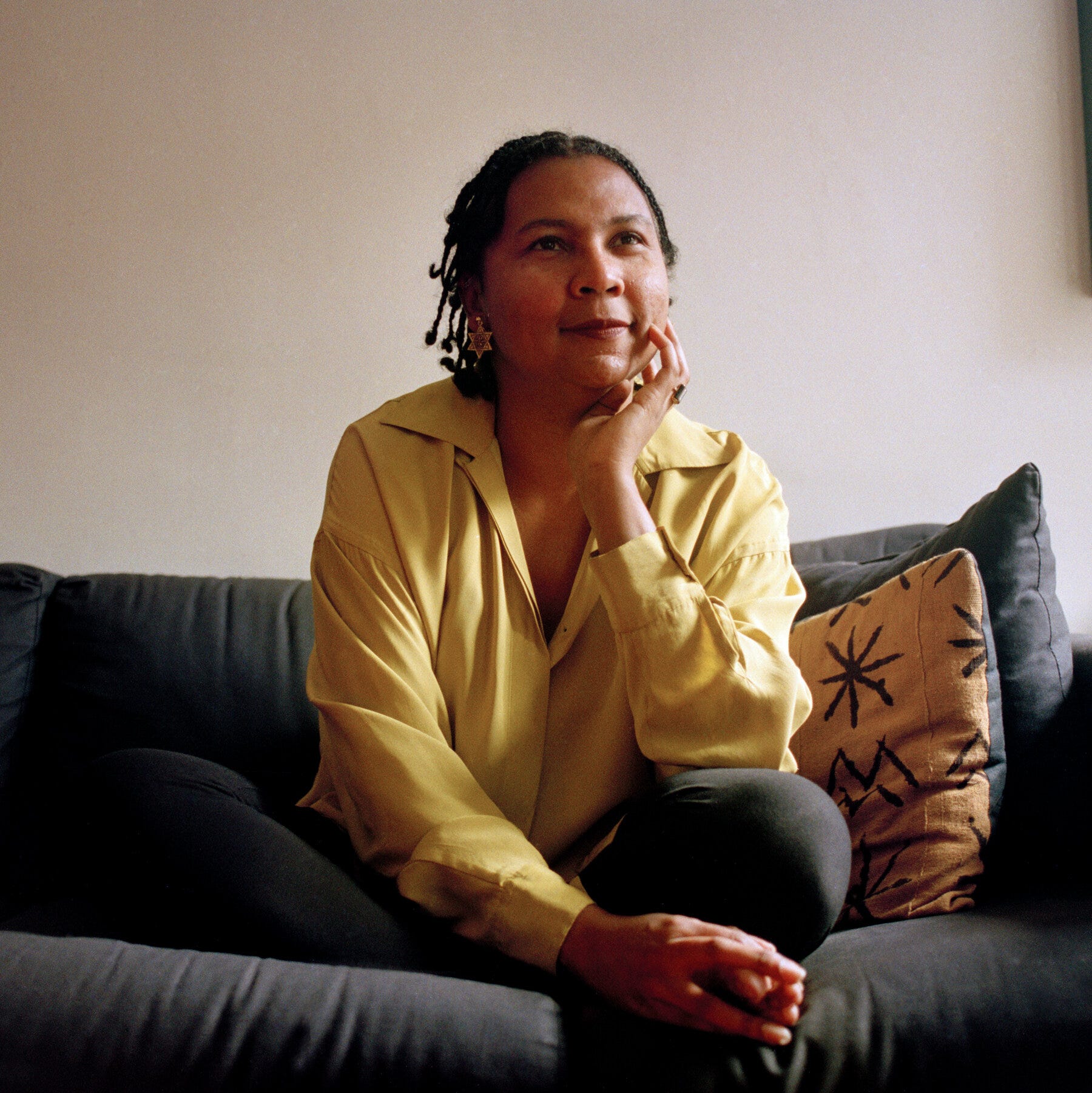
Now, bell hooks was a sharp, consistent critic of liberalism, and she was that critic for forty years, across nearly forty books, from Ain’t I a Woman in 1981 all the way to the last essays she published in Berea, Kentucky, before she died in December of 2021. She argued that its core principles was inadequate to achieving genuine liberation because she understood they failed to address the intersecting systems of what she named white supremacist capitalist patriarchy, and when she was feeling especially precise about it she said imperialist white supremacist capitalist patriarchy, because she wanted the foreign policy in the sentence too.
Most of y’all encountered that phrase on a tote bag. Most of y’all encountered that phrase as a caption. Most of y’all have never sat with the fact that she built it as a diagnostic instrument, not a slogan, and that the whole point of stacking those four words together was that you cannot pull one out and treat it separately, because the moment you treat racism as a separate problem from capitalism you get a solution that hires Black managers, and the moment you treat patriarchy as a separate problem from white supremacy you get a feminism that pays a Black woman eleven dollars an hour to watch the children while the movement goes to the conference.
So let’s do this right. Let’s put her four arguments on the table, and then let’s put a receipt under each one, because the tenth of nothing is still nothing, and theory without an archive is just vibes with footnotes.
Tomorrow, August 22, 2026, is the thirtieth anniversary of the Personal Responsibility and Work Opportunity Reconciliation Act, Public Law 104 193. A Democratic president signed it. A Republican Congress wrote it. It was sold as compassion. It has a thirty year record now. And that record is the single best piece of evidence for everything bell hooks was saying while people were calling her too radical, too angry, and not constructive enough.
Let’s get into it.
Hooks argued that liberal democracy operates as an ideological smokescreen that obscures the reality of systemic oppression. Rather than a system of liberty and justice for all, she contended that white supremacist capitalist patriarchy has a standing preference in favor of certain races, certain classes, and certain genders, and that this preference is maintained by structural violence, which is a fancy way of saying people die on schedule and nobody gets charged.
For hooks, liberalism is a reformist political framework focused on legal rights, equal opportunity, and inclusion within existing arrangements. The goal is getting a seat at the table. We’re talking voting, desegregation, equal pay, all that. The flaw, according to bell hooks, is that it mistakes legal inclusion for liberation. It does not challenge the fundamental structure of capitalism or any other system at all. It just wants those systems to move slightly fairer.
Here is where the archive backs her up so hard it hurts.
In 1935, this country passed the Social Security Act and the National Labor Relations Act in the same window. That is the founding architecture of the American social safety net and the American labor movement, and it is correctly remembered as one of the most significant expansions of economic security in the history of the republic. It is also correctly remembered, if you actually read it, as a piece of legislation that excluded agricultural workers and domestic workers from old age insurance, from unemployment insurance, and from the right to organize.
Now, who was the agricultural workers. Who was the domestic workers. Ira Katznelson, in When Affirmative Action Was White, does the arithmetic, and the arithmetic says roughly sixty five percent of Black workers nationally fell into those two excluded categories, and in the South the share ran higher than that. There is no race in the statute. There is no slur in the statute. The statute is race neutral on its face and it is a racial policy in its effect, and the reason it was written that way is that Southern Democrats controlled the committees and told Roosevelt what the price of their votes was.
That is mystification. That is exactly what hooks meant. The bill says universal. The bill does universal for some. The word “universal” then goes on to do political work for the next ninety years, because every time a Black person says the safety net was not built for us, somebody pulls up the 1935 statute and says look, it applies to everybody.
Apply Melamed here. Melamed’s argument in Represent and Destroy is that formally antiracist and formally inclusive frameworks do not simply fail to stop racial capitalism. They become the thing that makes racial capitalism legible as fair. The 1935 statute is the first great American demonstration. The bill says universal. The economy needs somebody outside the bill picking the crop and cleaning the kitchen. And once the word universal is on the page, the explanation for why that somebody stays poor gets assigned, in advance, to their family, their habits, and their morals, rather than to the committee chairman who wrote the exemption in exchange for his vote.
That is the move underneath all four of hooks’s arguments. Once the state can point to a universal statute, a desegregation ruling, or a diversity officer, it has purchased the right to describe every remaining disparity as a private failure of the people still on the bottom. The inclusion is not a broken promise. The inclusion is the receipt.
That is why hooks would not accept “we’re making progress” as an answer, and that is why she got called difficult.
Number two, the OG bell contended that liberal individualism was a flaw. She specifically criticized the ideology of competitive, antagonistic liberal individualism as something I would call lost in the sauce, and I’ll go a step farther and say a lot of y’all are lost in it right now. Hooks argued that it created a shallow common oppression narrative that ignores the differences and the intricacies, and that power and privilege allow a lot of y’all to mystify.
See, OG bell was arguing that this selfish prioritization of the individual undermines the collective solidarity that’s needed for radical change. As a matter of fact, some of y’all heard it. I don’t care what’s happening structurally with my tax dollars, as long as my grandma get her insulin. You feel me? You have to be able to understand how the individual suffering falls into the collective always already, and because they’re able to use your tax dollars to blow them up over there, your granny probably will never get the insulin. You see what I’m saying? You got to have the collective consciousness.
Let me put a whole legal chain under that, because this is the part where people think I’m being dramatic.
Between 1968 and 1971, poor Black women and their lawyers ran one of the most successful litigation campaigns in American history, and almost nobody knows their names.
King v. Smith, 392 U.S. 309 (1968). Alabama had a substitute father rule. If a caseworker decided a man was in the house, the children lost benefits, and the caseworker got to decide. Mrs. Sylvester Smith sued. The Supreme Court struck the rule down unanimously.
Shapiro v. Thompson, 394 U.S. 618 (1969). States were imposing one year residency requirements to keep poor people from moving in. Struck down.
Goldberg v. Kelly, 397 U.S. 254 (1970). You cannot terminate somebody’s benefits without a hearing first. Due process attaches to welfare. That case is now in every administrative law casebook in the country.
Individual rights. Individual dignity. Real wins. I am not dismissing a single one of them.
Now watch what happened in the same window.
Dandridge v. Williams, 397 U.S. 471 (1970). Maryland capped the total grant per family regardless of family size, so the sixth child got nothing. The Court upheld it. Rational basis. Economic and social welfare legislation gets the lowest level of scrutiny.
Wyman v. James, 400 U.S. 309 (1971). A caseworker can come into your home. It is not a search under the Fourth Amendment, the Court said, because you can always refuse and just lose your benefits.
You see the shape of it? The rights framework won you the hearing and lost you the money. It won you procedure and lost you substance. The state could not throw you off the rolls without a letter, but the state could set the grant so low that the letter did not matter, and the state could walk through your bedroom while you were on it.
That is what hooks meant when she said liberalism mistakes legal inclusion for liberation. The individual got a right. The class got a ceiling. And because we had been trained to celebrate the individual win, a whole lot of people read that decade as progress and never looked at the ledger.
Just admit it. Two things can be true. Goldberg v. Kelly is a genuine victory and the material position of poor Black mothers got worse across the exact same period. Holding both of those is not cynicism. That is literacy.
Number three, bell hooks argued that liberal feminism was inadequate. She understood that it was too focused on reform and that it primarily benefited and privileged white women. She saw it as acceptance within a structure rather than a demand for fundamental change. I would say a lot of y’all want to conserve your individual comfort at the expense of the collective because you worked so hard to get there. See, that’s how capitalism has hoodwinked and bamboozled you into being a self centered, selfish bastard in many instances, because as long as you got yours, right?
Now, hooks made this argument most famously in Feminist Theory: From Margin to Center in 1984, where she took apart Betty Friedan’s The Feminine Mystique not by calling Friedan a bad person but by asking a structural question: who did Friedan imagine when she wrote about the problem that has no name. The answer is a college educated housewife who was bored in a house that somebody else was cleaning. Hooks pointed out that the woman doing the cleaning was in the book only as furniture, and that a movement whose central demand is access to the workplace has already assumed a woman who is not in the workplace, which is not most Black women in this country and never has been.
And then the Combahee River Collective put it in writing in April of 1977, and this is the part I need y’all to sit with, because this is one of the great thefts in modern political language.
The Combahee River Collective Statement is where the phrase “identity politics” enters the world. Those were Black feminists, most of them socialists, several of them lesbian, in Boston, and what they meant by identity politics was the opposite of what the phrase means in your feed today. They meant that the people standing at the intersection of every system have the sharpest analysis of all of them, and therefore organizing from that position produces a politics that liberates everybody, because if Black women were free it would require the destruction of all the systems.
That is a maximalist, structural, anticapitalist claim. That is a claim about tearing the whole thing down.
Now it means a hashtag. Now it means a corporate affinity group. Now it means a cable news segment where somebody complains that the left cares too much about identity. Crazy how the phrase went from “the destruction of all systems of oppression” to “a panel at a conference,” and crazy how the people who did that conversion never had to explain themselves.
And notice what hooks is doing there, because it is sharper than a complaint about who got left out. She is saying liberal feminism inherited the measuring stick without ever questioning it. The standard was a heteronormative, property owning, nuclear household, and the demand was simply to be let out of the house it assumed everybody already had. Combahee refused the standard itself, which is the difference between asking for a seat and asking why the table is shaped like that.
Apply Melamed again. That is neoliberal multiculturalism doing exactly what it does. It takes a demand for redistribution, keeps the vocabulary, discards the economics, and hands you back a representation politics that costs the state nothing and pays a consultant something.
Argument number four, and this one got teeth on it, man.
Let me be precise here, because precision is the whole job. In Black Looks, published in 1992, hooks writes two different essays that people constantly collapse into one. “The Oppositional Gaze” is about resistance. It is about Black women spectators who refuse to identify with the image being sold to them and who look back at the screen critically, and that gaze is ours, that gaze is a weapon. The other essay is “Eating the Other: Desire and Resistance,” and that is the one about the market.
“Eating the Other” is the argument I’m making. That specific dynamic happens when capitalism and media team up to look at Black womanhood. It’s not the old school racist gaze of pure hatred or segregation. It is a transactional, market friendly surveillance that offers a cruel bargain: we will let you succeed, but only if we can use your pain as profit, your struggle as content, your frustration as engagement, and never, never, ever can you blame the system.
For hooks, neoliberalism is capitalism on steroids. It’s an economic and cultural system where market logic takes over every aspect of human life. I’m talking privatization, deregulation, and turning everything, including identity, pain, love, and education, into a commodity to be bought, sold, and branded to better the empire.
You know I’m a former debater, so that was the criticism. Now let’s do the alternative, because hooks always had one, and the people who call her a nihilist never got past chapter two.
Hooks’s alternative is a genuinely liberatory politic that requires a revolution of values, rooted in antiracist, anticapitalist, and feminist principles, not merely a reformation of liberal systems. Her politics has been described as socialist, as revolutionary, demanding a fundamental restructuring of society that makes us practice a radical form of love.
And I want to name something, because two things can be true. In May of 2014, on a panel at The New School, hooks used language about Beyoncé that traveled across the internet for a decade and that a lot of people, including a lot of Black women, found harsh and dismissive. Then in May of 2016, hooks wrote “Moving Beyond Pain” about Lemonade, and in that piece she is doing something more careful: she is praising the assertion of Black female subjectivity and simultaneously refusing to accept that a visual album sold inside a capitalist media apparatus can be the site of liberation. You can think she was wrong about the artist. You can think she was right about the apparatus. What you cannot do is pretend she softened her critique of the market when the product got beautiful, because she never did, not once, for anybody, including herself.
I promised you hooks had an alternative, so let’s land there, because I refuse to leave y’all in the diagnosis.
In the year 2000, bell hooks published two books. One was All About Love: New Visions. The other was Where We Stand: Class Matters. Same author, same year, same press house moment.
All About Love became a phenomenon. It has sold in the millions, it gets quoted at weddings, it lives on nightstands and in captions, and it is the reason a whole generation knows her name.
Where We Stand: Class Matters is the book where she says the thing directly. That book argues that class has been the great silence of American life, that the Black middle class has often bought its own comfort with distance from the Black poor, and that no amount of love language means anything if it is not attached to a redistribution of resources.
Y’all bought one of them.
And this is not a gotcha, because the two books are the same argument. That is the point people miss. In All About Love, hooks defines love, following Peck, as the will to extend oneself for the purpose of nurturing another’s spiritual growth. Will. Extension. Action. Not feeling. She is explicit that love is not an emotion you have, it is a practice you fund. And if love is a practice you fund, then a budget is a moral document, a block grant is a love letter or it isn’t, and a caretaker exemption that stops at thirteen is a statement about who this country is willing to extend itself for.
Alexis Pauline Gumbs, in her Black feminist work on mothering and survival, makes the point that Black feminist practice has always understood care as infrastructure rather than sentiment, that the aunties, the othermothers, the church mothers, and the block were a distribution system, and that the reason this country can starve the formal safety net is that it has always quietly relied on Black women’s unwaged labor to catch what falls through.
Apply Gumbs and you get the counterweight the diagnosis needs. The critique is that liberalism gives you the seat and keeps the deed. The alternative is not despair and it is not a better seat. The alternative is that the practice of care has to be organized, funded, and defended as a material demand, the way Tillmon demanded it in 1972 and the way Fannie Lou Hamer demanded it when she bought land in Sunflower County instead of asking for a grant.
Radical love ain’t a feeling. Radical love is a budget, a deed, a co op, a clinic, a bus route, and a line item.
1. Legal inclusion and material liberation are two different products, and this country has only ever been willing to sell you one of them. The 1935 Social Security Act was universal on its face and excluded roughly sixty five percent of Black workers through the agricultural and domestic categories. No race in the statute. Race all through the result. That is the template, and it has been reused every time since.
2. The rights revolution in welfare law won procedure and lost substance in the same five years. King v. Smith, Shapiro v. Thompson, and Goldberg v. Kelly gave poor Black women hearings, mobility, and due process. Dandridge v. Williams and Wyman v. James gave the state the power to cap the grant and search the home. Celebrate the first set all you want. Just do not confuse it with the second set.
3. “Identity politics” was a socialist, redistributive demand before it was a punchline. The Combahee River Collective coined it in April 1977 to argue that organizing from the position of Black women would require the destruction of all systems of oppression. It got stripped of its economics, kept its vocabulary, and came back as a corporate affinity group. That conversion is the clearest single example of what hooks was describing.
4. Thirty years of TANF is a controlled experiment, and the results are published. In 1996, sixty eight of every one hundred families with children in poverty received cash assistance. In 2023, twenty one did. California is at sixty five. Texas and Arkansas are at two. States sit on about ten billion in unspent funds while spending under one fourth of the money on actual cash assistance.
5. The 2026 rules put a number on who this country considers a child. The Medicaid interim final rule exempts a caretaker of a dependent child thirteen years of age and under. SNAP dropped its dependent child threshold from under eighteen to under fourteen. A fourteen year old cannot legally work, drive, or consent to their own care, but is old enough for the federal government to decide their mother is no longer a caregiver.

Black male educators are less than 2% of this profession—I am that 2%, and I am fighting alone against the systematic erasure of our histories, our legal protections, and our cultural truth. I have no foundation, no corporate sponsor, and no safety net; this work lives or dies on the integrity of this community alone. If every one of you reading this converted to a paid subscriber today, we would stop surviving and start building—a permanent, independent archive of Black expertise with the depth of PBS and the fire of our ancestors. So here is the ask: no shares, no likes, no thoughts—just a subscription. Fund the fortress or watch the erasure continue; the choice is yours.
Primary: bell hooks
hooks, bell. Ain’t I a Woman: Black Women and Feminism. South End Press, 1981.
hooks, bell. Feminist Theory: From Margin to Center. South End Press, 1984.
hooks, bell. Talking Back: Thinking Feminist, Thinking Black. South End Press, 1989.
hooks, bell. Yearning: Race, Gender, and Cultural Politics. South End Press, 1990.
hooks, bell. Black Looks: Race and Representation. South End Press, 1992. See especially “The Oppositional Gaze” and “Eating the Other: Desire and Resistance.”
hooks, bell. Teaching to Transgress: Education as the Practice of Freedom. Routledge, 1994.
hooks, bell. Killing Rage: Ending Racism. Henry Holt, 1995.
hooks, bell. All About Love: New Visions. William Morrow, 2000.
hooks, bell. Where We Stand: Class Matters. Routledge, 2000.
hooks, bell. Teaching Community: A Pedagogy of Hope. Routledge, 2003.
hooks, bell. “Moving Beyond Pain.” bell hooks Institute, May 2016.
Theory and Political Economy
Melamed, Jodi. Represent and Destroy: Rationalizing Violence in the New Racial Capitalism. University of Minnesota Press, 2011.
Robinson, Cedric J. Black Marxism: The Making of the Black Radical Tradition. University of North Carolina Press, 1983.
Singh, Nikhil Pal. Black Is a Country: Race and the Unfinished Struggle for Democracy. Harvard University Press, 2004.
Ferguson, Roderick A. Aberrations in Black: Toward a Queer of Color Critique. University of Minnesota Press, 2004.
Spence, Lester K. Knocking the Hustle: Against the Neoliberal Turn in Black Politics. Punctum Books, 2015.
Bell, Derrick. Faces at the Bottom of the Well: The Permanence of Racism. Basic Books, 1992.
Mills, Charles W. The Racial Contract. Cornell University Press, 1997.
Welfare, Reproduction, and the Safety Net
Roberts, Dorothy E. Killing the Black Body: Race, Reproduction, and the Meaning of Liberty. Pantheon, 1997.
Nadasen, Premilla. Welfare Warriors: The Welfare Rights Movement in the United States. Routledge, 2005.
Nadasen, Premilla. Household Workers Unite: The Untold Story of African American Women Who Built a Movement. Beacon Press, 2015.
Hancock, Ange Marie. The Politics of Disgust: The Public Identity of the Welfare Queen. NYU Press, 2004.
Katznelson, Ira. When Affirmative Action Was White. W. W. Norton, 2005.
Quadagno, Jill. The Color of Welfare: How Racism Undermined the War on Poverty. Oxford University Press, 1994.
Kornbluh, Felicia. The Battle for Welfare Rights. University of Pennsylvania Press, 2007.
Levin, Josh. The Queen: The Forgotten Life Behind an American Myth. Little, Brown, 2019.
Tillmon, Johnnie. “Welfare Is a Women’s Issue.” Ms., Spring 1972.
Edelman, Peter. “The Worst Thing Bill Clinton Has Done.” The Atlantic, March 1997.
Combahee River Collective. “The Combahee River Collective Statement.” April 1977.
Education
Givens, Jarvis R. Fugitive Pedagogy: Carter G. Woodson and the Art of Black Teaching. Harvard University Press, 2021.
Woodson, Carter G. The Mis Education of the Negro. Associated Publishers, 1933.
Erickson, Ansley T. Making the Unequal Metropolis: School Desegregation and Its Limits. University of Chicago Press, 2016.
Walker, Vanessa Siddle. Their Highest Potential: An African American School Community in the Segregated South. University of North Carolina Press, 1996.
Gaines, Kevin K. Uplifting the Race: Black Leadership, Politics, and Culture in the Twentieth Century. University of North Carolina Press, 1996.
Fairclough, Adam. A Class of Their Own: Black Teachers in the Segregated South. Harvard University Press, 2007.
Comments
Nothing yet. Say the first thing.
Sign in to join the conversation.