
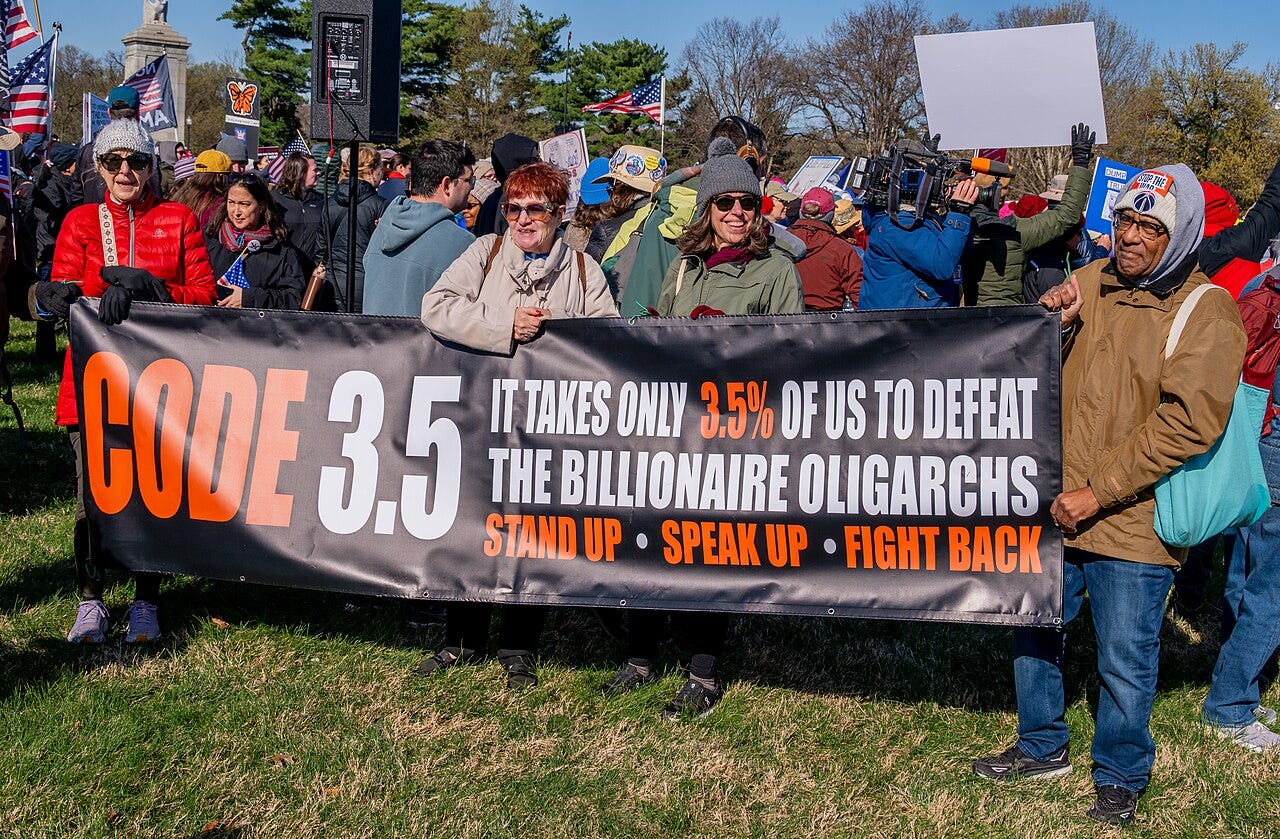
I have never been a fan of the so-called “3.5% rule” credited to Harvard Carr Center professor Erica Chenoweth, an expert on anti-authoritarian protest movements worldwide. In its simplest form, the rule, as stated on the Carr center website, says, “Nonviolent protests are twice as likely to succeed as armed conflicts – and those engaging a threshold of 3.5% of the population have never failed [sic] to bring about change.” Advocates, activists and journalists here in America have seized on this formulation as a kind of magical talisman, literally arguing that once we hit that level of nonviolent protest against Trump, the regime would have to fall.
For example, after the Hands Off protests of April 5, 2025, which drew perhaps three million to the streets, the 50501 movement said on Instagram, “April 5 was our fourth national day of action, and it won’t be our last. We are committed to building our peaceful People’s Movement and achieving 3.5% participation. History shows that when just 3.5% of the population engages in sustained peaceful resistance -- transformative change is inevitable.”
Here’s the liberal Center for American Progress hyping the 3.5% rule as enough “to help stop the nation’s slide into authoritarianism,” back in August 2025. Here’s the American Bar Association, in November. Here’s Robert Reich, this past March.
And here’s Rachel Maddow of MSNOW explaining the rule to late night TV host Jimmy Kimmel back on January 8, 2026, as the nation was reeling from ICE’s murder of Renee Good in Minneapolis:
“In political science terms, there’s what’s called the 3.5% Rule, which is that if you look at authoritarian regimes of various kinds all over the world over the last century, once you have 3.5% of a population protesting nonviolently against a dictator or an authoritarian, that is essentially an unstoppable force that they can’t oppose and that precludes them from consolidating dictatorial power. It’s not that much larger a number than what we’re already seeing in the streets against Trump….the key is nonviolent protest.”
Obviously, the 3.5% rule got lots of attention around each of the No Kings protests, as the total number of people participating rose from 5 million in June 2025, to perhaps 7 million in October and then a claimed 8 million this past March. Awareness of it has spread well past hard-core activists. Here is comedian Michael Kosta citing the rule after No Kings 3, for example.
But nothing in politics is inevitable, even if the historical record suggests that sustained and well-organized nonviolent mass movements have a much better success rate than violent ones.
People paying closer attention to Chenoweth’s work have always known this, and Chenoweth has made it clear that the 3.5% threshold wasn’t anything close to a “rule.” This chart, taken from a piece Chenoweth wrote for the Journal of Democracy in 2020, shows that the historic record favors nonviolent movements, but that they aren’t always successful.
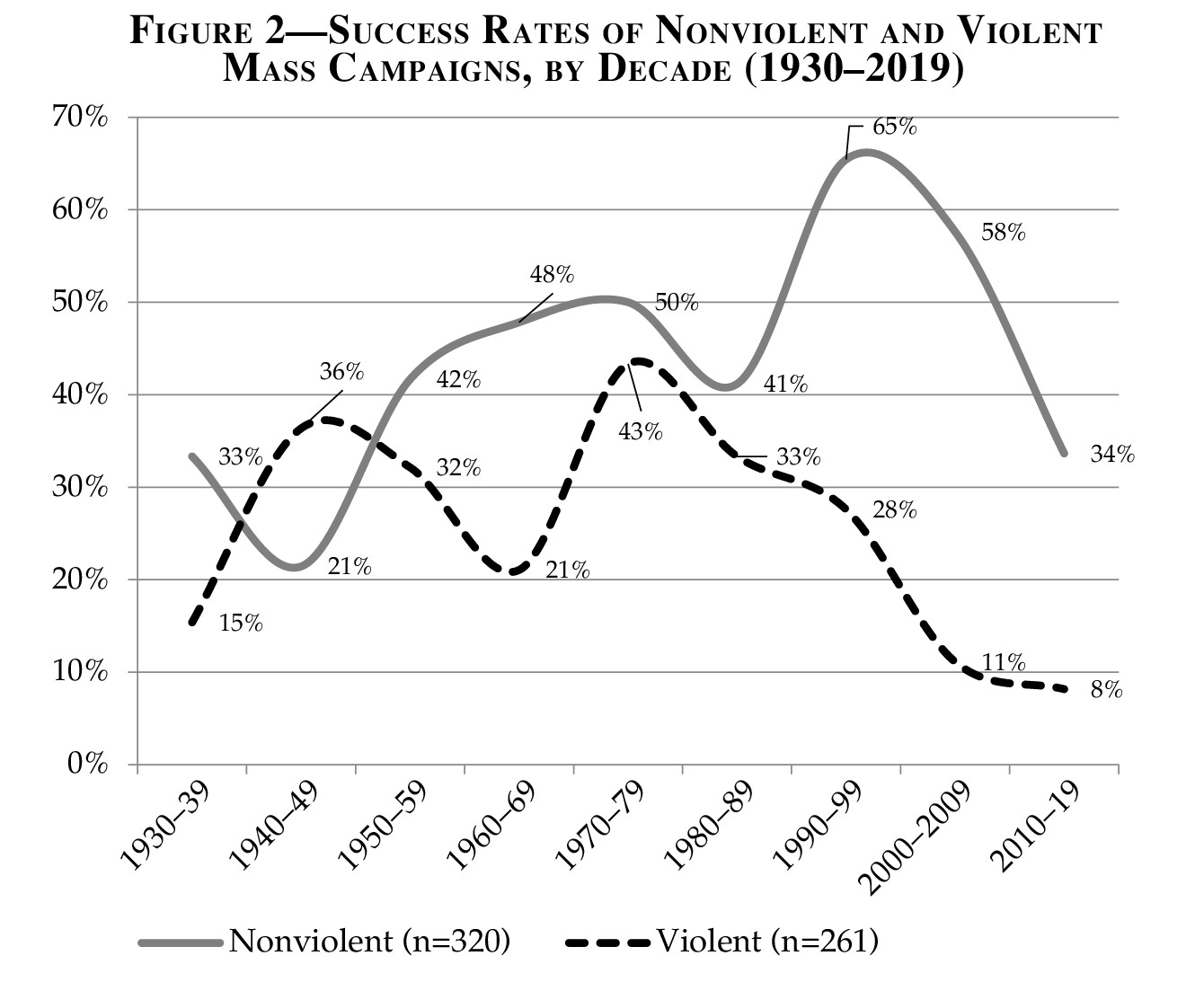
And even more concerning, the chart shows that their success rate has been in decline in recent years. Chenoweth mentions the failure of Bahrain’s democracy movement, which achieved more than 6% participation, and we could add Hong Kong and Israel as additional places where sustained mass movements have failed to withstand or dislodge authoritarians. In a more recent memo posted on Harvard’s Carr Center’s website, Chenoweth also notes that “other factors—momentum, organization, strategic leadership, and sustainability—are likely as important as large-scale participation in achieving movement success and are often precursors to achieving 3.5% participation.”
Nevertheless, despite all these provisos and cautions, I think it’s fair to say that if there’s one strategy that captured the imagination of most grassroots opponents of Trump since the beginning of his second term 18 months ago, it was the effort to build mass protest towards the goal of mobilizing something like 12 million Americans (i.e. 3.5%) in coordinated action. And sadly, that effort has not worked, giving people false hope. In my humble opinion, that’s because we’re counting the wrong thing. What matters is not how many people turn out or even how many localities host actions; what matters is how many well-organized, locally-led groups we have.[1]
The MayDay Strong rallies were the first sign that we weren’t anywhere close to the capacity needed, as I wrote before them and afterwards. And now this coming weekend of “Good Trouble Lives On” protests dedicated to continuing John Lewis’ legacy of fighting for civil and voting rights is another sign of movement weakness. By my count, there are just over 600 rallies scheduled for July 17-19; about three-quarters are under the umbrella of John Lewis Actions, a national group of unclear scope or origin, and the remainder are mostly being hosting by individual Indivisible groups. This is one-third the number of events that happened for MayDay Strong, and one-fifth the number of No Kings 3 rallies. (Barely more than 2,000 people watched the mass call for Good Trouble Lives On that was held last week, another concerning sign.)
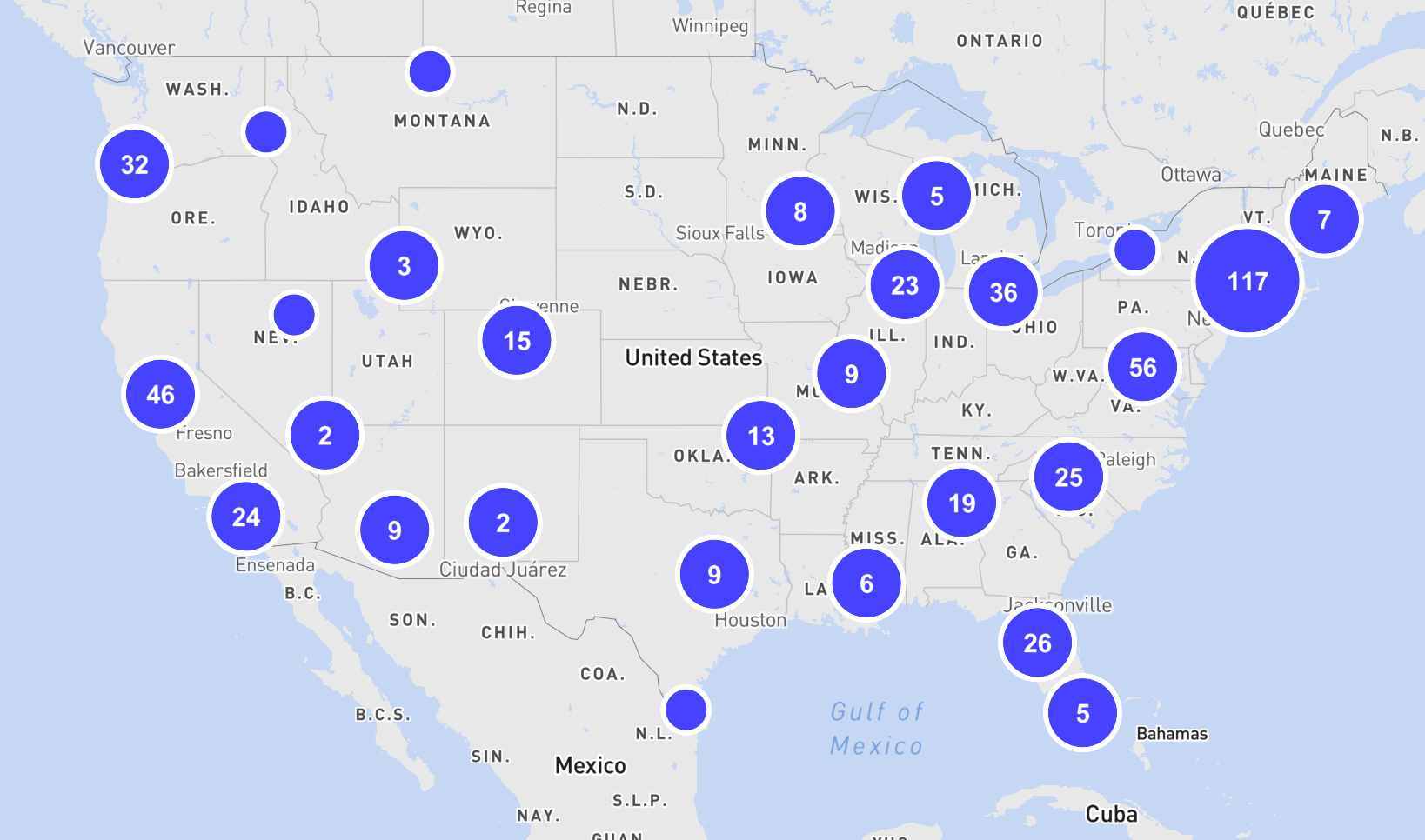
Counting the number of rallies and estimating the number of participants is a pretty poor way of figuring out if we’re putting our time, money and attention where it will do the most use. Furthermore, if fewer people are choosing to organize or attend rallies – a downward trend that we’ve been on since No Kings 3 – then maybe we need to figure out what that is telling us.
Last week, on Rory Truex’s weekly Civic Forum podcast (transcript here), I tried to make this point in conversation with Jess Craven, the movement dervish who writes the daily Chop Wood, Carry Water newsletter. With the November elections just over three months away, I asked, where are the gaps in election protection organizing, as one example. Who is taking responsibility for planning what happens in the top 25 cities where Trump may send ICE to disrupt voting? What fund should people donate to for frontline election defense work? Who are the people offering trainings?
“It’s all in my newsletter,” Craven replied. “I’ve got all that stuff in there every day!” She then mentioned secretive tabletop exercises by “people who don’t want to be known,” Democratic attorneys general “who are sort of scheming,” Democracy Forward’s pro bono legal work, and Indivisible’s “Hands Off Our Vote” program, which was just announced. I felt like we were talking past each other.
I tried again, noting that there’s no significant effort (yet) to organize and train volunteers to do parallel vote tabulation, a very powerful way of generating objective data about vote results that we may very well need if Trump’s thugs impound ballots and then make false claims about election results. And I also noted that while the Indivisible movement was very wide, with roughly 3,000 local groups (a significant rebound from its 2021-24 ebb), most of those groups get no ongoing coaching from movement veterans, leaving their volunteer leaders on their own to figure things out. Paid Indivisible staff dedicated to field organizing in individual states are stretched incredibly thin.
Craven waved me off, arguing this was “a longer-term question” and claiming that “Indivisible does a great deal of trainings for group leaders.” She returned to her mantra of promoting all the stuff that people are doing, like visibility brigades, local visits to their Congress members, protests in front of ICE detention centers, food pantries and the like.
She’s not wrong. A lot of valuable work is being done by locally-led volunteer groups. And I didn’t want to have an argument.
But I’m worried that collectively the pro-democracy movement has not developed the muscles, the structures, or the mentality to keep meeting the moment. Maybe flailing around is a feature, not a bug (god knows past political movements like the Vietnam antiwar movement were unruly messes too). But we seem to be pushing people in many cases to do things that don’t add up, or that allow for one-day bursts of action without much concern for whether they’re building something that can be sustained. This is especially true about the lack of infrastructure and coaching for local organizers. Indivisible has one paid staffer in New York, for example, where we have something like 200 groups. Understandably, she can’t provide individualized attention to any single group in a sustained way. Online trainings and mass calls are not sufficient. And because the national leadership of the movement operates in mostly opaque ways – for example, John Lewis Actions, the sponsor of Good Trouble Lives On, has no named leaders and when I emailed their media department no one replied – it becomes almost impossible to even talk intelligently about where the gaps are and how to help address them.
Not to end on a sour note, I want to uplift this new essay by Neeraj Mehta of the McKnight Foundation in SSIR on “The Gyms on the Corners” that made Minnesota’s response to ICE’s winter occupation of the Twin Cities metro area so powerful. Here are a few key paragraphs:
“Political scientist Hahrie Han argues that people are not born knowing how to be civically active; they learn it through structures and relationships that build that capacity over time. Her research distinguishes between organizations that mobilize, activating existing capacity when a moment demands it, and organizations that organize, building new capacity through sustained relational work. Both are necessary, and neither replaces the other.
Han uses the metaphor of a gym to make this concrete. People do not become strong by wanting to be strong. They need a place to train, equipment, coaches, and other people to work alongside. Civic capacity works the same way. Many of the people who marched in the Twin Cities on January 23, some for the first time, had been in training long before that moment. They had attended meetings at worker centers, volunteered with faith groups, participated in get-out-the-vote drives, or shown up in smaller ways that taught them collective action was possible and meaningful. The gym was already open. They already knew where it was.
Minnesota has invested in those gyms for a long time. By ‘Minnesota,’ I mean a combination of philanthropic funders, state and local government programs, and community-generated resources, each playing different roles at different scales. That investment has supported organizations on street corners, in community centers, and inside small, under-resourced groups that rarely produce outputs fitting neatly into grant reports, including culturally specific and community-rooted organizations that seldom appear in published research. The results of that investment are not always legible in advance. When a moment like January 2026 arrives, they become unmistakable.
Data from the ground reflects how place-based infrastructure functioned under pressure. Food shelf visits across Minnesota dropped 7% in January 2026 compared to the prior year, and by 17% in Ramsey and Hennepin counties, as people became afraid to leave their homes. The organizations that reached those families were the ones that had built trust over years through consistent local presence—they switched to home delivery, made door-to-door calls, and worked through the relationships that government agencies and larger nonprofits could not replicate.
One illustration of how decentralized organizing infrastructure operates in practice: a rapid response network in northern Minnesota began with approximately 30 people in October 2025. By January 2026, after federal agents killed Renee Good, it was filling entire church sanctuaries. Its model is not coordination from a central hub but distributed capacity-building, training people to train others until knowledge is held broadly and locally. The work is difficult to measure precisely because of how it operates. That difficulty is not accidental. It reflects the decentralized nature of the model.”
Minnesota’s population is 5.83 million. 3.5% of that number is 204,050. The highest estimate I’ve seen for the number of people who marched in the Minneapolis general strike of January 23 is 100,000, though most observers say it was closer to 50,000-75,000.[2] The 3.5% rule was not met there, but despite all the pain and suffering the state went through, it’s also fair to say that Minnesotans built enough power to force ICE to reverse course, at least for a time. Nazi cosplayer Greg Bovino was given his retirement papers, and ICE Barbie Kristi Noem was stripped of her job as head of Secretary of Homeland Security and given a diplomatic role of little importance.
Six months later, ICE is still acting with impunity, killing two men--Johan Sebastián Durán Guerrero in Maine and Lorenzo Salgado Araujo in Texas—in just the last week. Neither had any criminal history (as if that would justify these extrajudicial murders). In ICE detention centers, abuses are rampant and unchecked—with at least 52 people dying in them since Trump’s second term began. Calls for protest are rising. But have we grown our capacity to force the Trump administration to back down?
—David Wildstein, “Sherrill administration will suspend enforcement of new data law,” New Jersey Globe, July 10, 2026. Turns out there’s a bit of a contradiction between protecting people’s “sensitive data” and the needs of the political targeting industry.
—Maeve Buckley Anderson, “The Permanent Electorate,” The Hudson Line, July 9, 2026. The Mamdani effect is real: “Enough of the voters who cast their first primary ballots in the 2025 mayoral race returned in 2026 to make clear that New York City’s primary electorate has not snapped back to what it was before Zohran Mamdani won…. A voter who comes back the next year stops being an oddity. They cease to be a data point that flashed once in the voter file during a bout of civically minded delirium. They assert themselves as part of the persistent electorate of this city.”
—Lauren Gepford, “It Wasn’t a Political Earthquake. It Was a Decade of Creating Left Infrastructure,” Inside the Work of Change, June 24, 2026. Her key insight: the Democratic establishment is being caught flat-footed because it spends too much of its time on “tens of thousands of required committee meetings every year, consuming the energy of volunteers who got involved because they wanted to change the world, not run elections for internal party office.” I like her solutions too: reduce elected party positions, increase ways to participate, strengthen party committees while restricting outside money, and most of all create real membership systems and pre-primary processes. Maybe we should go further and replace primaries (which have become all about who raises the most money) with elected delegate conventions?
—It’s good to see that Mayor Mamdani wants to upgrade how NYC uses technology to deliver better services, announcing the formation of a Public Interest Technology Crew (PIT-CREW for short) to build “in-house” solutions, starting with improving how people apply for and get city permits. But the Mayor’s office should heed what Matthew Burton, a long-time good government nerd, has to say about the limits of this approach: “This would be like hiring one of those 24-hour bathroom makeover services for a house with low water pressure and a cracked soil pipe. The team will likely do a great job on the bathroom, and every non-technical outside observer will be initially impressed by their work. But the achievement won’t last. The underlying systems aren’t strong enough to support it.”
—Bookmark this: New_ Public’s Angela Quicksey and Eli Pariser are crowdsourcing a Google doc “reading list” on AI and the Information Environment.
—Bookmark this too: The Higher Ground Institute has revamped its AI Campaign Stack, which is curating more than 50 tools being used by progressive campaigns for things like fundraising, field and communications.
This quote of Senator Lindsey Graham by Richard Fontaine of the Center for a New American Security in The Atlantic may just about explain everything: “When I was first elected to the House,” he recalled, “I looked for the they. They who run things. They who know how things really work. They who know what they are doing. But I couldn’t find the they.” After that, he went on, “I went to the Senate. But there was still no they. And then I started to get invited to the White House, and to closed-door briefings, and to meetings with top officials. No they.” “What I finally realized,” he concluded, “is that there is no they. There is only we, and we usually don’t know what the fuck we’re doing.”
Britain’s most famous racist politician, Nigel Farage, may have met his match.
[1] Here’s longtime progressive political consultant Will Robinson, agreeing: “…the left does not have the infrastructure the right has built. We need permanent, always-on communications and organizing - not operations that spring up during campaigns and disappear the day after Election Day. And it cannot just mean supporting a handful of national groups. We need to build a real progressive organizing ecosystem: local, durable, connected, and capable of communicating year-round. That is where people can go to make change after working on a campaign. And full time organizing gets people healthcare and other benefits. Finally, we need far more training. Campaign staff, activists, and local leaders are too dependent on consultants for basic skills. We should be giving grassroots organizers and super-volunteers the tools they need to build power themselves. With the right training, they can do much of what consultants are paid to do - and in areas like digital organizing and local communications, they can often do it better because they know the community, the relationships, and the people. The goal should not be to make campaigns more dependent on consultants. It should be to make communities more powerful.
[2] Polling after the fact found that one in four Minnesotans either stayed home from work that day or know a relative who did, but I would take that finding with a giant grain of salt—a reflection of an aspiration akin to the Indivisible poll from the first week of April that found that a whopping 7% of registered voters claimed they had participated in the March 28 No Kings 3 rallies. If that had indeed happened, sure Trump would already be gone, right?
No posts
Comments
Nothing yet. Say the first thing.
Sign in to join the conversation.