
“Modern democracy is unthinkable save in terms of the parties.” So wrote E.E. Schattschneider, one of the most influential political scientists of the 20th century. And like it or not, political parties are essential building blocks for democracy. They do things that individual voters simply can’t do on their own: develop shared programs around common values, recruit and train candidates, signal which candidates hold those common values, and, when in power, try to enact shared policy priorities that voters can hold them to. When parties are weak, democracy is weak. And we have a word for countries that have only one party: dictatorship.
Mass political participation without strong party organization is the defining condition of our time, a point made cogently by Belgian historian Anton Jäger. In Hyperpolitics: Extreme Politicization without Political Consequences, Jager’s 2026 book, he blames the deinstitutionalization of political life for the evident failure of today’s mass protest movements to create lasting change. Without strong parties, or other membership organizations like unions, churches and civic clubs, protest doesn’t get converted into power, it dissipates. And so, we flail away, wondering why for all our struggle and effort, we simply seem to be mainly treading water. It’s our big disconnect.
The political media doesn’t cover this story, because it’s nowhere near as sexy and compelling as the story of the individual candidate on their hero’s journey, or the story of one imaginary team (aka party faction) as it purportedly challenges another team. The media’s need for simple narrative frames—something Paul Ford called “The Epiphanator” years ago—keeps it focused on these surface manifestations. And political consumers brought up on a diet of horse-race stories and polling updates can hardly be blamed for not realizing how their attention is being misdirected.[1]
But if you ignore the health of the political parties, and most specifically that of the party that you identify with in the state where you live, you will forever be flummoxed by how little progress you make on whatever cause you care about. Parties, even more than other membership organizations, movements or advocacy groups, are where votes get turned into real power. What they do, or don’t do, to grow and sustain the support they have from voters, is integral to what they can get done. Thus, any attempt to demystify and, forgive me, sex up the importance of party-building must be saluted. All of this is to say: Bravo to Ben Wikler, the state chair of the Wisconsin Democratic Party from 2019 to 2025, for making the case for robust party-building so clearly in his new book, This is the Plan: How to End America’s Meltdown and Save Democracy.
Not only that, it’s a fun book to read. Wikler writes about politics as if Ted Lasso were sitting at his shoulder, suggesting lines. The book is chock-a-block with wonky jokes and earnest writing like this: “If only there was some kind of institution tasked with working on all the elections taking place in a particular place, year after year. Where volunteers could get involved in all the different battles and get to know each other and perhaps eventually get married and have volunteers of their own. It sounds fun, right? Almost like…like a party. The party. The Party.”

I should say from the start that though I have known Ben casually since 2007, when he was working for Avaaz, and then at Change.org, and then at MoveOn.org, and helped him organize a memorial service for our mutual friend Aaron Swartz at Cooper Union back in 2013, and was an early supporter of his radio program The Flaming Sword of Justice, we aren’t particularly close. I’ve watched his career take off mostly from afar, or through a few mutual friends. Like everyone else who pays attention to Democratic Party politics, I’ve heard plenty about how in recent years the Wisconsin party was one of the few bright spots, where party leaders and organizers were “doing things right.” But as readers of The Connector must know by now, I’m skeptical by nature. If something sounds too good to be true, maybe it isn’t.
So, I’ll admit, I came to read This is the Plan with a bit of a gimlet eye. Ben has been on a national book tour that has been largely laudatory. Some of what he is talking about, both in those appearances and in the book, is beyond the scope of this review: things like how to fix the Supreme Court, why to abolish the filibuster, and the like—big, medium-term goals that we will have to wrestle with in 2028 and beyond. But his central claim has been this: “In addition to being a civic organization and a bank account, a party can be a third thing: a permanent campaign….A strong party can change politics.” [My emphasis.] Even more, he asserts that thanks to his work and that of many colleagues in the Wisconsin Democratic Party, there is now, as he told Politico last month, “a network of neighbor-to-neighbor organizers in every community in Wisconsin, in every county, in every small town, in every big city and suburb that are going to be ready to go” to propel its candidates to victory in the fall.
That’s a big, even audacious, and very checkable claim. And yet, in none of the coverage of Ben’s book have I seen anyone try to verify it. So I did. And I’d say it’s probably 80-90% true. Or true enough. And we should be impressed, though the story of how this has been built and maintained is complicated.
First, the publicly available data from WisDems’ Mobilize.us account as well as state campaign finance disclosure reports shows that, as I noted a few months back, the state party is genuinely invested in a lot of grass-roots community organizing and county-level party-building. As of yesterday, August 18, WisDems listed 546 upcoming in-person events on Mobilize, with just under half described as a canvass, followed by meetings (18%) and community events (10%). Geographically, these aren’t quite “in every county,” as Ben claimed to Politico, but they’re in 55 of the state’s 72 counties (76%). Of the ones that lack events, several are among the state’s smallest counties by population, and several recently had events but don’t have anything fresh listed coming up. (Also, about 20% of all the upcoming events didn’t give clear enough location information, so it’s possible we’re undercounting all the counties covered.)
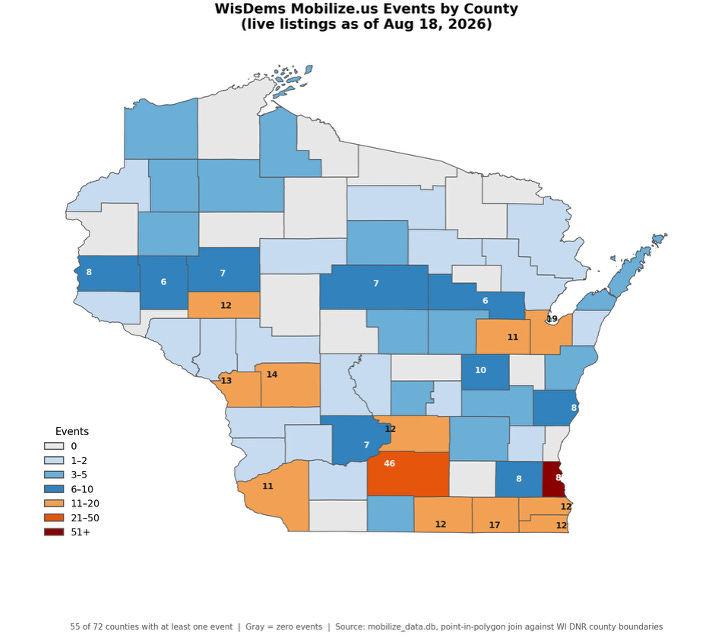
Many of these WisDems events are taking place in recurring local hubs. Mobilize lists 57 locations that have listed two or more events, of which 17 are explicitly named county-party offices, with the rest split between university student unions and other community venues. We need more of these kinds of places—if every campaign that temporarily rents a grimy, empty storefront to host its field effort instead poured that money into the annual rental costs of a dedicated party or community clubhouse, imagine how different local politics might feel. (Ping me if you want to work on this idea.)
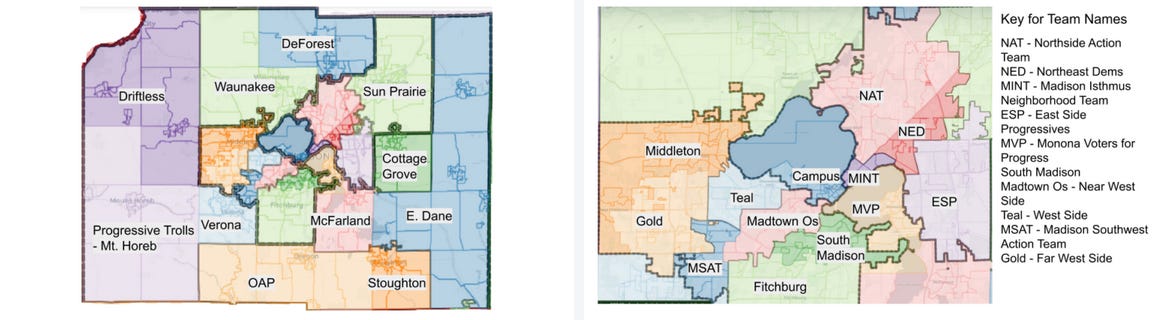
That’s not the only evidence for Ben’s claim about WisDems’ local organizing. In addition to subsidizing county-party office rents, the party also supports about two hundred fifty “neighborhood action teams” that are made up of local volunteers who not only lead canvassing around election time but also do voter education, issue advocacy, candidate forums, persuasion canvasses and more—year-round. Though Ben doesn’t say so in his book, some of these teams date themselves all the way back to the 2008 presidential election, when they started out as Obama organizing hubs. (The one he joined when he moved back to Wisconsin from Washington DC, the Madtown Os, was originally named that way for its Obama connection.) So it turns out OFA didn’t die out everywhere!
This coverage map for Madison shows what a well-organized hothouse of local Democratic activism can look like:
This is not to say that quality of local, grassroots organizing supported by WisDems across the state is as fulsome as the quantity. One contact of mine in a rural part of the state who serves on their county party’s executive committee and asked to remain anonymous wasn’t impressed. They told me, “We get two things from the state party: a few hundred bucks/month toward our office space and an organizer who’s stretched across a huge region and is generally unresponsive to our requests.” They added, “For example, he refuses to cut turf as requested by our volunteer leaders (who’ve been canvassing the community for years, while he’s a transplant who’s been here less than a year). The WisDems organizer is also generally unwilling to support organizing efforts outside the single largest city in our county.”
Another friend who volunteers with a different county’s party, also in a predominantly rural part of the state, said he believed that it was “better organized and better financed this year than in past years, but I think most of that is due to local people stepping up more.” He said that before 2024, this county party “went for years without having their own website, and this is the first year we’ve been able to afford a local office that stays open year-round.” He also complained about the state party’s heavy reliance on NGPVAN for canvassing lists—but as Connector readers know well, that problem is universal and scarcely close to being fixed.
Frankly, it’s hard to judge how well local WisDems groupings do as organizing hubs without more resources than this one-person newsletter. Anecdotal reports are just that. Compared to other Democratic state parties, though, the WisDems still stand out from the pack. Any legal resident 14 or older can become a dues-paying card-carrying member complete with voting privileges in party affairs; 70 of the 72 county parties list contact info for their chairs and hold regular meetings, and the party also has several membership caucuses that bring together likeminded people across the state across common identities. Not only do county parties hold annual conventions, so do some congressional districts.
In both absolute and per-capita terms, the WisDems outclass nearly every other state party for how much it has going on. My analysis of Mobilize event data shows it ahead of every other state, with only Alaska – where the Senate race is a top priority for national Democrats – climbing ahead on the leaderboard at a similar pace of upcoming events. The two charts below show the number of total Mobilize events by party account and per million residents.
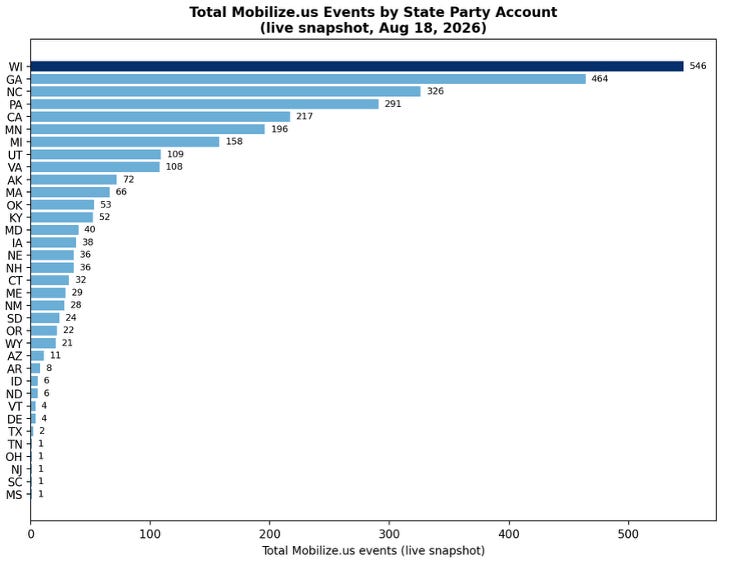
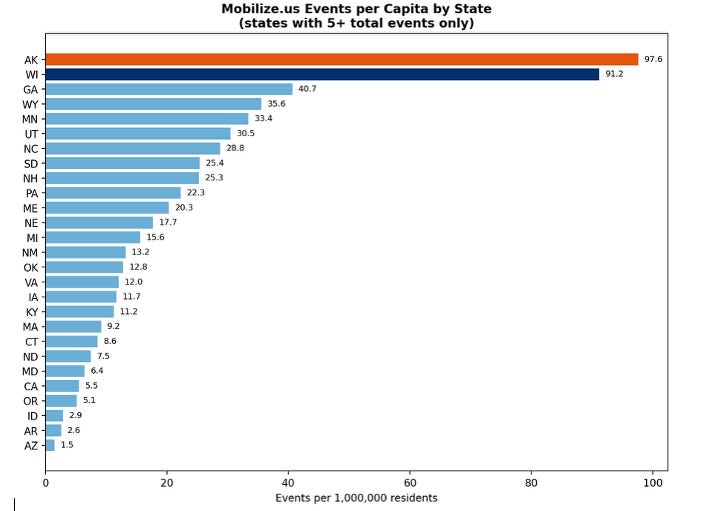
One thing this analysis also reveals: a damning number of state Democratic parties are more like insider clubs than organizing machines. The Democratic parties of Washington, DC, Florida, Indiana, Missouri, Montana, New York, Washington, and West Virginia all have Mobilize accounts but show zero upcoming events. Texas, Tennessee, Ohio, New Jersey, South Carolina, and Mississippi all list between one and three events. And Alabama, Colorado, Hawaii, Illinois, Kansas, Louisiana, Nevada, and Rhode Island aren’t on Mobilize at all. This doesn’t mean these state parties and their county affiliates are dormant—but it does mean they aren’t bothering to make it super-easy for interested residents to find their way to them. (This is a best-effort name search, not an authoritative registry — some states may run official field programs under names this search didn’t catch, which would understate their totals.)
One of the things that makes This is the Plan an invaluable document for today is how Ben uses the Wisconsin experience of the last 16 years as a template for pro-democracy activists everywhere. The MAGA backlash and authoritarian power-grab came to Wisconsin starting in 2010, after all, when Republican Scott Walker won the governorship and began going after key pillars of Democratic power in the state—attacking labor unions’ to organize, undermining access to the ballot for college students and Black voters, and gerrymandering the hell out of state legislative districts. And the Democratic resurgence that Ben is arguing for spreading across the country started really gaining momentum in Wisconsin after the 2018 elections, when his predecessor as party chair, Martha Laning, decided to start building up its grassroots organizing work.
“In the aftermath of Trump’s victory [in 2016],” he writes, “Chair Laning launched what would be a brilliant innovation: What if, instead of building neighborhood teams dedicated to a single candidate, you built them to help every candidate—through the party itself? And then supported and expanded those teams year round?” According to This is the Plan, WisDems knocked on twice as many doors in 2018 as they did in 2016, at half the cost in staff and supplies. Not coincidentally, in 2018, Democrat Tony Evers swept into the governor’s office by what Ben jokes was “a landslide” of 1.1% and the turnaround began. That’s because the WisDems adopted Laning’s core philosophy, as Ben’s cites her saying: “A candidate is like a car. The party builds the roads on which candidates drive.”
But there’s one more crucial ingredient to the story: Money, lots of it.
In 2015, the Wisconsin GOP revised the state’s campaign finance laws, making it legal, Ben writes, for “an infinitely wealthy donor” to “give infinity dollars to a state party (say, the Wisconsin GOP), and the party could transfer infinity dollars to a candidate (say, Scott Walker). We took to calling this the ‘Scott Walker loophole.’”
Ben was elected state party chair in June 2019. At the time the party had a full-time staff of 23, of which half were part of the year-round organizing program launched by Laning. And he immediately set to work fundraising. In his first three months, he raised more than a million dollars. In the next three months, more than twice that. And in 2020, with tremendous national attention on several WI election fights, ten times that. Which he writes, enabled the state party to quadruple its paid staff.
To his credit, Ben doesn’t deny how much this infusion of money has mattered. Nor does his dance around how hard it is for most state party chairs to raise the kind of money he did in Wisconsin. As he writes, while the WisDems are very interested as a party in including and involving ordinary residents as members, what makes state Democratic parties different from other sorts of civic clubs is that they have “a very unusual type of bank account.” Not only that, most of the time, what drives money into that bank account are candidates running for high level office, since the limits on what people can give to federal candidates are more stringent. But that kind of fundraising – where candidates ask their wealthiest donors to give more to their state party—comes with obvious strings: the money is supposed to be spent on their behalf. “When a party leader doesn’t take the hint, campaigns stop raising money for the party,” Ben writes. “That generally leads to the party leader losing their reelection bid and being replaced by a hint taker.”
But in his case, things were a bit different. “Remember the Scott Walker loophole?” he writes at one point. “Well, we drove a truck through it.” (141) In This is the Plan, Ben mainly describes his efforts to motivate small donors to help support WisDems’ party-building work, citing triumphs like a mass Zoom attended by 100,000 people during the height of the Covid lockdown, when most of the case of The Princess Bride appeared to reenact scenes from the movie. That event alone raised $4.25 million, Ben writes. He adds, “I view our approach as building a form of party-based public financing for Democratic candidates in Wisconsin.”
Well, sort of. Because a glance at the Wisconsin campaign finance transparency website shows that of the $136.1 million that the state party has raised into its state bank account since 2018, $48.7 million of that came from just nine billionaires: Reid Hoffman, Karla Jurvetson, J.B. Pritzker (governor of Illinois), George Soros, Sage Weil, Lynn Schusterman, Robert Price, Lynde Uihlein (a scion of the Wisconsin Republican clan who leans the other way), and Robert Rubin. In 2024, those nine gave almost 40% of the total the state party raised to its state account, and while the party’s fundraising overall is lower this cycle, that charmed group of nine is still amounting more than 37% of its haul so far. Only two of them live in state.
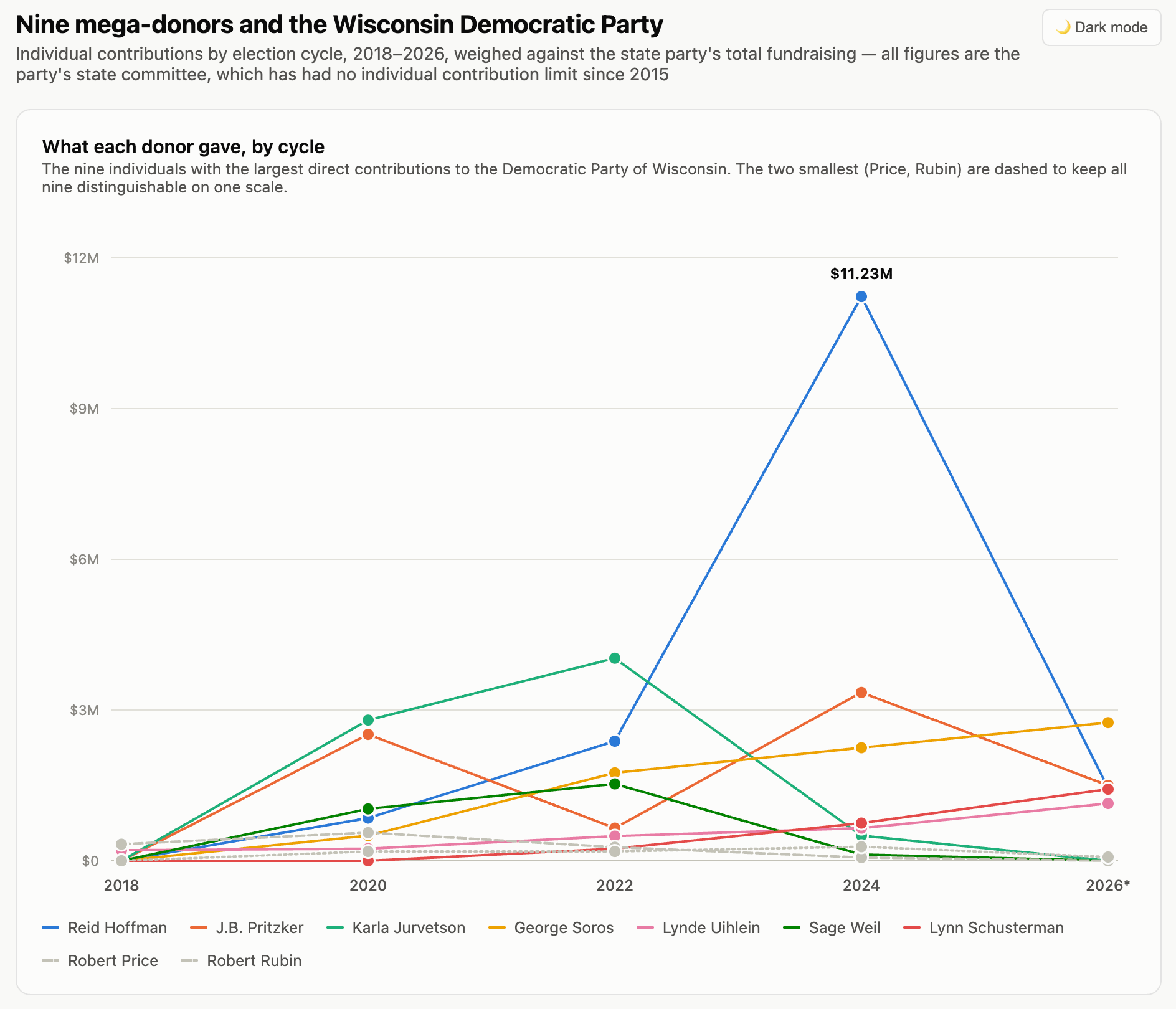
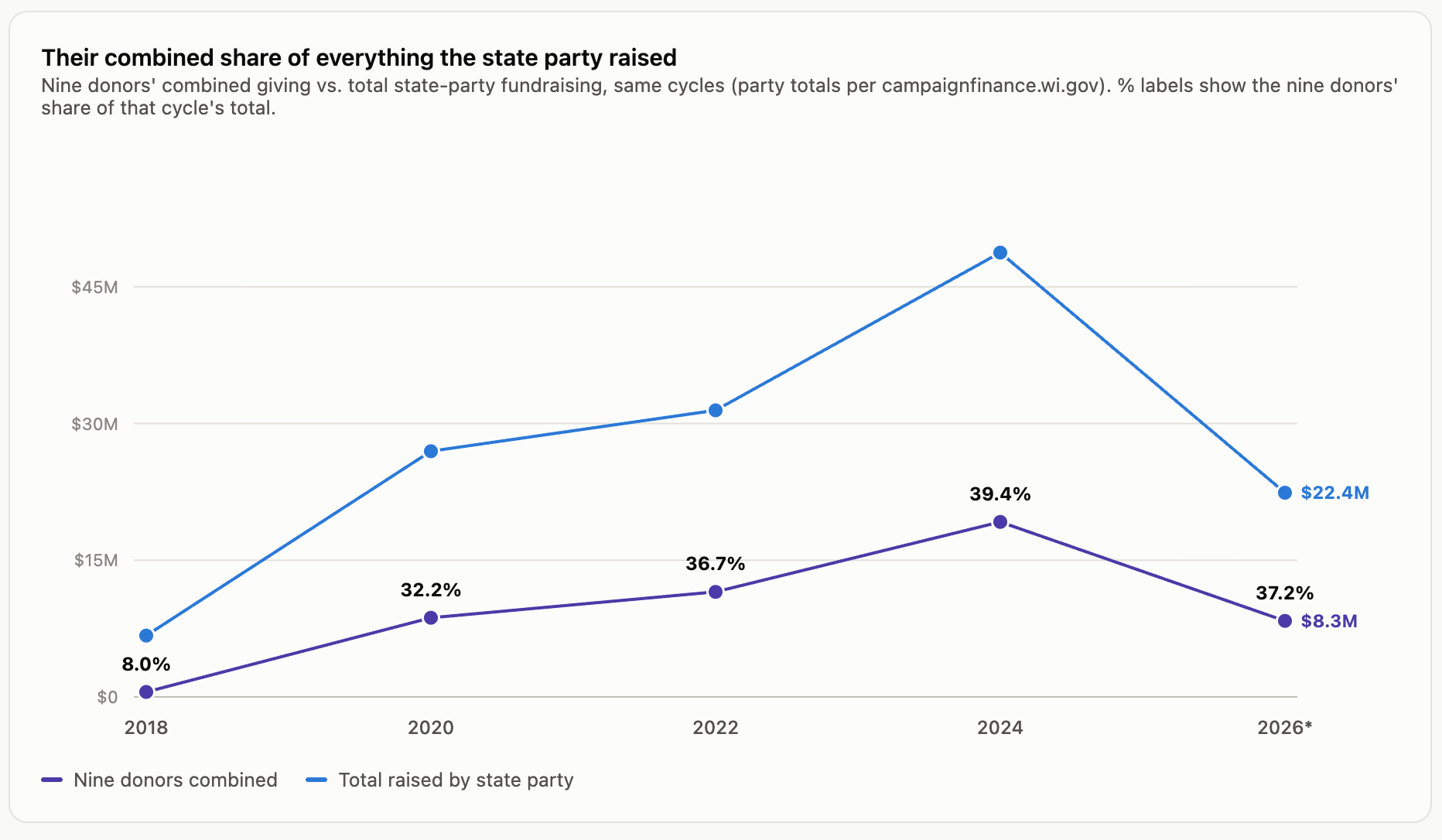
In the post-Citizens United world, where Republican billionaires outnumber Democratic billionaires, and one quasi-trillionaire has personally put up hundreds of millions to back GOP candidates, you can’t really fault the WisDems for hoovering up every dollar they can find. But the state party’s reliance on Democratic-leaning billionaires to fund so much of its operations makes Ben’s argument a little shakier. After all, he who pays the money calls the tune. There’s no way around this problem but genuine public financing for political parties (in exchange for them abiding by contribution limits), and that conversation has barely begun. See Lee Drutman’s essay, “Campaign finance reform for a multiparty America,” for a start.
As we slouch towards the elections of 2026 and 2028 and begin to glimpse the possibility of a democracy renewed and strengthened, This is a Plan leaves a critical challenge unresolved. Along with all the other changes to the political process that we desperately need—proportional representation for House elections, fusion voting for Senate seats and other single-office seats, an expanded Supreme Court, statehood for DC, universal voting—if we want a stronger democracy, we also need our political parties to be stronger. One engine for that change can be the dynamic that has played out in Wisconsin, where a harsh Republican takeover led to a fierce Democratic response—albeit built on a mix of grassroots organizing and billionaire largesse. Another engine could be more competition from upstart parties, which could rouse some of the more complacent state branches of the Democratic Party to wake up. But none of this will happen without organized people and committed, visionary leaders. Wisconsin in recent years has been blessed with both, enough to offer the rest of us a model.
—Make time to read both parts of Adam Bonica’s new investigation into Democratic scam PAC, the data story itself which is damning for how much senior abuse it documents, and the backstory of how the DSCC and DCCC intimidated The New York Times into not publishing his investigation (after soliciting it and factchecking it), and then how Mothership Strategies and the Progressive Turnout Project did the same to the Bulwark, which had considered publishing it after the Times rejected it. You’d think that a party that prides itself on fighting to defend the most vulnerable would be addressing the serious abuses Bonica has unearthed, but instead there’s been a deafening silence from Democratic Party electeds and officials (as well as the national press corps) since he posted his reports at the beginning of this week.
—Food for thought for organizers: Garrett Bucks, “Our political movements should be better at organizing than the average megachurch,” The White Pages, August 5, 2026. Very practical comparison between how a typical megachurch welcomes newcomers vs a local Indivisible or DSA chapter.
[1] The current wave of stories about some kind of gigantic struggle between “the left” and “the center” or “progressives” and “moderates” inside the Democratic Party is just one recent example of how the media overlays a simple narrative over a much more complex phenomenon. To me, the much more significant story of this primary season is the big surge of Democratic turnout compared to 2018, the last big Blue Wave year: up 122% in Texas, up 95% in Georgia, up 72% in Maine, up 48% in Wisconsin, up 32% in Michigan. (It’s also up in some Republican primaries, most notably Iowa, Georgia and Texas but generally not as much.)
No posts
Comments
Nothing yet. Say the first thing.
Sign in to join the conversation.