
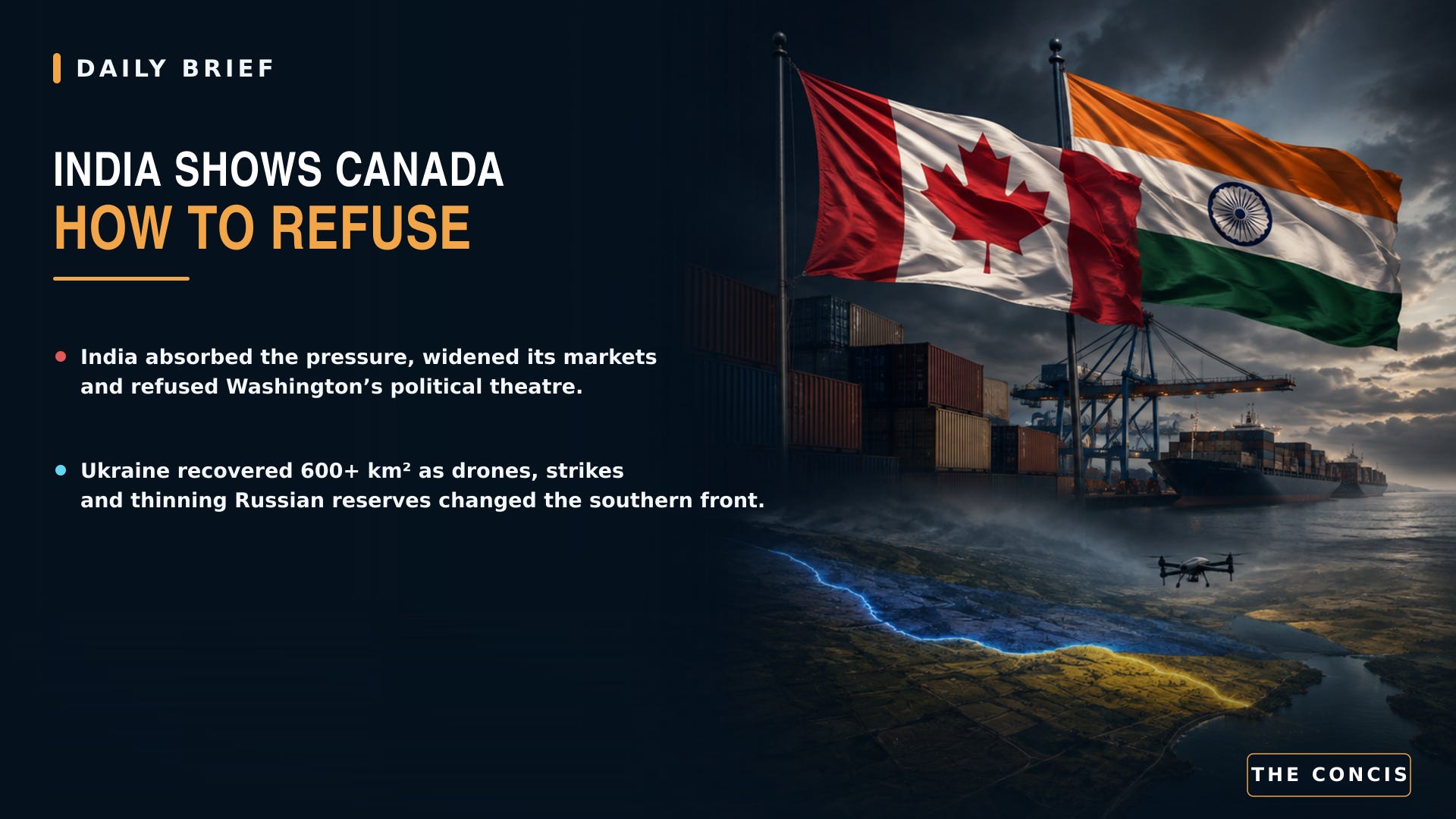
On Friday, August 14, during a press gaggle in Des Moines, U.S. Trade Representative Jamieson Greer said:
“If a country retaliates against us, we’re obviously not going to tolerate that. We’ll take action.”
Greer went further. He compared Canada’s countermeasures to “the kind of things that China would do” and said those measures would have to be resolved before Canada could avoid the next round of American tariffs.
Look closely at the opening clause: “If a country retaliates against us.”
What exactly is the message?
When Washington applies pressure, imposes tariffs and breaks agreements, the other country is expected to accept it. If it wants those tariffs removed, Washington will provide a list of concessions it must make. But if that country responds to American pressure with pressure of its own, the United States “will not tolerate that.”
Canada retaliated because the Trump administration imposed tariffs on products covered by an agreement the United States itself had signed.
The doctrine Greer articulated is therefore brutally simple: Canada is not allowed to challenge the contractual breach, and it is not allowed to respond to it. If Canada does respond, the administration compares it to China and threatens further punishment.
But Canada is not the only country against which this administration has attempted an elaborate tariff manoeuvre.
There was also India.
And there is a great deal that Canada—and countries around the world—can study in what India did, how it did it and what followed.
Bloomberg later reported that, in early September 2025, shortly after Modi met Vladimir Putin and Xi Jinping in China, National Security Adviser Ajit Doval travelled to Washington and delivered a blunt message to Secretary of State Marco Rubio: India would not be bullied by Donald Trump or his senior officials, and New Delhi was prepared to wait out Trump’s term.
In January 2026, Howard Lutnick said Washington had told New Delhi that Modi needed to call Trump to complete the proposed trade agreement.
“It’s all set up and you have got to have Modi call the President,” Lutnick said. “So Modi didn’t call.”
Consider what Lutnick was admitting. The Trump Oligarch Administration had imposed tariffs on India for buying Russian oil. During the first five months of 2025, meanwhile, the United States imported more than $596 million worth of enriched uranium from Russia under the waiver system permitted by American law.
Washington then told the Indian government that its prime minister had to call Trump to get the proposed trade agreement over the line.
Modi did not make the call.
He did not personally appeal to Trump to remove the tariffs. He did not provide the display of submission Washington was apparently demanding.
India also continued building alternatives. It signed a trade agreement with the United Kingdom in July 2025. Its agreement with the European Free Trade Association entered into force that October. In January 2026, India and the European Union concluded negotiations on an enormous free-trade agreement.
With the United States, the two governments announced an interim trade framework in February 2026. Six months later, the formal bilateral trade agreement still has not been signed. India did not isolate itself. It expanded its options, absorbed the pressure and refused to negotiate on a political stage constructed by the Trump administration.
Canada’s position is more difficult. In 2025, 71.7% of Canadian merchandise exports went to the United States. That concentration gives American tariffs an outsized ability to damage Canadian growth, employment and investment.
It also explains why the pressure feels so deliberately targeted. Washington has identified Canada’s principal economic vulnerability and is attempting to turn that dependence into political leverage.
But backing down will not remove the vulnerability. It will merely prove that exploiting it works.
Today, the pressure may involve one set of tariffs and demands. Tomorrow, it will involve another industry, another concession or another political objective. That is how coercion operates: identify the dependency, apply pressure and treat every concession as evidence that the tactic can be used again.
Canada cannot reproduce India’s strategy overnight. Its economic integration with the United States is far deeper. But the underlying principle remains the same: absorb the immediate pressure, expand alternative markets, build the infrastructure needed to reach them and steadily reduce the other country’s ability to inflict economic pain.
A version of the Indian model remains the best path forward—not because it is painless, but because the alternative is permanent vulnerability.
Some of the groundwork was laid by a pair of glorious Kremlin own goals.
In February, Ukraine and SpaceX disabled thousands of unauthorized Starlink terminals that Russian forces had incorporated into their battlefield communications. Russian units had been using them to coordinate movements, direct drones and communicate across areas where conventional networks were unreliable or easily jammed.
Then the Kremlin restricted Telegram—the platform many of those same frontline units used to exchange battlefield information.
Russia had allowed its military to become dependent on an American satellite network and then disrupted one of the principal applications its soldiers were using to compensate for losing it. Command links fractured. Drone and artillery coordination deteriorated. Russian assaults slowed.
The disruption landed just as Ukraine’s counterattack was beginning. During the first five days following the Starlink cutoff, Ukrainian forces reportedly recovered more than 200 square kilometres. By early April, Ukraine said it had regained approximately 480 square kilometres across several southeastern and eastern sectors—not all of it within the Oleksandrivka operation.
But this was never simply a matter of advancing across open ground.
Ukraine spent months dismantling the system supporting Russia’s southern positions. Intermediate-range drones and missiles struck command posts, air-defence systems, railway infrastructure, ammunition depots and fuel facilities. Ukraine gradually established a tactical drone advantage over sections of southern Ukraine while pushing its strike envelope across occupied territory, Crimea and the Sea of Azov.
That campaign most recently reached Novorossiysk. A large combined drone-and-missile assault hit Russia’s Black Sea naval base, where Ukraine said it damaged two frigates, a large landing ship, a corvette and other vessels. Two major grain terminals stopped operating. Two days later, crude loadings were suspended at the Sheskharis terminal, Russia’s principal Black Sea oil-export facility, which normally handles approximately 700,000 barrels per day.
While Ukraine was compressing Russia’s southern logistics from the rear, it was also eating into the grey zones along the front.
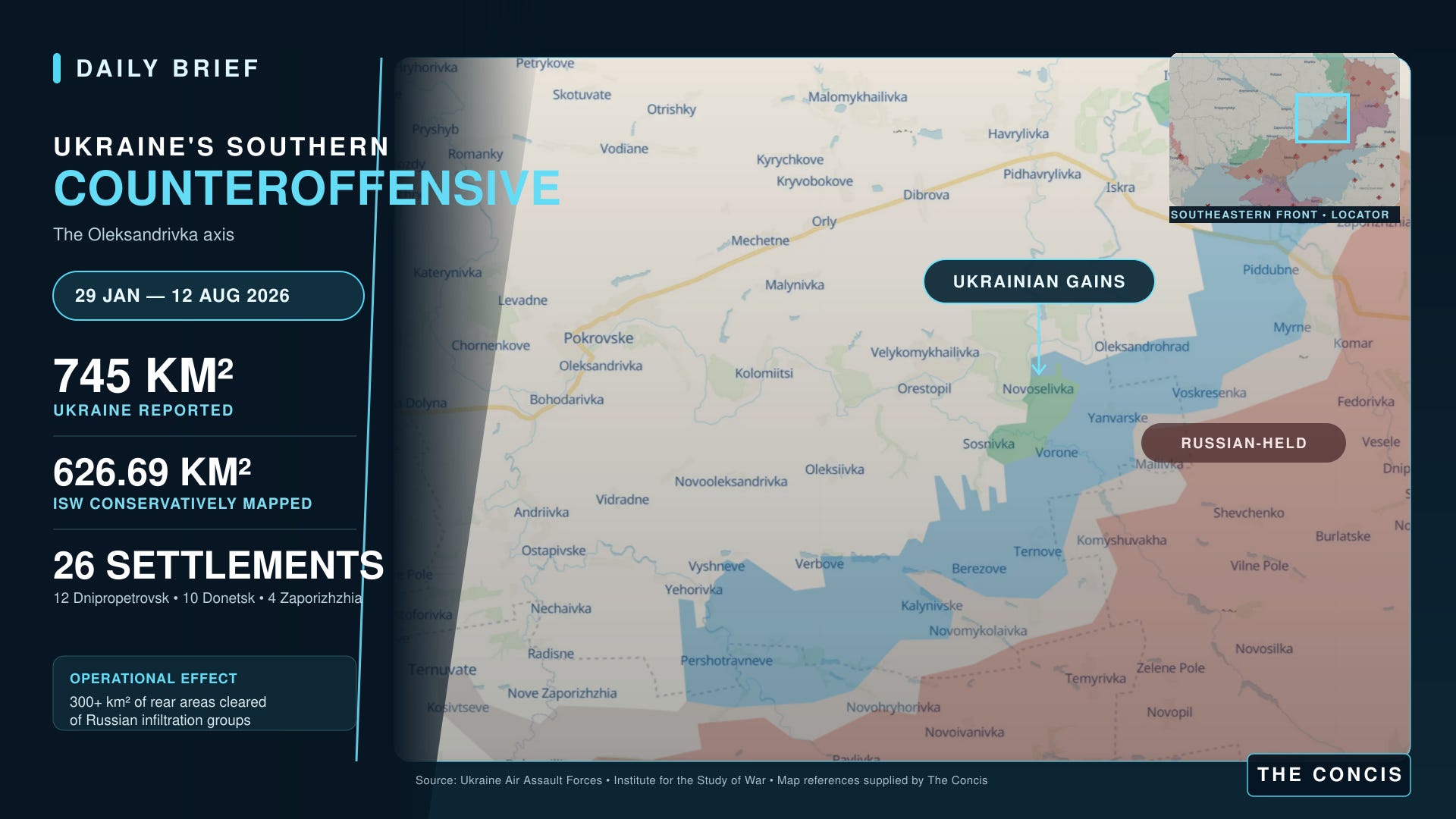
A few days ago, Ukraine announced that its months-long operation on the southern front had liberated 26 settlements: 12 in Dnipropetrovsk, ten in Donetsk and four in Zaporizhzhia. Ukrainian forces also cleared more than 300 square kilometres of rear territory where small Russian groups had infiltrated without establishing secure control.
Ukraine places the total territorial recovery at 745 square kilometres. Approximately 400 square kilometres were recovered during the operation’s first phase, from January 29 to May 4, most of which unfolded after the February 1 Starlink disruption. The second phase began on May 5 and brought the cumulative total to 745 square kilometres by August 12.
ISW separately mapped approximately 627 square kilometres across the Oleksandrivka direction and northern Huliaipole. Its geographical accounting is not identical to Ukraine’s, but ISW says its conservative methodology probably underestimates the Ukrainian advance.
All of this was happening while Russia continued absorbing approximately 30,000 casualties every month. Recruitment has been declining, leaving the Russian command with less room to replace losses, rebuild damaged formations and maintain reserves behind every threatened section of the front.
That pressure has now produced the result Ukraine was seeking.
A Russian military channel says Moscow withdrew troops from attacked sections of Dnipropetrovsk Oblast after transferring available reserves toward the Donetsk offensive. It blamed the Russian General Staff and the Vostok grouping for failing to accumulate enough manpower to stabilize both sectors.
The details remain incomplete, but the military logic fits what has appeared on the ground.
What happens when Ukraine presses two weak points and Russia no longer has enough uncommitted troops to stabilize both? Moscow has to choose. It reinforces the axis it considers most important—and allows the other one to give way.
That is what appears to have happened along the Oleksandrivka front.
I understand why this can sound confusing. Our minds tend to imagine territorial recovery as one large counterattack—a concentrated assault that breaks the Russian line and sends troops surging forward. But large sections of the southern front are grey zones: territory where neither side has established secure control. Russian troops hold positions on one side; Ukrainian forces hold the other.
Throughout this year, Ukraine has been steadily moving into those grey zones, clearing Russian infiltration groups, securing new positions and forcing the effective Russian front line backwards.
The map is not changing through one spectacular attack. It is changing through steady corrosion—one position, one settlement and one grey zone at a time.
The Concis still has fewer than 13,000 subscribers. That is a meaningful audience, but it is not yet large enough to make this work independent of algorithmic distribution. Platforms can reduce a story’s reach overnight, regardless of its importance or the work behind it. Building a direct relationship with readers is the only durable answer.
Every free subscription helps these stories travel farther. Every paid subscription helps finance the reporting, research and analysis required to produce them. Paid subscribers receive complete access to our PRO series, in-depth reports and concrete recommendations for NATO and allied governments.
If this work is useful to you, subscribe for free. If you want to help strengthen the desk behind it, become a paid subscriber.
No posts
Comments
Nothing yet. Say the first thing.
Sign in to join the conversation.