
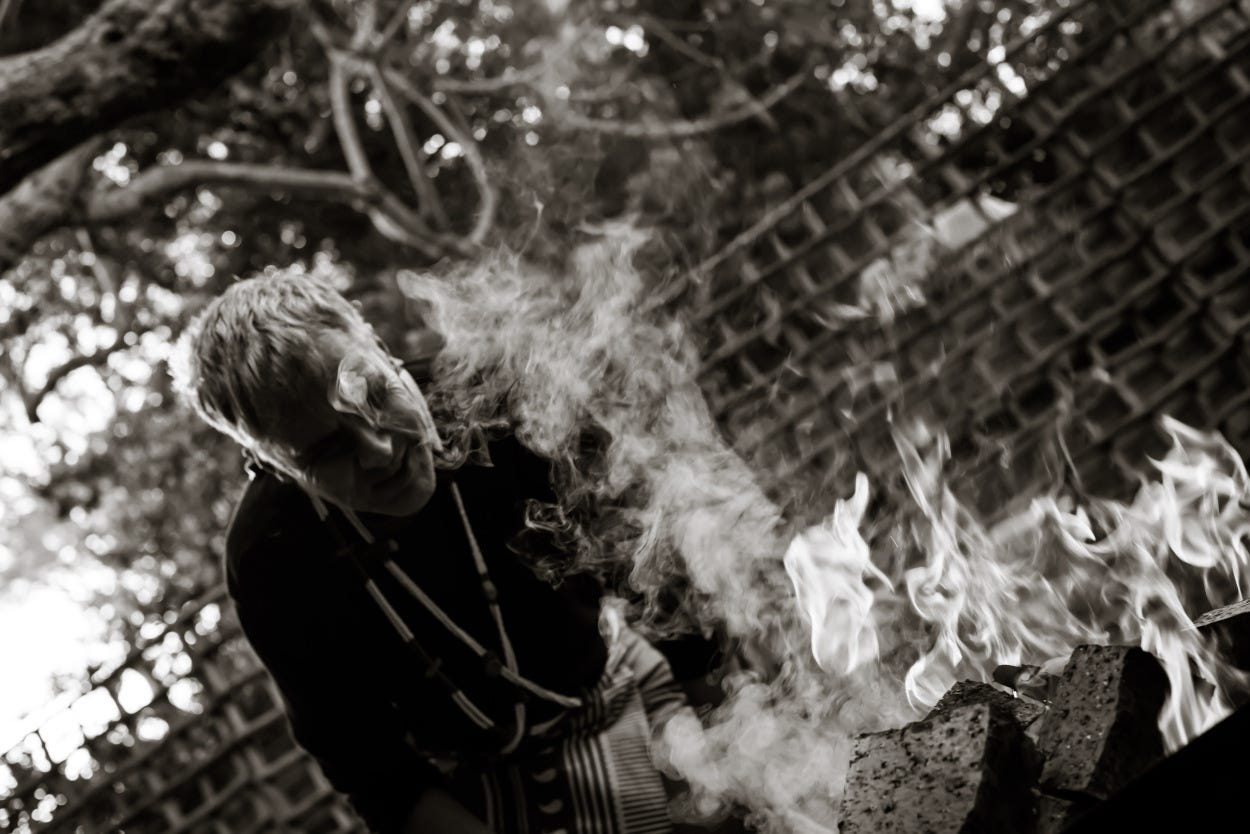
I am sitting in a circle, holding space for Colin Campbell, a Sangoma ‘medicine man’ from Botswana. He has asked everyone to turn over a card, an animal card, from a range of exotic animals found in his country of birth, the pangolin, the lion, the vulture. These are divination cards and form part of a tradition for which he is an elder and lineage holder. Many of these animals can also be found in the jennet-skin bag he carries with him, which contains the hard-won bones of his trade. These are ‘ditaola’, and he is what we might here in western slang call a ‘bone reader’ or diviner. He uses a method of speaking with the ancestors, by throwing animal bones onto a mat and then translating their messages through one of hundreds of poems that these configurations invoke.
I have seen him throw the bones often, and each time I feel a rush of excitement for what the ancestors will say about the question we ask, carefully crafted to leave no room for doubt about our meaning. Often this question, whether we are asking it as a group or for ourselves, is along the lines of … ‘what should be my stance’ … in whatever situation concerns us. The answers in poetic form, use natural metaphors like the patterns of weather, the direction of the wind, the beginning of rains, or perhaps the behaviour of animals and what they immediately bring forward in the minds of the land-based traditional people of Botswana. They take some translation for us here in South West England, having no knowledge of experiences that come from another land, another people, another time.
Colin is the bridge. Only through him can we understand what the ancestors are telling us through the bones, whether they are the ancestors of his people or ours, whether they are those buried in this soil on which we sit, whether they are the birds, the mountains, the rivers, or if perhaps we go far enough back, they all coincide. But the answers never fail. People come from all over the world for a reading with Colin, one of the few bone readers of his kind. For him the divinatory poems are all related to the ‘primary text of nature’, a phrase he has borrowed from Thomas Berry to describe nature as the script in which the lore of all things is written. We can come to read this primary text ourselves, each one of us, by being in relationship with our other-than-human kin, with the land, with our places, something the co-creators of these ancient poems would undoubtedly have been.
So much of this ancient tradition and the observations of nature on which it is based has been decimated in Colin’s lifetime. The herds of migrating animals gone as the land was fenced, the rites of passage, the stories, the knowledge and community practices decimated in the face of development, even the weather is changing. His quest, born out of grief for what has been lost, is what brings him to these circles to share, explore and salvage the vast treasure of traditional ways in which humans can live in balance in the world. I have sat here with him often, wondering how we can help with this enormous undertaking, knowing this knowledge is needed in our contemporary lives and yet grappling with how to cross from one radically different cognitive and contextual framework to another, without appropriation.
According to Colin our task here is to remember it for ourselves. These sharings, these bone readings, these poems, are simply a reminder and a prompt for us to find our way in our own places. His feeling is that we still have the architecture for these understandings, the archetypes, the ability to read the primary text, deep in our psychological structure, from the times when our common ancestors would have been immersed in this way of thinking. It is a case of activation, of cultivating within ourselves this sense of ‘relationality with the world’, through tracking our dreams, our images, and the feelings that arise when we are fully present in the wild green spaces that are still open to us. It is a case of making ourselves porous again to the places we inhabit.
We often send people out on vigil, to spend time alone in the woods, mountains and sacred places, to make themselves vulnerable. This is not a transactional quest for visions and answers, but a way of offering ourselves in humility to the world. Other creatures show up, their tracks crossing ours, their voices beside us in the dark, and visions and images may come. But the unfolding happens in the weeks and years after, as though our offering is just the start of an alchemical process of change. One thing is certain. When people share their experience of vigil, particularly in poetic form, the words and metaphors are recognised by all. There is a deep common language that we carry in our depths, that we can understand and retrieve, the language of Nature expressing herself through us.
As I come back to the present, here in this divination circle with Colin, I realise it is my turn to pick a card. Sitting next to him, the circle has come full round and there is one left for me and one for him. I turn mine over and am surprised to find my old friend Blue Crane. “That’s amazing” I say, sharing my response as everyone else has done. “It’s the one I always get!” Colin grins. The Blue Crane, as I remember, keeps the balance of the worlds, standing still, perfectly poised, a messenger and holder of the ways between this visible world and those worlds not seen. It is an image I can understand with no explanation. It is, as ever, an honour to draw this card, to take on its medicine, to sit in this strange circle and know that we as humans are offering ourselves to these places, to these worlds, to balance and beauty, in this crazy time.
Colin Campbell teaches online and in-person through animate-earth.org
He teaches about divination as a way of maintaining balance in the world in his online apprenticeship Cultivating The Diviner starting this June. Half price places are still available on application for people with limited means or non-favourable exchange rates. If you are not able to make the first session you can still join, all the sessions are recorded.
For more information on Colin’s way of divination, here is an interview I did with him two years ago. I remember being amazed to hear that divination is a much deeper and important practice than I had initially realised and one that is largely missing, and probably needed urgently, in contemporary western culture.
No posts
Comments
Nothing yet. Say the first thing.
Sign in to join the conversation.