
[AUTHORS NOTE: this was written several months ago, but was not completed until now.]
The war was expected to be short-lived. When the cannons boomed at Fort Sumpter in 1861, none expected that 800,000 men and also women would lose their lives in a devastating war. “It will be over in a few months.”
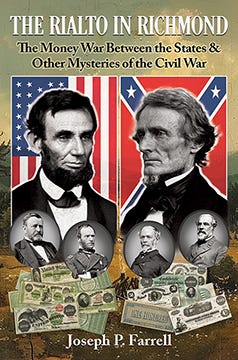
We have been told that the war was over slavery. We have been told it was the fault of the slave states. There have been many books published that have chipped away at the notion that the northern states “saved the union.” But I think it safe to say that no book before this one has sewn into place a quilt for the reader offering a clear picture of the likely state-of-play in the minds of the leadership of both combatants in the conflict. The book is The Rialto in Richmond.
The main factors in the ignition of the war were two: financial disputes over interstate tariffs and an epistemological fight over the meaning of the Agreement Between The States, formally known as The Constitution.
Before the ink had even set on The Constitution in 1787, a furious race was underway for control of the wealth of the United States. And the battle lines of 1861 were already identifiable in 1787. The “slightly more perfect union” of the constitution that replaced the Articles of Confederation, a document that had taken the former colonies from vassal states to full-fledged nations in their own right, was found wanting by an urban American elite that knew little outside of the British system. They believed that the British system was perfect except for one thing: they did not control it.
The decentralists, led by people such as Jefferson and Monroe, had had a belly full of distant bureaucracies organizing financial schemes that impoverished their neighbors and enriched the urban financial elite.
Fast forward to the period after the presidency of Andrew Jackson. North and South were on a collision course, seen even in the time of the founding as a future apocalypse. The collections of white papers on the new Constitution, known as the Federalist/Anti-Federalist papers, displayed the future conflict in vast relief. Everyone knew a blowup was coming. Everyone was hoping to find a way to avoid it. Some came along who wanted it to happen so they could exploit it. But most people don't understand that it was a war over money and business models.
Farrell takes us through the era of the 1850s and the banking system, takes us into the mind of secretary of war Stanton, a manipulative and power hungry man he was. Like the murder of John F. Kennedy a century later, Mr. Lincoln was a victim of security stripping. He actually took the time to complain to Stanton about his safety and how his request for additional coverages were being denied.
Most people are not aware, but if you read Dr. Farrell’s book, you will come to understand that Lincoln’s murder was actually a broad coup. Two people were shot that night, Lincoln and the Secretary of State, William Seward.
Although one might be tempted to see this book on the surface as a book about the end of the Civil War and the murder of Mr. Lincoln, the book is really about undercurrents. The undercurrent of money flows, coinage, and currency, and the hidden role of European powers in the conflict, a fascinating dive into the Civil War version of “follow the money.” The behaviors of the north and south toward the end of the war, when the die was cast, especially involving the area of East Texas to Alabama called the Trans Mississippi, are highly suspicious. Huge amounts of money were being moved. Who was moving it and why? Where did it go? Who has it now?
One of the things that is important to credit here is that Dr. Farrell has given us the gift of understanding what the civil war was really about. Who was really fighting? What were their objectives? What were they afraid of? Who is involved that didn't want to be seen? There's a lot more going on than just the details of Civil War battles.
Follow the money has never been more true than it has in Dr. Farrell's analysis of the Civil War. Highly recommended.
Comments
Nothing yet. Say the first thing.
Sign in to join the conversation.