
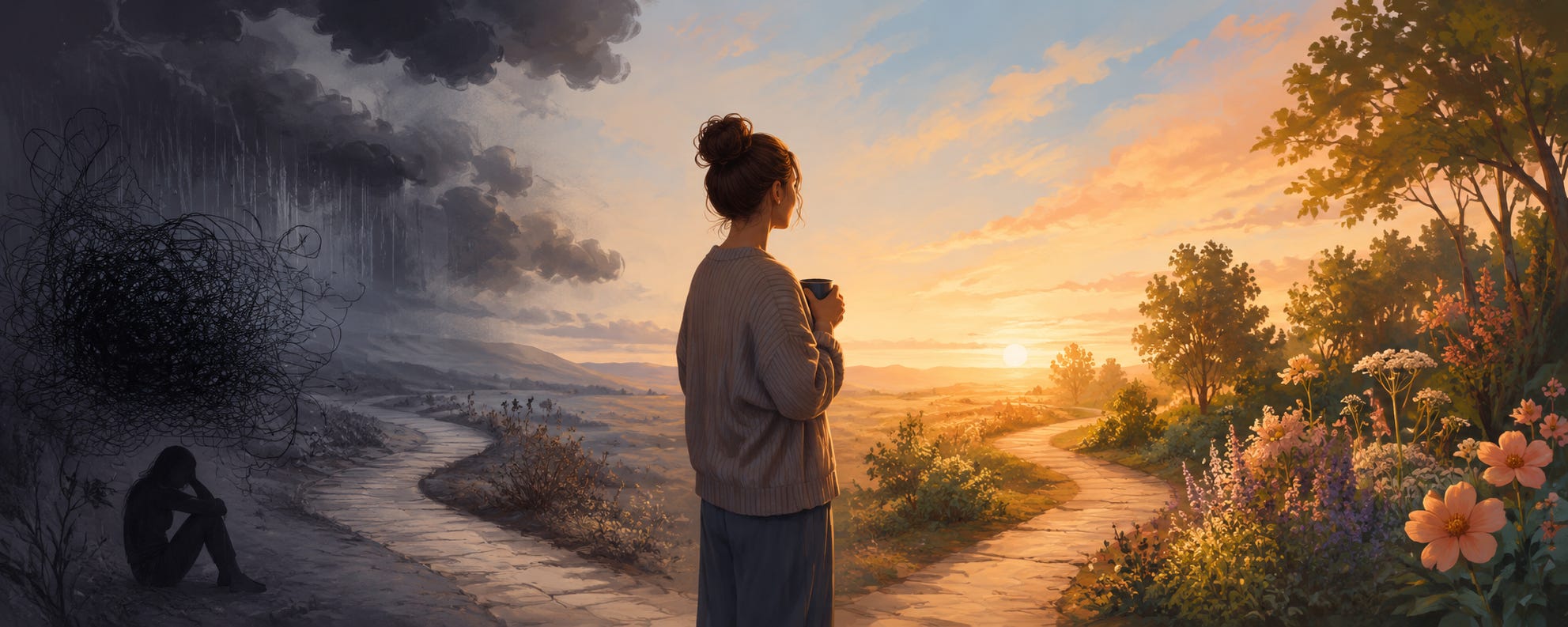
I have become more visible online. Instagram, TikTok, Facebook — and let me tell you something: being perceived this way is overwhelming. I do not particularly like it.
I am not on social media to become an influencer or to monetize my content. Though I will admit that would be nice.
It has been strange to go from 700 followers to nearly 6,000 in a few days. My inbox is full of messages I could not possibly respond to all of, so I have not responded to any of them yet. I want to say that plainly, because silence can read as indifference and it is not that. It is arithmetic.
People are resonating. I think that matters, and I am not going to pretend otherwise. Some of it was written and some of it was spoken — videos as much as essays now — and either way something reached people it was not reaching a week ago, and some of them needed it.
And some people have not been kind. That has been a challenge for me since day one of social media — the cruelty that gets projected online is hard on my nervous system, even now, even with years of protective strategy built around it.
So this is where the essay comes from. How strange it is to be a scholar-practitioner in neurodiversity education, with 47 years of lived experience, trying to do this responsibly while the visibility itself arrives faster than any framework I have for holding it.
What visibility actually does
Nobody warns you that visibility is not the same as being known. Six thousand people can see a sentence I wrote and none of them know what it cost me to write it, or what was happening in my life the day I wrote it, or whether I am the same person today that I was in it.
I wrote recently that you cannot see someone’s capacity from their visibility. I am now living the other side of that sentence. People are looking at a version of me assembled from a handful of posts and treating it as the whole person — not out of malice, mostly. That is just what a feed does. It flattens.
The part that is hard on purpose
I want to be honest that some of this discomfort is not a problem to be solved. It is supposed to be uncomfortable, because it is new, and because I built my nervous system’s baseline around a much smaller audience for a very long time.
But some of it is a real cost, and I do not want to romanticize it. The cruelty is real. It is not evenly distributed — it lands harder on the days I am already low, and it does not ask permission. I have protective strategies now that I did not have ten years ago, and they help. They do not make it nothing.
Why I am not chasing this
I want to say something plainly because I think it needs saying more than once: growth is not the goal here. If it were, I would be doing this differently — posting more, softening the parts that make people uncomfortable, engaging with every controversy instead of choosing carefully where my energy goes.
I am not doing that. I would rather have 700 people who are actually met than 60,000 who encountered an archetype of me. The whole argument of this newsletter runs the other direction from where visibility wants to pull me.
Doing it responsibly
So here is what responsibly looks like right now, in practice. I am not going to answer every message, and I am not going to feel guilty about the ones I cannot get to — guilt was never going to make more hours exist. I am going to keep writing the way I write, at the length and pace that is actually true, rather than the length and pace a bigger audience is assumed to want. I am going to let the cruelty land, name it when it needs naming, and not let it decide what I say next. And I am going to keep saying the uncomfortable, unresolved things, because that is the actual work, and a wider audience is not a reason to sand it down.
Forty-seven years of lived experience is not a credential that makes any of this easier. It just means I have had longer to notice when I am doing it for the wrong reasons.
Why I still write this
I am a high-capacity autistic person. I am also gifted and ADHD. I am 47, and I have had the enormous privilege of learning my own neurotype in ways many people have not had the safety, resources, or time to do yet.
My daily life today is not one of disability.
But I have lived there. Many times.
My last two autistic burnouts were profoundly disabling. There were periods when the person you see online today simply did not exist in this form.
Today I write constantly, publish almost daily, research, teach, facilitate. I have a very high relational, emotional, and cognitive capacity right now.
That capacity did not appear because I became a more capable autistic person. I built a life that supports it. Relational support. Emotional security. Autonomy over my time. Tools that fit how my brain works. Years of learning what overwhelms me, what regulates me, what kind of environment lets me function well.
That ecology makes this version of me possible. Seven years ago my life looked nothing like this. I was barely surviving. I was not writing think pieces. I barely understood who I was.
This is the ecological model of disability, and I did not invent it — I have watched other autistic people describe the same thing independently, sometimes with a blind cave salamander as the example. A salamander living in darkness is not impaired for lacking a visual system it does not need; within that niche, the trait that would be a deficit elsewhere is simply not a deficit there. Strength and weakness are not fixed properties of an organism. They are relational, and they depend on the environment the organism is actually in.
Apply that to a person and disability stops being a fixed category you either have or do not. It becomes a relationship between a person and their conditions — which can shift, sometimes completely, as the conditions shift. I am the same neurology I was seven years ago. I am not the same ecology.
The mistake I think we are making
That history is why I want to say something about a pattern I keep seeing in autistic communities online, and why I think it matters more than it looks.
We see visibility and assume capacity.
Someone has a platform, so we assume emotional capacity. They write articulately, so we assume cognitive capacity. They post frequently, so we assume relational capacity. They made a video today, so surely they have the capacity to respond to whatever the controversy is today.
Visibility is not capacity. And I have been guilty of forgetting this too — approaching autistic people online with reasoning, nuance, or complexity they simply did not have access to in that moment. Maybe they did not understand what I was communicating. Maybe I did not understand what they were communicating. Maybe neither of us had the cognitive flexibility available to bridge the distance right then. None of that means either person is stupid, cruel, or unwilling to learn. Sometimes a human being does not have the resources a particular interaction requires, on that particular day.
I wrote about the mechanism underneath this in Autism as Ecological Disclosure: online, platforms reward certainty over ambiguity and moral clarity over complexity, so a disagreement between two nervous systems that are both trying to stabilise meaning under uncertainty collapses into symbolic categories — victim/perpetrator, safe/harmful, legitimate/illegitimate. Once that happens, people stop encountering each other relationally and start encountering archetypes. That collapse is exactly what erases capacity from view: an archetype does not get tired, does not have a body, does not need groceries.
Empathy, operating differently
I do not believe autistic people lack empathy. I think autistic empathy can operate differently. Not better, not worse. Differently.
And sometimes our own experience of justice becomes so consuming that we temporarily lose sight of the whole human ecosystem on the other side of the screen.
The person you are demanding a statement from might be working out how they will buy groceries this week. They might be deciding whether they can call out of a shift while approaching burnout, weighing that against whether missing it costs them rent. They might be trying to advocate for their autistic kid at school without being able to afford the advocate someone online told them they should hire. They might have a platform too — and that platform might bring in just enough this week that they can order food instead of spending the last of their energy navigating a grocery store.
You do not know. You cannot see someone’s whole ecology through a screen. Not their financial capacity, not their relational capacity, not their cognitive capacity, not what happened five minutes before they opened the app, not whether the post you are reading took them twenty minutes or four days to write.
What disability justice actually asks of us
This is part of what disability justice means to me. Not defending disabled people as an abstract political category — remembering the actual human being. Fluctuating capacity. Invisible labor. The fact that access needs can conflict with each other. The fact that someone’s ability to produce one thing does not mean unlimited capacity for everything else. And the fact that being marginalised does not make any of us omniscient about someone else’s life.
What I am doing with my own capacity now
At 47, for the first time, I have substantial relational and emotional security. I am not rich. I am not famous. I built an ecosystem with enough safety in it to do work I love.
I will not spend that security on online conflict. That is not a refusal of accountability. It is stewardship of the capacity I finally have.
If something I say hurts you, I want to know. If my work lands differently than I intended — especially for people whose marginalisation differs from mine — I want the chance to understand that. That is what the feedback form is for. You can tell me how the work lands. You can challenge my thinking. You can show me something I have not considered. You can disagree with me completely.
But visibility does not grant unlimited access to me. You do not get to shame me because I am visible. You do not get to accuse me of things you have never asked me about because I am visible. You do not get to be cruel to me because you have decided my capacity is greater than yours.
And I will extend the same dignity back. I will try not to assume your capacity from what I can see of you. I will try to remember there is a whole life happening beyond your profile picture, and that the person I meet today may not be who you were seven years ago or who you will be seven years from now.
Where this leaves disability justice
Because disability justice, to me, has to make room for all of that movement. For disability and capacity. For dependence and autonomy. For burnout and thriving. For needing enormous support in one season and having enormous capacity to give in another. For people whose disability is relatively stable and people whose relationship to it changes across environments and across a life.
We do not have to flatten those differences to care for one another.
Maybe disability justice begins there. You cannot see another person’s capacity from their visibility. You cannot know their ecology from their content. There is always a whole human life happening on the other side of the screen.
Where this thinking gets built out
This is the argument underneath Neurodiversity & Disability Justice — free, six modules, on access as design rather than accommodation, internalized ableism as a reflex rather than a failing, and why justice work has to hold fluctuating capacity rather than a fixed category. It is one of thirty-seven courses, written and finished, on a static site because the part that lets anyone have an account has not been built yet.
I am asking the community this is for to fund the last of it — $150 for a founding year, $500 for the practitioner tier, both cheaper than paying monthly. Nothing is charged until the number is reached, and every pledge carries a second seat to give away.
Fifteen people have pledged — $3,300 of the $5,500.
The founding campaign, with the full pitch →
— Sher
PS: If you’ve filled out my feedback form, I haven’t forgotten about you. It just takes me a little time to organize my thoughts and respond thoughtfully.
Comments
Nothing yet. Say the first thing.
Sign in to join the conversation.