
The NEAR network has been growing and drawing a lot of attention from the market. Industry leaders have shown genuine interest in the ecosystem thanks to its efficiency, security, privacy, scalability, and technological edge.
Amid all of this, the NEAR token has been performing exceptionally well, with solid price gains and higher on-chain and off-chain trading volumes. In this context, a good chunk of on-chain transactions are happening on a DeFi protocol that’s still relatively unknown to anyone outside the community.
Rhea Finance is the leading decentralized finance platform on the NEAR network. It’s already fully integrated with NEAR Intents and offers fast cross-chain operations with low fees across more than 35 blockchains in addition to the native network. Built-in perpetuals and Zcash DeFi are also part of its stack.
In this article, we’ll check out the current state of the protocol, the RHEA token, and the DeFi opportunities available on the platform.
This article is sponsored by Rhea Finance, which made the time invested in researching, understanding, writing, and editing this material possible. The content remains completely authentic and received very little direct influence from the team—they respected the independent creation.
Check out the Carrd below to learn about my services and sponsorship options.
Rhea Finance is a name that popped up recently in the NEAR ecosystem (July 2025), but its roots go back further. The app is the result of a merger between Ref Finance (DEX) and Burrow (lending), with smart contracts live on mainnet since 2021.
Today, the platform is a unified cross-chain DeFi hub thanks to its implementation of NEAR Intents.
Users can swap tokens from the NEAR ecosystem or from over 35+ other blockchains and interact with liquidity pools using the traditional automated market maker (AMM) model you’d find on DEXes like Uniswap.
On top of that, there’s also a system similar to Aave. Users can interact with deposit and loan contracts (lending and borrowing) that automatically pay or charge interest (APY) based on the law of supply and demand—total borrowed versus total available to borrow.
Moreover, the hub has recently launched (June 3) Hyperliquid perps built-in in its platform, allowing Rhea users to fund Hyperliquid accounts and open positions with ease.
The source code for the contracts used by Rhea was open-source until recently (April). The team decided to close it temporarily over security concerns, following AI developments and a wave of attacks against DeFi protocols.
If you know me, you know I’m not a fan of this decision. I criticized the same move from the CalCom team and even published an article on HackenProof addressing exactly this point.
My opinion hasn’t changed when it comes to Rhea’s decision either, and I hope to see the smart contracts open-sourced again as soon as possible. That said, the solution RHEA implemented isn’t one of the worst. In fact, I think they pulled off the code closure in the best way possible, which leaves me pretty optimistic.
In an article published on April 27, the team explained their intention to return to open-source, along with plans to strengthen the contract layer, grant source code access to trusted institutions, and create proofs that users are actually interacting with secure, audited contracts—validated by community members.
In short, the contract will be used as input to generate an encrypted hash. Private audits will attach that hash to their reports to confirm the current state. The community can then verify the input using the same cryptography algorithms and get the exact same hash as output—creating a verification layer that doesn’t replace open-source but can still be really useful.
I myself was promised access to the source code for an independent audit and I’m waiting my turn. I plan to publish something about it when it happens, so follow me on X (@vinibarbosabr) and subscribe to my two free Substack newsletters (thecoding.substack.com and codigoaberto.substack.com) to stay in the loop!
Rhea Finance’s core primitives—liquidity pools + swaps for DEX and lending/borrowing—run via smart contracts. Primarily written in Rust compiled to WebAssembly on NEAR, with key contract references like v2.ref-finance.near.
It supports permissionless pools, advanced AMM variants, multi-pool routing, over-collateralized lending with dynamic rates, LP tokens as collateral, and a NEAR liquidity staking protocol and derivative token (rNEAR). Cross-chain access uses NEAR Chain Signatures and Intents for native interactions from other chains without wrapping.
The liquidity pools are a shared digital “pot” (smart contract) holding two tokens, say NEAR and USDC, deposited by everyday users and professional market makers called Liquidity Providers (LPs).
Instead of traditional stock exchange where buyers and sellers must find each other via order books, the pot itself act as the automatic counterparty using math to set prices.
Want to swap NEAR for USDC? The contract calculates the exchange rate based on how much of each token in currently in the pot (literally the rate between their liquidity supply) and executes instantly.
LPs earn a small fee on every swap (like a commission for providing the “market”). They receive LP tokens representing their share of the pot, which can be staked for extra rewards.
Different “flavors” of pots exist: normal ones for any tokens, stable ones for similar assets (like USDT/USDC) with less price variation, and advanced “concentrated” ones that focus liquidity in popular price ranger for better efficiency.
Anyone can create a new pot for any token pair (the permissionless part). Prices adjust automatically. If lots of people buy one token, it gets more expensive in the pot.
Think of it as a decentralized bank run by code.
The user deposits (supply) tokens into the lending pool and earn interest automatically from the protocol itself (like a savings accounts).
Others borrow those tokens but must first lock up more value in collateral than they borrow (e.g., borrow $100 worth of USDC but lock $150+ of other assets, like NEAR). This over-collateralization protects the system against bad debt.
If the collateral value drops too much (e.g., NEAR crashes), the position gets automatically, partially liquidated (sold off) by anyone to repay the loan and protect lenders.
Borrowers will see their loan amount increase overtime (borrow APY) and they need to repay the updated amount to unlock their collateral. This repayment adds to the pot and is what guarantees lenders’ interest accrual.
Everything is self-custodial, meaning users keep control via their crypto wallets. The cross-chain implementation allows deposits or interactions from Bitcoin, Ethereum, Solana, Zcash, or other major networks using a NEAR account.
Staking NEAR natively via the protocol is probably the most secure, self-custodial, and decentralized way to get a 3.5%-4.5% APY over your NEAR holdings but has some trade-offs.
NEAR is locked and has a 48-72 hours unbounding period and becomes illiquid, meaning you can’t use it to pay, swap, or supply as collateral. That’s why liquid staking was invented for and Rhea offers its own liquid staking protocol and derivative token. I’ll explain.
Instead of staking their NEAR token to a validator like myself (thecoding.pool.near), holders may opt to stake it in Rhea’s liquid staking contract. Rhea will them distribute it all to a list of handpicked validators, managing the staking rewards itself.
If you want to support my work, you can delegate your staked NEAR to thecoding.pool.near using any of the most popular NEAR wallets.
The user receives some sort of an IOU called LST (Liquid Staking Token). Rhea’s is rNEAR. This can be exchanged for NEAR, wNEAR, or any other ecosystem token at any time, used as collateral on Rhea Finance’s lending or transferred to other NEAR accounts (e.g., for payments).
Interestingly, rNEAR has an automated system that makes it increase in value against NEAR, according to the staking rewards the protocol’s contract is receiving—proportional to the network’s staking APY minus protocol fees.
The RHEA token launched via TGE (Token Generation Event) in July 2025, right alongside the platform. There were seasonal airdrops rewarding REF and BRRR holders (the tokens from Ref and Burrow, respectively) plus active users of the app.
RHEA has a maximum supply of 1,000,000,000 RHEA (1 billion), with roughly 400 million currently in circulation.
The project’s tokenomics revolve around a three-token system: RHEA, xRHEA, and oRHEA.
RHEA is the exposure token and the project’s core asset that unlocks the functionality of the other two. It can be staked and used to pay for RHEA fees in some cases. This asset captures protocol growth and revenue generated from trading fees, lending, and treasury activity.
Every staked RHEA earns the holder a corresponding amount of xRHEA—like a liquid staking derivative that appreciates in price relative to the base asset over time.
Holding or depositing xRHEA into lending contracts or liquidity pools also unlocks benefits in the form of higher APY, multipliers, or oRHEA airdrops. It serves as valid collateral to increase borrowing power on the platform.
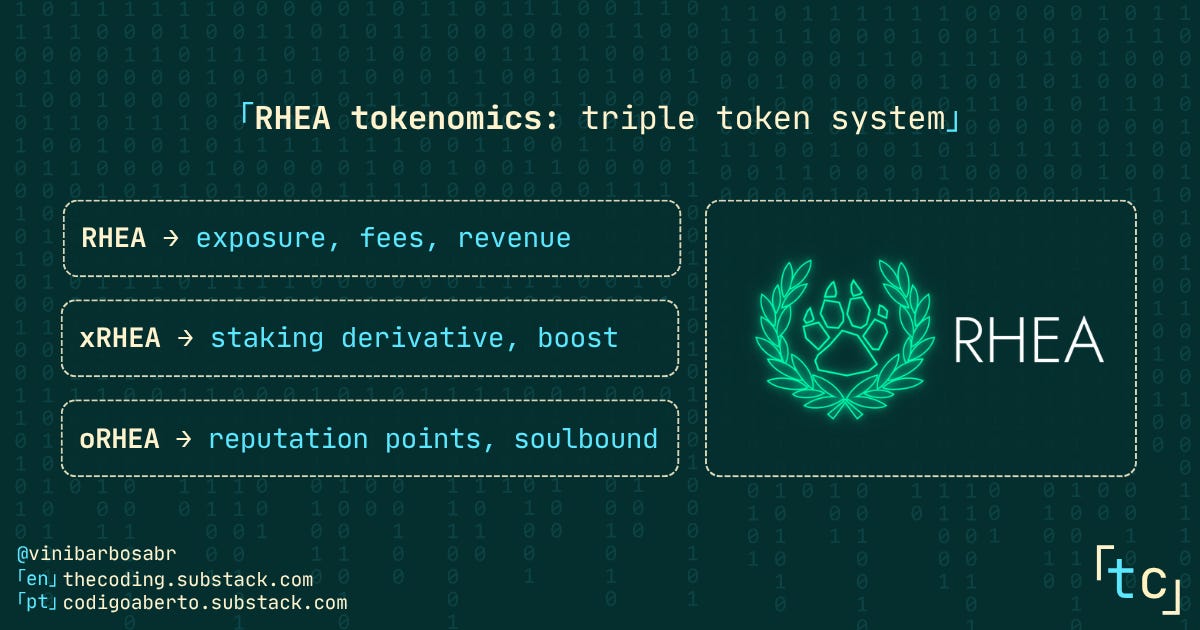
oRHEA is the reputation and points system for Rhea Finance users. It’s non-transferable (soul-bound) and can be converted into RHEA or xRHEA under certain condidtions. Distribution is seasonal and based on the points generated from using the platform.
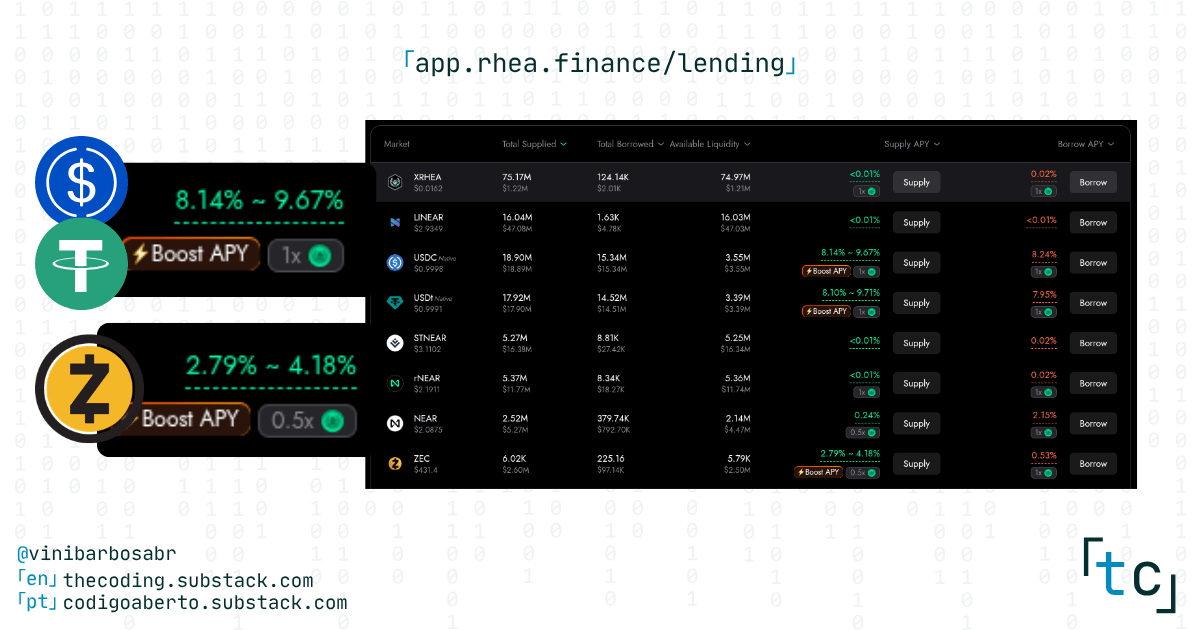
Right now, staking RHEA is yielding around 3.5% APY and depositing xRHEA into lending is yielding around 0.1% APY—with a total of 124,000 RHEA borrowed from a pool of 75M RHEA deposited.
Lending USDC and USDT can pay up to 10% interest to lenders with a boosted APY powered by xRHEA. Lending ZEC is paying up to 4% under these conditions.
1 RHEA is currently costing $0.015 at the time of publication of this article. Some voices on X see RHEA as the best “beta” play in the NEAR ecosystem—one that should ride and amplify the performance of the native NEAR token.
For example, zhynx describes the project as a $2.5 million mcap monopoly inside a network with a $3 billion market cap, responsible for ~95% of the entire ecosystem’s TVL.
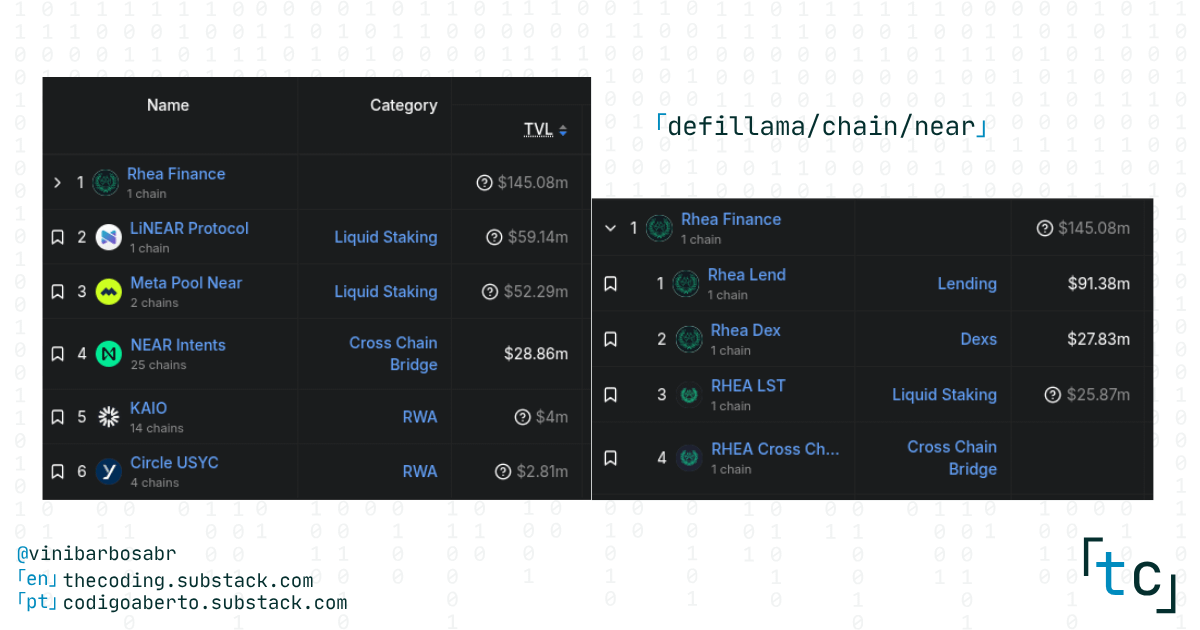
Data from DefiLlama paints a positive picture for Rhea Finance as the leading DeFi hub in the NEAR ecosystem.
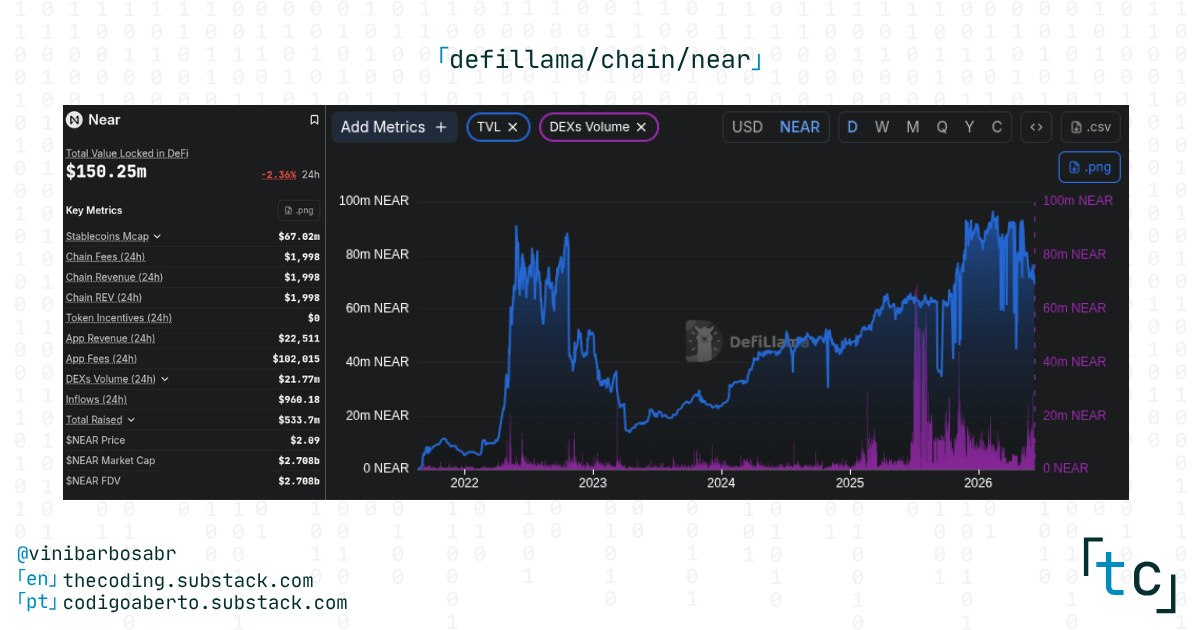
As of this writing, NEAR has $150.25 million in total value locked (TVL). Out of which, $145.08 million (96.5%) come from Rhea smart contracts. It’s a clear dominance and highlights the project’s importance for the chain.
LiNEAR Protocol and Meta Pool Near have the second and third positions respectively, with $59.14M and $52.29M in TVL. Both are NEAR’s leading liquid staking protocols.
Notably, they have more than double of Rhea’s liquid staking TVL ($25.87M), which accrues for only 17.8% of Rhea Finance’s total TVL and 19% of NEAR LSTs—at a total of $137.3M staked in these protocols.
IMPORTANT!
Liquid Staking TVL may included double counts from lending and DEX, as the LSTs may be locked in these contracts.
Rhea’s lending has the highest TVL, with $91.38 million, while Rhea’s Dex has $27.83 million.
Overall, the ecosystem’s total value locked has been growing overtime when measured in NEAR, but faces temporary challenges when measured against the US Dollar. As the massively dominating protocol, RHEA’s history is similar—with ups and downs, but growing when measured in the network’s native token, weighted by NEAR’s price performance when measured in USD.
I honestly believe RHEA may benefit a lot from the current momentum, as soon as macro conditions improve. With an increased market interest and demand for NEAR, Rhea is very likely the first ecosystem project to see direct benefits, which may impact its own token’s performance.
I’m cautiously optimistic. “Cautiously” because of macroeconomics and the temporary closed source code. Optimistic because NEAR is gathering momentum, Rhea Finance’s team has been shipping and demonstrating solid work even under adversarial conditions, and because much of the ecosystem’s DeFi volume will inevitably rotate through the platform.
Let me know your thoughts in the comments and make sure to try using RHEA! I would also love to know your experience there.
No posts
Comments
Nothing yet. Say the first thing.
Sign in to join the conversation.