
Privacy has never been more important as in this era of pervasive digital surveillance and escalating data breaches.
Financial privacy is a very important extension of that and the usual on-ramp to other privacy tools that need to be paid for and maintained. There is no real privacy without financial privacy and Dash is one fantastic project I like that is building with that in mind.
This article is a Dash special with some privacy advocacy. We will understand Dash’s orchard implementation on Evo, how it can keep high performance thanks to GroveDB and what the heck GroveDB is. As usual, it will have a technical outlook, an easier explanation, and some utility- and security-focused perspectives.
According to the IBM Cost of a Data Breach Report 2025 (covering 2026 data), the global average cost of a data breach reached $4.44 million, with the United States hitting an all-time record of $10.22 million per incident. Breaches often involve human elements and take an average of 241 days to identify and contain, leaving sensitive financial and personal data exposed for extended periods.
In the cryptocurrency space, compromised account data frequently appears on dark web markets, with values ranging from $20 to over $2,650 per record, underscoring the real-world risks of traceable transactions on public ledgers, often leading to kidnapping or other threats in the meat world.
Dash has built privacy solutions since its early days. In 2014, it introduced PrivateSend (a CoinJoin-based mixing feature), making it one of the longest-running blockchains with built-in protocol-level privacy tools. This foundation positioned Dash as a valuable payment network that balanced usability with confidentiality long before many competitors entered the space.
In February 2026, Dash announced plans to integrate Zcash’s Orchard shielded pool technology into its Evolution chain (also known as Dash Platform). With that, Dash brings advanced zero-knowledge privacy features to it’s application-focused layer.
I wrote about that when it happened:
The implementation stands out for combining Orchard-level cryptographic privacy with GroveDB-powered performance advantages and a fully on-chain design that avoids new third-party dependencies. We will dive more into that later.
Platform 4.0, which includes this Shielded Pool, was released earlier this month (July 2026). This timing makes now an ideal moment to understand how Dash is delivering shielded privacy with high performance and scalability.
This article is sponsored by DashPay. Their support made it possible for me to spend the time researching, understanding, writing, and editing this piece. The content remains fully authentic and didn’t suffer any direct influence from the team, who respected its independent creation.
Dash operates on two interconnected layers. The original Core chain handles the primary payment functionality and has long relied on its masternode network for governance and features like PrivateSend.
Evolution, also called Dash Platform, is the newer application-focused layer built on top of it — and the one that now has its own version of the Zcash-forked Orchard.
Evolution runs as a fully Proof-of-Stake system and is loosely based on Cosmos-style architecture. This gives some very practical advantages:
blocks are produced roughly every second (one-second block time)
and finality is deterministic, not probabilistic (as in Proof-of-Work chains)
Meaning that once a block is validated, it’s deterministically final. There is no need to wait for multiple confirmations like happens with Bitcoin, Zcash, Monero, and Litecoin, for example. This speed and certainty matter a lot when you’re dealing with private transactions that involve zero-knowledge proofs.
The real secret sauce here is GroveDB, Dash’s custom structured database layer that powers the entire Evolution chain. I have to say I didn’t know about GroveDB before and it is a fantastic open-source tool for storing and querying large chunks of data efficiently.
Instead of a simple key-value store, GroveDB organizes data as a hierarchical forest of Merkle AVL trees. It supports secondary indexes, cryptographic proofs for queries, sum trees for aggregates, and efficient append-only structures.
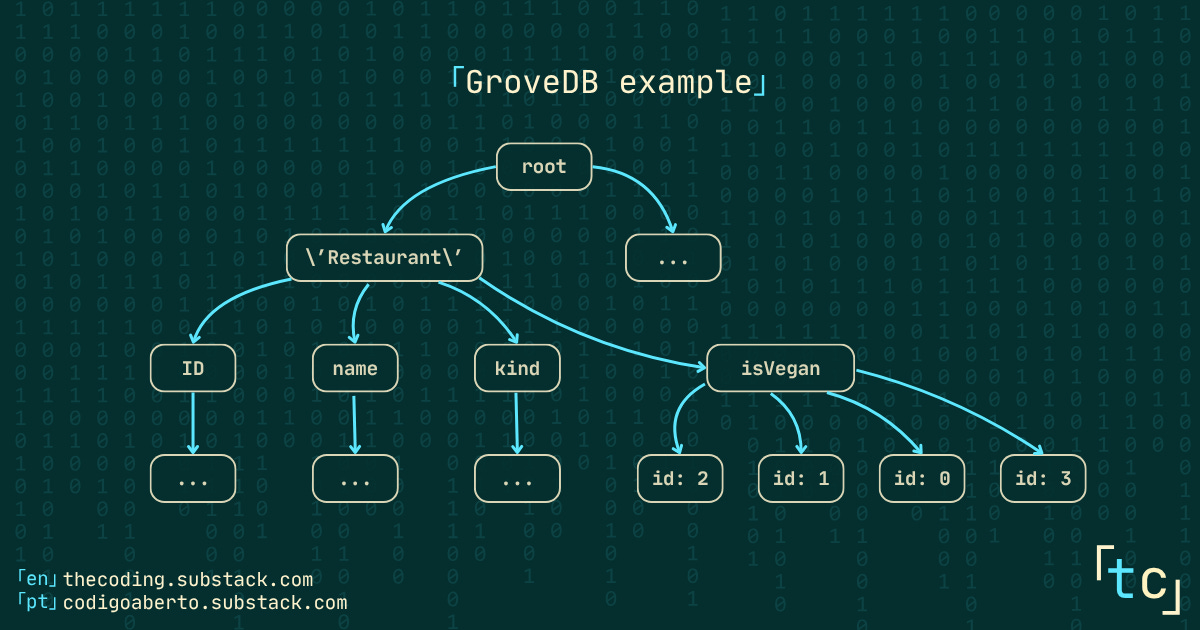
This design is what makes advanced privacy features practical at scale. Without a database layer built for structured, provable, and fast access, running something as computationally heavy as an Orchard shielded pool on-chain would likely come with major performance trade-offs.
We’ll take a closer look at how GroveDB works later.
First of all, it’s super important to say I’m a HUGE FAN of Zcash. It is, easily, one of my favorite crypto projects for many reasons.
Zcash introduced shielded transactions back in 2026 with its original Sprout shielded pool. It was groudbreaking at the time because it allowed users to send and receive funds without revealing the sender, receiver, or amount on the public blockchain. However, Sprout came with a trusted setup ceremony and relatively heavy computational requirements.
In 2018, Zcash upgraded to Sapling. This version made shielded transactions much more practical by significantly reducing proof generation time and improving overall efficiency. Sapling removed most of the trusted setup concerns from everyday use and became the standard for private Zcash transactions for several years.
Orchard, activated in 2022, represents the current state of the art. It was built from the gound up using the Halo 2 zero-knowledge proof system. Unlike earlier versions, Orchard requires no trusted setup at all. This removes a long-standing point of criticism and potential attack surface.
It’s worth noting that Zcash is now migrating to another shielded pool: Ironwood. The design logic is the same of Orchard and the migration is happening only to verify the total shielded ZEC supply, following an already-fixed bug found in the old code base — but that’s a topic for another article.
At a high level, shielded pools work by using special “notes” instead of regular transaction outputs. When you receive funds in a shielded pool, you get a note that contains the amount and is encrypted to your viewing key. To spend it later, you create a zero-knowledge proof that proves you own a valid unspent note and that the total value is conserved — without ever revealing which specific note you are spending or who you are sending it to.
Think of it like putting money inside a sealed envelope. Anyone can verify that the envelope contains exactly the right amount and that it hasn’t been tampered with, but nobody can see who put the money in or who is allowed to open it. The nullifier acts like a unique serial number that gets publicly marked as spent once the envelope is used, preventing double-spending without linking it back to the original note. Brilliant!
Orchard’s strength include strong privacy guarantees, better performance than previous generations, and support for future scalability improvements through recursive proofs. In practice, millions of ZEC now sit in the Orchard pool (and will soon migrate to Ironwood), showing real adoption.
That said, Orchard on Zcash still has noticeable limitations. Wallets must scan and trial-decrypt large portions of the blockchain to find incoming notes, which makes initial sync slow. The growing set of commitments and nullifiers also contribute to increasing state size over time, which affects both node operation and long-term scalability (Tachyon is is an ongoing development that aims to address some of these trade-offs).
This is exactly where Dash’s approach starts to diverge in interesting ways.
Dash didn’t just copy Zcash’s Orchard code and released this copy with a different name. They took the mature cryptographic foundation and adapted it specifically for the Evolution chain and GroveDB’s unique storage model. It’s a well-thought Dash-specific implementation of what talented cryptographers built for Zcash, but the Dash adjustments are equally important (and very exciting).
The core cryptography is the same as Zcash’s Orchard. It uses the Pallas and Vesta elliptic curves, Sinsemilla for the note commitment tree, RedPallas signatures for spend authorization, Halo 2 for the zero-knowledge proofs, and ChaCha20-Poly1305 for encrypting notes.
Key derivation also follows the ZIP-32 standard. This means Dash benefits from years of security review and real-world testing that Zcash’s Orchard has already undergone.
Where Dash diverges is in how it integrates and optimizes the system. Instead of using Zcash’s full orchard crate directly, they maintain a Dash-parameterized fork inside the grovedb-commitment-tree crate (part of the GroveDB repository). This fork lives comfortably inside GroveDB, which is the structured database layer that powers the entire Evolution chain.
The shielded pool is stored under a dedicated ShieldedBalances root tree in GroveDB. This root is itself a SumTree, which automatically maintains aggregate balance checks across the pool. Inside it sits a single credit pool (keyed as “M”) that contains five carefully positioned subtrees. The most important ones are:
A CommitmentTree (using Sinsemilla) that stores note commitments and encrypted payloads in chunks.
A ProvableCountTree for nullifiers that prevents double-spends with strong atomic guarantees.
Additional trees for anchors and running totals.
This design lets the network efficiently verify balances and spent notes without scanning everything from scratch every time. It leverages a smart mapping architecture and GroveDB’s efficient querying for that.
Dash also made several practical modifications. Memos are much more compact (36 bytes instead of Zcash’s 512-byte memos). Addresses use a clean Bech32m format with the dash1z prefix for easy identification.
One very interesting aspect: there’s no fee bidding mechanism. Fees are flat for a given transaction size, which reduces fingerprinting based on different fee patterns that could be used for profiling and chain analysis. The sighash is also customized to bind Dash-specific fields like identity keys and withdrawal scripts.
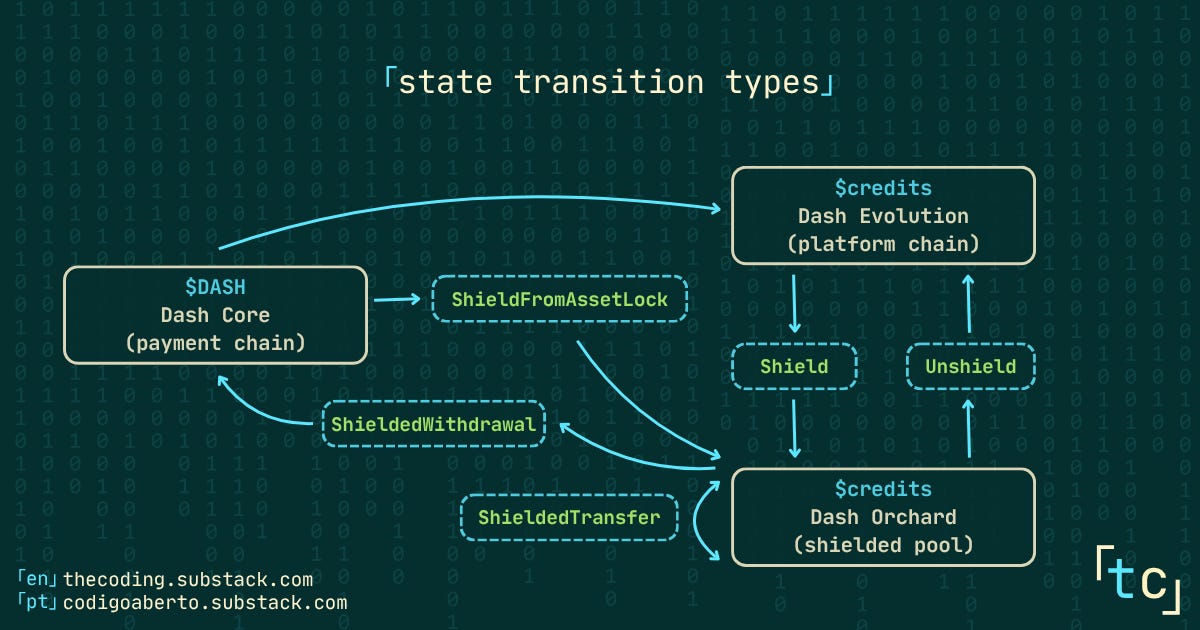
On the functionality side, Platform 4.0 introduces six new state transition types that make the shielded pool usable in real applications:
Shield and Unshield (move credit funds in and out of the pool)
ShieldedTransfer (credit private transfers inside the pool)
ShieldFromAssetLock and ShieldedWithdrawal (bridge with the Core payment chain)
IdentityCreateFromShieldedPool — a particularly interesting one that lets users create new identities funded entirely from shielded credits, using fixed denominations to strengthen the anonymity set.
Perhaps the biggest practical advantage comes from how GroveDB handles network synchronization. Because the shielded state is stored in well-structured, append-only trees with efficient chunking, wallets can sync from scratch very quickly.
Dash calls this fast sync capability BLAST sync, and early testing shows it can complete in around 21 seconds on a fresh wallet — a massive improvement over traditional shielded implementations that often take hours or days.
The team also put serious effort into hardening the implementation before release. Platform 4.0 included extensive testing and stability work (with help from newer AI-assisted tooling) to make sure the shielded pool would be reliable once activated.
Finally, the known counterfeiting vulnerability that affected Zcash’s Orchard has been addressed in Dash’s version before the pool goes live on mainnet.
Talking to Joël Valenzuela, he revelead some alpha from internal discussions. These are not confirmed directions yet, but some insights worth considering while studying Dash’s Orchard implementation.
He expanded on the plans about the shielded token implementation, which comes with a different flavor than the plans for Zcash Shielded Assets (in research by Zooko’s Shielded Labs).
In Zcash, the idea is to combine all tokens and regular ZEC value transfer in the same pool for maximum anonymity set.
In Dash, the idea is to have a separate pool for tokens as fr regular DASH credit transfers.
“This splits the anon set, but makes it more efficient. It’s seen as an acceptable trade-off,” Joël said. “I’ve heard plans of allowing token users to create a shielded pool for just their token for maximum cost-effectiveness, but I’m not sure.”
Personally, I prefer a larger anonymity set, considering Dash already has many performance optimizations. But it’s a valid approach.
Now that the shielded pool is built into Platform 4.0, what can people actually do with it?
The most immediate use case is private credit transfers on the Evolution chain. Users can convert their DASH (from the core, payment chain) into credits (in the evo, platform chain) and then move funds into the shielded pool.
Once shielded, they can send these funds privately to others, and pull them back out when needed, all while keeping the amounts and counterparties hidden from the public ledger. Private fee payment is also supported, so even the cost of using the network can stay confidential.
A particularly interesting feature is IdentityCreateFromShieldedPool. This allows someone to create a new Dash identity on Evolution using only shielded credits. The system uses fixed denominations for these identity-creation transactions, which helps strengthen the anonymity set: every transaction of the same denomination looks identical from the outside. This opens the door to creating private identities and profiles without linking them to transparent on-chain activity.
In the near future, Dash plans to extend shielded functionality to tokens. While the initial release focuses on credits, the team has already signaled that shielded token transfers are coming next. This would let users move tokenized assets (including RWAs) with the same level of privacy currently available for regular credits.
Privacy is the utility. Both for users and for builders who will be able to ship more privacy-focused solutions built around Dash and the Evolution ecosystem.
For developers, the shielded pool is now part of the core Platform 4.0 state machine, which means it can be used directly through the existing Dash Platform tooling once wallets and SDKs add support.
The main places to explore the implementation are:
dashpay/platform — the primary repository containing the state transitions and shielded pool logic.
dashpay/grovedb — where the actual cryptographic storage lives (specifically the grovedb-commitment-tree crate).
dashpay/orchard — Dash’s parameterized fork of the original Zcash Orchard code.
Most developers won’t need to work directly with the low-level cryptography. Instead, they’ll interact with the shielded pool through higher-level Platform SDKs (JavaScript, Rust, etc.) and updated wallet libraries. Wallets will need to add support for the new shielded state transitions and the specialized sync endpoints that GroveDB exposes for fast note retrieval.
This opens up interesting possibilities for builders. You can now create applications that use private identities, confidential document handling, or shielded credit flows without having to build privacy from scratch. Once shielded tokens are added in future upgrades, the design space expands further: private token transfers, confidential DeFi primitives, and more.
If you’re building on Evolution and care about privacy, this is worth keeping an eye on. A deeper technical follow-up on how to actually integrate shielded functionality into applications could be valuable once more wallets and SDKs have mature support.
Dash’s Orchard implementation stands out because it brings mature zero-knowledge privacy to a chain that prioritizes speed and usability, supported by an OG community of users.
By integrating it directly into GroveDB, Dash avoids the slow sync issues common in other shielded systems while keeping everything fully on-chain and recoverable with a standard seed phrase. Security + efficiency and scalability already built in the system.
One caveat: I expect this implementation to slowly start differing more and more from Zcash’s orchard implementation as time goes by and updates are shipped into each code base. It’s the natural expected path for a fork, which has pros and cons.
Cons: Dash’s implementation doesn’t have the native dev-capital that built the original solution they’ve forked and are now using. Zcash-related improvements may not be added in the future, either due to compatibility issues with the moving code base, or due to the lack of specialized contributors, who are focused on Zcash. The same goes for bug fixes and security audits.
Pros: At the same time, Dash’s Orchard can move faster for Dash-specific needs and adjustments. Becoming more and more unique, requiring a different set of skills and source code knowledge, meaning it may see performance and scalability benefits sooner, given Dashpay’s focus on these attributes.
Overall, both ecosystems can benefit from this fork.
Zcash developers can watch what Dash developers are building and treat Evolution as some sort of testnet for experiments around speed, scalability, and shielded tokens, which are being researched by ShieldedLabs, for example. Meanwhile, Dash can already benefit from ZEC’s mature shielded pool and further open-source development to strengthen the privacy offerings for its users and builders.
We all win with more privacy tools built for different needs and the tech advancements that come from experimentation and deployment. These are very interesting times we are living in.
Drop your thoughts or questions in the comments — I’ll answer everything I can, or point you to the right person if I don’t know the answer myself.
Thanks for reading 「thecoding」!
Follow me on X at vinibarbosabr and subscribe for free to [en] thecoding.substack.com or [pt-br] codigoaberto.substack.com for more pieces like this.
No posts
Comments
Nothing yet. Say the first thing.
Sign in to join the conversation.