
(Update: While this piece concerns the possibility of the Fix Our Forests Act coming up for a vote, the bill’s backers are also working to tack portions of it onto other legislation, like the Farm Bill, the National Defense Authorization Act and the Continuing Resolution. So if you do call your Senators, be sure to ask them to oppose these back door efforts as well. Thanks!)
This coming Friday, August 7, the US Senate is scheduled to adjourn for a five week recess and backers of the Fix Our Forests Act (FOFA) are pushing hard to get FOFA up for a vote before then. The reason? They want to use this particularly bad fire season to whip up support for their logging-bill-disguised-as-a-fire-fighting-bill.
That was the strategy when FOFA was put before the House on January 23rd, 2025. In the midst of the terrifying fires in LA, the bill was framed as a response, even though the LA fires had nothing to do with forest management. They were grass and brush fires that spread into human communities. The kind of backcountry “fuels management” envisioned by the Fix Our Forests Act would have done nothing to prevent them. But that didn’t stop Representative Josh Harder, a cosponsor, from titling his press release about the house vote—In Response to Devastating LA Wildfires, House Passes Largest Wildfire Prevention Bill in History.
It may be misleading, but it is effective. Frame it as a “wildfire prevention” bill, then time the vote to correspond with dramatic wildfire activity, when people are understandably concerned about wildfires. That’s why I’m phoning my Senators to encourage them not to take the bait, and I hope you’ll do the same.
I also want to make you aware of a webinar happening this Friday, beginning 10 am Pacific Standard Time, called The Truth About Forest Thinning, with Dr. Chad Hanson, author of Smokescreen: Debunking Wildfire Myths to Save Our Forests and Climate, and Stephen Kropp, Founder of the Legacy Forest Defense Coalition.
Lastly, here is an excellent piece by Monica Tomosy, a Forest Service veteran who speaks with authority and in plain language about why this bill is such a disaster.
By Monica Tomosy, Sisters Oregon
I have over 30 years of federal service experience in U.S. Forest Service, U.S. Fish and Wildlife Service, and the U.S. Geological Survey at field, regional, and national office levels. While working in the USFS national forest system in Oregon and Washington, I served on interdisciplinary land management teams. In USFS research and Development, I was immersed in climate change, fire, and fire management science. Working in the USFS, I’ve seen the good, the bad, and the ugly, and I believe this Fix Our Forests Act would bring out the ugly. To make things worse, there is an attempt to attach the Fix Our Forests Act to the National Defense Authorization Act, wrapping America’s land management in with all the complexities of the Department of War.
FOFA ignores the science of wildfire risk reduction. For decades, natural resource scientists made tremendous progress in forest ecology science for applications to management, and it makes zero sense to ignore it. Massive logging projects do not lead to sustainable forests. Excessive thinning often leads to increased understory vegetation followed by accelerated moisture loss, increasing fire risks. Clearly the supporters of FOFA are not interested in creating a bill that uses the body of knowledge on how to reduce wildfire risk.
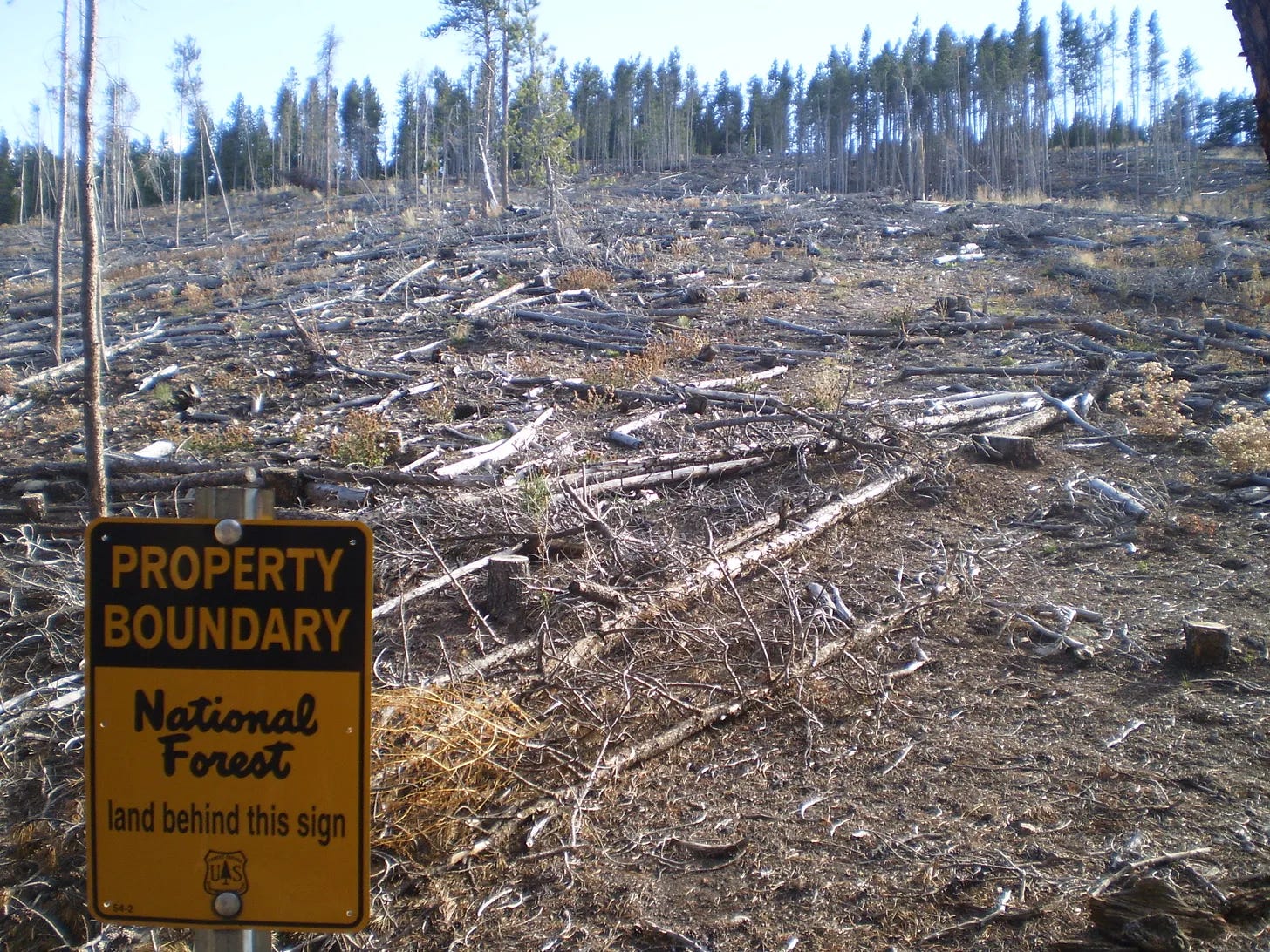
The focused efforts of FOFA are backward: Rather than directing USFS to manage in a way that protects and supports communities, it encourages logging functional ecosystems in the backcountry. If FOFA is enacted, ecosystems will become less resilient, less able to provide ecosystem services, and more fire prone. Losing the hydrological services (flood control, erosion control, water storage) would lead to devastating consequences. In FOFA there is no funding for the most effective action: Prescribed burning of floor fuels. FOFA is a “log baby, log” bill disguised as a wildfire risk reduction bill.
FOFA allows for 15 square miles of harvest to be administered through a categorical exclusion. It allows for the elimination of public disclosure, public input and judicial review. Its broad definition of “as determined by the responsible official” leaves the door open for line officers to administer harvest of nearly anything anywhere for any reason. There are zero safeguards for mature and old-growth forests, water storage, water quality, wildlife, and fish. It would deem the National Environmental Policy Act and the Endangered Species Act irrelevant.
The USFS cannot carry out its congressionally-mandated National Forest Management Act mission without responsible policies, proper staffing, and the use of available scientific information. Yet key staff have been forced to leave, first by Elon Musk and later by Russell Vought. With staff gutted in the federal natural resource agencies, the capacity to ensure the best science is utilized and the existing laws are followed is severely weakened.
What we would experience is landscape scale changes to hydrologic and microclimatic systems, destruction of very limited old growth and mature forest ecosystems, elimination of populations of plant and animal life, and very likely more wildfires, landslides, floods, and reduced water storage. (my emphasis)
This administration is not the governing environment in which to drastically overhaul how forests are managed. FOFA was designed within the context of a chaotic and corrupt environment — an administration already looting our public natural resources. Who believes that this administration would not abuse any discretion Congress gives them? FOFA could be another step toward divestment and transfer of public lands to State and private interests. The laws that Congress passed and presidents signed, that have been in place to sustain our natural resources for the long term, would be deemed meaningless. Whether FOFA is tacked onto defense act or stands alone, please contact your senators and representative to say “No on FOFA” today.
— Monica Tomosy lives in Sisters.
Thanks for reading! I’m glad you’re here. I keep this page free for all but depend on reader-generosity to make this project, and the research involved, possible. Please consider a paid subscription if you can and don’t forget to hit the “like” and “share” buttons.
No posts
Comments
Nothing yet. Say the first thing.
Sign in to join the conversation.