

Hi Friends,
You may have heard the term horizon gazing. It's become popular in neuroscience and trauma therapy circles. While the name is new, the principle isn't. When we lift our eyes from what's directly in front of us and look into the distance, we naturally broaden our field of vision. That can help quiet the brain's threat response and remind the nervous system that we're safe. I love that long before neuroscience described this, Scripture repeatedly tells us to lift up our eyes. Have you ever noticed how naturally your eyes are drawn toward whatever feels most overwhelming?
When life gets hard, we tend to focus on things like a tough diagnosis, unpaid bills, unanswered prayers, strained relationships, or worries about the future. Our minds replay conversations we wish had gone better and imagine every possible outcome. Soon, our attention is taken over by the very things that have robbed us of peace. Our focus becomes narrow.
Again and again, God invites His people to lift their eyes. To widen our focus.
David writes, “I will lift up my eyes to the hills—From whence comes my help? My help comes from the Lord, Who made heaven and earth” (Psalm 121:1–2). Later he declares, “My eyes are ever toward the Lord, For He shall pluck my feet out of the net” (Psalm 25:15). The psalmist again prays, “Unto You I lift up my eyes, O You who dwell in the heavens” (Psalm 123:1). Isaiah tells God’s people, “Lift up your eyes on high, And see who has created these things” (Isaiah 40:26). Then the writer of Hebrews encourages believers to run with endurance “looking unto Jesus, the author and finisher of our faith” (Hebrews 12:2).
God does not ask us to ignore what is real. David didn’t either. He wrote many Psalms while hiding in caves, feeling betrayed, running from Saul, mourning his failures, and crying out honestly to God. His prayers show us that faith does not mean we never feel fear or sadness. Faith is about choosing where to focus our attention, even in hard times.
In the Bible, remembering and looking are closely linked. God often told Israel to remember what He had done for them, because it changed how they saw their current situation. When they remembered how God brought them out of Egypt, gave them manna, parted the Jordan River, and stayed faithful through the years, they saw that God had not changed. Their situations changed, and their feelings changed, but God stayed the same.
I believe that same invitation is extended to us today.
When we lift our eyes, we are not ignoring our problems. Instead, we see them from the right perspective. We remind ourselves that our real security is not in our situation, but in God’s unchanging character. Biblical hope is not just wishing for the best. It is a confident trust in the One who always keeps His promises.
While the Bible was not written to explain how the brain or nervous system works. Its purpose is much bigger: to show us who God is and His plan to save us through Jesus. Still, since God wrote Scripture and created our brains, it is wonderful to see how His Word and His design fit together.
Let’s look at how vision, attention, and the nervous system are connected.
Most of us think of our eyes simply as organs that help us see, yet they are far more remarkable than that. The retina is composed of neural tissue that develops as an extension of the brain during early development, making it part of the central nervous system (Purves et al., 2018). Every moment of every day, our eyes gather information about the world around us and send it to the brain, helping us determine what is safe, what requires our attention, and how we should respond.
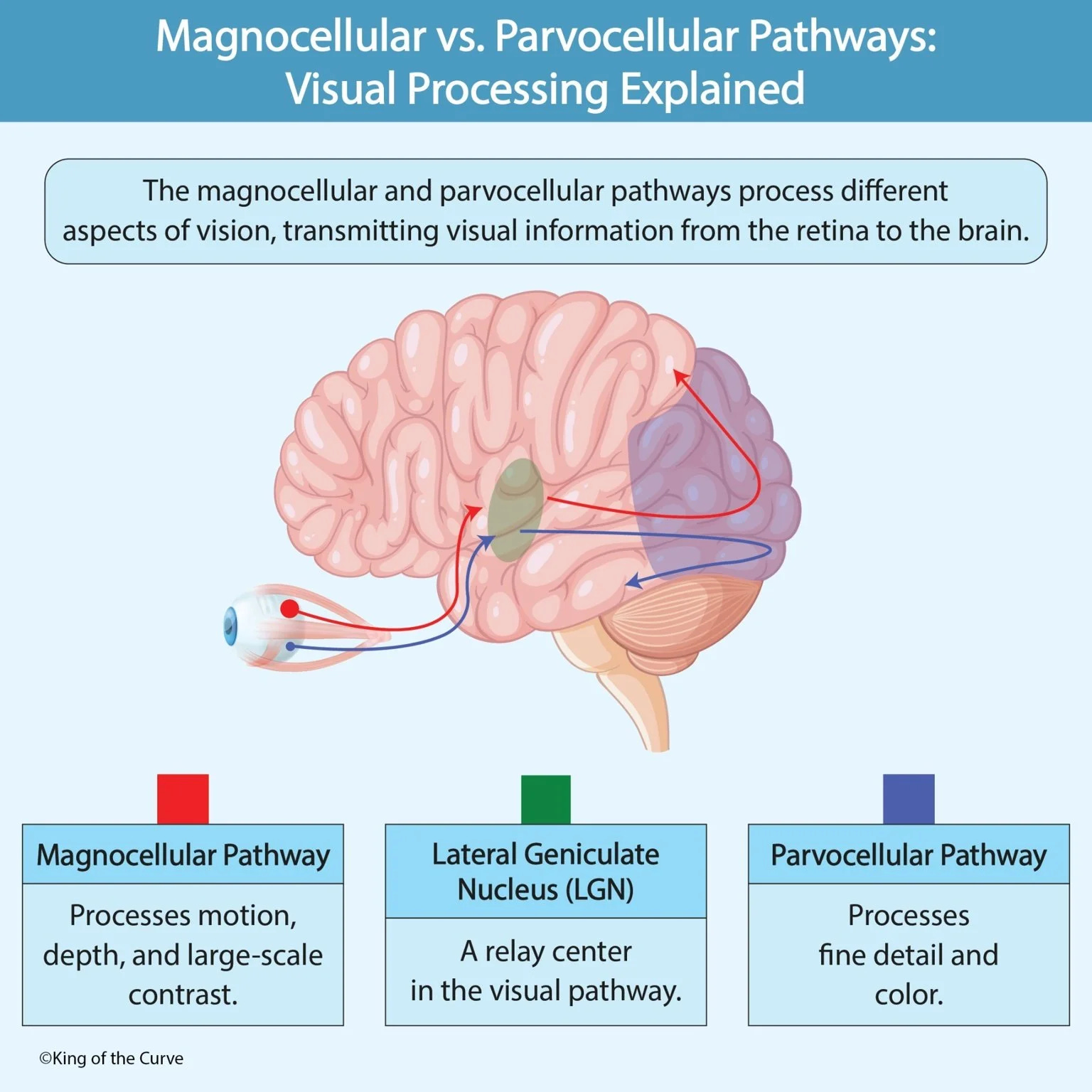
When the brain perceives a threat, the amygdala (the brain’s threat-detection center) rapidly evaluates the information and communicates with the hypothalamus (the brain’s command center responsible for maintaining the body’s internal balance). This activates the sympathetic nervous system (our fight-or-flight response), increasing cortisol (the body’s primary stress hormone) and adrenaline (a hormone that prepares the body for immediate action). As a result, our heart rate increases, our breathing becomes more rapid, our muscles become tense, and our attention narrows as the brain focuses on whatever it believes is most important for survival (McEwen, 2007).
From a biological perspective, this response is an extraordinary gift. If you were walking through the wilderness and encountered a dangerous animal, focusing your attention on the threat would increase your likelihood of survival. Psychologist James Easterbrook described this principle more than sixty years ago, demonstrating that heightened emotional arousal narrows the range of information we attend to, allowing us to focus on what appears most urgent (Easterbrook, 1959).
The challenge, however, is that our brains often respond to modern emotional stressors using many of these same pathways. An unexpected phone call from a physician, financial uncertainty, conflict within a relationship, or the fear of an unknown future can all activate the same stress response, leaving us mentally exhausted and emotionally overwhelmed even though we are not facing immediate physical danger.
That realization leads to an interesting question.
If fear naturally narrows our attention, what happens when we intentionally broaden it?
This question is now a key topic in neuroscience, and I think it beautifully reminds us of God’s wisdom in designing both our brains and our faith.
Researchers have long understood that our visual system does much more than allow us to appreciate the beauty of God’s creation. Vision is intimately connected with attention, arousal, and the way our nervous system responds to the world around us. Neuroscientist Dr. Andrew Huberman has helped bring renewed attention to this relationship by explaining how our visual field and our physiological state continually influence one another (Huberman, 2021a, 2021b).

When we become frightened, our vision naturally changes. Our pupils dilate, our attention becomes fixed on the perceived threat, and our visual field narrows. This response, sometimes described as focal or tunnel vision, allows the brain to devote more of its resources to whatever appears most important for survival. It is an extraordinary design when we face genuine danger, as it helps us react quickly and efficiently.
The link between vision and the nervous system goes both ways. Scientists are studying how widening our visual focus, called panoramic vision, might help calm our bodies and lower stress (Huberman, 2021a). Instead of staring at one thing, letting our eyes take in more of our surroundings seems to send a different message to the brain. This research is still growing, but it shows how connected our bodies really are.
Closely related to this is the concept of optic flow, which describes the movement of the visual world across our eyes as we move through our environment. If you have ever walked through a park while watching the trees sway in the breeze, noticed the horizon stretching before you, or simply observed the scenery passing by as you walked down a quiet street, you have experienced optic flow. It is one of the many ways our visual system interacts with movement, balance, and the nervous system (Huberman, 2021b).
This may be one reason so many people instinctively say, “I just needed to go for a walk.”

Walking does much more than burn calories. Regular exercise can boost your mood, reduce anxiety and depression, improve thinking, and increase levels of a protein called BDNF that helps brain cells grow and adapt (Erickson et al., 2011). As we walk, our bodies move, our eyes see more of the world, and our brains get the message that we are not stuck focusing on just one problem.
Morning sunlight is another great example of God’s design. Getting natural light soon after waking helps set our body’s main clock, which keeps our sleep, hormones, and many other processes on track. Good morning, light also affects our daily cortisol and melatonin levels, leading to better sleep, mood, and overall health (Khalsa et al., 2003; Foster & Kreitzman, 2017).
Thinking about these discoveries brought me back to the Psalms. David didn’t know about the retina or the nervous system. He never heard words like amygdala, hypothalamus, or neuroplasticity. But led by the Holy Spirit, he often wrote about lifting his eyes to God, remembering God’s faithfulness, and focusing on the One who stayed steady even when life was uncertain. The writer of Hebrews gives us such a powerful picture of the Christian life. He compares it to a race, encouraging us to “lay aside every weight, and the sin which so easily ensnares us,” and to “run with endurance the race that is set before us, looking unto Jesus, the author and finisher of our faith” (Hebrews 12:1–2). The Greek word translated “looking” conveys the idea of turning our eyes away from one thing to fix them intentionally upon another. It is not a passing glance. It is a deliberate and sustained focus.
Every runner understands this principle. A runner who constantly looks over his shoulder, watches the crowd, or becomes distracted by those running beside him will eventually lose both his rhythm and his direction. The Christian life is no different. God has not called us to run someone else’s race. He has called each of us to faithfully run the race He has marked out for us, keeping our eyes fixed on Christ. The One waiting for us at the finish line is also the One who faithfully strengthens us every step along the way.
Fear can make us focus only on our problems. Faith helps us look back to Jesus. Fear leaves us stuck on what we can’t control, but faith reminds us of the One who holds everything together.
Throughout Scripture, God repeatedly invites His people to lift their eyes. David lifted his eyes because he knew where his help came from. Peter walked on water while his eyes remained fixed on Jesus. The writer of Hebrews encourages every believer to “lay aside every weight, and the sin which so easily ensnares us, and… run with endurance the race that is set before us, looking unto Jesus, the author and finisher of our faith” (Hebrews 12:1–2). Although these passages were written centuries apart, they point to the same unchanging truth: where we direct our attention matters.
The imagery of Hebrews is especially powerful because the Christian life is compared to a race. Endurance athletes understand that success is not determined simply by strength or talent. It also depends upon where attention is directed. Sports psychologists have long recognized that attentional focus is one of the most important components of performance because the brain has a limited capacity for processing information. Athletes who continually look behind them, become distracted by the crowd, compare themselves to competitors, or dwell on previous mistakes divide their attention and often sacrifice both efficiency and endurance. Those who remain focused on the next stride and the finish line are better able to regulate their thoughts, emotions, and performance under pressure (Moran, 2012; Weinberg & Gould, 2023).

The Christian life has its own distractions. Some of us get stuck on past regrets. Others worry about the future. Many compare their lives to those of others. Soon, we spend our energy on things that shouldn’t be our focus. The Bible calls these things “weights.” Not all weights are sins, but every extra weight makes our race harder. Worry, rumination, comparison, and fear are all weights. Carrying what Jesus asks us to give up will eventually wear us out.
Then comes one of the most beautiful invitations in all of Scripture: “looking unto Jesus.”
The Greek word for “looking” (ἀφορῶντες, aphorōntes) means to look away from one thing and focus on another. The writer is not telling us to just glance at Jesus now and then while staying caught up in fear, disappointment, or comparison. Instead, we are invited to keep turning our attention back to Christ. It is a choice we make again and again as new distractions come up.
The same principle helps explain why Peter began to sink. The wind had not suddenly become stronger. The waves had not become higher. Jesus had not moved. Peter’s circumstances remained the same, but his attention shifted. Matthew records that “when he saw that the wind was boisterous, he was afraid; and beginning to sink, he cried out, saying, ‘Lord, save me!’” (Matthew 14:30). His gaze moved from the Savior to the storm, and fear quickly followed.
Many of us have felt this way. Life may not have changed, but our attention drifts from God’s faithfulness to the worries around us. We replay hard conversations, imagine the worst, revisit old hurts, compare ourselves to others, and scroll through bad news. Soon, our minds are so full of what we can’t control that we forget about the One who is always in control.
One of the things psychologists have learned is that where we place our attention matters. The more we focus on something, the easier it is for our brains to return to it. Because of neuroplasticity (the brain’s ability to change through repeated thoughts and experiences), habits like fear, rumination, or worry can become automatic (Doidge, 2007). The good news is that our brains can also build better habits. When we turn to God’s Word, think about His promises, remember His faithfulness, and focus on Christ, we help our minds move toward hope instead of despair.
This is one reason God repeatedly commanded Israel to remember. They were to remember the Red Sea, the manna in the wilderness, the pillar of cloud by day, and the pillar of fire by night. They were to remember His covenant, His provision, His protection, and His faithfulness. Remembering was never merely about recalling history. It was about strengthening hope. Every reminder of God’s past faithfulness became fresh evidence that He could be trusted with the future.
Maybe that’s why lifting our eyes is such a powerful spiritual habit. When we focus on Christ again, our perspective changes. We remember who God is, what He has done, and that even though our situations change, His character stays the same.
Tomorrow morning, before you grab your phone, try starting your day differently. If you can, step outside and let the morning sunlight wake up your body. Take a slow walk and notice the beauty around you, and remember the Creator. Look toward the horizon instead of a screen. Read Psalm 121 and Hebrews 12. Thank God for His faithfulness. Remember the prayers He has answered and how He has helped you through tough times. Begin your day by focusing on Jesus.
Walking, morning light, broadening your visual attention, and spending time in God’s creation are beautiful gifts of common grace. They support the nervous system because they are part of the way our Creator designed the human body. Yet they are not the source of our hope.
Our hope is not found in a technique, in neuroscience or psychology; our hope is found in Jesus Christ, the Author and Finisher of our faith. We abide, but the Holy Spirit renews us.
The One who created every neuron in your brain also knows every anxious thought that has ever crossed your mind. The One who designed your nervous system also understands every burden you carry. The One who calls you to lift your eyes is the same One who promises to sustain you as you run the race He has marked out for you.
Lift up your eyes, Fix your eyes on Jesus. Run your race with endurance. Your help has always come from the Lord.
If this encouraged you, be sure to follow The Christian Mind Reset Substack, Apple Podcasts, or Spotify for weekly conversations about neuroscience, psychology, and renewing your mind through God's Word.
Closing Prayer
Father,
Thank You for reminding us that our help has always come from You. When fear begins to capture our attention, teach us to lift our eyes back to Christ. Help us lay aside every weight, run the race You have set before us with endurance, and fix our eyes on Jesus, the Author and Finisher of our faith. Renew our minds with Your truth, strengthen our faith through Your Word, and help us remember Your faithfulness in every season. May our hearts find lasting peace, not in our circumstances, but in Your unchanging presence.
In Jesus’ name,
Amen.
Love and Light,
Dr. April Joy
Philippians 1:6
Disclaimer: This letter is for informational purposes only. It contains general information, drawn from my experience, research, and best practices. It is not health care advice, and is not intended to replace the counsel of your health care provider. Consult your provider before starting any new treatments or making changes to your health routine. This message does not constitute a doctor-patient relationship between us.
If you are experiencing significant anxiety, distress, or need support, please seek care from a qualified healthcare professional. You may also consider reaching out to a licensed Christian counselor or pastor for additional support.
If you are in crisis, having thoughts of harming yourself or others, or feel unsafe, please call 911 or go to your nearest emergency room immediately.
References
Doidge, N. (2007). The brain that changes itself: Stories of personal triumph from the frontiers of brain science. Viking.
Easterbrook, J. A. (1959). The effect of emotion on cue utilization and the organization of behavior. Psychological Review, 66(3), 183–201. https://doi.org/10.1037/h0047707
Erickson, K. I., Voss, M. W., Prakash, R. S., Basak, C., Szabo, A., Chaddock, L., Kim, J. S., Heo, S., Alves, H., White, S. M., Wojcicki, T. R., Mailey, E., Vieira, V. J., Martin, S. A., Pence, B. D., Woods, J. A., McAuley, E., & Kramer, A. F. (2011). Exercise training increases size of hippocampus and improves memory. Proceedings of the National Academy of Sciences, 108(7), 3017–3022. https://doi.org/10.1073/pnas.1015950108
Foster, R. G., & Kreitzman, L. (2017). Circadian: The rhythms of life. Yale University Press.
Huberman, A. (2021, June 14). The science of vision, eye health & seeing better. Huberman Lab.
Huberman, A. (2023, June 28). Exercises & nutrition to support eye health. Huberman Lab Newsletter.
Khalsa, S. B. S., Jewett, M. E., Cajochen, C., & Charles A. Czeisler. (2003). A phase response curve to single bright light pulses in human subjects. The Journal of Physiology, 549(3), 945–952. https://doi.org/10.1113/jphysiol.2003.040477
McEwen, B. S. (2007). Physiology and neurobiology of stress and adaptation: Central role of the brain. Physiological Reviews, 87(3), 873–904. https://doi.org/10.1152/physrev.00041.2006
Moran, A. (2012). Sport and exercise psychology: A critical introduction (2nd ed.). Routledge.
Purves, D., Augustine, G. J., Fitzpatrick, D., Hall, W. C., LaMantia, A.-S., Mooney, R. D., Platt, M. L., & White, L. E. (2018). Neuroscience (6th ed.). Oxford University Press.
Weinberg, R. S., & Gould, D. (2023). Foundations of sport and exercise psychology (8th ed.). Human Kinetics.
No posts
Comments
Nothing yet. Say the first thing.
Sign in to join the conversation.