
DEAR READER: If independent journalism matters to you, please consider a $5/month membership. I report daily from inside Ukraine’s war — through blackouts, through attacks — and your support makes that possible. These dispatches will remain free to all readers. This work depends on those willing to sustain it, and I’m grateful to everyone who does. — Chris Sampson, Kyiv, August 24, 2026, Day 1642 of full scale Russian war against Ukraine.
I got up this morning wanting coffee, which is not usually a story. Today it is, a little, because of what today is, August 24th, Independence Day in Ukraine. Thirty-five years since Ukraine declared itself free from under the Soviet Union, and I walked out my front door at 8 am to go get coffee and see the day start. I stopped and celebrated the day with my neighbors for a minute, noting our Independence Day and talking about my feelings as an American here for four years.
Then I looked down. There was a little black kitten, walking out from under our door lady’s feet, coming toward me. I asked her if the kitten had a home. She said no, she’d just been seeing her around. I said, well, she has one now.
I scooped her up. Coffee could wait. First priority was securing the kitten!
Upstairs, I let her get used to the apartment, closing a few of the doors to reduce the overwhelm. I held her for a while so she’d have some sense that the enormous strange place she’d just been carried into wasn’t a threat. When it was time for me to actually leave, for that coffee, I had to walk her all the way to the far end of the apartment, away from the front door, before I could slip out without her chasing after me.
From there it was straight to the pet store. First, I told the woman behind the counter to give me the beginner bundle. While she was putting it together I was already turning over names in my head, and the first one that landed was Mazepa, after Ivan Mazepa, one of our great national heroes, a name with real weight to it.
Then I found out she was a girl.
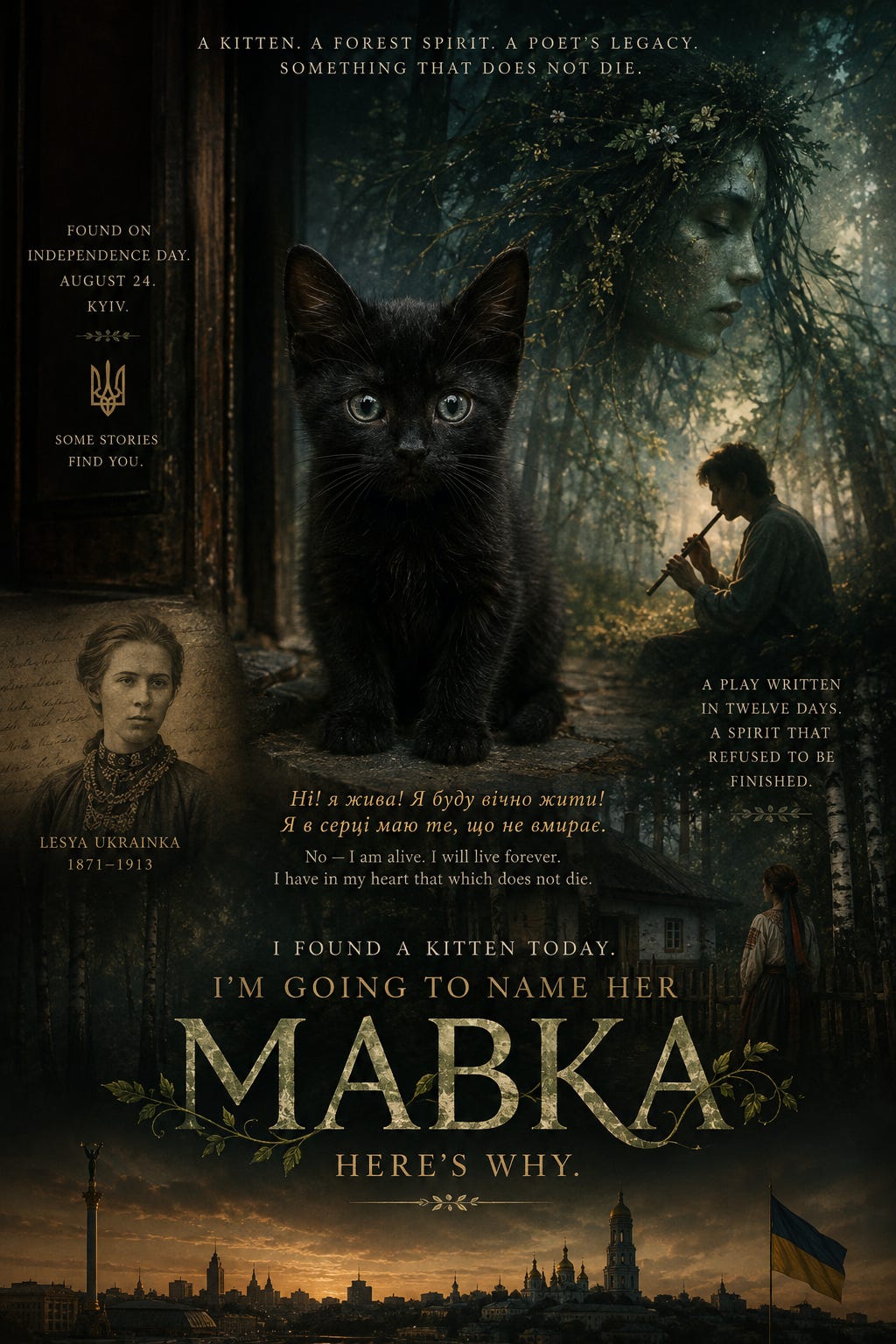
That ruled out Mazepa fairly quickly, and I needed a replacement. One word entered my mind immediately, and there’s a second name that arrived right alongside it that’s actually part of the same story, Lesia Ukrainka, one of our most legendary writers, and the woman who wrote the character I’d just landed on.
Here’s why.
Long before the Ukrainian writer Lesya Ukrainka ever touched the word, a mavka was already a fixture of Ukrainian folk belief, particularly in the forested northwest, Volyn, Polissia. The stories date back for many centuries to Pre-Christian Ukraine.
Mavky were not gentle woodland sprites like in the Disney style movie from a few years ago. In a lot of the older tradition they're bound up with premature or unnatural death, girls who died before their time, spirits that didn't go where spirits are supposed to go and instead stayed in the forest. Some tellings have them beautiful from the front and hollow from behind, a warning built right into the body: don't mistake loveliness for safety. They lure travelers off the path. They confuse, they enchant, and they are not reliably kind about it.
Beautiful, wild, elusive, not entirely safe, and not entirely of this world. That's the mavka before anyone wrote a play about her, and already a fairly accurate description of a small black cat who appeared from under someone's feet on Independence Day with zero regard for whether I was ready for her.
But there’s a second Mavka, and she’s the one I actually named the kitten after.
In the summer of 1911, Ukrainian author Lesya Ukrainka was in Kutaisi, in Georgia, being treated for the tuberculosis that would kill her two years later. Far from home and sick, she wrote a play in ten or twelve days, by her own account, in a letter to her sister Olha, a stretch so intense it left her, in her words, sick and devastated once it was finished.
The play was Лісова пісня, The Forest Song. She called it a драма-феєрія, a fairy drama, set it in the Volyn woods of her own girlhood, the same country of legend she’d grown up hearing about. It wasn’t presented on stage until 1918, five years after she died, at the Kyiv Drama Theater. It’s now generally considered the finest thing she ever wrote and one of the foundational texts of Ukrainian literature.
She takes the folk mavka, dangerous, uncanny, not to be trusted, and gives her something the folklore never bothered to give her: an inner life.
Her Mavka wakes from winter sleep in the hollow of an old willow. She hears a sound she’s never heard before. A sopilka, the wooden Ukrainian flute. Played by a village boy named Lukash.
She follows it out of the forest.
Lukash has something in him worth following. The music. The willingness to see a birch tree as anyone’s sister. And by the end of the play, that thing in him gets traded away for a working farm and a wife who doesn’t ask him to notice things like that.
That’s the real betrayal in The Forest Song. Not infidelity. Self-abandonment, dressed up as growing up.
Later in the play, a dark figure comes for Mavka, the Той, що в скалі сидить, roughly "the one who sits in the rock." He tells her she's already lost. That for a creature like her, happiness was never anything but a shadow. That she was never really alive to begin with.
She answers him like this:
Ні! я жива! Я буду вічно жити!
Я в серці маю те, що не вмирає.
Translation: No, I am alive. I will live forever. I have in my heart that which does not die.
By the time she says this, Lukash has already chosen Kylyna. The love that pulled her out of the forest has already failed, at least in the shape she wanted it to take. She has every reason available to a person, or a spirit, to agree with the thing telling her she isn’t real.
She doesn’t. Something in her keeps refusing to be finished. Underneath the pain there’s something else, something that survives the failure of the thing that produced it.
How it ends
Lukash eventually understands roughly what he threw away. Understanding doesn’t change anything that already happened. Mavka comes back to him at the end folded into the willow, into the winter, into the forest itself. And Lukash plays his flute again.
I’ve lived in this amazing country through everything since the end of January 2022. Lesya Ukrainka had no way of knowing how any of this would turn out. She was writing about her own forest, her own illness, her own losses, over a century before any of it.
But I found this kitten on Independence Day. After starting my morning celebrating a day that has cost this country more than most countries ever have to pay for their own name. And I’ve read that line, я в серці маю те, що не вмирає, more than once since I got here. It lands differently in Kyiv than it might somewhere else. Because of who I keep meeting here, and what keeps surviving in them regardless of what’s been taken.
I almost called her Mazepa. Instead: Мавка.
Not just because she’s black and the name has an appropriately mystical ring to it. Not only because Mavka is a well known figure from Ukrainian folklore, though that alone would have been reason enough. But because once you know what the name actually holds, the forest, the flute, the mother who couldn’t see past the useful, the man who traded his own music for an ordinary life, and the thing in her that refused to stop existing when he did, it stops feeling like a costume. It starts feeling like the name she was already wearing when she walked out from under that door lady’s feet this morning.
And it pays respect to one of our greatest writers, one adored by our people here.
This sweet kitten has no idea what day it is, or what her name means, or that a woman dying of tuberculosis in Georgia wrote her into existence in twelve days back in 1911. She’s asleep on my shoulder right now, having spent her first hours as a Sampson doing what kittens do, which is not much, and doing it as though it were the most important work in the world.
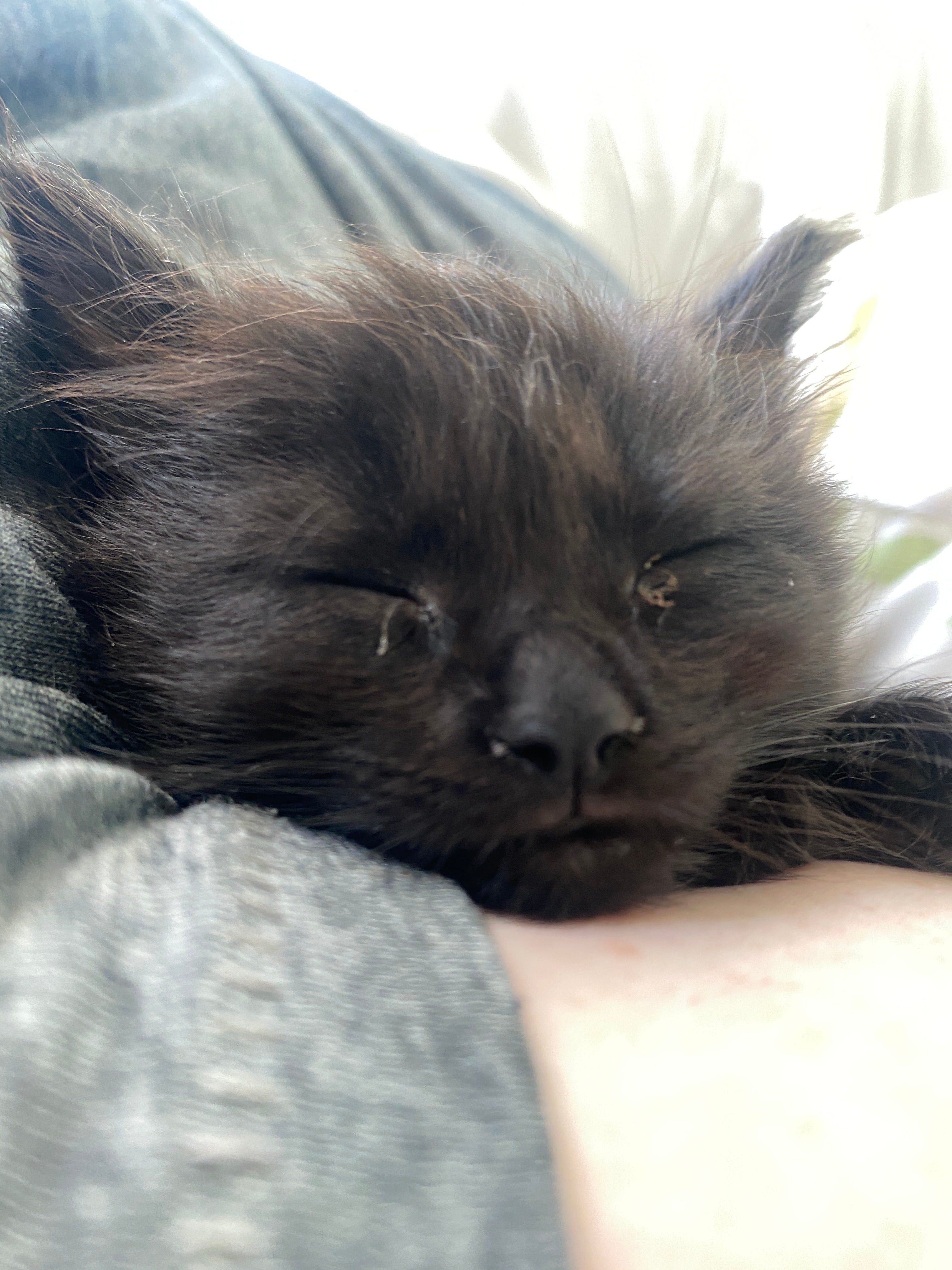
Мавка.
That’s enough.
Слава Україні
Героям слава
І слава Мавка
І смерть ворогам
No posts
Comments
Nothing yet. Say the first thing.
Sign in to join the conversation.