
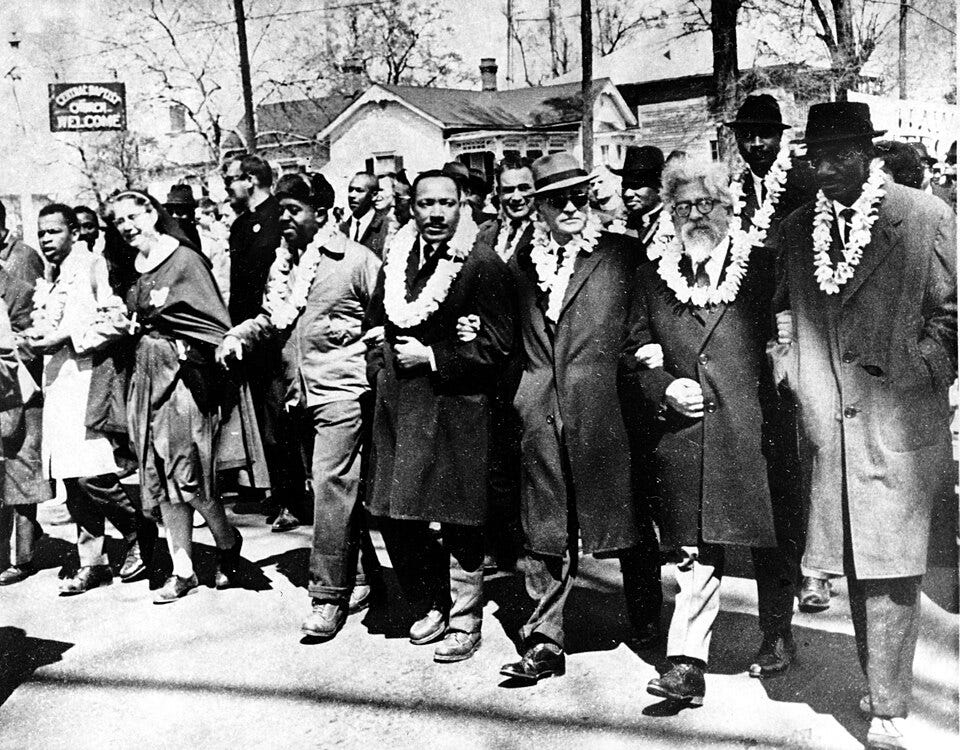
For American Jews, participation in the civil rights movement is a source of pride. The photo of Rabbi Abraham Joshua Heschel marching alongside Rev. Dr. Martin Luther King Jr is perhaps the most defining image of 20th-century American Jewish history. That photo captures a whole ethos: two minority groups, side by side in lockstep, inspired by Biblical messages of justice, peacefully demanding equality from a country that was long on promises but short on delivery.
Despite ongoing alliances, the political and ethical romance between African Americans and Jews frayed over the decades. Neighborhoods once organically integrated by non-white groups (in Seattle, look no further than a Garfield or Franklin yearbook from the 1950s to see pages full of Jewish, black, and Japanese students) started to self-segregate, success rates diverged, power dynamics shifted, and both communities turned inward, with Jews turning their attention to the state of Israel and the era of MLK giving way to black power and Malcolm X.
Over the past few years, the distance between these allies has become more obvious. While the black-Jewish alliance loomed large in Jewish imaginations, Jews became reclassified as white, an interesting bookend to the beginning of the relationship, where Jews joined African Americans as fellow minorities. Jews imagined themselves as allies without fully realizing that they had become considered part of the oppressor class. And when Jewish institutions jumped on the antiracism train, they found that the anti-Israel team had gotten on board much earlier.
“I think we have often been over-reliant on nostalgia in speaking about the alliance and the relationship,” says Sam Jefferies, the creator of The Kids Table PAC who organized Lox and Legislators, a black-Jewish dialogue breakfast this past Wednesday morning at Herzl-Ner Tamid on Mercer Island.
The breakfast sat dozens of elected and communal leaders from both communities around tables over bagels to talk about areas of shared experience and how to get back on the same page. The morning opened with prayers from Christian and Jewish leaders and remarks from Attorney General Nick Brown, who talked about how his father marched with King and taught him how critical partnerships were to the civil rights movement.
Despite the tension many Jews have felt with the state’s elected leaders around inaction on anti-Semitism, Jefferies has found a partner in Brown. “He’s physically shown up at our spaces, even when that’s not a politically easy thing to do,” he says.
With elections coming up and in light of political anti-Semitism and racism, the event sought to open more honest conversations about the trajectory of the two communities. “The interfaith seders of 2019 are really a vestige of another age,” Jefferies says. “Sorry, I don’t want to talk about the Exodus, and neither do they.”
Jay Rosenbaum, rabbi emeritus of HNT, who has been part of a black-Christian-Jewish Bible study for six years, understands the need for more honest conversations.
“Being Jewish in America is not like being black in America,” he says. “We came here to escape tyranny, and they came here because of tyranny.”
He thinks the central narrative of the Exodus should be replaced with the narrative of the wilderness. Free from servitude, both communities can forge a society together.
“It shouldn’t be the case that the only way you can get sympathy is being a victim,” Rosenbaum says. “What you’re saying is the moment I succeed, I’m going to abandon you… The success of black people is what makes white racists crazy. That’s something we have in common.”
It’s a frustration shared by Rep. David Hackney (D-11).
“Kids are being taught that racism is so bad, being black you can’t accomplish anything,” he says. “I didn’t hit a triple. I was born on third base. My family set me up to go to college and law school, not because I’m such a virtuous person or I’m brilliant. I was set up to succeed.”
Hackney recalls growing up in a civil rights-oriented home in Ohio but only meeting Jews for the first time in college at Cornell. “It’s that interaction that eliminates the ignorance of racism and hatred and anti-Semitism,” he says. Bringing the communities together for holidays or cultural celebrations would be a step toward a deeper partnership. “It’s hard to be ignorant and hate your friends,” he says.
A moderate up for reelection in South King County, Hackney has served as a war crimes prosecutor in the Hague. He traveled to Israel last year and visited the Nova massacre site, where he also experienced multiple midnight trips to the bomb shelter.
“I didn’t quite understand until I got there, until I met with people, until I saw the destruction,” he says. “If Hamas put their weapons down, so would Israel. You can’t attack someone and then cry war crimes when they attack back. That’s not how it works.”
The purpose of a renewed partnership, though, is not to get the black community to sympathize with Jews or to convince anyone that anti-Zionism is anti-Semitism. The shared struggle is also based simply on dignity.
“All my black friends, they are so at risk of racism based on physical appearance,” Jefferies says. “That’s not a problem for me based on my outward appearance. My concern is my kids have to hide their identity until it fades…Your biggest risk is that someone judges you based on how you look, and my biggest risk is we allow someone to degrade who we are.”
When asked what he would want from the Jewish community, Hackney was quick to answer.
“You know what’s really needed? We need alternatives to juvenile incarceration,” he says. “We need mentors for kids in families that are broken. They need big brothers and big sisters to help them understand what college is about. There are so many things you can do.”
How to build that relationship without it becoming transactional is an important question. Rosenbaum points to the 1960s, when Jews were heavily involved in black causes and were perceived at times to be exploiting them.
“To shift the narrative and understand how our success and our resilience is what we have in common, I think that will help the relationship,” he says. “I think it will take some time.”
Adding to the mix is a new community, the African diaspora. Emmanuel Muvunyi, Deputy Director of Business Operations for the International Rescue Committee (IRC) in Washington and Montana and a Rwandan, feels a natural bond with the Jewish community that’s based on an entirely different set of shared experiences.
“As Attorney General Nick Brown said yesterday, these conversations are vital and today was a great start, but the real measure of success is what we do next,” Muvunyi said over email the day after the event. “We can’t change the past, but we do have the power to shape the future starting by rebuilding bridges in our relationships and building coalitions so that we fight one fight together and support one another.”
At the end of the day, a reinvigorated black-Jewish partnership could be a lever in the effort to pull American politics away from the edges.
“A coalition isn’t everyone agreeing on everything all the time,” Jefferies says. “I don’t want a watered-down project. I want some people to be with us some of the time. I would imagine my black friends and neighbors want the same thing. There is room to find it.”
Check out the Seattle Jewish community calendar.
Candlelighting in Seattle is at 8:43 p.m. The parasha is Devarim.
Send shoutouts and announcements to thecholentseattle@gmail.com.
Help us recover from recent disasters
Please also consider helping the reconstruction of the tahara facility, which was also destroyed in a fire. Donate now.
Support the Jewish community of Venezuela, which was affected by an earthquake. Donate to the Friends of Yajad Venezuela.
Mahjong Retreat Labor Day Weekend
Join us at Camp Solomon Schechter for “Mahj & More,” Friday, September 4 to Monday, September 7. This fun-filled, adults-only getaway features mahjong, great kosher meals, community, and camp activities. Whether you want to learn mahjong, advance your game or just play all weekend, this getaway is designed for everyone. Early bird discount ends July 10. Learn more: www.campschechter.org/mahj/
Travel to Spain with Jewish History Tours: October 18-29, 2026
Join for an extraordinary travel opportunity to learn about Sephardic history and the Golden Age of Spain through walking tours, world heritage sites, and lots of delicious food and wine. The tour will begin in Barcelona and then continue to Andalucia to Granada, Cordoba, Seville, Madrid, and Toledo. We offer small group travel, 4–5-star boutique hotel accommodations, smart local guides, and of course, lots of tapas!
For all the details, itinerary, and pricing - go to: https://www.norakaplan.com/spain.html#/
This will be the 5th tour in partnership with Moises Hassan of Jewish Spain Tour and Qesher with group leader and local Seattleite, Alexis Kort.
Contact Alexis via cell phone at 347-446-1422 or email alexis.learnintrips@gmail.com

Comments
Nothing yet. Say the first thing.
Sign in to join the conversation.