
→ Fashion Prompt is a weekly series where I entice your curiosity about fashion through an excerpt, quote, photo or other piece of media that you may have saved, scrolled past or forgotten about.
Hellooo my swans,
I hope you’ve had a beautiful week! For today’s issue, we have a short quote with a short(ish) reflection.
One of the main inspirations behind this series is my desire to make more time for revisiting. I feel like there’s so much pressure these days to constantly take in new information, new ideas, etc. But with that, I think we forget about the things sitting in our saved folders and bookmarks.
So, as an add-on to this series, I created a digital commonplace notebook that you can download and use as your own practice of revisiting.
You can get it through the link below. (If you’re a paying subscriber, I’ll give it to you for free! Just email me at arbela.hello@gmail.com).
Today’s prompt comes from a quote by the one and only Marc Jacobs.
Interestingly enough, when I first picked this quote and started writing about it, I was actually using a misquote. (This is another reason why I’ve been enjoying doing these posts as a practice for myself because it’s forcing me to pay closer attention to inspiration I take in!)
Anyway, I originally thought the quote was: “Clothes mean nothing until they are worn.” But actually, it’s:
“Clothes mean nothing until someone lives in them.”
Slightly different, but this still changed my thoughts a bit. The idea of clothing having no meaning before it’s applied to the body is the same, but what has changed is the word “lived”.
Here’s what the distinction prompted from me: someone putting on or briefly wearing something (a rental, an item in a dressing room, a borrowed piece) may not give too much meaning to the piece.
But, if someone lives in the clothing — throughout the years, their workdays, their milestone occasions — well, then that certainly means so much more.
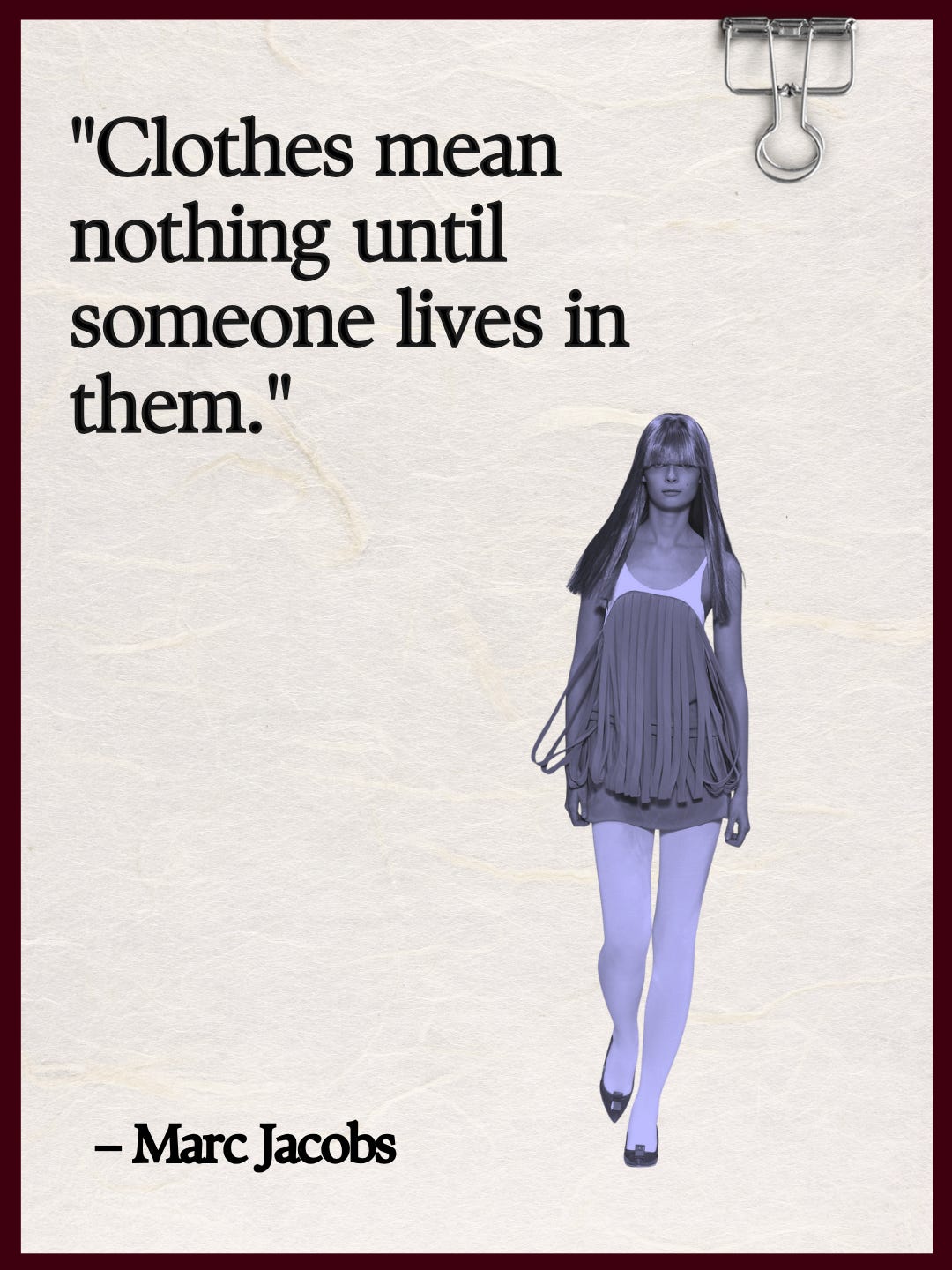
Whatever iteration, I’ve always loved this quote when I saw it. It speaks to the core of how I view clothing and fashion. What has always been most interesting to me is how clothing becomes defined and redefined by a person’s life.
And still, as simple as it is, this quote brings out more questions.
Here’s my interpretation: I think when he’s referring to the “meaning” of clothes — it’s about how a piece becomes interwoven with the person — their body, their life, their routines.
But, if he was in front of me and I had a chance to ask a follow up, it would be: do models “living” in your pieces on the runway/in photoshoots count?
Also, I would imagine that to many designers, their pieces hold some sort of meaning, worn or unworn. If anything, in the context of something they created. A piece of clothing on a mannequin or on the cutting room table have some kind of life or pre-existence. And every stitch that was chosen or material manipulated had a purpose behind it.
Ultimately, the relationship of clothing to the body is what gives the pieces a definition, a three-dimmensional life of their own. And oftentimes, designers play with clothing’s relation to the body to create thought-provoking designs.
An example I think of is the backward heel from Marc Jacobs himself that came out in 2008. The shoes on their own immediately have a meaning, in my opinion, because they’re flipping around the meaning of what a shoe can look like. However, you can only really feel that when you see it on the human foot.
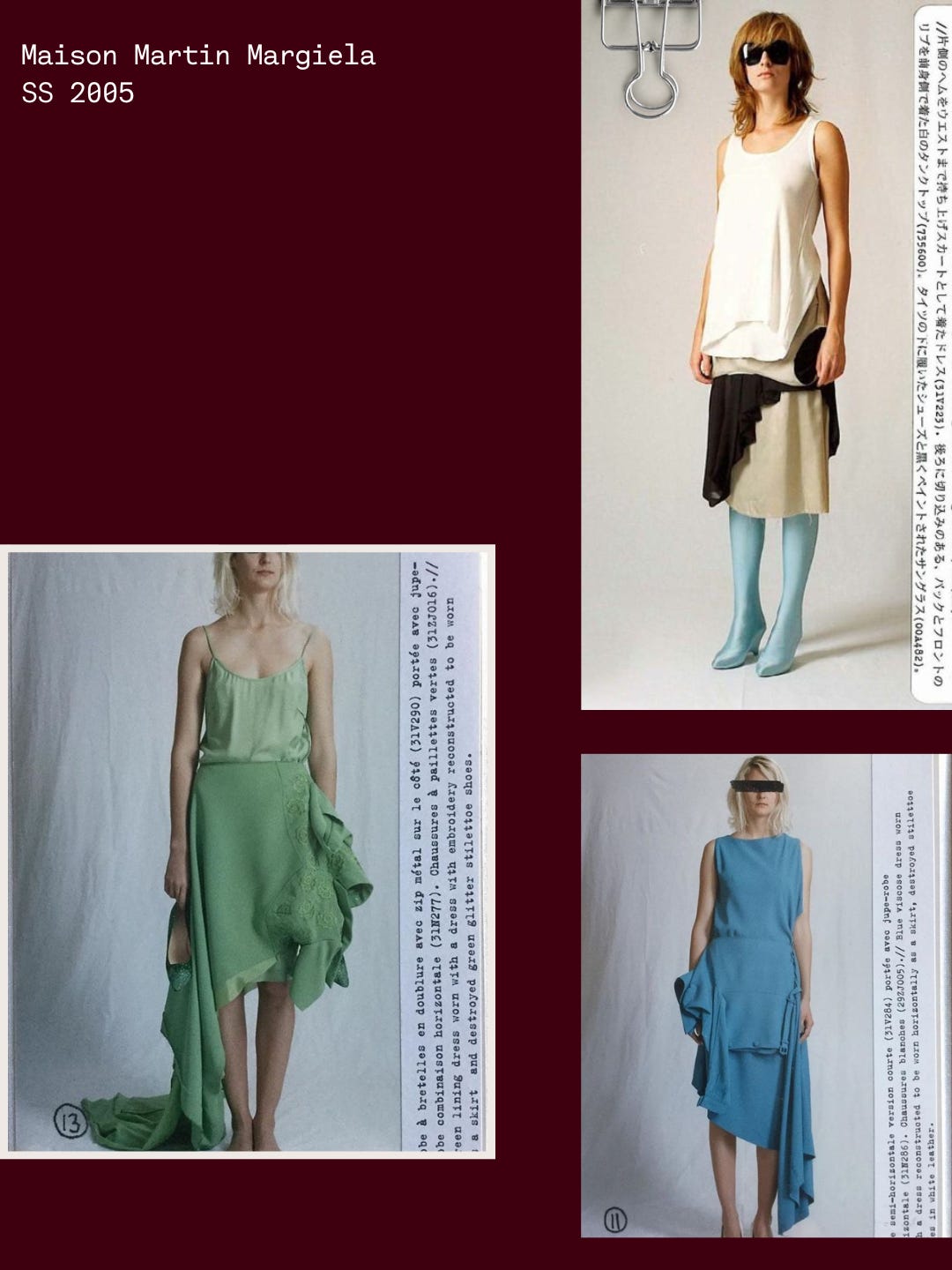
I also can’t help but think back to this 2005 runway collection from Maison Martin Margiela where he purposely threw the idea of wearing clothes “correctly” on its head. Shoes were carried in model’s hands, dresses became skirts, shirts were worn backwards, hanger loops were placed on the outside of garments, and so on.
The disheveledness of it all excites me because it reflects the movement of people’s lives — how we are often messy and nonsensical, and how our clothing can become a part of that chaos.
But, I would absolutely agree that clothing (and accessories) find a truer meaning when it spends time on the body. Perhaps, that’s when it reaches its final form.
So does that mean that unworn clothes have no meaning? Obviously that’s a very literal interpretation, but that’s part of what I’m trying to exercise here. Because a lot of clothes on this earth remain unworn — whether they’re forgotten, lost or disgraded. There is a meaningless in that and even a sense of grief.
To me, the meaning that remains is potential. All clothes have a potential to be worn and have a future. Their very existence of a piece of clothing — from the arm holes, the lining or the material — is an invitation be put on, not left on a hanger.

What is the meaning of clothes before they are worn?
Think of a piece of clothing in your closet that has changed after you’ve worn it in certain places or for certain occassions. Does it hold more or less meaning since you got it?
Has there ever been a piece of clothing (or outfit) you’ve seen or observed out in the wild that you had an original opinion about that changed once you saw it styled on someone?
What are some outfits or pieces of clothing throughout pop culture history that have become associated with a specific person or brand?

— Things I saved, screenshotted and reflected on this week.
Bella Hadid wears what Jane Birkin wore wrong. I didn’t know until Bella Hadid wore this dress for the Cannes Film Festival that the original inspiration was a result of Jane Birkin wearing a dress wrong. It’s not a plunging neckline, it’s the back of the dress!
The SATC reference in the Charli XCX’s music video for her song “SS26” is everything to me. And the whole art direction of the video itself (directed by Torso) is just perfect.
Kateryna Bohun is my new favorite art content creator on Instagram and I think you should follow her! Her approach is so interesting but easy to understand. I especially love her videos on Mark Rothko.
I hate when I find a graphic T-shirt I relate to on a deep spiritual level that I may never find or own.
One of my favorite brands and IG accounts, Rummage Stretch reminded me about the existence of the Glamour Magazine high heeled sprint that happened in 2007. Not surprised at all that this was in Russia because women in Eastern Europe are on another level when it comes to wearing heels.
Thank you for reading and being here!
Stay curious,
Arbela
No posts
Comments
Nothing yet. Say the first thing.
Sign in to join the conversation.