
Marie Malvar was 18 years-old when she hopped into the passenger seat of a dark pick-up truck in south Des Moines, Washington, and promptly disappeared. Her boyfriend, Robert Woods, watched her go, playing his part in the system they’d agreed to ensure Marie’s safety as she was selling sex on the streets of Seattle and the surrounding areas. It was 1983 and the last day of April. As the truck pulled away, Robert began to tail the vehicle, another precaution the couple had established. Pulling level, he could see Marie making energetic gestures; Robert thought she looked upset. The truck accelerated and Robert followed until he lost it at a turning. Uneasy, he returned to the parking lot to await Marie’s return. She never came back.
But Marie Malvar was the “cherished”1 daughter of a large Filipino family. When she failed to turn up, Robert went to her father, who started leading searches of the neighbourhood, looking for the truck Marie had been whisked away in. Four days after Marie’s disappearance, they found it, parked in the driveway of a ranch house on a nondescript residential street. They called the police, who dutifully arrived and spoke briefly to the owner, a sturdy, dark-haired man in his mid-thirties.
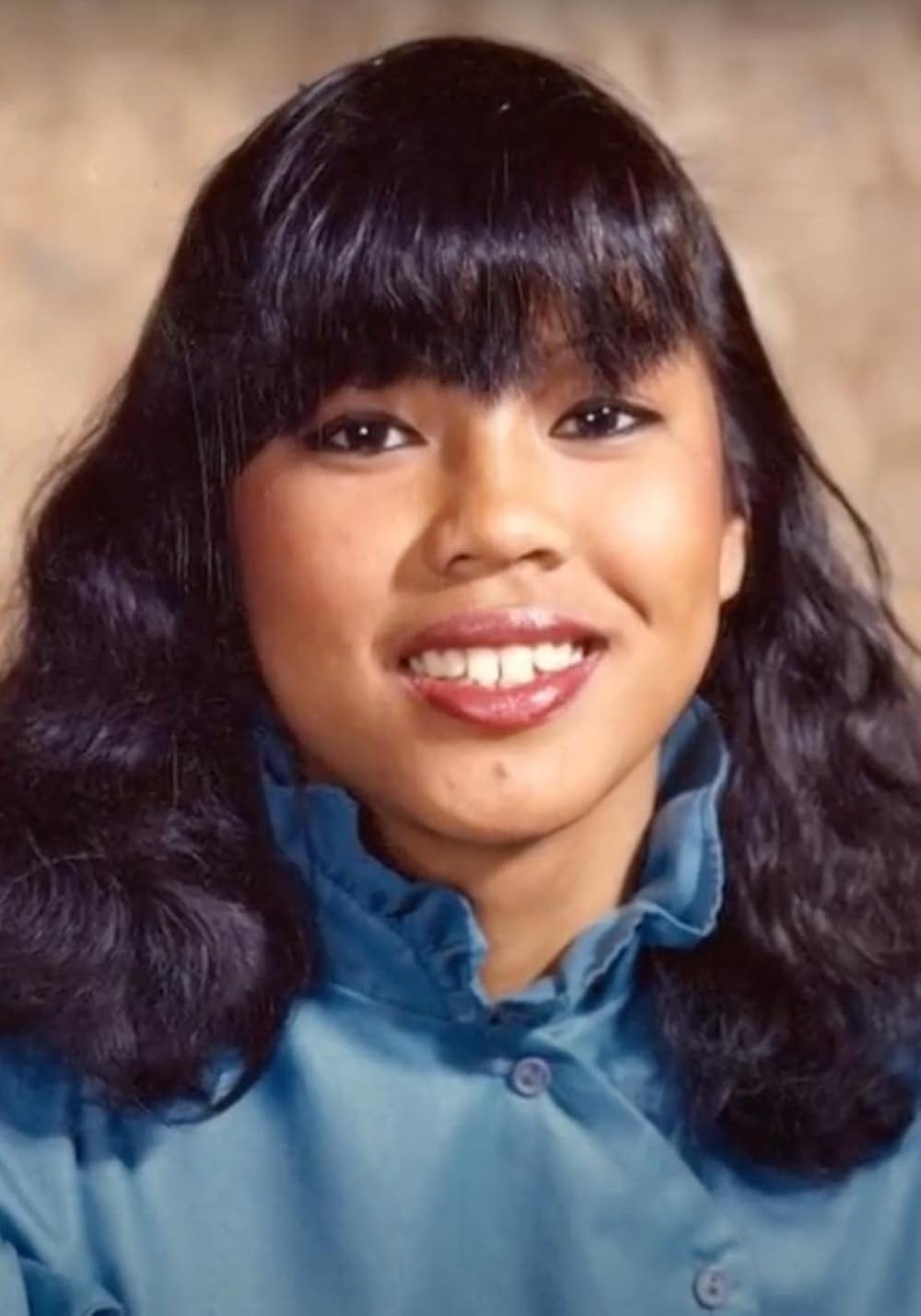
“He says there’s no woman in there,” the lead detective told Marie’s father, Jose Malvar2. “Hasn’t been a woman in there.”
In fact, Gary Ridgway, the man who’d answered the door to officers, had spent the conversation hiding deep gouges on the inside of his left arm. They’d been inflicted by Marie Malvar as she fought for her life inside his house. She’d lost; Marie’s skeletal remains would be recovered 18 years later, in a lonely ravine in Auburn, Washington. Ridgway had dumped her there because he was angry she’d left a mark, he told detectives in 2001, during his confession to the murders of at least 49 young women since the early 1980s. He’d had to cover the scratches by pouring acid on them; he still bore the scars.
‘’I know every time he looks at that scar, he remembers my sister,’‘ Marie’s brother told the New York Times when this detail came to light. ‘’At least she got that. At least she didn’t go down without a fight.’‘
Marie’s story is just one of many I’ve absorbed over the past few weeks. I’ve been reading and watching a lot of ‘true crime’, something I’ve done since adolescence in odd fits and spurts. It’s probably more honest — and shameful — to call it ‘bingeing’.
Like many people, I feel an uncomfortable and morbid pull to the amateur study of murder. There have been many attempts to analyse the obsession with true crime. Why do so many of us want to burrow inside the horror, turning it over? I like to think I have red lines around certain presentations: I won’t watch Ryan Murphy’s drooling portrayals of serial killers and I don’t enjoy media that turns brutal murder into salacious or comedic fodder. But at the end of the day, no matter how elevated or sensitive I think a true crime work is, it still belongs to the same pantheon as all the other penny dreadfuls.
Part of the appeal of true crime is simple narrative structure. They are mysteries, fraught with tension and stakes. Usually there is a resolution as someone is apprehended for the slaying. Strong protagonists emerge, whether in the form of grieving family, investigating officers or even, as in The Jinx, the suspected killer themselves. As I have aged, and my empathy has developed, I find myself almost wholly uninterested in the psychological development of murderers. Instead I’m far more invested in the lives of the victims they claim, and the social circumstances that allow them to do so. Why was Jeffrey Dahmer able to kill so many gay men of colour in 1990s Milwaukee? For the same reason police officers once handed him back a bruised and bleeding teenage Laotian victim who was attempting escape, accepting Dahmer’s explanation they were lovers because “it was a gay thing”. The backdrop included a highly charged and racially unequal city, plus homophobic stigma fuelled by the AIDs crisis.
Cases that become notorious also say a lot about the particular social moment in which they first captured public imagination. Narcissistic showman Ted Bundy offered up Hollywood spectacle in the late 1970s, as well as being a human embodiment of growing American fears about the monster who could be living next door. ‘Serial killer’ was a term just beginning to have resonance outside law enforcement when Bundy offered himself up as an archetype, eagerly courting press and attention.
In 2014, trust in policing institutions and their treatment of ethnic minorities was fraying. It seems little coincidence that the Black Lives Matter movement was born the same year a podcast suggesting a brown Muslim man was wrongfully imprisoned for the murder of his girlfriend 15 years earlier, exploded globally. Such was Serial’s cultural power, it eventually led to Adnan Syed’s conviction being overturned (a decision becoming more controversial with hindsight) and reshaped the true crime landscape for a new generation.
My most recent foray back into the badlands introduced me to Marie Malvar and her tragic sisters-in-arms: the other 48 (known) victims of Gary Ridgway aka the Green River Killer. Ann Rule spends most of Green River, Running Red, her comprehensive book on Ridgway, piecing together the lives of the victims he plucked from around Washington. Almost all were sex workers; Ridgway liked them very young, very beautiful and very overlooked by the authorities. The women were deeply missed by their family, lovers and friends. But the police did not take their disappearances seriously at first, or connect enough dots when they did.
Ridgway emerged as a clear suspect after 1983 and Marie Malvar’s abduction. Police received several tips relating to him. He was subject to a polygraph test in 1984. Unique paint samples from Ridgway’s job as a truck painter were found on the clothes of his very first victim in 1982. While forensic science was unable to process the multiple DNA samples he left at crime scenes, it was perfectly capable of examining these traces and linking them to a man his own colleagues called ‘Green River Gary’. And yet, it wasn’t until twenty years later, when DNA technology had progressed, that detectives finally hauled ‘Green River Gary’ in and charged him. Who knows how many lives could have been saved in the interval?
Police failure and error is an oddly under-remarked upon theme that underpins most of the biggest true crime cases, and lots of the ‘smaller’ ones too. Repeat offenders often become infamous, but they are only able to continue their campaign of terror because they haven’t been caught. Ninety-nine per cent of the time, this isn’t due to any great intelligence on their part.
So many victims would not have met their ends in such a devastating manner if policing was more efficient, or organised or not inflected with some sort of bias. The tension here is that police personnel are usually central narrators of true crime when the story finally gets told. As the administrators of the investigation, they have the inside scoop and are essential to understanding what happened. Frequently, their sacrifice is remarked upon: detectives who devote great portions of their lives to a case and are forever haunted by it. I don’t mean to undermine that. But for anyone with pattern recognition, the correlation between a police task force which makes repeated errors, and a serial killer able to continue their atrocities uninterrupted, seems obvious.
One example in particular stood out to me during my latest true crime binge. It came via a Netflix documentary examining the so-called ‘Happy Face Killer’, who murdered eight women across America between 1990 and 1995. His first victim was Taunja Bennett, a 23 year-old found strangled in January 1990. A local woman confessed to the murder, claiming her partner had killed Bennett and forced her into helping him dump the body. The woman, Laverne Pavlinac, changed her story multiple times. Key details didn’t add up. But police proceeded to charge Pavlinac and her partner anyway. A year later, as she took the stand at her trial, Pavlianc had a very different confession to make: she’d falsely admitted to the murder to escape her abusive relationship. At the same time, graffiti appeared in rest stop bathrooms in Montana and Oregon. “I killed Tanya [sic] Bennett Jan. 21, 1990 in Portland, Oregon,” the Montana message read, finishing: “People took the blame and I’m free”.
Days later, Pavlinac and her hapless partner were sentenced to life imprisonment.
It didn’t stop there. In 1994, The Oregonian newspaper began receiving letters, signed with a smiley face. They contained confessions to the killings of five women since 1990, Taunja Bennett among them. The letters included details that had never been made public. Columnist Phil Stanford began writing weekly articles, holding up the claims to the light. He named the series after the potential killer’s signature, the happy face, and had high hopes for the power of his journalism. “I thought the way I had taken apart the state’s case made it clear that these people were innocent,” Stanford says in the Netflix documentary. “I thought ‘oh the D.A will see this, McIntyre [Jim McIntyre, lead prosecutor on the Taunja Bennett case] will see this and they’ll say ‘woah we made a mistake’.”
He smiles wryly. “Of course, that was foolish of me”.
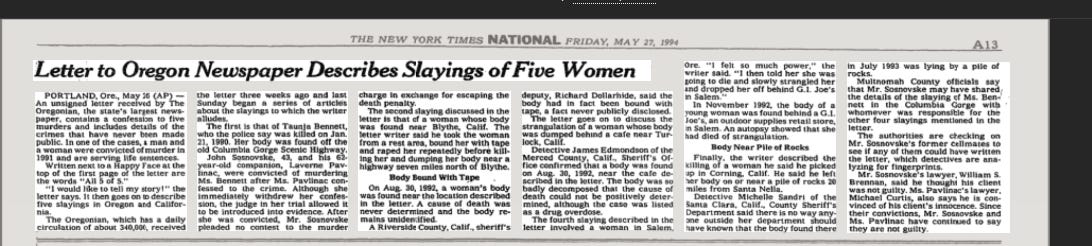
“Stanford fashioned himself a crime reporter who was uncovering all the things the state had done wrong,” McIntyre sneers in response (this was, in fact, exactly what Stanford was doing). “I thought it was nonsense”. The former attorney declared he didn’t read a “single column, line for line”.
Even when the actual killer turned himself in, 12 months after Stanford’s series, McIntyre still didn’t believe they’d made a mistake. Police in a different county had apprehended a man named Keith Jesperson on suspicion of murdering his girlfriend, Julie Winningham. While in custody he owned up to being the Happy Face Killer. He wanted the kudos; always had. But McIntyre refused to believe Jesperson and revisit the case until a trusted source — Jesperson’s lawyer, who McIntyre “knew personally” — told him “Jim, you have to listen to this”. Only then were the wheels put in motion to exonerate Pavlinac and her partner.
Meanwhile, Keith Jespersen placed a call from jail to Phil Stanford, the man who had heeded his gruesome missives.
“It is difficult to turn yourself in for murder,” Jesperson mused over the line. “Especially when the police don’t want to admit they are wrong.”
Speaking of crime, non-fiction maestro Patrick Radden-Keefe has a new book out, London Falling. I finished it in 48 hours because Radden-Keefe makes reading so easy and compulsive. This is no accident; I listened to his appearance on the How I Write podcast which revealed a very dedicated and principled author who is obsessive about writing the most skilful, yet easily digestible thing he is capable of. He openly admits to his ambitions, saying he wanted his 2017 profile of chef Anthony Bourdain to be the “definitive” one. London Falling is all about double lives and the capital’s culture of faking it til you make it — or dying in the process. Very good; very sad.
Related literary things I did not know: one man runs Waterstones, Barnes & Noble and Daunt Books: James Daunt. Daunt Books came first. In retrospect, this does explain why Daunt Books always nabs such an A-List speaker line-up.
I was going to say I watched #Bieberchella but that’s just not true; I saw a few extended clips of #Bieberchella, consuming it as intended. It looked like a great show — if you were watching, like I was, through a screen. But for a live audience, at a distance? Far less compelling a moment.
A new tax year dawns and it’s time to review my subscriptions. I culled my New Yorker sub after the first two issues arrived and I realised not only do I find the magazine too self-satisfied at full-length (and boy is that length full. Where was the editor on Ronan Farrow’s Sam Altman piece?), my current schedule has absolutely no room for a weekly trudge through it. It takes me about a fortnight to finish single editions of NYMag and Harper’s and I actively enjoy reading those. So I cancelled my sub. Unfortunately, it is pre-paid for a year; a misguided ‘birthday treat’ from me to me, turned terrible pretentious prison of my own making. If anyone in south east London would like some free New Yorkers, please let me know.
Observation: move over Trader Joe’s tote, the Jimmy Fairly is the new girl about town. I’ve spotted this adorning many a trendy shoulder over the last few weeks.


Ann Rule, Green River, Running Red (Simon and Schuster UK, 2004), p.147
No posts
Comments
Nothing yet. Say the first thing.
Sign in to join the conversation.