
Many years ago, there was an old guy who went on our supporters’ bus and he would sing a song titled, ‘The reason why I love the Celtic team’, to the tune of the Irish melody, Old Skibereen. It was a great wee song and although I can’t recall the words, it portrayed the reasons why someone may choose to support Celtic.
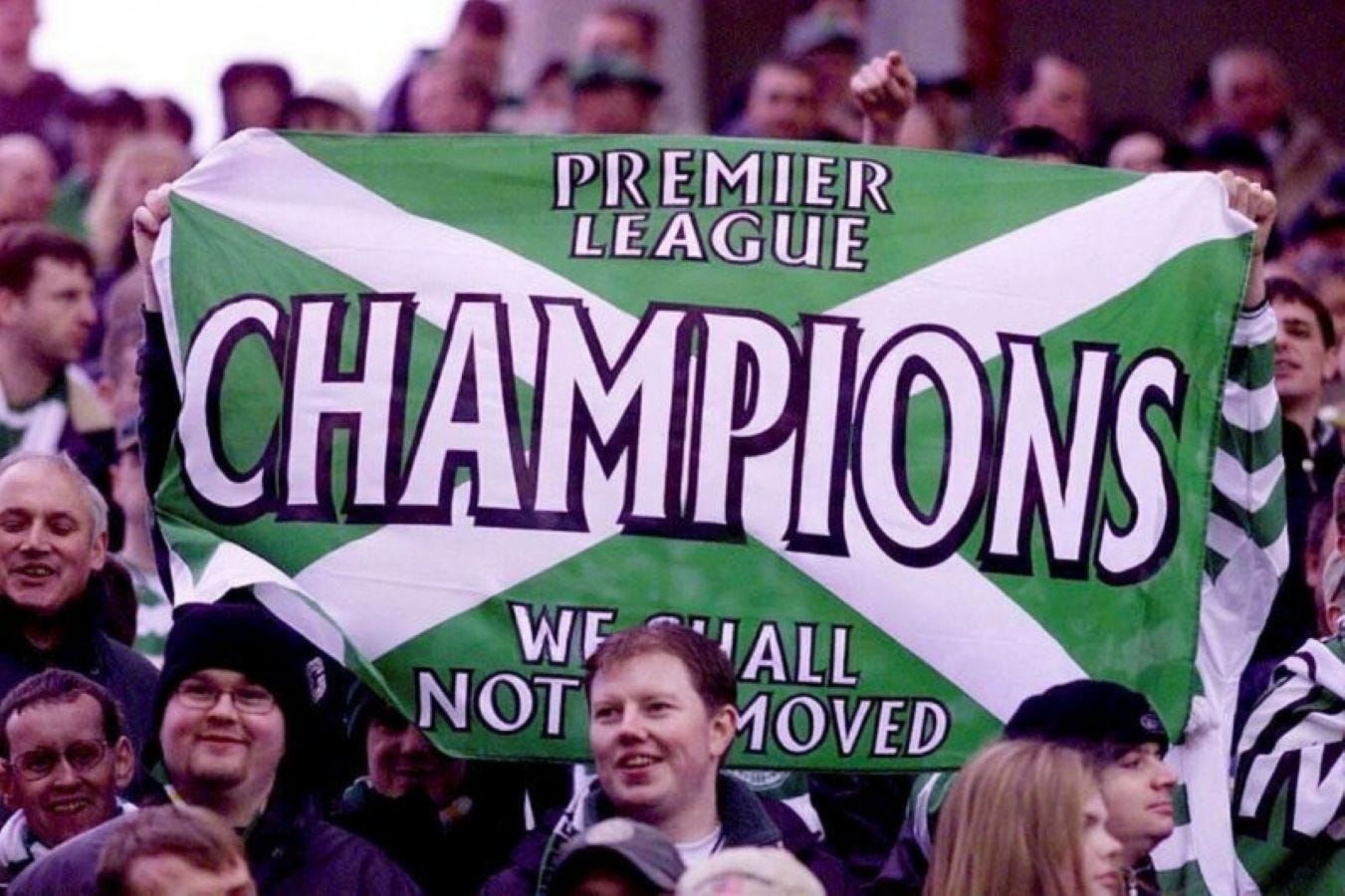
In my time I have come across many reasons why people have supported Celtic and it has always fascinated me. The main reason most of us support Celtic is because we follow what our Fathers did and what their Fathers did before them, going back generations. A friend of mine was working down south with a Chelsea fan a while back. He asked him how he came about supporting Chelsea, and the guy replied it was due to watching the 1970 FA cup final replay between Chelsea and Leeds United. He had watched live on TV and marvelled at the talents of Peter Osgood, Alan Hudson, and Charlie Cooke, so it was Chelsea for him after that. He asked my friend how he came to support Celtic. My friend laughed and told him there was no choice, it was decided in the womb! He explained that in Glasgow, it’s very much a case of supporting who your Father supported, and that this was installed into us at an early age. The Chelsea fan, although amused, couldn’t understand this. For Celtic fans it’s very much a source of pride following Celtic and passing this legacy on from father to son.
As someone who was born into a Catholic family of Irish heritage, and attended a Catholic school in inner city Glasgow in the 1970’s, there was only one team worth supporting, and that was Celtic. A club formed by Irishmen to feed the poor Catholic children of the Glasgow east end in 1887/88, was something laudable and to be admired. What added further to the ‘choice’ of club was the fact that Rangers practised their own form of religious apartheid for decades by not signing Catholic players. Sure, they never admitted it, and it was always a laugh hearing them say they would sign one – if he was good enough. Imagine the hilarity that Pele, Di Stefano, Eusebio, and Maradona would have had reading that. I recall playing football in the park at a very impressionable age and being told that ‘you cannae play for Rangers.’ When I asked why, I was told it was because I was a ‘Kafflick’. Even at such an early age I remember the absurdity of what was being said, so most of us learned young about Glasgow’s sectarian football divide. At school it seemed everyone was a Celtic fan. The kids, the teachers, even the Janny. And on Sundays after Mass, the parish Priest would discuss the pros and cons of Celtic’s result on the Saturday. Not supporting Celtic was never to be an option for me and thousands like me. There can be no doubt that the majority of Celtic’s support come still hails from the Irish-Catholic community in the west of Scotland. That’s what has given Celtic its own distinctive characteristic for the last 138 years. Without Irish migration and having that proud identity, Celtic would likely have been another Partick Thistle or Clyde. And with Rangers adopting such a staunch, Protestant tradition on their side, the great Glasgow footballing divide was created. No wonder the clubs were once referred to as ‘The Old Firm.’
It should be noted that despite the strong Irish-Catholic heritage, Celtic was never an exclusively Catholic club for players or fans. I can recall in the mid 1990’s a student at Glasgow University initiated a considerable, detailed survey on the background, religious persuasion, and political voting intentions of a large section of the Celtic support. 15% of those polled said that they were of a Protectant persuasion and 3% said they were actually church elders. A few years back I interviewed current Celtic chairman, Brian Wilson, and he said that his father was a Celtic fan and also a church elder. This is the way Brother Walfrid would have wanted the modern Celtic to be. Inclusion is a great buzzword these days and we can be rightly proud of Celtic’s policy of inclusion from their earliest days. As a club, Celtic were inclusive and diverse before these things became trendy in the modern age.
I have been overjoyed to hear many other people’s stories about why they support Celtic. For some, the reason why they follow Celtic is as simple as the strip. The Celtic kit of green and white hoops, white shorts, and white socks, as worn in Lisbon, has always been aesthetically impressive. The Celtic jersey remains one of the most distinctive and recognisable in world football, alongside other such unique kits as Ajax, Feyenoord, Inter Milan, Arsenal, and even Hibs. Apparently Adidas are highly delighted, that since taking on the contract for producing the Celtic strip, their sales have been outstanding and they are well pleased with the club’s world wide appeal.
I have also met people through the years who were attracted to Celtic because of their attacking style of play. I recall hearing the story of the Celtic fan who went to Lisbon in 1967. He travelled on a Euro rail ticket and has his route mapped through France, over the Pyrenees into Spain, then on to Portugal. At each town he stopped at he would say ‘Celtic Glasgow’ and the locals would stare at him in mystification and this somewhat diluted his enthusiasm during his journey. After Celtic had defeated Inter Milan 2-1 in Lisbon, he returned home by the same routes and by the same towns. This time the locals were overjoyed to see him and wanted his Celtic scarf, badges and other souvenirs. Such was the power of the new medium of television that the continent had witnessed the Lisbon Lions demolishing Inter, and now Gemmell, Chalmers, and Stein were all household names. It wasn’t just the fact Celtic won it, it was HOW they won it which attracted many people to the Celtic cause. To this day Celtic continue to be standard bearers for attacking, entertaining, football. As Jock once said, ‘We did it by playing football. Pure, beautiful, inventive football.’ And Celtic must always try to live up to those ideals.
In 2001 I met a Celtic fan in England who said that the reason he liked Celtic was that Henrik Larsson was his favourite player. Henrik was certainly a personality player, with the dreadlocks (or even without), wearing the iconic 7 shorts, and having that distinctive tongue out goal celebration, he remains one of the most photogenic Celts of all time. As each generation passes, Celtic have always had personality players who attract people’s interest. Just think of Charlie Tully, Jimmy Johnstone, Kenny Dalglish, Danny McGrain, Paul McStay, through to Henrik and beyond. Hopefully there will be many more to come.
Traditionally, Celtic have always had a majority working class support. These days, I certainly have much more disposable income and free time than my Dad ever did working in heavy industries in the 60’s and 70’s. However, the fans still retain those working class roots and, dare I say it, a left wing, ethos which previous generations have always had. This is seen through the prism of politics where socialist ideals were always popular. Many occasions saw collection cans at Parkhead for striking workers to assist with their financial struggle. In the modern age, the left wing stance still remains but can be traced in a different way. This is highlighted by elements of the Celtic support supporting the Palestinian struggle in the Middle East and there has also been a surge towards Scottish Nationalism, away from the previous traditional support for the Labour party. Many of a left wing disposition will see their spiritual home at Celtic Park when it comes to choosing a football team.
Celtic remain proud of their Irish heritage and many in Ireland are similarly proud to support the club because of this. The Irish flag, so often a source of controversy through the years, still flies proudly at Celtic Park on match days, in tribute to our forefathers who formed the club. Celtic’s support in Ireland has been reduced somewhat in recent years due to the advent of satellite TV, where the EPL is now such a massive draw and many have an unhealthy obsession with that cash-rich environment. Yet, many football fans in Ireland will support an English side but have a liking for Celtic also. In the north of Ireland, Celtic’s support has remained constant. During the troubles from 1969-1997, many Irish fans felt that Celtic gave them a sense of identity during such traumatic times. Visiting Celtic Park, they were able to fly Irish flags and sing Irish songs. For their part, Celtic fans in Scotland had a majority Republican outlook and mainly supported ‘The Cause’ for a united Ireland. During the troubles, Celtic fans often came in for criticism for singing pro-Irish Republican songs at games and this only served to widen the sectarian footballing divide in Glasgow, with Rangers fans taking a pro-Loyalist stance for their own ‘cause.’ In the modern era, Celtic continues to enjoy much support from Irish supporters, who travel in great numbers on planes, boats and buses and spend huge amounts of money in doing so. This level of support should never be taken for granted.
By supporting Celtic, we are part of a broad church or as the club like to say, we are a club open to all. So, no matter what your religion may be, what your political viewpoint is, or what background you come from - rich or poor - the words from another popular old Celtic song still remains the same – Celtic, Celtic that’s the team for me. No matter what reason you may have for supporting them.
Thanks for reading The Celtic Underground Substack! This post is public so feel free to share it.
No posts
Comments
Nothing yet. Say the first thing.
Sign in to join the conversation.