
I’ve been able to draw for as long as I can remember. As of now, I have over 50 years of drawings, sketches, illustrations, designs, doodles, and abstract paintings. I’ve definitely passed my 10,000 hours of deliberate practice to become an expert in my creative field. If you include my decades as a full time graphic designer, that number easily exceeds 50,000 hours or more. Wow, just saying that out loud feels like a major accomplishment.
But like any true Hero’s Journey, I had a lot of help along the way. My parents were very supportive of my talents from an early age. My father, who worked as a project manager in the early days of tech, would bring home stacks of discarded green bar printer paper. Some of you are probably old enough to know what I’m referring to. I would spend hours each day inking and coloring the blank backsides of those stacks with drawings of superheroes, knights, space aliens, movie characters, Dungeons & Dragons campaign maps, and anything else my imagination concocted.
I also received a lot of encouragement, feedback, and instruction from friends, school teachers, college professors, and future coworkers. But a significant portion of my art education initially came from books, beginning with Little Golden Books, Richard Scarry’s fantastic cutaway drawings, Star Wars concept art books, and piles of used Bronze Age comics. We also had a few Norman Rockwell coffee table books in my house growing up, that I wish I still had today. In college, my eyes would be opened to ancient antiquities, the great masters, and modern artistic geniuses. My learning and visual input was both wide and deep.
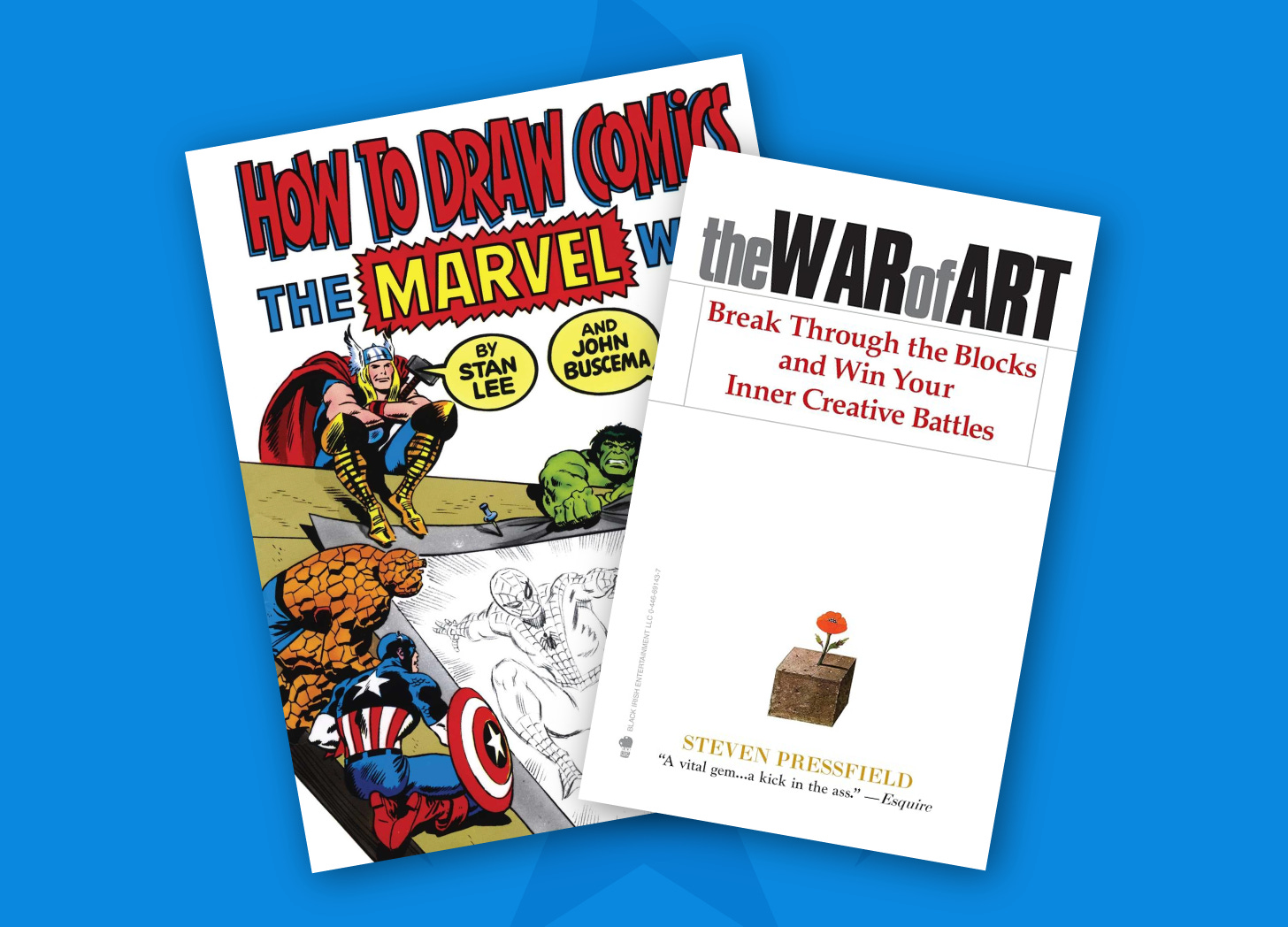
But there are two books that influenced me in a fundamental way at my core. The first was more practical and technical. The second reoriented my heart and brain, and rewired how I approached creativity as a process.
How to Draw Comics the Marvel Way
This is the first real art book I ever bought with my own money earned delivering newspapers, the Asbury Park Press. I was about 13 years old, circa 1981, when I first spotted this hardcover masterpiece (to me) in a bookstore in the mall. Until that point, I was mostly self taught by copying the work of Jack Kirby, Neal Adams, John Romita, Rudy Nebres, John Buscema, and an endless list of amazing artists too long to include here.
But something was different about this book. For the first time, I was shown the mechanics and structure to picture making. It broke down anatomy, perspective, and composition in a way my young mind could understand and implement. No more winging it. I began to create with intentionality and focus, built on a foundation of principles and (ahem) rules. I learned the science behind the expression. I continued to grow as an artist throughout high school and into university. This book became the cornerstone upon which all my future learning would be built.
The edges of the pages are still tinted with the gray-brown residue of oily teenage fingers mixed with graphite smears from the thousands of times thumbing through its hallowed pages. This book remains one of my most prized possessions, 43 years later.
The War of Art
Few authors have managed to illuminate the inner mental landscape of creativity better than Steven Pressfield. I stumbled across this magnificent little gem at a critical juncture in my career, about ten years after college. I was doing good work and making decent money. By all accounts I should have been happy and content in my vocation. But for some inexplicable reason, something felt amiss and I couldn’t quite put my finger on it. I felt a continual, low-grade dissatisfaction and frustration with my artwork. Pressfield’s book put a label to my creative angst: Resistance, in all its myriad forms.
Resistance, as defined in The War of Art, is the invisible, insidious force that opposes creativity, growth, and meaningful work. It is the inner enemy that rises up whenever you try to do something important. It’s like a spiritual adversary working tirelessly to prevent you from becoming who you are meant to be.
I’m tempted to go into more detail, but I don’t want to spoil the magic for anyone reading it for the first time. It literally changed my life as an artist and a person. I never tire of recommending it, and it is the book I have gifted more than any other.
By the way, the concepts are not just applicable to art. Resistance also shows up in business, personal growth, and relationships. This is a wonderfully brief, succinct book with zero fluff and can be read cover to cover in a single sitting. As a refresher, I try to read The War of Art at least twice a year. The inner critic, as my mentor calls it, never goes away. All we can do is greet Resistance with courage, discipline, and love.
The right book at the right moment has the power to shape your destiny. These two books molded me into the artist, writer, designer, and mentor-coach I am today. And for that, I am eternally grateful.
Curious, what books have impacted your life in a meaningful way?
If you could use some help exploring your creative journey, visit my About page to learn how to work with me 1:1 as your guide and life coach.
Comments
Nothing yet. Say the first thing.
Sign in to join the conversation.