
Productions are picking up across the UK — though not as much in London. If you’re only here for the list of 30 in development, prep and filming, it’s at the bottom.
This month: the new BFI board and the consultation on where its money goes, the wave of mergers reshaping who commissions British television, the Pact Red Book, a tax change that could affect every freelancer reading this.
First, an indulgence. After 15 years, we’ve launched a new website and a (kind of) change of direction: thecallsheet.co.uk

Back to the industry news.
The last month has reshaped the industry at a pace that’s easy to miss. Between them, these deals will determine who owns and commissions for British television, and how much of it.
The Paramount/WB merger cleared the EU last week and got a DOJ green light in June — but it’s now hit the wall at home. A federal judge has paused it, and David Ellison has agreed not to take any step toward acquiring Warner until June 2027, or until the lawsuits clear, whichever comes first. Twelve state attorneys general and the Writers Guild are challenging it in the States, while actors Benedict Cumberbatch, Alan Cumming and Benedict Wong warn against it in this op-ed for the Guardian.
Which leaves Larry Ellison — the real money behind the deal, and a donor of many millions to Donald Trump — in a familiar position. Whether he now picks up the phone to ask the White House for what we’ll call an Infantino remains to be seen; for now, the courts have other ideas. And every quarter the deal sits unclosed from October, the bill runs to some $650m — with a $7bn termination fee if it collapses altogether.
Comcast has bought ITV — though not ITV Studios. That leaves Channel 4 looking like krill, and talks have been taking place privately between the BBC and Channel 4, the only British broadcasters left at the table. Culture Secretary Lisa Nandy — who keeps her place in Cabinet under new PM Andy Burnham, himself a former Culture Secretary — is signalling a change to the licence fee, and the BBC’s annual report shows that licence fee payers have fallen by half a million. Something has to change. Steven Knight put an idea to the CMS committee last month: why can’t people overseas subscribe to the BBC?
Netflix stock is down around 45% on this time last year. They’ve reverse-ferreted on the promise to publish viewing figures twice a year rather than annually, largely because they’re losing up to 60% of the audience between first and second series of their biggest shows. But grow or die — and they still have the war chest that wasn’t spent on WBD, which was to have been a cash purchase. So who’s next? The Ankler reckons it might be Spotify.
Sky and ITV. Banijay and All3Media. Paramount and Warners. And now BBC and Channel 4. Any one of these would have been the story of the year. Together they may only be the starter.
It’s not out of the question that the UK ends up with a single national broadcaster, under sustained assault from vested interests, while most of the rest is owned in the US or the Middle East.
Which is why the protection of a UK public service broadcaster matters more now than it has in years. While the new version of “What has the BBC ever done for me” lacks some of the charm and wit of the 1986 original, the point still lands. Ask yourself what fills the space if it goes.
Back in February, we asked Barry Ryan who he tipped as the next big thing. Watch what he said:
And this weekend, at San Diego Comic-Con:
Since it launched in 1994, the National Lottery has put a staggering £53bn into arts, culture, sport, heritage and charity. How that money is spent hasn’t been reviewed since 2002.
Under instruction from Lisa Nandy, every major recipient of Lottery funding now faces a consultation on where the money goes. The BFI, naturally, “welcomed” it. You can have your say — you might want to read the numbers below first.
There’s also a new board. Six new governors join: Tanya Cordrey, Mark Herbert, Ganan Kanagathurai, Hakan Kousetta, Ryan Prince and Jane Tranter. Profiles for each are here. And Isabel Davis takes over the BFI’s National Lottery Filmmaking Funds from Mia Bays in October.
They inherit a set of decisions worth digging into.
The BFI’s new National Lottery plan runs to £150m over three years, up 10% on the last cycle. Filmmaking takes £61m, audiences £33.5m, education and heritage £13.3m, with smaller sums for international, insight and industry. The filmmaking figure is up 13% on the previous plan — but broken down annually it comes to £20.3m a year, still short of the £25m a year the Film Fund commanded back in 2022/23. International activity, meanwhile, has been cut by more than half.
Here are the ten best-funded features of the period.
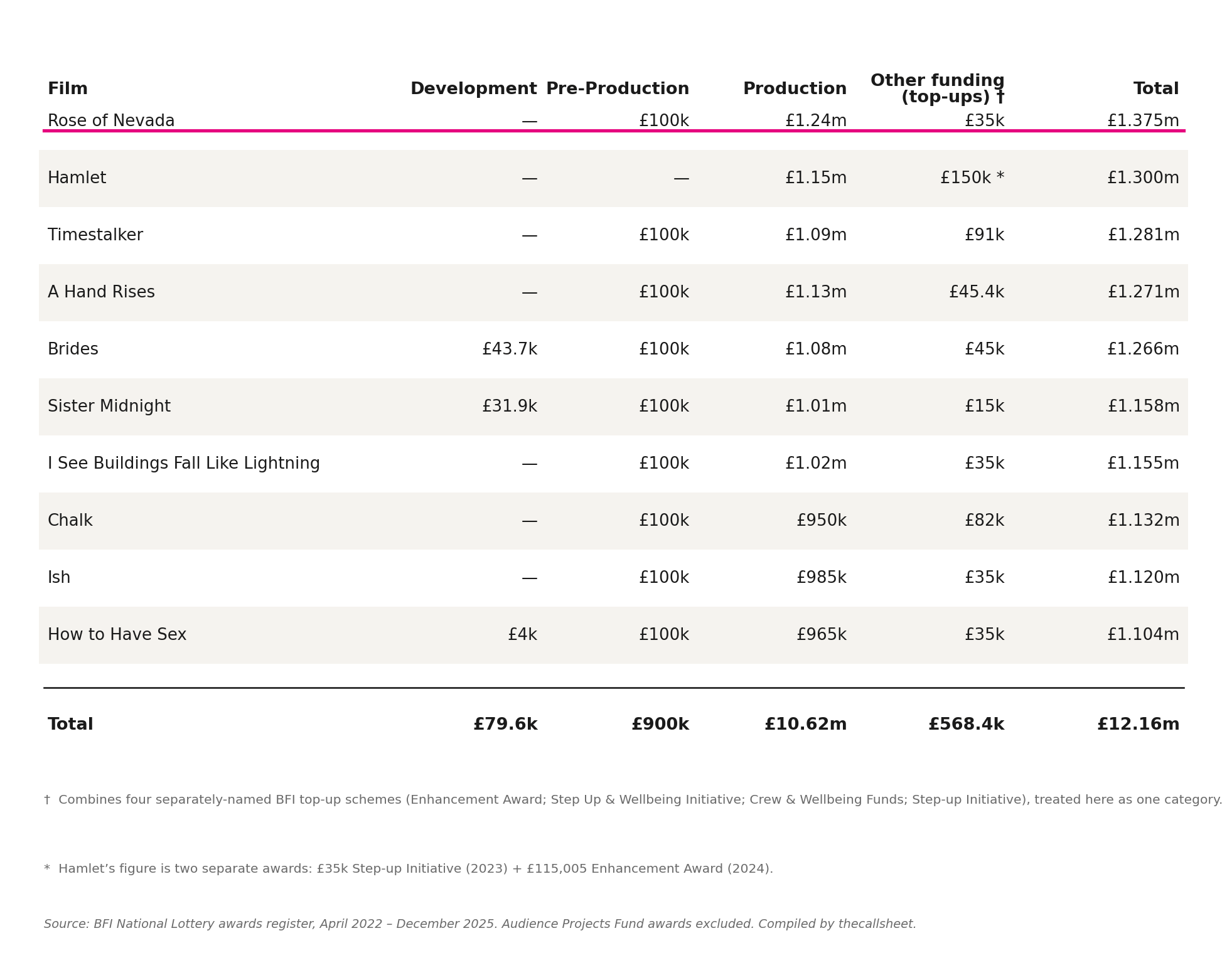
These are just the top 10 beneficiaries for that period.
The BFI backed 35 features in this period. The ten above account for £11.5m of it; the other 25 averaged around £580k each.
Beyond the ten above, the BFI funded hundreds more projects through its development, short-film and feature funds — north of 500 titles, averaging around £53k each.
And yes — we thought Hamlet’s £150k in top-ups (£115k wellbeing, £35k Step-up) sat oddly against the standard £15k most BFI films get for wellbeing.
The BFI does not lack for critics. Two of the loudest live on LinkedIn, where they post about it with a regularity that borders on vocational.
They cannot both be right. One — a Sydney-based producer and former distributor, with interests in AI production — thinks the BFI is too busy proving its diversity credentials to fund watchable films. The other — a London, West Country and former LA-based producer-director-editor (who once worked with the BFI) — thinks it is not diverse enough, and run by, in his own words, “Oxbridge nepos”. Same institution, same money, opposite complaints, matching levels of charm.
So: have your say. The government has opened a 12-week call for evidence — National Lottery Good Causes: Fund What Matters To You — the first proper look at where this money goes since 2003. It runs to midday on 23 September, takes about twenty minutes, and you can save and come back to it.
Readers of this newsletter either work in the industry or follow it closely, so your view carries weight. If you’ve been turned down for funding, try to leave the grievance at the door and think about the wider ecosystem — what the sector actually needs, not just what you didn’t get. The early part of the survey is general; the questions that bear on our world come later, so stick with it. Respond online, by post or by email. Here’s the link: https://www.gov.uk/government/calls-for-evidence/national-lottery-good-causes-fund-what-matters-to-you
Three things worth your attention if you’re freelance — which, reading this, you probably are.
Rates. Pact has published its Red Book: recommended terms for engaging crew on UK feature films with budgets between £1m and £10m. It’s guidance drawn up by the producers’ association, non-binding rather than enforceable — but it sets out what fair engagement terms should look like, and if you work in low-budget features it’s worth knowing what you can reasonably ask for. Click HERE for the Pact website
Tax. The government is consulting on moving self-assessment payments from annual to quarterly or monthly. Every freelancer knows the dread of the tax bill that lands long after the money’s passed in and out of the account. In the short term the change would sting; over time it might spread the load more evenly. Either way it hits your cashflow directly, and the consultation is open now. Click HERE for the consultation.
The numbers. A new report from ScreenSkills, Channel 4’s 4Skills and Ampere Analysis sizes up the state of the workforce — a sobering read, couched in bloodless corporate speak. Workforce utilisation — people actually in work — has fallen to around 50–55%, down from 60–65% in 2023. The volume of UK-produced film and TV released fell 13% between 2022 and 2025. Worst hit was VFX and post: from 45% capacity in 2023 to just 30% now — which will surprise no one who’s watched Soho empty out. The report models three futures — baseline, lower and upper — but with this many variables (see Tectonic Plates, above), it’s honest enough to admit no one can really call it. A commissioning slowdown, and work drifting to European competitors, hasn’t helped. https://www.screenskills.com/media/esxdnqau/sizing-up-the-future-july-2026.pdf
A new service launched last month that replicates — almost exactly — what thecallsheet set out to do fifteen years ago, and borrows the name of another pioneering service from around the same time. Flattering, in its way. But the model is a hard one to sustain. After the initial flurry, people tend to drift back to how they always crew up — and in a buyers’ market, that means WhatsApp, Telegram and the private Facebook groups. As a full-time business in this climate, it’s a tough ask.
One production bucking that trend is Larkin 2 (a returning Apple TV series). They’ve taken the progressive step of hosting their own website for crew to apply directly to a production. That’s a genuinely open, transparent way to do it, and it deserves a nod. Good on the 60Forty team, Karl and Azariah, for pioneering it.
They start filming this week (after their dates initially pushed), so most full-time roles have been filled — but keep an eye on the site in case any daily or 2nd unit work comes up.
https://larkin2opportunities.com/roles/
More good news for Manchester. Following last month’s £10.5m fund for filmmakers, the city’s slate is filling up nicely — House of Guinness, Dirty, Dragon Slayers, Black Ops, Daddy Issues and Army of Shadows are all shooting there, or partly there. More on each in the full list below.
And there’s a bigger move afoot. The TV Festival — the Edinburgh TV Festival, the most important date in the UK television calendar — is leaving Edinburgh after 50 years and relocating to Greater Manchester from 2027. The last Edinburgh edition takes place this August. It’s a smart move: August in Edinburgh means competing with the Fringe for every hotel room, and the switch should cut costs sharply for delegates and passes alike. Good for Manchester, and good for a festival that badly needed to widen access.
Philippa Childs will step down as head of Bectu in January 2027, after more than eight years leading the union — its first female head. She stays in post until then to support her successor, to be named by parent union Prospect. A tireless leader, and a consistent voice on bullying, harassment and freelancer rights through a brutal few years for the sector.
Seb Barwell, Channel 5’s drama commissioner, departs.
Laura Mansfield steps down as CEO of ScreenSkills, a role she'd held since early 2024; Lisa Opie takes over as caretaker until a permanent replacement is found. On appointment, Mansfield said she was "looking forward to working with our partners across the UK." Yet seven of the key external training providers (of which we are one) who deliver the majority of ScreenSkills' courses confirm that not one of them had a single official meeting with her across her tenure. A missed opportunity.
Northern Ireland Screen’s chief executive Richard Williams is stepping down after 23 years — part of the team that brought Game of Thrones to Northern Ireland and big shoes to fill.
And the Banijay/All3Media merger is already shedding executives: CEO Louise Pedersen, COO Sara Geater, and execs Jonathan Hughes and Steven Brown are all out. This is just the start of the exodus — expect the Sky/ITV deal to start doing the same over the coming months.
Heat. Michael Mann’s 1995 masterpiece — Pacino and De Niro, one of the greatest cops-and-robbers films ever made. If you’ve somehow never seen it, fix that. And there’s timely reason to revisit: Heat 2 is finally happening. Mann shoots his prequel-sequel in November, with a cast including Leonardo DiCaprio, Christian Bale, Stephen Graham and Adam Driver. Quite a line-up — and this time it’s real, not rumour.
Digger. The trailer’s out. The crew that worked on it said that it was one of the most challenging shoots they’ve ever been on — but that the early cuts suggest the sweat was worth it, and that this could be something special. Filmed mostly at Pinewood (despite being a Warners picture) under the codename “Judy”. One to keep an eye on. Here’s the trailer.
RIP Brenda Fricker. The brilliant Irish actress — the first ever to win an Oscar, for My Left Foot in 1990 — has died. Remarkably, before her Academy Award she was best known to UK audiences as Nurse Megan Roach in Casualty.
# thecallsheet -- July 2026: Production Updates
*Published 26 July 2026*
---
Better Later (BBC, Wales) - This was a Ruth Jones project; she will now go on to reunite with James Corden on a brand new series based in London (Listed on Production Radar since May).
Prodigies (Apple TV). First Woman (ITV) -- both wrapped and Ashley Walters is about to return to London for his next Project for Apple.
Elden Ring has moved to Iceland for the final leg of production. Gangs of London series 4 is in its final weeks. The Husbands (Apple TV) main unit wrapped last month and is now tackling pick ups. JJ Abrams movie The Great Beyond (AKA Ghost Writer) completed it’s additional photography since our last post.
thecallsheet is an independent industry newsletter. The information contained in this issue is gathered from a combination of publicly available sources and confidential industry intelligence. Where information is unconfirmed, this is indicated in the text.
The production list is compiled using Production Radar, an early-intelligence monitoring system. Productions are included based on verified or credibly sourced information. Stage, location and crew details reflect the position at time of publication and are subject to change.
Nothing in this newsletter constitutes legal, financial or employment advice. thecallsheet accepts no liability for decisions made on the basis of information published here.
This newsletter is intended for subscribers only. Forwarding or reproducing any part of this issue without permission is not permitted.
© thecallsheet 2026. All rights reserved.
---
Am I Being Unreasonable? – Series 3
Comedy thriller written by and starring Daisy May Cooper.
BBC (Boffola Pictures) · Bristol, Bottle Yard Studios · Filming
Writer: Daisy May Cooper · Producer: Ali Marlow · Producer: Emily McDonald
Gangs of London – Series 4
Fourth instalment of the gritty crime series.
Sky (Pulse Films) · London · From April 2026 · Filming
Producer: James Levison · Line Producer: Marshall Leviten · Production Designer: Darryl Hammer
Down Cemetery Road – Series 2
Based on Mick Herron’s novels. PI Zoë Boehm and Sarah Trafford navigate the dangerous world of black-market antiquities while hunting a serial killer. Band 3 drama. Based at OMA Studios.
Apple TV+ (60Forty Films) · London · Filming starts this week
Director: Börkur Sigþórsson · Writer: Morwenna Banks · Producer: Jamie Laurenson · Producer: Hakan Kousetta
Bad Bridgets
Drama set in famine-era Ireland, following the fates of Irish women. Based on the book by Elaine Farrell.
Luckychap · Belfast · From July 2026 · Filming
Director: Rich Peppiatt · Producer: Trevor Birney · DoP: Ryan Kernaghan
Reputation
A celebrity legal battle spirals out of control.
BBC (The Forge) · London · Filming
Director: Mahalia Belo · Writer: Anya Reiss · Producer: Alex Kazamia · Line Producer: Henry Woolley
Army of Shadows
Under de facto American occupation, a former British Army officer builds a covert resistance cell from scratch — navigating betrayal, moral compromise and the tension between patience and action — as young recruits fight to reclaim their country and their futures. Inspired by the 1969 French film about the Nazi occupation.
Channel 4 (Two Cities, StudioCanal) · Manchester, Liverpool · From Summer 2026 · Filming
Writer: Ronan Bennett · Director: Lisa Gunning · Producer: Alison Sterling · Production Designer: Tom Sayer
First Day on Earth
Michaela Coel comedy-drama (codename Mykito). Coel writes, stars and co-directs with Sam Miller. Now back from Ghana and based at WBSL.
BBC / HBO · WBSL / Ghana · From February 2026 · Filming
Director: Sam Miller · Director: Michaela Coel · Producer: Johann Knobel · Costume Designer: Cobbie Yates · Production Designer: Simon Rogers · Production Manager: Adanna Adams
Elden Ring
Alex Garland writes and directs an adaptation of the George R.R. Martin story. Wrapped in the UK; unit now in Iceland.
A24 · Sky Studios Elstree · Filming
Director: Alex Garland · Producer: Matthew Penry-Davey · Line Producer: Charlie Reed · Production Designer: Mark Digby
Halftime Hero
Drama set at West Ham in the 1990s, when Harry Redknapp put a fan on the pitch during a pre-season friendly. Eddie Marsan stars.
MetFilm · London and Hampshire · From July 2026 · Filming
Director: Ole Sanders · Producer: Anna Mohr-Pietsch · Co-Producer: Ross Williams
Chocolate Wars
Period drama about the founding of Cadbury’s.
Britbox (Fable Pictures) · Birmingham · From July 2026 · Filming
Director: Tom McKay · Producer: Faye Ward · Producer: Hannah Farrell · Line Producer: Joseph Sharpe
Subscribers get access to 10 pre-production titles, 10 development titles. If you’re a head of production or head of department, you can sign up to Production Radar BETA (currently free).
Comments
Nothing yet. Say the first thing.
Sign in to join the conversation.