
Come Back Buddy brought their time machine along to Clarkdale for Saturday’s Concert in the Park, where it was rapturously received by the audience—music from the fifties seems to draw the Clarkdale crowd more than music from the eighties does. It was a night of infectious rhythms built from simple foundations, such as the Penguins’ “Earth Angel,” in this instance coming across as heartfelt instead of petulant and with a nice sax solo counterpointing the vocals. The big hits of the evening were Buddy Holly’s “Everyday,” which had a more intimate, vibrant tone than the original thanks to the band’s reduced forces letting the melody come through; “Chantilly Lace,” rendered with vim and swing; “Peggy Sue,” who got the crowd especially engaged; and “La Bamba,” which made the dance floor explode. “Pretty Woman” neatly demonstrated that Clarkdale audiences keep way better time than Sedona audiences when asked to provide percussion.
It was delightfully nostalgic to hear the band break into a solid cover of “The Tennessee Waltz” before making a swift change to Ricky Nelson’s “Goodbye Heart.” Their “Dream Lover” was more satisfied than yearning and their “Splish Splash” rather too moderato. When they played “The Stroll” by The Diamonds, the dancers preferred “Let’s Twist Again” to merely strolling, which Come Back Buddy was able to blend seamlessly and most appropriately into “Let’s Go to the Hop.” And it wasn’t just the adults who were hopping on the dance floor to the rhythms of a bygone time; it was the kids, too. There are kids everywhere at these Clarkdale shows. If anyone is wondering what attracts families to a locality, free summer concerts would seem to be one answer.
Sedona Dance Academy’s inaugural gala and scholarship benefit is coming up on August 29 to raise funds for scholarships for local dance students. “Sedona Dance Academy has quietly provided scholarship assistance to students since opening in 2020. As the academy and the number of families it serves have grown, so has the need for scholarship support,” founder Jessica Phillips said. “These are children who absolutely light up when they dance.” The event at the Mary D. Fisher Theatre will support SDA’s new permanent scholarship fund to support dance education in the community, with residents and local businesses invited to show their enthusiasm for arts education in a city animated by the arts, and will include a presentation on the scholarship fund and a performance by current SDA students.
SDA’s gala will be followed by the Fine Art Museum of Sedona’s First Friday event to open the Curt Walters exhibit on September 4 and the next Concert in the Park on September 5. Flagstaff Symphony kicks off the Beethoven anniversary season on September 19, in conjunction with Pickin’ in the Pines; plan ahead.
This weekend’s edition marks the start of year two of The Cactus Quill, and we can fruitfully begin it by wondering just what new abuses the Leninists will attempt to inflict upon us in the coming year now that we’ve shot down their Cultural Park fantasies once and for all. My sincere thanks to all my enthusiastic subscribers—and also to the non-subscribers, who actually outnumber the subscribers. Special thanks to those who have passed along information they thought was important for the community to know and pointed out errors or needed corrections in the text.
On reflection, I have continually been impressed by how, whenever I’ve thought there wouldn’t be enough scandal for next week’s edition, city of Sedona council and staff have almost inevitably and conveniently done something newly stupid to supply me with additional material. They are most obliging when it comes to setting themselves up as targets for public disdain. That’s likely the biggest public service the city performs. Let’s have a big hand for the cast of Clueless 2!
No guarantees, but stay tuned over the next few weeks; I have a new twist in mind for future installments of the Quill. In addition, the print version of the first year’s editions will be out before the end of the year. Yes, that’s right, the print version. All the information and comments no one at the city or the Snooze wanted put on the record at all will be physically printed and eventually available in libraries, and it will be to that information that future historians of Sedona and of totalitarianism will turn as a primary source document. One of the things you learn as a historian is that it’s the graffiti and the gossip and the account books that tell the real story, not the press releases and the Official Gazette.
As we move into another two years of Sedona being run by a cabal of special interests associated with and backed by the Democrats of the Red Rocks, with the assistance of what used to be and still calls itself the Chamber of Commerce, it’s time to take a look at the overlapping alliances that enable this nepotistic network of favoritism—to, in the words of the World War II advertisement, put the whole mess on the diagram and try to trace the short. Specifically, we’re talking about a Euler diagram here; a Venn diagram can only show three sets of logical relationships, while plotting the overlapping relationships of Sedona’s special interest groups requires mapping the interactions of twenty-one sets at the moment.
So here’s an attempt to create a Euler diagram of the behind-the-scenes network that runs this town, freshly exposed in the aftermath of the latest campaign cycle, when everyone had to put their money where their loyalties are:
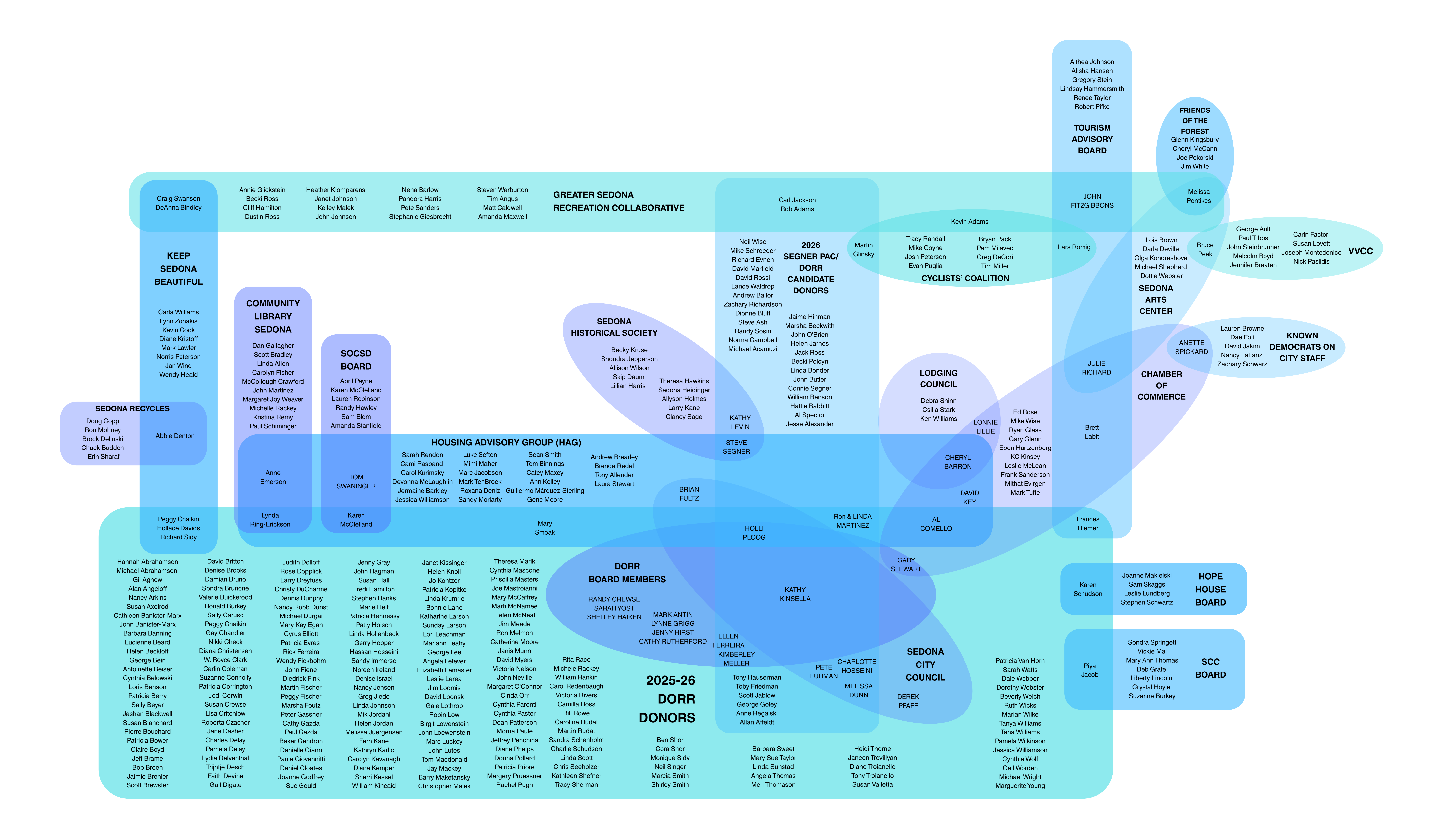
The diagram represents an initial effort to map who’s running Sedona these days, the overlapping layers of power and influence that operate in this town, who calls the shots and who aids and abets the shot-callers, consciously or unconsciously. Who’s talking to whom, who networks with whom. Whose voices get represented to the centers of power. “Enablers” is one word to describe many of the people included in this diagram who are not directly charged with decision-making; “adjacent” is another.
It was an amusing exercise while devising the diagram to contemplate all of the possible referential titles it could be given. “We few, we happy few.” “The ties that bind”—nods to PG Wodehouse for the imagery. “Oh, what a tangled web we weave,” as Sir Humphrey quoted mournfully. “The annual Karen migration,” to pluck a delightful phrase from the garden of Christopher Fox Graham. “The plot against Sedona,” in homage to the Philip Roth novel. “The ladies who lunch,” as Sondheim would have it. And of course it’s impossible to look at the diagram and not recall those old turn-of-the-century cartoons of the octopus of global capitalism worming its tentacles into everything. Inevitably, the octopus was adorned with the leering features of either Rockefeller or Rothschild, depending on the cartoonist’s locale and immediate subject matter.
At the center, naturellement, is the city council, comprising comrades Ploog, Fultz, Pfaff, Dunn, Kinsella, Furman, and Hosseini, who closely overlap with the board of directors of DORR. In fact, if you weren’t aware, Ploog and Kinsella openly serve as directors of a partisan political organization while nominally serving in office as nonpartisan officials. The rest of the DORR board consists of Ellen Ferreira, Kim Meller, Jenny Hirst, Mark Antin, Randy Crewse, Lynne Grigg, Shelley Haiken, Cathy Rutherford, Sarah Yost—and Gary Stewart, who cross-links the DORR network with the Chamber. The Chamber, in addition to Stewart, is run by Cheryl Barron, Lonnie Lillie, Julie Richard, Ed Rose, Mike Wise, Brett Labit, Al Comello, Ryan Glass, Gary Glenn, Eben Hartzenberg, KC Kinsey, Leslie McLean, Frank Sanderson, Mithat Evirgen, Mark Tufte—and, oh yes, guess who is the city liaison to the board? Our dear city mismanager and Hillary Clinton supporter, Anette Spickard. La Spickard links the chamber to the city’s policy objectives and to those city staffers, out of the couple of dozen who actually live in the city, who are known to vote as Democrats and who routinely manipulate council into greater acts of authoritarianism: Lauren Browne, Dae Foti, David Jakim, Nancy Lattanzi, and Zachary Schwarz. This compares to five staff names that returned as swing voters and one that came back as a Republican, by the way. We can of course predict that comrades Whitehorn and Allender also vote the Party ticket.
Associated with the Chamber-city relationship and providing a bridge to a number of other special interest groups is the Tourism Advisory Board, which plays a surprisingly significant role in local manipulation of the political system, as it provides a facade of public participation for the redirection of our tax dollars to the priorities and organizations associated with some of the the board’s members: John Fitzgibbons (who runs Pink Jeep), Althea Johnson (VOC), Alisha Hansen (five businesses, including a fraudulent crystal shop; also married to Eben Hartzenberg of the Chamber), Brett Labit (two galleries), Frances Riemer (former director of NAU’s gender program), Gregory Stein, Julie Richard (Sedona Arts Center), Lars Romig (Cyclists’ Coalition), Lindsay Hammersmith (Sedona Elite Properties), Renee Taylor (three galleries), and Robert Pifke. The Chamber and TAB overlap with yet another front group to give the appearance of variety, the Sedona Lodging Council, which is run by Barron and otherwise consists of Debra Shinn, Csilla Stark, Lonnie Lillie (again), and Ken Williams.
Hovering on the outskirts of the discussions of all these groups is the Sedona-Oak Creek School District, which is desperately seeking to divert public funds to propping up its practice of child abuse, and which is run by Tom Swaninger, April Payne, Karen McClelland, Lauren Robinson, Randy Hawley, Sam Blom, and Amanda Stanfield.
The DORR program—to destroy individual political and social freedom and economic and environmental sustainability in Sedona in pursuit of “progress” benefiting only an elite few—is funded by a donor list that has raised almost $89,000 in support of Leninist ideology over the last two years, so committed are Sedona’s neoliberals to imposing their program. Mark these names well. These are the elitist minority who are willing to pay good money to tell the rest of us that we’re too ignorant to have or deserve a voice and that therefore we must be taken care of by them, in accordance with what they think is best for us. Fortunately, it’s a surprisingly short list compared to the size of the community, and quite an elderly list. As Byron said so pointedly, “Time and skill will couch the blind.” Then, too, it’s rather impressive how much money a bunch of unemployed people have in Sedona.
Apart from contributions to Die Partei, there were also those individuals who donated to the openly Democratic Party candidates in a nonpartisan race during the 2026 campaign, or to Comrade Segner’s anti-democratic Sedona Democracy Alliance PAC: Neil Wise, Mike Schroeder, Charlotte Hosseini, Holli Ploog, Linda Martinez, George Goley, Carl Jackson, Richard Evnen, David Marfield, Rob Adams, David Rossi, Ellen Ferreira, Lance Waldrop, Melissa Dunn, Anne Regalski, Pete Furman, Andrew Bailor, Zachary Richardson, Dionne Bluff, Steve Ash, Randy Sosin, Norma Campbell, Michael Acamuzi, Tony Hauserman, Jaime Hinman, Marsha Beckwith, John O’Brien, Kathy Kinsella, Helen Jarnes, Jack Ross, Becki Polcyn, Kathy Levin, Kimberley Meller, Toby Friedman, Linda Bonder, John Butler, Martin Glinsky, Scott Jablow, Steve Segner, Connie Segner, William Benson, Allan Affeldt, Ron Martinez, Hattie Babbitt, Al Spector, and Jesse Alexander. The single biggest financial surprise of the 2026 campaign was Schroeder’s $200 donation to Fultz.
Beyond the official and political groupings organized in support of pushing a big government agenda in Sedona, there are several organizations in town, as we all know, that receive large contracts from the city to provide public services, contracts that are intended to ensure the organizations, their employees, and their volunteers remain in lockstep with city staff’s official priorities, regardless of whether those priorities are actually useful to the organizations. Including the members of these organizations’ boards within the analysis helps to indicate how far their operations have been integrated with those of the city-DORR cabal. DORR donors have representation on the boards of the Sedona Community Center (Piya Jacob), Hope House of Sedona (Karen Schudson), and Community Library Sedona (Lynda Ring-Erickson), on which HAG member Anne Emerson also serves. The Sedona Historical Society has DORR financial supporters Steve Segner and Kathy Levin on its board.
Especially significant is the role of the Sedona Arts Center, run by Julie Richard, a non-artist who has wangled her way onto the Chamber and TAB boards to further benefit her career while SAC declines, assisted by Melissa Pontikes, Bruce Peek, Lois Brown, Darla Deville, Olga Kondrashova, Michael Shepherd, and Dottie Webster. Peek provides a cross-connection to another city contractor, Verde Valley Caregivers’ Coalition, the board of which includes George Ault, Paul Tibbs, John Steinbrunner, Malcolm Boyd, Jennifer Braaten, Carin Factor, Susan Lovett, Joseph Montedonico, and Nick Paslidis. Pontikes is further embedded within Friends of the Forest and the Greater Sedona Recreation Collaborative, two of the organizations that provide opportunities for environmentalist neopagans and ecofascists to lobby local governments for the restriction of the public’s free access to public lands while also working to secure handouts of tax dollars for themselves. As of September 2025, Friends of the Forest claimed a membership of 701 and was directed by Pontikes, Glenn Kingsbury, Cheryl McCann, Joe Pokorski, and Jim White.
Perhaps the loudest of the neopagan groups in recent times has been the Greater Sedona Recreation Collaborative Motorized Recreation Working Group (ye gods!), an ad hoc body established to advocate for taking away the right to ride OHVs on public lands as well as other losses of access. The membership consisted of Pontikes, Fitzgibbons, Amanda Maxwell, Annie Glickstein, Becki Ross, Carl Jackson, Cliff Hamilton, Craig Swanson, DeAnna Bindley, Dustin Ross, Heather Klomparens, Janet Johnson, Kelley Malek, Kevin Adams, John Johnson, Matt Caldwell (of Utah), Nena Barlow, Pandora Harris, Pete Sanders, Rob Adams, Stephanie Giesbrecht, Steven Warburton, and Tim Angus.
Swanson and Bindley may also be encountered aboard of Keep Sedona Beautiful, historically the area’s most prominent ecofascist group, where they are joined by DORR contributors Peggy Chaikin, Hollace Davids, and Richard Sidy, as well as Carla Williams, Lynn Zonakis (formerly of P&Z), Kevin Cook, Diane Kristoff, Mark Lawler, Norris Peterson, Jan Wind, and Wendy Heald, and by Abbie Denton, who links KSB to the board of Sedona Recycles: Doug Copp, Ron Mohney, Brock Delinski, Chuck Budden, and Erin Sharaf. It is wildly entertaining to note that GSRC has no Democratic Party donors on the board and KSB very few—but these non-Democrats are nevertheless trying to use the Democrats who are in power and who spout environmental rhetoric to achieve their own ecofascist and NIMBY objectives. In the same ballpark is the Verde Valley Cyclists’ Coalition, which is connected to the TAB via Romig and the GSRC via Kevin Adams and otherwise consists of Tracy Randall, Mike Coyne, Martin Glinsky, Josh Peterson, Evan Puglia, Bryan Pack, Pam Milavec, Greg DeCori, and Tim Miller.
Another overlapping category to consider is membership in the ad hoc Housing Advisory Group, a lobbying body run by Linda Martinez that Shannon Boone found useful as an astroturfing organization to provide, as Bill Noonan described it, the appearance of consent. Membership in the group as of January 2026 per city correspondence included Martinez herself, Sarah Rendon, Cami Rasband, Carol Kurimsky, Cheryl Barron, David Key, Devonna McLaughlin, Jermaine Barkley, Jessica Williamson, Judy Poe, Luke Sefton, Mimi Maher, Marc Jacobson, Mark TenBroek, Mary Smoak, Ronald Martinez, Roxana Deniz, Sandy Moriarty, Sean Smith, Steve Segner, Tom Swaninger, Tom Binnings, Catey Maxey, Ann Kelley, Anne Emerson, Al Comello, Guillermo Márquez-Sterling, Gene Moore, Andrew Brearley, Brenda Redel, Brian Fultz, Holli Ploog, Tony Allender, and Laura Stewart. As of August 2022, Martinez’s group had additionally included the late and unlamented Comrade Boone (since fired by the city), Comrade Jablow (since fired by his council colleagues), Comrade Moriarty (long since fired by the residents she tried to force to mask up), Comrade Spengler (long since departed since her job consisted of nothing), Dan Surber, George Ault, Marci Taylor, Tania Simms, Mary Chicoine, Nga Losacco, and various since-departed school and chamber officials. As of February 2025, the group had included Randy Crewse, Tyson Shelly, Devonna McLaughlin, Comrade Blum (nee Comrade Frieder), Joan Bouck, Mary Garland, Elizabeth LeMaster, Comrade Pfaff, Allan Affeldt, and Max Licher. A number of these are names that have turned up elsewhere on this diagram either currently or at some point in the not-too-distant past. Membership in Sedona’s astroturfing groups apparently exhibits a revolving door effect similar to the one that occurs within the federal military-corporate-civil service bureaucracy.
A couple of organizations receive city funds but show no overlap of formal or informal city influence as yet, most notably the Sedona International Film Festival and the Sedona Humane Society.
Some of the people who feature in this Euler diagram will no doubt be unhappy to see their names included within one or more of these spheres of influence. Well, I’ve also been unhappy to see some of the names that showed up on these lists during the process of building the diagram. Do I assume that everyone whose name came up as an indirect associate of the DORR cabal is engaged in a purposeful, sinister conspiracy to destroy Sedona? Of course not. However, it is a fact that by their willingness to collaborate with the hardcore DORR ideologues, and by helping to provide the appearance that all is well within subverted community organizations, a number of these individuals are are in effect giving their silent support to the whole overdevelopment and totalitarianism scheme DORR is running whether they agree with that scheme or not. Now, they might have the option of withdrawing from some of these organizations, but that would leave the organizations open to further city takeover, and the act itself would be a spineless desertion of the community. A preferable response might simply be for those who are not part of the DORR scheme to make very sure that the organizations they represent distance themselves from city council and staff and the latter’s big government agenda in the future.
Silence gives consent. Not to speak is to speak. Not to act is to act.
That gang calling themselves the Cottonwood city council approved an affordable housing plan for Cottonwood on August 4, a plan that barely repays the time spent skimming through it, as it consists of the same sort of vague gibberish as Sedona’s plan: “Expand partnerships with nonprofit organizations.” “Amend the city zoning code to minimize barriers to affordable housing.” “Consider establishing a community land trust.” Meanwhile, Cottonwood and Sedona roll along with implementing the 2024 international building codes, which will continue to make housing even more inaccessible for everyone. The plan also included the usual suggestions that the municipal government simply throw money at welfare programs.
The study—by Elliott Pollack, former city of Sedona consultants—makes it abundantly clear that Cottonwood is proceeding down the Sedona route with regard to demographics, with nearly all new residents added since 2019 being over the age of 60. “During the same period, the population under age 25 declined significantly, and labor force participation fell to approximately 48 percent, well below the statewide average.” Less than 14 percent of Cottonwood’s population is now under the age of 20, compared to 24 percent statewide, while 37 percent is over age 65, compared to less than 19 percent statewide. Median age went from 46 in 2019 to 55 in 2024—seemingly a faster rate of change than occurred in Sedona. Meanwhile, new construction is limited, with the city granting, on average, only fifty-four single-family home permits per year, on par with Sedona in recent years in spite of Cottonwood’s supposedly greater favorability to development.
The plan suggests Cottonwood will need an additional 607 units of housing by 2040, a very modest proposal compared to Sedona’s much-reduced scheme of 775 in ten years’ time.
This week’s developments in America’s ongoing campaign against Flock (un)Safety include the use of foam sealant to disable the spycams and, in a move that brilliantly combines resistance to the government with nonviolence and sarcasm, the arrival of the Flock Sock: a 3D-printed slip-on cover for the spycams that slides on and off without damage, thereby obviating any ethical and legal problems associated with, oh, say, wrapping four twists of primacord around the base of a Flock pole. The MakerWorld enthusiast who designed the device described it in the following delicious terms:
The Flock Sock is a slip-on cover designed to help protect a Flock camera from the harmful radiation of the sun. Your city spent their very own hard-earned tax dollars scattering these cameras everywhere to keep you safe; all it cost you was a little privacy. The very least you can do is help protect these valuable civil servants from getting a bad sunburn...
No glue, no screws, and zero structural changes. Because it pops off instantly with absolutely no damage caused and costs exactly $0 to revert, it conveniently avoids some of the troublesome labels that Uncle Sam might stick to you. It’s just a removable accessory.
I don’t much like plastics, but—excuse me while I go break out the ABS.
The Jason Arday scandal reached its inevitable and fitting conclusion with the pseudo-professor’s suicide last Friday. This would be an appropriate moment for those Oxbridge types to revisit Dorothy Sayers’s masterpiece, Gaudy Night, a moral tale set at Oxford that not only speaks to the themes of preferring the objective over the subjective and dedication to truth over personal attachments but also includes this ironically apropros exchange between the detective and the detective novelist in conversation with their university colleagues:
“I once thought I had the agreeable choice between hanging my brother or my sister. Fortunately, it came to nothing.”
“But supposing it had come to something?” demanded Miss Barton, pinning the argumentum ad hominem with a kind of relish.
“Oh, well—What does the ideal detective do then, Miss Vane?”
“Professional etiquette,” said Harriet, “would suggest an extorted confession, followed by poison for two in the library.”
Gaudy Night, incidentally, is one of the most important books you can read, as Sarah Crown explains lucidly:
The book feels so fundamental to me, now, that I find it hard to cast my mind back to a time when I hadn’t read it, and harder still to explain what it’s about, because it seems to be about everything. It’s a novel about work and the moral value of work; the importance—indeed the necessity—of finding the job you’re fitted for and doing it to the very best of your abilities. It’s about truth, and the need, in a slippery, shifting world, to find the one true thing you’re willing to defend, no matter what the personal cost. It’s about friendship, and how it ebbs and flows as you yourself grow—or stop growing. It’s about writing: what it means to write well and how to do it. It’s about love and integrity, and the thought and work and consideration that must go into establishing and maintaining a relationship of equality and mutual respect.
Arday appears in the Oxford world of Gaudy Night only as a blank space, the space occupied by the memory of the already-dead character who didn’t ultimately want to make the effort to do the job he signed up to do. It is, in fact, the Arday character who is the real villain of the story even in his absence, the serpent in the scholars’ paradise who thinks that delivery rather than substance is all he needs in order to succeed, and who offs himself when he realizes that scholarship doesn’t work that way.
Traditionally, universities were supposed to filter out superficial poseurs concerned with presentation rather than showing their work, and that’s exactly what happens in Gaudy Night, but with the coming of the modernists, who no longer believe that truth or facts exist or that facts can be known, academics—who thereby have separated themselves from scholars—can afford to be unconcerned with the truthfulness of a candidate’s story provided that the story conveniently fits the fantasy narrative they wish to construct in place of reality.
Delivery doesn’t matter. Presentation is totally irrelevant to reality and those who concern themselves with presentation over content betray their own mental weakness and attempted animalism in formulating responses based upon chemical reactions rather than rational understanding. Part of our job as humans is to make sure that we do not choose superficiality over logic or subjective impressions over substantive deductions. In any event, the “presentation” or “delivery” attack on an argument or individual is often or usually fundamentally dishonest, as it is simply employed to soften a fundamental disagreement with the content of an argument. There is, for instance, no polite way to inform an individual that they are incompetent or that an action they propose to take is inherently evil, so a critique of such statements on the grounds of supposed lack of politeness falsifies itself.
Nevertheless, as we all know, claiming an objection to a particular delivery method for information is a common form of dishonesty in Sedona, and particularly among city staff, as demonstrated in their risible new housing strategy. The strategy, among its other cynically humorous moments, proposes improving the quality of the customer service experience at the housing department—but the housing department’s job is to say no to people who want to build and thereby to harm them. It is laughable to propose that there is a way to be polite about, or to make people happy about, efforts to deny individuals their needs and to harm them. Those who do harm must learn to admit it instead of trying to put lipstick on a pig.
Chemical & Engineering News has published and is soft-pedaling reports of some highly risky genetic work being done in, of all places, the People’s Republic of China. Seven separate Chinese studies are currently exploring the use of DREADDs (appropriately named, as it turns out), chemogenetic compounds that use an adeno-associated virus to introduce a protein that codes for genetically-altered neurochemical receptors into selected groups of neurons in the brain, subsequently enabling these receptors to be activated precisely and at will by administration of the corresponding drug for which the receptors were tailored. The technique is, in essence, as C&EN admits, a highly targeted chemical alternative to physical removal of a portion of the brain. In other words, the Chinese are breaking new ground in techniques that the totalitarian state can abuse to chemically lobotomize its subjects. Specifically, the authors note that one focus area for the Chinese research is control of neuropathic pain—which opens up all sorts of speculative possibilities involving purposeful causation and suppression (see, for an analogy, the cases of Thufir Hawat and the Guild navigators in Dune), and you can bet that the Marxist-Leninist bureaucrats in Peking are already speculating about those possibilities.
For thousands of years, our species has faced the danger of incidental domestication: reductions in cognition, initiative, creativity, and related factors occurring as unintentional side effects of environmental, dietary, and social changes stemming from the Neolithic revolution and the evolution of urban-industrial civilizations. Now technical knowledge and awareness of how that knowledge may be used have reached a point where purposeful domestication of one portion of the species by another becomes a distinct possibility. Any such efforts will ultimately abolish themselves in the long run by dropping human cognitive capacity below the point at which the complex societies necessary to the maintenance of technological coercion can be sustained and forcing another collapse and reset, but the experience in the meantime will be distinctly and unnecessarily unpleasant for billions of humans.
A new study appearing this month in Proceedings of the National Academy of Sciences confirms, to absolutely no one’s surprise, that sugar consumption early in life produces dramatically increased risks of developing a wide range of cancers, while individuals who are fed little or no sugar for a period of approximately three years during the first five years of their lives have their risk of cancer reduced by between 36 percent and 69 percent, maintain healthier and more diverse diets than their sugar-fed counterparts over the remainder of their lives, and experience 2.2 fewer years, on average, of biological aging. The research team analyzed historical records of children growing up in Britain during the 1950s when sugar rationing was in place in order to reach these conclusions, which supplement known data on the detrimental effects of sugar consumption in general and early childhood sugar consumption in particular on cardiovascular and metabolic health.
Increasingly in recent years, I’ve been reflecting on the number of people I know in my own age group who are more active than the norm—athletes in some cases—who lead fairly healthy lifestyles, and who are nevertheless developing random, inexplicable, sometimes incurable ailments such as peculiar allergies or neurological disorders. Their situations raise the question of what role their early diets played in contributing to their systemic physiological weaknesses decades later. My brother and I were raised with almost no sugar in our diets for, in my case, about the first ten years of my life, along with a lot of meat and dairy, a lot of freshly-made foods, and not much in the way of fats, which went hand in hand with other complementary elements like no air conditioning and playing in the dirt all the time. Today, we don’t have to feed the medical-industrial complex with a significant chunk of our labor in exchange for the privilege of being allowed to continue to live. Our immune systems work just fine, unlike, it seems, those of many of our age-group counterparts. Youthful overexposure to sugar can be considered a form of malnutrition; it is reasonable to hypothesize that, like other forms of malnutrition, it has lifelong effects on immune response in a wider variety of ways than have so far been explored, as the results of the cancer study suggest.
Occasionally there are moments when you realize you’re straddling the latest epidemiological transition.
No posts
Comments
Nothing yet. Say the first thing.
Sign in to join the conversation.