
It’s time for a weekend precious metals and miners update. It was an extremely volatile and eventful week, with ongoing Iran war tensions, one of the most highly anticipated Fed meetings in years, surging U.S. bond yields, sinking tech stocks, Friday’s U.S. PCE inflation report, and joint Japanese–U.S. intervention to support the weakening yen. All things considered, precious metals continue to hold their ground above key support zones, as we’ll see shortly, and are waiting for the next catalyst to drive their next major move.
On the energy front, crude oil started the week weak on hopes of a peace deal with Iran but ended up recouping its early losses to close down just $3.76 per barrel, or 4.16%, for the week. Meanwhile, gasoline fell approximately 3%, while heating oil/diesel rose 1.39%. As a reminder, it is the price of refined products like gasoline and heating oil/diesel that is driving the most inflation concern, as they have remained persistently high even when crude oil dipped sharply, albeit temporarily, in June.
Late on Friday, just minutes before the futures market closed, President Trump announced that the U.S. would launch some of its heaviest attacks yet against Iran in an effort to force a peace deal. That news sent crude oil surging by $2.30, or 2.7%, in the final 10 minutes of trading before the weekend, while stock and Treasury bond futures also moved lower.
Then on Saturday, Trump backed off from the planned attacks at the urging of Saudi Arabia and other Middle Eastern countries, while stating that the “perimeters of a deal” had been reached with Iran to reopen the Strait of Hormuz. As a result, IG Group’s “Weekend Oil” market shows crude down about 6.43% at the time of writing, though it remains to be seen what will actually happen when oil futures open this evening.
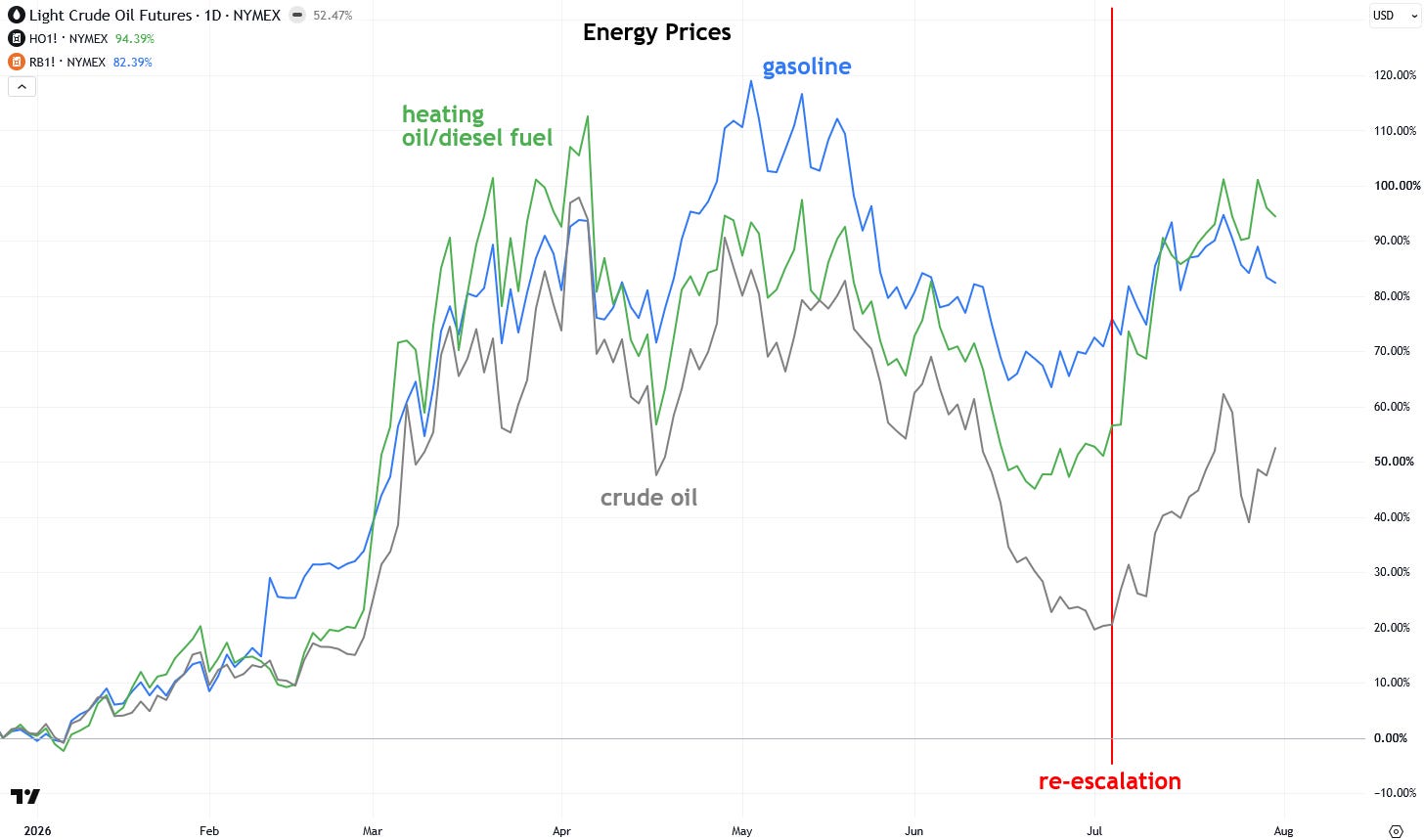
This back-and-forth, on-and-off, deal/no-deal, Hormuz open-then-closed pattern has defined this entire chaotic Iran war, which has now dragged on for five months and is becoming truly maddening. It is impossible to predict how this will play out, and every swing in the oil market has had major repercussions across other markets, including stocks, bonds, commodities, and precious metals.
Someone on X asked me whether I’m interested in investing in oil and if the energy sector is better than precious metals, and here was my response:
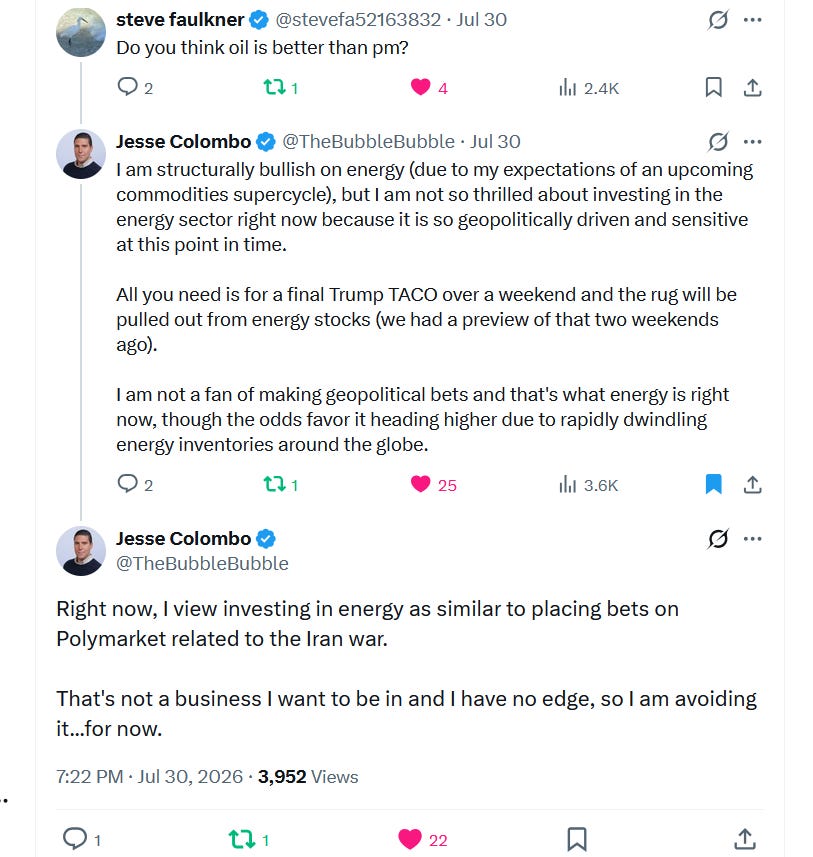
As I said, I am very interested in the long-term bullish energy thesis, and I plan to publish a report, possibly this week but with no guarantees, outlining my thoughts on that and the energy ETFs and stocks I believe are best positioned to play it. However, I believe energy right now is an especially risky proposition due to the geopolitical volatility and uncertainty, so any exposure I take would be conservative. That said, I do hope to scale it up once this Iran war (hopefully) winds down.
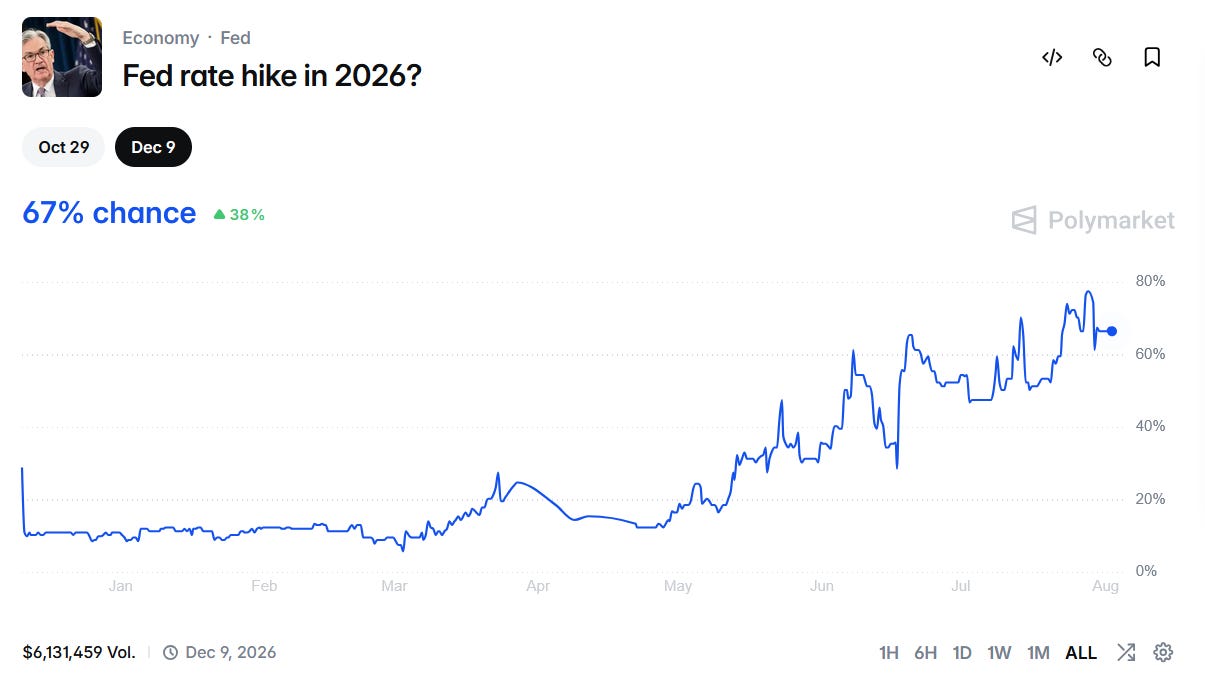
Fed 2026 rate hike expectations dropped from 78% to 67% after Wednesday’s Fed meeting, which resulted in no hike, though expectations have risen significantly in recent months due to the surge in energy costs tied to the Iran war.
In the coming week, we have a series of U.S. labor reports, including the ADP private employment report, initial jobless claims on Thursday, and the key July nonfarm payrolls report on Friday. These have strong potential to move the markets, although the Fed is currently more focused on inflation risks than employment risks.
Something notable I want to point out, and which has been the talk of the financial world over the past few days, is the spike in U.S. government bond yields (and the corresponding sharp decline in bond prices) following the Fed meeting.
This is a sign that bond investors were not pleased with the Fed’s decision to hold rates steady instead of raising them by at least 25 basis points to prevent inflation from becoming entrenched. As a reminder, bonds are particularly sensitive to inflation, with long-duration bonds such as 20- and 30-year Treasuries being the most sensitive to changes in inflation expectations.
30-year Treasury bond yields reached 5.27% by the end of the week, the highest level since 2007. This surge is now threatening a breakout from the triangle pattern that has formed over the past four years, and if confirmed with a solid close, it points to even higher yields and further downside in bond prices in the years ahead.
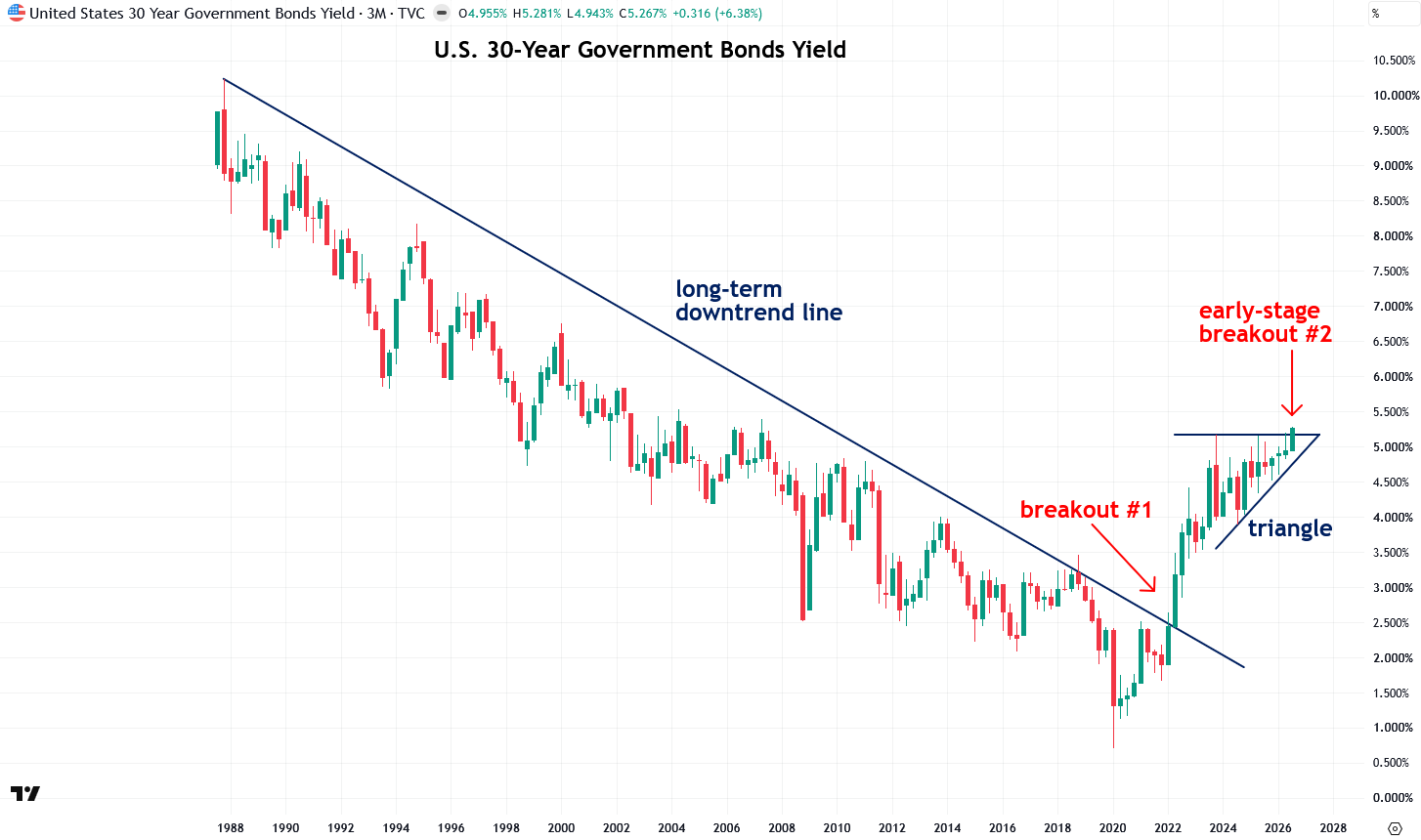
I have been expecting a bear market in U.S. government bonds and much higher yields in the years ahead due to persistent inflation and the U.S. government’s extreme level of indebtedness. As I wrote in May, publicly held U.S. national debt surpassed 100% of GDP for the first time since World War II, so this recent spike in bond yields is not at all surprising to me.
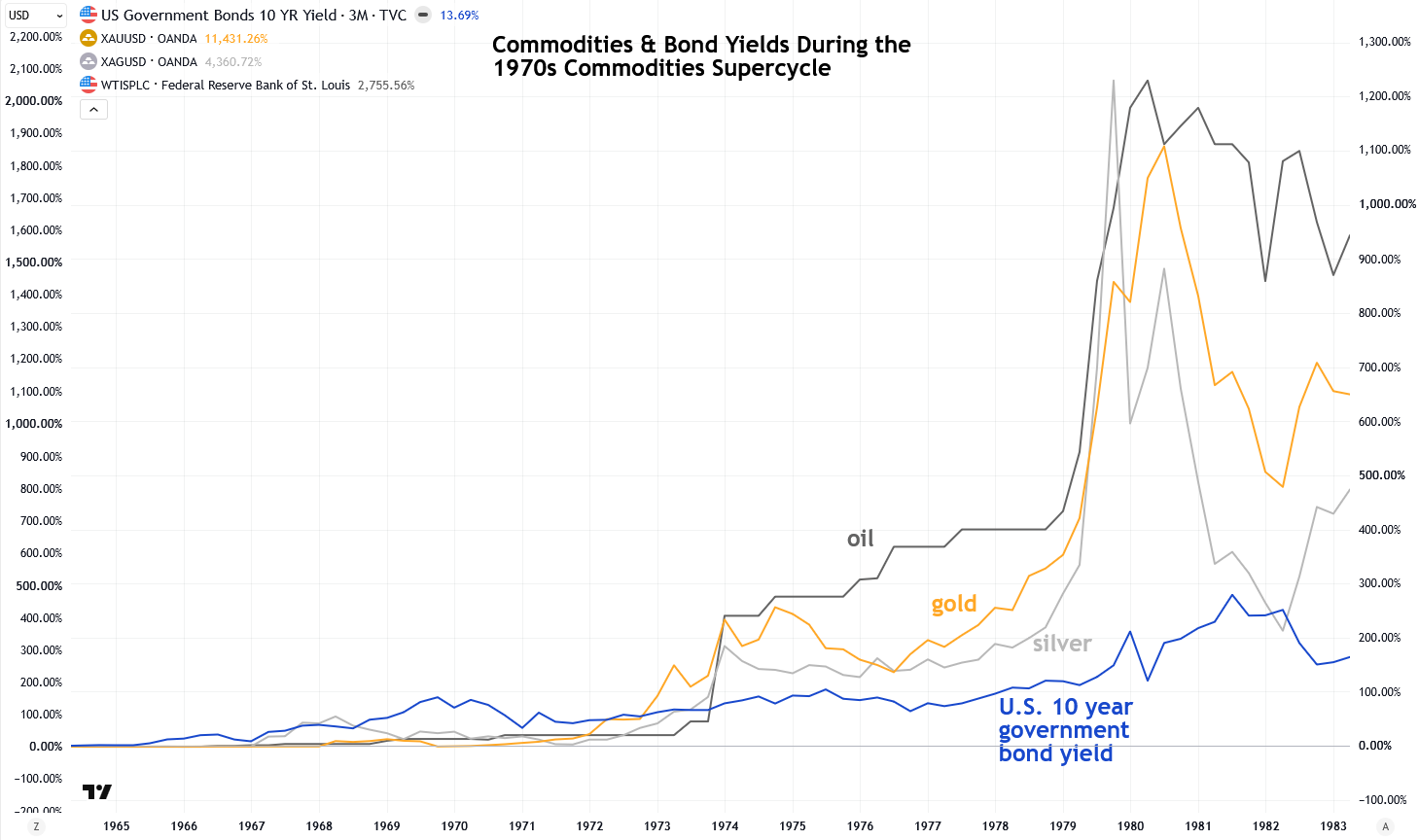
While there has been a strong narrative lately that inflation and higher bond yields are bearish for precious metals—and I can see how they may create short-term volatility—history shows that the biggest bull markets in commodities and precious metals have occurred alongside the sharpest spikes in bond yields, such as during the inflationary 1970s (as show in the chart below). I view that period as a strong analog for the era we are heading into, which leads me to expect oil, precious metals, and bond yields to rise together while bond prices fall as inflation erodes their value.
The reason I believe surging Treasury bond yields (and falling bond prices) will ultimately be bullish for precious metals is that the U.S. government will be forced to step in and support the bond market by any means necessary, including policies such as yield curve control and other measures that are effectively equivalent to creating new money. That will further erode the purchasing power of the dollar and drive precious metals and other commodities significantly higher.
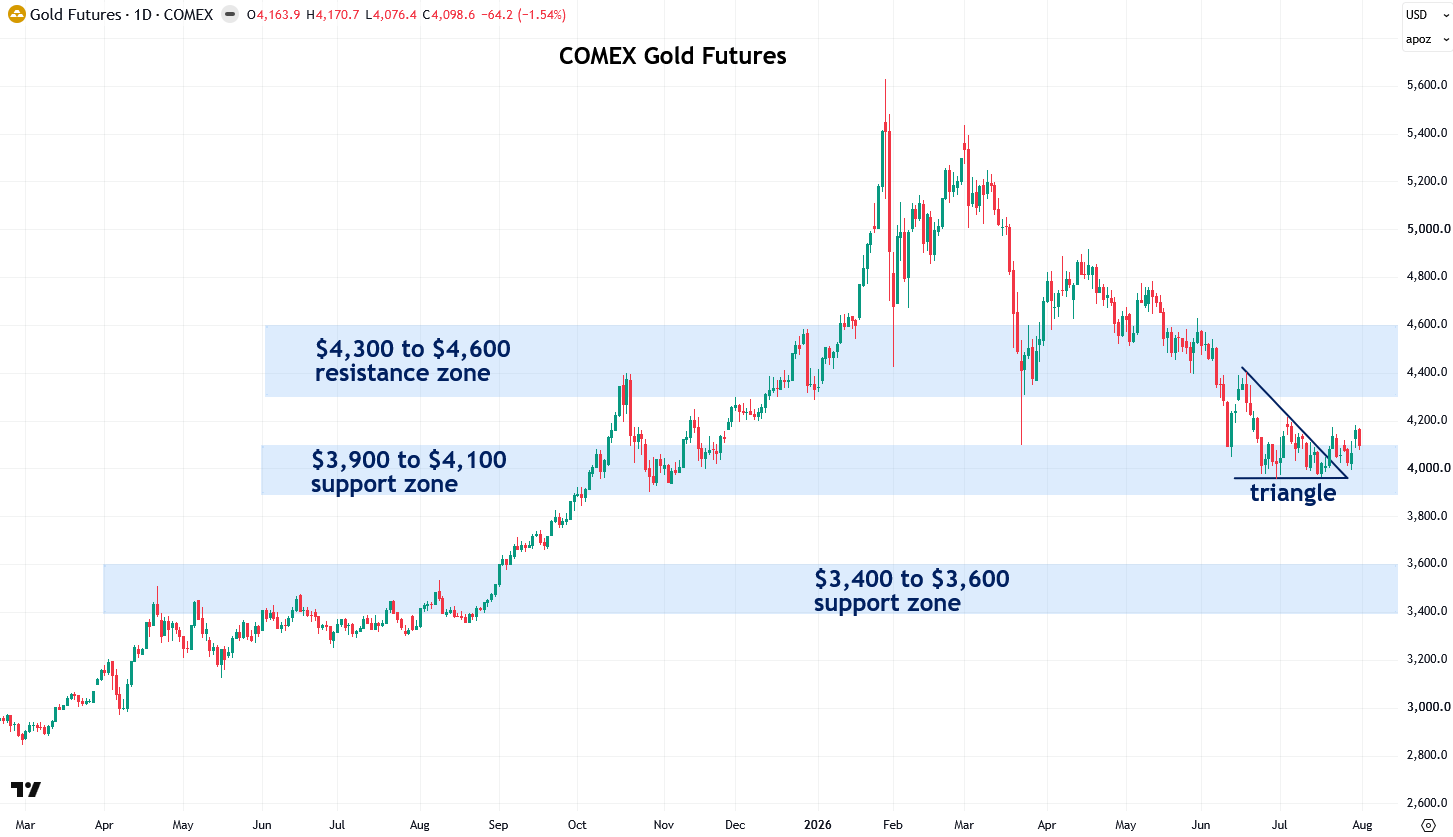
Now let’s take a look at where precious metals stand, starting with gold, which leads the overall complex. Despite an extremely volatile week filled with confusing crosscurrents, gold continues to hold its ground and gained another 1%. More importantly, the breakout from its triangle two weeks ago remains valid, though I would still like to see stronger upside follow-through.
I believe a new catalyst to drive that move is ahead, whether it be a falling dollar, growing concern over rising Treasury yields, the deflating tech bubble, or something else—we shall soon see.
Gold continues to hold its $3,900 to $4,100 support zone, which formed at the lows in October and November 2025, and I would like to see it decisively push above that zone for further confirmation of strength and the triangle breakout. Encouragingly, it has already reached the top end of this zone but still needs to clear it fully, as it is just a couple of dollars away, with front-month COMEX gold futures closing at $4,098.60 on Friday.
Assuming gold can push decisively above the $3,900 to $4,100 zone, I then want to see it clear the next hurdle at $4,300 to $4,600. A strong break above that zone would be a solid signal that the recent weakness has run its course. This resistance was established over a nine-month period by the highs and lows from October through June.
To learn more about support and resistance zones, I recommend reading my two-part tutorial (Part 1 and Part 2).
Silver is currently sandwiched between its $45 to $55 support zone and the $60 to $70 resistance zone, and I am now looking for further bullish confirmation in the form of a move above that $60 to $70 resistance zone just overhead. A breakout there would allow the rebound to fully gain traction and signal that the correction is over.
As I’ve been saying in my recent updates, the financial markets—including precious metals—are currently in the low-volume, thinly traded summer doldrums, and it may take a pickup in volume after the summer for a sustained upside move to develop, as volume is the lifeblood of the financial markets.
Comments
Nothing yet. Say the first thing.
Sign in to join the conversation.