
"Nvidia hit $4 trillion and the world called it a miracle—until history shrugged and whispered: we've seen bigger.”
If you zoom out a few centuries, you’ll see history already beat us to the punch—and by a wide margin. In 1637, the Dutch East India Company (VOC) was worth over $10 trillion in today’s dollars. That’s more than Apple, Microsoft, Nvidia and Tesla combined.
We’ve been here before.
But the question is: are we learning anything new?
The market loves a good acronym. First it was FANG, then FAANG, now MAG7. These seven tech giants—Microsoft, Apple, Nvidia, Amazon, Alphabet, Meta and Tesla—aren’t just leading the market.
They are the market.
Together, they now command over $18.6 trillion in market cap—more than the GDP of the European Union.
They’re fast, scalable, data-rich, and increasingly irreplaceable. The consensus? These companies are the "new empires"—digital monopolies printing profits like 18th-century kings minted coins.
But that story is missing one crucial element: context.
Let’s take a historical walk.
In the 17th and 18th centuries, companies like the Dutch East India Company, Mississippi Company, and South Sea Company weren’t just “big.” They were national economies wrapped in corporate form. Backed by government charters and colonial ambitions, they controlled trade routes, waged wars, and issued currency.
Dutch East India Company (VOC): Peaked in 1637 at the height of Tulip Mania. Valuation? $10.15 trillion.
Mississippi Company (France, 1720): Backed by monopoly rights to trade in the Louisiana Territory. Valuation? $8.35 trillion.
South Sea Company (UK, 1720): Absurd hype, minimal profits. Valuation? $5.52 trillion.
All three collapsed in spectacular fashion.
Sound familiar?
These companies were fueled by a potent cocktail of monopoly power, investor euphoria, and government complicity.
And when the music stopped?
Massive wealth evaporated.
Compare that to today’s tech titans:
Nvidia: $4.2T, riding the AI boom.
Microsoft: $3.79T, embedded in enterprise software and cloud dominance.
Apple: $3.15T, still printing cash from its walled garden of devices and services.
They’re real businesses, not paper fantasies.
But remember: the same thing was said about Cisco in 2000.
At its peak, Cisco was the world’s most valuable company. Analysts called it the first “trillion-dollar stock.”
It crashed 80% within two years.
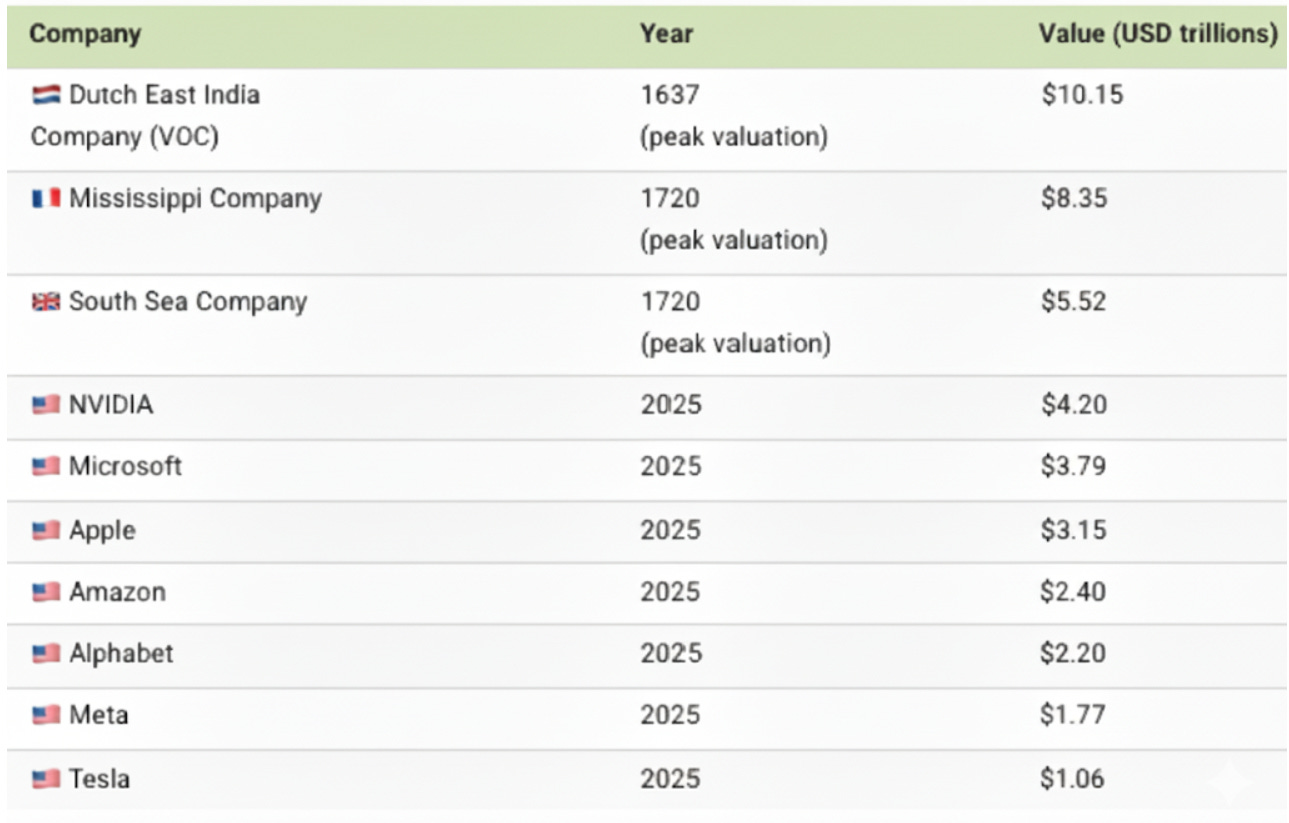
The VOC wasn’t just bigger—it dwarfed the biggest of today’s titans.
Behavioral psychology offers a clue:
Recency bias: Nvidia’s 2023–2025 run has been jaw-dropping. Investors expect the trend to continue indefinitely.
FOMO: AI is the new electricity. And no one wants to miss the next trillion-dollar boom.
Narrative fallacy: We overrate the neat storylines—“Nvidia will power all AI,” or “Apple is a safe haven.”
That’s why markets routinely overprice certainty and underprice surprise.
Let’s be clear: this isn’t a call to short the Magnificent Seven. They're dominant for a reason.
But it is a call to avoid becoming the 2025 version of those Mississippi Company investors who mortgaged the farm for a slice of speculative glory.
In 1637, Dutch investors thought the VOC was too big to fall.
In 2000, Cisco seemed untouchable. In 2025, the same is said about Nvidia and friends.
But markets are cyclical. And history’s bubbles always pop when the story gets too perfect.
The VOC’s fleet is long sunk.
Let’s make sure your portfolio doesn’t go down with it.
No posts
Comments
Nothing yet. Say the first thing.
Sign in to join the conversation.