
I quite vividly remember when I first opened up a blank unit plan template.
It was a few weeks before my first year of teaching, and I had just received my teaching schedule: Pre-AP English 9, Pre-AP English 10, English 11, and English 12.
And a Personal Finance elective.
Also? Zero curriculum provided.
To make matters worse, I had entered the classroom through Teach For America and the program’s expectation was very clear: completing a full unit plan working backwards from an assessment for each of my assigned courses, to be submitted and reviewed by an assigned mentor before classes began.
“Excuse me,” I remember saying to my mentor, “I mean, I have five different courses.”
They said that I could prioritize my four English courses and get to the Personal Finance unit plan when I could.
(Note: if you’re curious about that Teach For America experience, including myriad critiques I have about it, I talked with Jim about TFA last summer here and here!)
Anyways, there I was staring at a very blank document with zero idea of where to even start, while at the same time being quite aware that there were several other very blank documents I needed to complete and the clock was ticking before students would step foot into my first ever classroom.
Yeah, it wasn’t a great experience.
That did not happen overnight.
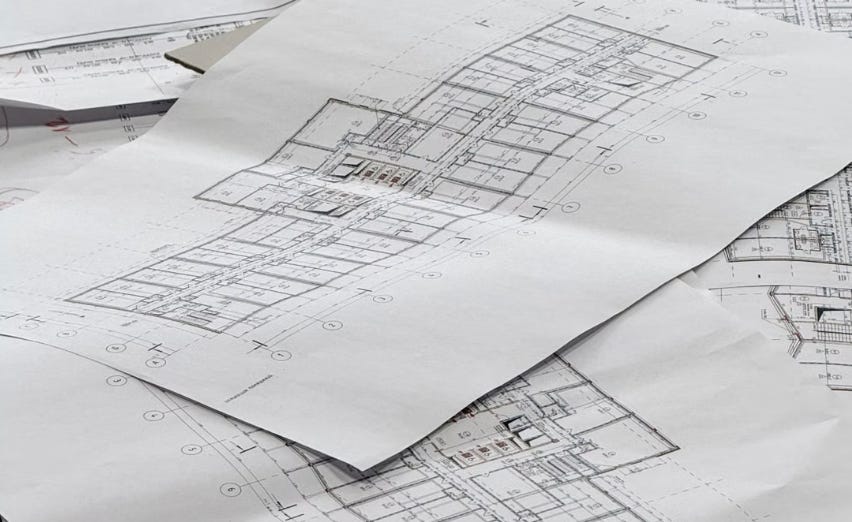
Those early unit plans were like housing blueprints from a rookie architect who had never stepped foot on the property—and, consequently, plans that were never going to be built into anything resembling an actual structure.
Without question, in an ideal world we would provide many more resources to early career teacher, not just exemplar unit plans but also time spent with expert mentors to sit down in-person and build these plans together. (To be clear: this was not what Teach For America was at all!)
Still, I look back on my struggles with unit planning in those initial years, and I have to admit: the blank outlines were still valuable as I stumbled through that crazy course schedule during my first year of teaching.
I knew there needed to be a shape to what I was doing, and “what am I teaching tomorrow?” was not just unsustainable.
It wasn’t good teaching.
Those unit plan templates were important reminders of where the bar was, and thankfully each year of teaching those blank unit plan templates became less intimidating, too, to the point that I eventually began tinkering with them myself—trying to make the template work for me and my own practices.
That’s what I wanted to share in today’s post: [1] why I’ve arrived at a new unit plan template this summer that I very much am enthusiastic about; [2] the changes I’ve made recently to how I design units; and [3] a brief reflection about why I believe so much in designing unit plans for my own classroom.
And before getting too far into the post, here are some actual resources:
For the comment section: how do you feel about unit planning for your classroom? What are your go-to moves and resources, what do you enjoy about it and what is difficult, and what advice would you offer to early career teachers who are still getting their “instructional design” sea legs?
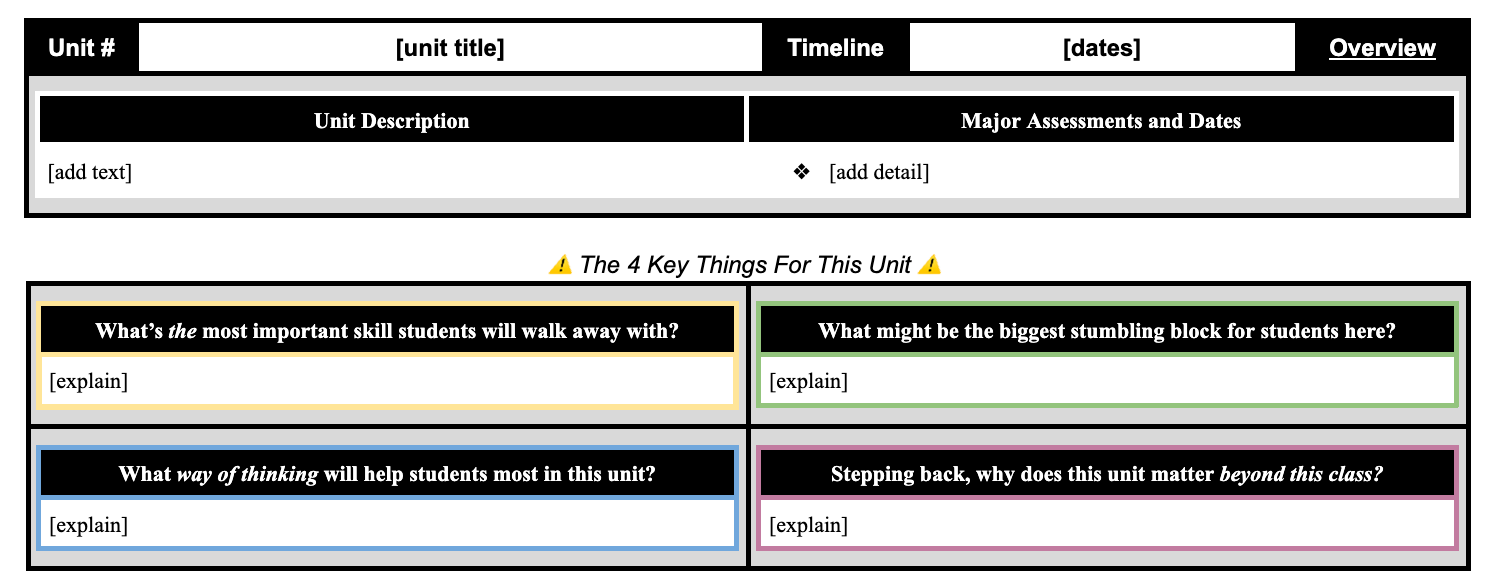
In this new template I’ve been working with this summer, the first change I made was to remove some things I previously included.
A lot of my earlier unit plans were built from the Understanding by Design framework, which was great as far as listing lots of helpful things as a teacher—goals, essential questions, standards, skills, knowledge, etc.—but could very quickly became cluttered, particularly when students and families would look at them.
This is not to say that a teacher shouldn’t be designing around these things. Rather, it is, at least for me, simply an admission that sometimes we dump so much onto a document that it forsakes its utility—including for us as teachers.
In my mind, a unit plan should tell a story. If things are getting in the way of the storytelling, then, I wonder: are they really that necessary to include?
This is why I decided to make the initial section much simpler: a brief description of what we’ll do and “Major Assessments and Dates,” with the goal of immediately giving my students—who are often already over-scheduled—a clear place to begin planning out their path to success over the next 4-6 weeks as well as dates for student families to follow up on.
I keep a lesson-by-lesson calendar on the second page, too, because some students like to have the visual of how the full unit will go, and I also use this calendar as a place to link our individual lesson slide decks. I then went ahead and added a couple English-y flourishes with the reading list and “a quote to hold onto” at the end.
But the most important shift with this new template, I believe, is not just adding but really emphasizing “The 4 Key Things For This Unit”:
What’s the most important skill students will walk away with? Instead of a list of standards and skills, this is a more-helpful question that I very-much should be able to answer as a teacher: when it comes down to it, what skill matters most in our work over the next month or so?
What might be the biggest stumbling block for students here? Given that I’m going into Year 15, I’m at the point were I generally know what to expect with each unit, and in each unit I can usually anticipate what will be the biggest obstacle. So the goal here is simple: name that anticipated “stumbling block” in advance—which can be a great check-in point for families, too.
What way of thinking will help students most in this unit? This is a direct result of reading Christian Moore-Anderson’s work and learning from him in our conversation in June: I want to include video models of the ways of thinking that matter for students (example: how to annotate using TQE or what it means to use critical theory lenses), and I look at this box as a way to hold myself accountable to more-consistently modeling what that expertise thinking can look like.
Stepping back, why does this unit matter beyond this class? This is another move of pragmatism on my part, as I believe that by reflecting and writing out an answer to this question for each unit, I will be much better at communicating this deeper, lasting importance to both students and families. Honestly, what are we doing if we cannot answer this question?
After using this template to prepare several different instructional units over the past month, what I love most about centering these four boxes within the template is that as a teacher I’m better off as a result of answering their questions, which gets to a deeper truth about unit design, I think: the work of the designing the unit myself strengthens who I am as a teacher stepping into the classroom.
(Another reason, I’d add, why it is so important not to outsource this work!)
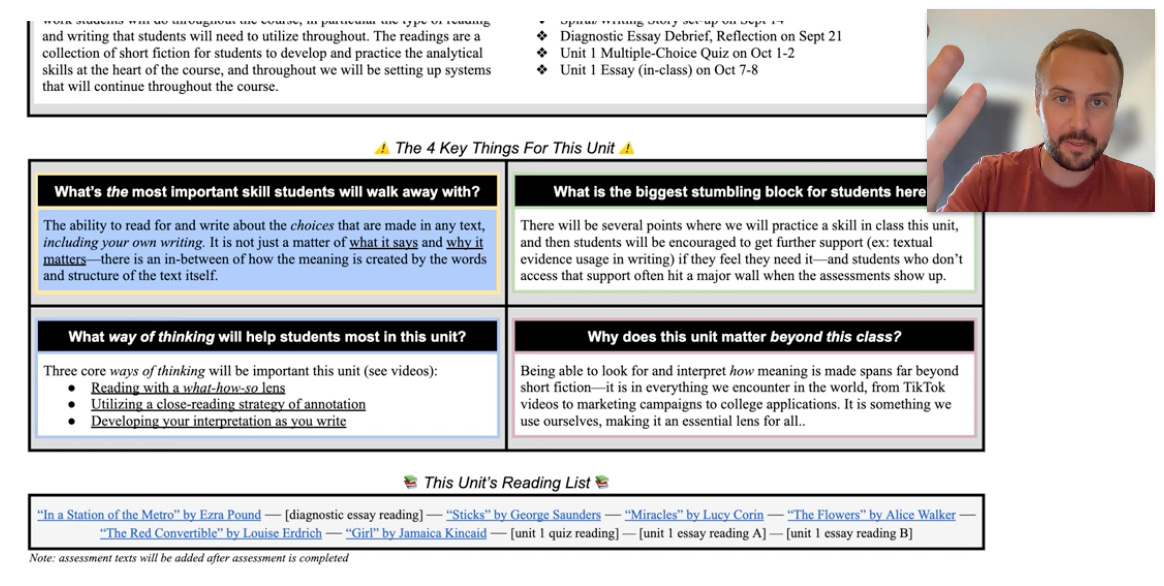
The other free tool I’ve fallen in love with as a teacher over the past year has been Google Vids, which is far and away the easiest screen capture tool I’ve used.
My goal with each unit plan this school year is to include a brief video talking through what we’ll be doing over the instructional unit: (a) talking through the key dates and week-by-week calendar; (b) discussing the assessment and what students should expect; and (c) walking through the “4 Key Things” boxes that I’ve added to this new template.
I use Google Vids in myriad ways right now in my teaching practice: reviewing expectations for planned absences that the substitute can play aloud for students; adding explanations to go with examples provided for students on major assessments; and modeling key skills and ways of thinking that I can embed in these unit plans. (Also: it’s super helpful for embedding videos within Substack posts!)
As stated above, one of my main intentions with this unit plan template shift is to make them more student and family-facing, and the inclusion of these videos leans into that intention. (If you’re curious, here is the draft video I created for our opening unit of the year!)
For much of my father’s career he worked as a general contractor in building construction—but he also drafted blueprints for various remodels and house projects. This meant that, after a long day at the construction site, I’d frequently find him at his drafting table in the basement.
(Two quick notes: yes, it is really cool to grow up in a house that your parent designed and built himself; and yes, he definitely made sure I had my own mini drafting table to “work” alongside him when I was growing up!)
One of the advantages my father always spoke about when it came to his drafting work was the vast, authentic experience he gained as a general contractor and how critical that experience was to his work when he sat down at the drafting table.
Unlike those who go straight from graduate school to work in architecture, my father spent decades doing the actual building with these plans. In other words, he knew what it was like to be at the actual construction site and look over plans from afar. And, consequently, he knew the difference between plans designed with an authentic knowledge of what the work of construction required—and plans designed without that authentic knowledge.
I think there’s a reason, perhaps, that construction sounds so much like instruction.
At this point in my career, I love designing unit plans for myriad reasons, including the agency inherent in this work. In other words, I understand that it is a privilege to have that blank template afforded to me. We are in a moment where agency in the work of teaching is becoming an increasing scarcity, and I don’t take mine for granted for a second.
While there are standards I need to cover and certain texts I need to make sure to hit, that design work? Still in my hands, and I’m genuinely grateful for that.
Furthermore, as I mentioned earlier in this post, I love the work of designing the path for our classroom because of the understanding it affords me within our classroom. John Warner has frequently observed that “writing is thinking,” and in a way I find a parallel here in that, at least for me, designing is understanding.
When I step into a classroom to facilitate a lesson that I crafted myself, within a broader instructional framework I designed myself, I have an authentic, irreplaceable expertise around what is about to take place.
That I know my classroom space makes me better at the design work; that I did the design work myself makes me better at stepping into my classroom space.
Just like my father at his drafting table and construction site.
To outsource that expertise? Rather than develop and hone it? Quite honestly, a travesty—in the short term and especially down the road. So while I recognize how overworked and under-resourced we are within this profession, I continue to caution those who are turning to shortcuts to “find” unit plans that will “suffice” rather than doing the at-times-difficult, always-important design work ourselves.
This leads to the last point I’d like to make, too, which I expanded upon in the video at the beginning of this section: if you’re reading this posts as someone newer to teaching and feeling overwhelmed at the idea of a blank unit plan template, that feeling is completely valid. Indeed, I remember like yesterday what it felt like to look at those blank templates!
However, what I want to be super-clear about here: it was worth the struggle.
The “reps” of learning to design my own unit plans, including the work of mastering the content that takes place within them? They were essential steps in the path to who I am now as a teacher, and any shortcut then would have changed who I am now.
Should you ask for help? Yes. (I still do!) Should you go it alone? Not at all.
But is it worth it to do the design work as a teacher for the learning that takes place in your own classroom?
Yes. Yes. Yes. A thousand times over.
It matters, it is worth investing in, and it is worth fighting for.
In the classroom and outside of it.

Four pieces to share today in our closing. All voices that I’d highly recommend to anyone who enjoys reading The Broken Copier and, if I had to guess, many of our subscribers are already familiar with these excellent education voices:
Chesterton’s Fence by Peter Greene – I’ve been reading Peter’s blogs for well over a decade now (a habit I very much recommend), and this might be a Mt. Rushmore line for me from his writing: “Don’t tear down a fence until you know why someone put it up.” Yup.
Leathercraft by Adrian Neibauer – I can’t believe it, but Adrian has officially been writing on Substack for three years! I know we already have quite the overlap between his newsletter and Broken Copier subscribers, but if you haven’t signed up yet, not sure what you’re waiting for?
Why I think AI literacy is necessary (Part 2) by Mike Taubman – Yes, I’m biased after this conversation that was released on Monday, but Mike is a must-read voice around AI in education—so regardless of your particular vantage point, I’d encourage you to check out his Substack!
Dave Eggers on Writing, Art, and “Contrapposto” by John Warner – Since he’s already referenced in the post, I figured it was worth pointing to this fantastic interview with Dave Eggers, including this gem: “ So schools should be building and maintaining their staffs with great care and an attention to stability and continuity. And when their districts and states and governments don’t give them the resources to keep some continuity and stability, then schools fail and the system fails. But when you benefit from a stable school full of experienced teachers — that’s where you have happy kids and relieved families and evidence of a sane, evolved society.”
That’s where you have happy kids and relieved families and evidence of a sane, evolved society.
Talk about a worthwhile aspiration for the “unit plan” of education at-large.
Note: blueprint image featured in post is from Pexels.com by Marina Zvada
Comments
Nothing yet. Say the first thing.
Sign in to join the conversation.