
I share a lot about things that are working in my classroom.
That was a huge part of what inspired The Broken Copier in the first place, after all: a belief in the power of sharing what is working in our classroom and, more broadly, of making sure to tell the good story about our classrooms whenever we can.
I still believe in that. The problem, though, is that I think it can come across at times as if everything is going absolutely swimmingly in my classroom—and, I hope it goes without saying, that is decidedly not the case.
Just like any teacher, every single school year I encounter challenges: some reliably showing up each year (ex: student attendance), but others are more particular to a given school year.
Each year has its own shape, after all, as well as its own challenges.
Next week I to work for the school year officially, so I wanted to use today’s post to name and reflect on three separate challenges that I am anticipating going into this upcoming year of teaching—along with how I hope to respond to each them proactively. (I also included an additional, broader concern at the end of the post, even though I have zero idea of what a solution can and should look like in response to it.)
Several days ago I received access to my tentative course schedule and rosters for the upcoming school year, and here is what it looks like:
4 sections of AP Literature, each with at least 30 students
2 sections of English 10, each with at least 35 students
Acknowledging that things can change a bit between now and when students walk in on Day 1, It is very likely that I will have between 180-190 students in my English classes this school year.
Needless to say, I consider that to be a lot.
To be fair, this is sort of the normal of my current context—though most years it is a bit spikier, with a few classes in the mid-30’s and some that settle in the 20’s. However, our state is not immune from the nationwide issue of dropping public school enrollment, and It seems like we are in a buckle-your-seat-belt moment for the next stretch as public school teachers. (Emphasis on public, which I’ll elaborate on in the video later in this post.)
As any teacher will tell you, the difference between a class size in the mid-20’s and one in the 30’s is an exponential chasm in terms of the lived experience of students and teachers alike. It ripples into almost every aspect of the classroom, too, from the ability to the flexibility of seating arrangements to the time it takes to prepare materials to a teacher’s capacity to differentiate meaningfully.
In my experience, there’s also a more-basic Rubicon that gets crossed: there gets to a point where there are too many kids in a class for me to know how each student is doing at the end of every class period.
In a class of 25-28 students, if you ask me how Albert is doing? 100% of the time, I have a genuine answer I can give you.
In a class of 30-33 students, however, if you ask me about Albert? I cannot guarantee that I’ll have a genuine answer every single class period.
Bigger classes means fewer students feeling seen and affirmed. Period. Which is a heavy thing in myriad directions, and a burden one way or another that is shouldered by everyone.
As a teacher going into Year 15, there is admittedly a gut instinct to double-down on structure and my “tool belt” of moves meant to help keep the ship running smoothly. Clear expectations, tight transitions, etc. Preemptive design to account for more potential disruptions and to get to a solid baseline in each class period as quickly as possible—which is where the real work begins, right?
I think this instinct is understandable but also at least partially incorrect. In particular, I believe that if I go into the school year with a “behavior management” lens, then it will be self-fulfilling prophecy as far as the culture of the classroom that emerges in response.
Instead, I am going to trust that the correct response is to lean into community, which at times might feel like veering into the skid. Some things that I plan on doing for this:
Protecting time for students to get to know each other early in the course, both with them getting classroom rosters to add to their spirals paired with activities that have them interacting with those rosters—knowing names as a starting point to knowing each other more authentically.
Sticking with my belief in assigned seats but then taking the time to plan out more-frequent rotations. The goal here is to have students get opportunities to interact with more classmates early in the semester, especially when we’re leaning into low-stakes collaborative discussions.
Not letting go of systems of affirmation and celebration. I know in past years that large class sizes have led to more-difficult starts and, in response, me forfeiting some of the practices that are most impactful in building community, from out-of-seat activities to our signing the wall ritual. This is a mistake, as I elaborate on in the video above—and I’m making a commitment right now not to repeat this mistake in response to larger-than-expected class sizes.
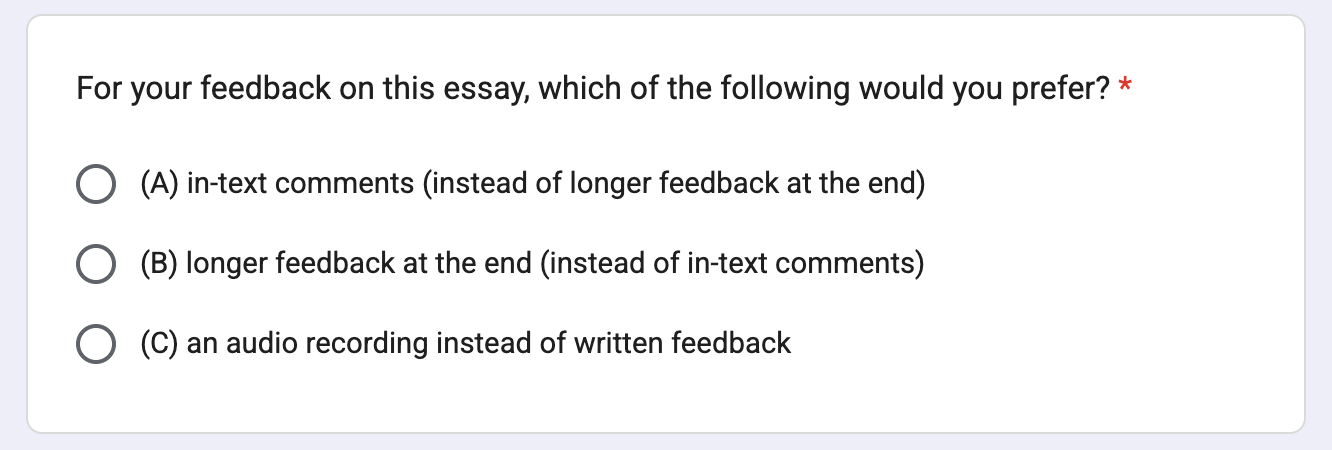
This second challenge is of course inextricably related to the first challenge, as my ability to offer high-quality, authentic feedback to students will unquestionably be tested by the class size alone in the classroom. I think this will be felt in AP Literature especially, where I’ll have about thirty more students than I typically have across those sections.
But I think it is at least somewhat myopic to point to class size as the main obstacle to authentic feedback—particularly in this moment.
To name some other challenges, all of which feel as if they are increasing: [1] increased “guidance” from the district around writing assessments, which can limit the authenticity of what students are asked to write about; [2] increased embedding of AI tools into actual writing platforms that students use, which means that unless I want to shift 100% to handwritten work (I do not, for a host of reasons) then the shortcuts around authentic writing for students will continue to be pervasive; [3] increased norming of AI-generated feedback amongst teachers, which can make the Sisyphean task of providing original, authentic feedback all the more isolating.
Add increased class sizes onto all of that? It can feel like a tipping point, for sure.
That said, I walked out of this past school year with as much conviction as ever in the value of investing time to closely read student writing and offer authentic feedback—to metaphorically walk alongside them in their journey as writers and provide them an expert, real audience as they identify growth areas, take risks, and reflect on their own progress.
I continue to believe, too, that the “feedback space” is one of the most powerful places to build trust and rapport as well as student confidence and affirmation, and I continue to fear what education will look like as more and more teachers forfeit the power of that space by outsourcing it to AI.
Indeed, students have told me time and time again how much they value the feedback they receive in our course, particularly with their writing. It makes a difference and it makes an impact. (Seriously: I do worry about this a lot and continue to be disappointed—sorry for being honest here, folks—by how quickly teachers are moving to AI for feedback on writing in particular. I worry as a teacher and I worry as a parent.)
Despite these convictions, I still recognize that it might as difficult as ever this upcoming school year to consistently offer that authentic feedback given the sheer volume of writing to respond to with these class sizes along with all the other aforementioned factors.
Continuing to lean on strategies around collective feedback and guided self-assessment in the classroom, as in recent years this has without question been a saving grace for me—not just as a more-efficient way to provide support for student writing, but much more importantly as a way to offer more agency to students in understanding their own writing.
Exploring different ways to embed choice for students in how students receive feedback. A fellow attendee at the Humans First conference suggested a three-prong set of options for students to get feedback that they get to select from upon submitting, and I’m definitely going to give this a whirl this year to see how it goes. (You can see a mock-up version of what this might look like above!)
Another version of choice: having students "zoom in” on specific aspects of their writing they want me to focus my feedback on. I would anticipate that this is something that I lean on later in the course, but I do think it is another example of offering agency to students alongside added responsibility of having self-awareness of what is most important within their writing to focus on.
Last October, I recorded a solo podcast reflecting on what it felt like to recognize myself losing patience more frequently than I had in previous years:
In past years, I feel like I would be self-aware enough to pause and wait and to give it a chance to come back maybe later in class, let them know their options and check back in, still holding my tone, still staying kind and patient as much as possible. This year, though, it’s almost like I’m watching myself lose my patience and being quicker to frustration.
Reflecting back, this was mainly the result of one specific class period that was quite large and, at times, quite difficult to navigate that first semester—and now looking ahead at my schedule, there’s a good chance that there could be multiple like this out of the starting gate.
One of the gifts of being in my second decade of teaching is an ability to “see the whole board” more than I used to, but I have to acknowledge that this also at times leads to impatience: you see patterns of behavior emerging in the classroom that you wish you could shortcut; you see systems outside the classroom not functioning that you know in previous years have run more smoothly.
You sigh deeply and keep going, but there comes a point where you can sigh too deeply, too often, I think—to the point that it impacts how you show up in the classroom.
In part because of the named challenges I’ve already reflected on and in part because even in a year that was incredibly affirming and successful I still found myself getting impatient too quickly, I think it is important to step into this new school year clear-eyed about this challenge, too.
Continuing to invest in colleagues in our building, as I know that sometimes an over-emphasis on “making the classroom good” is a straight-line path towards feeling isolated in this work—not to mention that the best of intentions do not alleviate the consequences of trying to solve everything yourself. We need each other in this work—and it’s worth investing in each other.
Holding a lens of regulation in how I look at what is taking place in our classroom—which includes doing so with a mirror. As Jennifer Haber wrote, “before we can help students regulate, we have to notice when we’re becoming dysregulated ourselves.” This means being reflective not just on what I’m doing as a teacher but even more so how I’m doing.
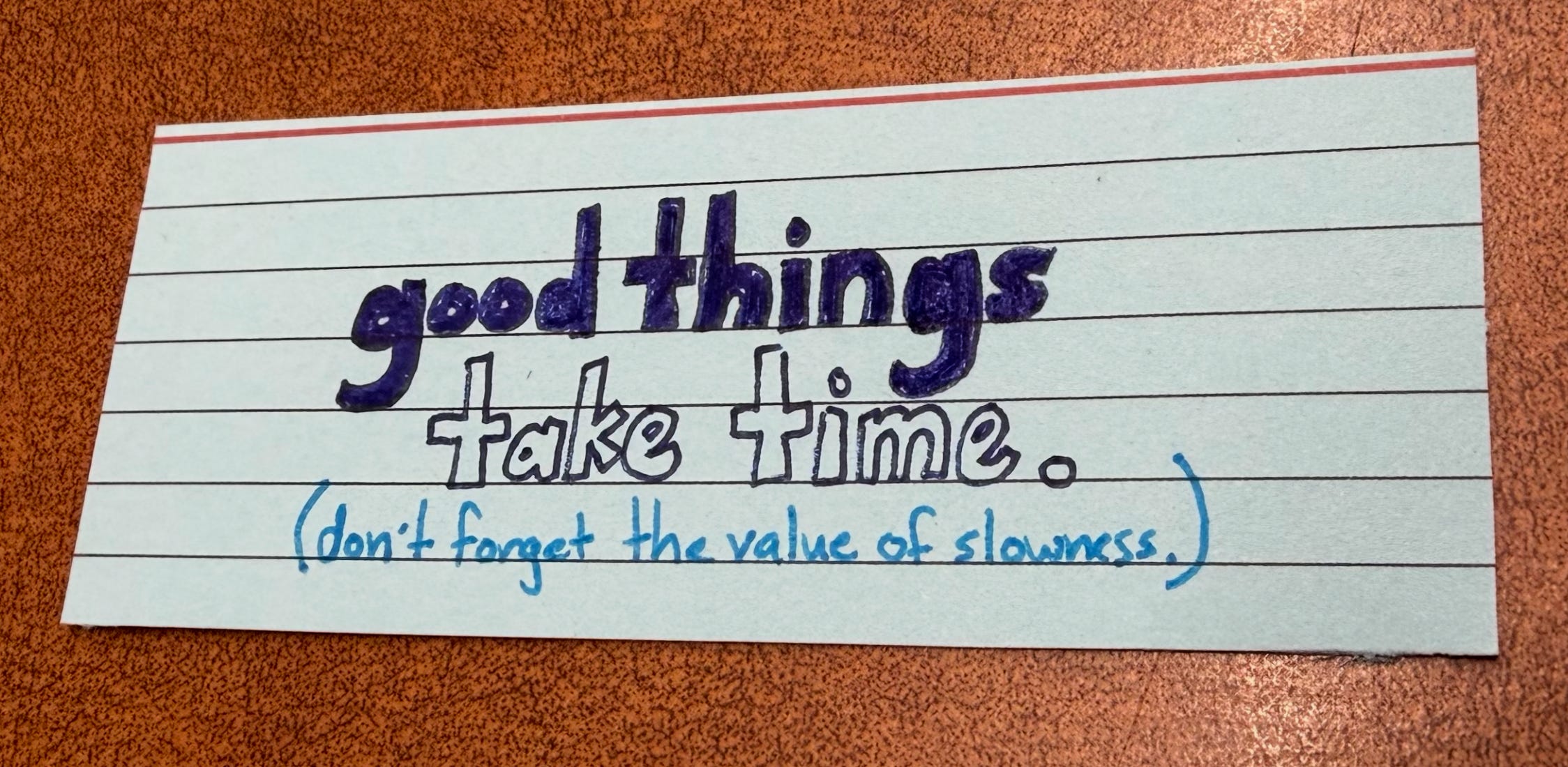
Centering the value of slowness for myself. Not just with the laminated sticky note on my desk—though as you can see above, that’s happening!—but by sitting with slowness as a value. At least for me, “patience” can seem reactionary, like something we do in the face of what is challenging. Slowness, on the other hand, is an opportunity—a door to unlock what could not be realized otherwise.
As I’ve already noted and linked to concerns around student enrollment earlier in the post, I’ll for the most part let this concern live in the video above—but the gist of it is this: I’m really concerned about public education.
From the retreat of the Department of Education to the misguided, outlandish (in my opinion) momentum of AI-powered schools to the expansion of public dollars to private schools, student enrollment issues are far from the only issue for public education.
Indeed, read a report like this one from ProPublica, and it makes you wonder what direction we really are going?
I could hyperlink for days in this concluding section of this post, but I think what really is worrying me underneath all those very-concerning hyperlinks is the pulling-away I’m seeing and feeling from a collective commitment to public schools.
What I mean by this: the simple, foundational idea that part of being a community member and citizen is taking part in the public schools in your area—which includes, barring exceptional circumstances, sending your children to them.
I go into this more at length in the video, but my fear essentially is this: too many adults—including too many adults working in public schools—have decided that public schools aren’t good enough for their own children.
I recognize that I have zero insight into anyone’s individual situation and I also recognize that here are a host of issues involved in who has access to which public schools based on where they live. And it goes without saying, I hope, that I’m just one teacher with one perspective here. I understand that many folks disagree with this.
Setting those acknowledgments aside, though, my concern about where we’re heading with public education still remains and, as you can hear in my voice in the video, remains considerable: if fewer and fewer people believe in public education, especially based on where they send their own children, what is going to happen to it?
I think about this daily, as a teacher and a parent, and it is a concern that I have no idea how to begin to respond to other than expressing it—along with expressing how much good I have seen daily in the public schools I’ve worked in from Day 1 onward in my career.
There are consequences for not telling and sharing the good stories about what is happening in our schools, and I fear that we’re only starting to see those consequences.
If you’re willing, you can respond with your own “anticipated challenge”—or, for those who have already begun your school year, perhaps a challenge you’re already experiencing—along with what you’re doing in response. Sharing might not necessarily solve the problem, but sometimes it is a start towards recognizing patterns and starting conversations around what a solution might be like.
One of the things I noticed over this summer was the potpourri of thoughtful comments

Before signing off from an admittedly long post, I wanted to make sure to include four pieces that added value to my own thinking and practice this week as a teacher:
When “Good Teacher” Becomes Your Whole Identity by Dr. Cathy White – This was unquestionably the “read of the week” for me in how it just forced me to sit there for a bit after I was done, thinking about my own response to the question it offers to all those in this work.
Rethinking Participation to Include More Student Contributions by dr. Jane R. Shore – I feel like I read this at the perfect moment on the eve of a new school year, as it pushed me towards humility and open-mindedness around what a collaborative classroom can and should look like that is truly inviting for all the students in the room.
Thaumaturgy by Adrian Neibauer – Along with unofficially winning the “best article title I’ve come across in some time” award, Adrian’s piece showcases the work and care that goes into the literal world-building of a new classroom—and the hope that can be found in that work and care, too.
Why coaching taught me to stop solving by Rod J. Naquin – At the end of this week’s post, Rod included a “talk move” that I loved (a) on its own as a strategy I can use right away in the classroom but (b) as a reminder of how valuable it can be to bring tangible strategies like this into the classroom for students around conversation.
One other quick celebration, too: we are about to cross the finish line of our Bleak House journey this weekend! It has been a remarkable stretch of months reading and discussing this novel collectively, and a reminder too of how much good can come from simply finding and investing in community as educators. Cheers to the finish!
Comments
Nothing yet. Say the first thing.
Sign in to join the conversation.