
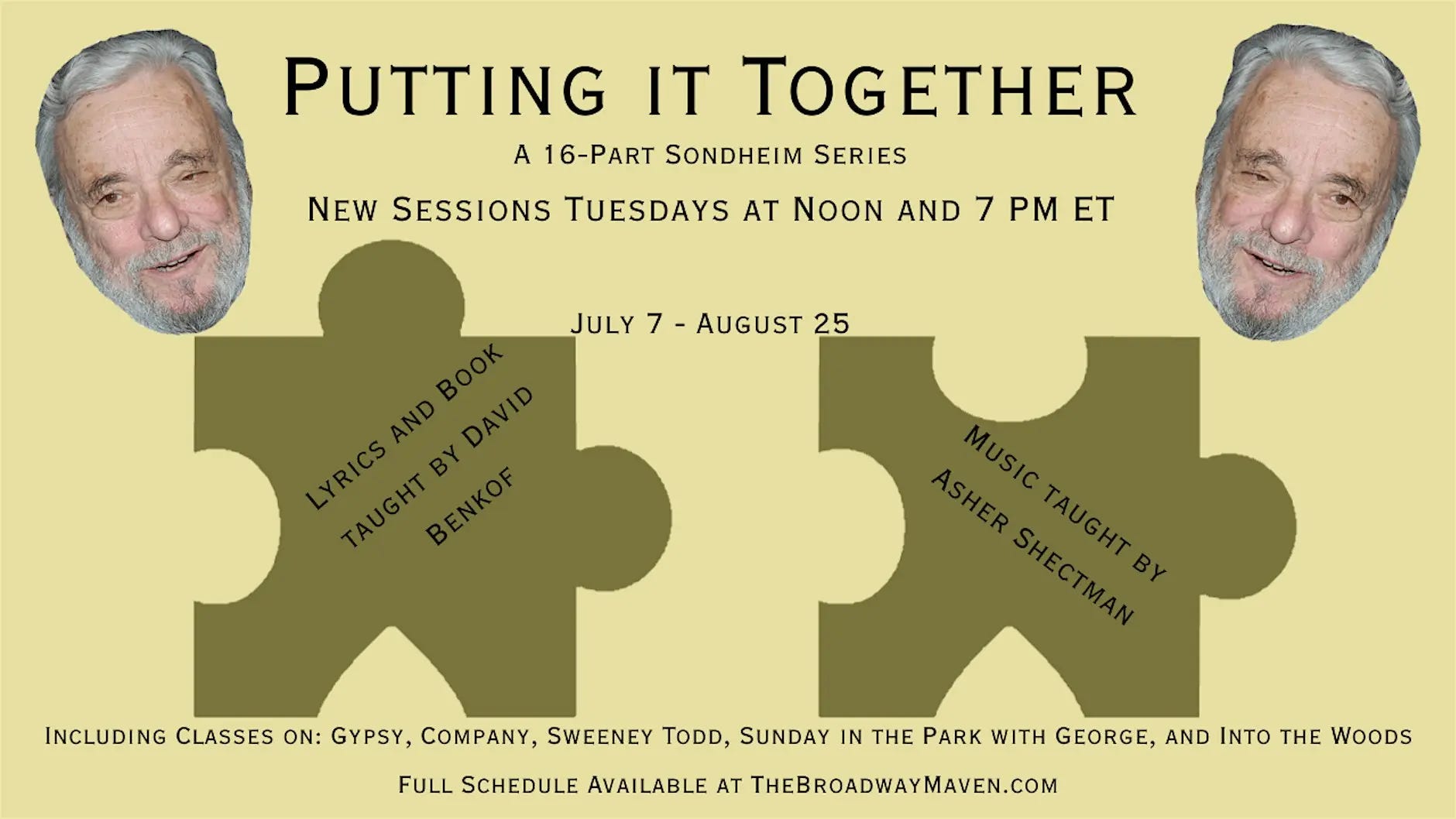
The Broadway Maven is pleased to announce a 16-part Sondheim series, every Tuesday in July and August at both Noon and 7 pm ET. Broadway Maven faculty members David Benkof (lyrics and book) and Asher Shectman (music) will trace The Master’s career from Gypsy (1959) to Into the Woods (1987). We’ll be looking at themes in both the plot and the music, and peeling beneath Sondheim’s many layers to understand his sublime genius as expressed in his best works. The course is FREE for Members, and $50 for non-Members (just a few dollars per class session).
On today’s marquee: A) An essay about the ways Lynn Ahrens constructed the lyrics for Ragtime with some of the same techniques she used in the 1970s when putting together American history cartoons for Schoolhouse Rock; B) a Maven Scholar review of Shrek the Musical; C) a “Broadway Close Up” game; and D) a Last Blast about A Little Night Music.
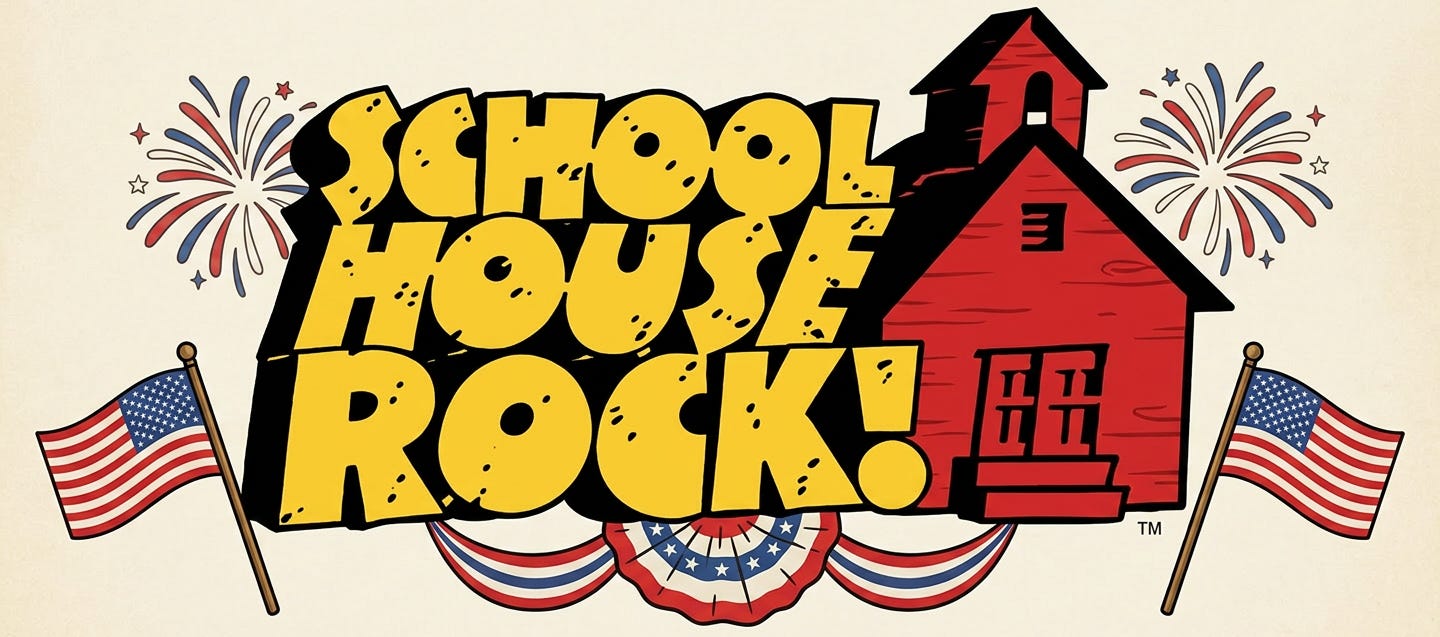
ESSAY: Before Lynn Ahrens helped make America sing on an epic Broadway scale in Ragtime, she had already done it in miniature — in three-minute bursts of melody, civics, history, and wit for Saturday morning television’s Schoolhouse Rock.
That earlier chapter feels newly resonant now, with Ragtime back in the spotlight and the country entering its 250th anniversary year. Though it never hides America’s faults, Ragtime ultimately stands as a testament to the American experiment. It’s a topic—and a mood—Ahrens had been writing long before Evelyn Nesbit and Henry Ford found their way into song.
And I can prove it.
When Ahrens visited The Broadway Maven in 2020, she drew explicit connections between the two works: “I feel like everything I know I learned on Schoolhouse Rock in a weird way: economy of language, writing visually, imagining visuals in my mind as I’m writing, telling stories in song, all of that’s part of theatrical writing.”
She gave two examples of songs in Ragtime that draw from the lessons she learned on Schoolhouse Rock: “Crime of the Century” and “Henry Ford.” Each tells a “whole story,” she said, “a three-minute song like Schoolhouse Rock, and there’s all this specific history written into those little lyrics, and it’s very entertaining and lots of fun onstage.” She called “Crime of the Century” (which is just seven seconds shy of three minutes) in particular “a delightful song” which is “a direct descendant of Schoolhouse Rock.”
Ahrens, by then already an experienced jingle writer, contributed both the lyrics and the music to all the “America Rock” songs she composed.
And Schoolhouse Rock did something deliciously radical: it treated civic process as inherently theatrical. Laws were characters. Ideas had tempo. History unfolded in rhymes. Ragtime inherits that belief — that America is not a static monument but a story in motion, propelled by individuals whose ambitions collide. The tone is darker, the irony sharper, the innocence fading. But the underlying faith remains the same: that if you shape history into song, audiences will lean in and listen. Ahrens didn’t abandon the civics classroom when she reached Broadway. She widened it.
In her mid-1970s songs, the patriotic lessons in miniature that presaged Ragtime are unforgettable:
• “Fireworks.” Perfect for Saturday’s holiday, this video uses the language of musical theater to celebrate the process of passing the Declaration of Independence. (It took the musical 1776 two acts to do what Ahrens did in three minutes.) Notable for its evocative images (”diamonds in the sky”) and apt rhymes (”though some people tried to fight it, a committee was formed to write it”), the song also contains excerpts from the document and names of its authors that make learning easy—and fun.
• “No More Kings.” The slogan today evokes the contemporary “No Kings” street political movement, but the Lynn Ahrens version was already broadcast in September 1975. The song traces American history quickly and efficiently from the Mayflower through the Boston Tea Party (”turn this harbor into the biggest cup of tea in history”) and the American revolution and the election of the first president.
• “The Great American Melting Pot.” This paean to immigration is probably my favorite Schoolhouse Rock number because its first lines tell exactly, exactly my family story: “My grandmother came from Russia, a satchel on her knee. My grandfather had his father’s cap he brought from Italy.” The song presents the growth of the United States through a powerful metaphor:
Lovely Lady Liberty
With her book of recipes
And the finest one she’s got
Is the great American melting pot.
• Probably most importantly, “The Preamble,” whose catchy tune and surprisingly easy-to-articulate lyrics have etched the key ideas of our Constitution into the collective memory of generations of young people. Musically it feels like a jingle, but lyrically it arranges complicated words in a fun, educational way. Words and phrases like “a more perfect union,” “domestic tranquility,” and “do ordain and establish” roll off the tongues of millions of Americans because of her songwriting talent.
Ahrens’s fingerprints are unmistakable in the two songs she herself identified in the musical she wrote with composer Stephen Flaherty and librettist Terrence McNally.
“Crime of the Century,” like many Schoolhouse Rock songs, packs a ton of educational information into its verses without a single extraneous word and still manages to deliver a catchy chorus. Ahrens revived an episode of American history that has largely faded from public memory, shaping it into a complete dramatic arc with a beginning, a middle, and an end, just as she did in “Fireworks” and “No More Kings.”
“Henry Ford“ accomplishes much the same a tad more quickly, and with delightful rhymes like “what this country is moving toward/that’s the notion of Henry Ford.” In just a handful of lines, Ahrens explains the assembly line more vividly than many textbooks. The lyrics are densely packed but with a light touch, if you will. Here’s my favorite section, which combines wordplay (nation/notion) with vivid imagery that happens to precisely represent the industrialist’s innovative but elitist invention:
Mass production
Will sweep the nation
A simple notion
The world’s reward
Even people who ain’t too clever
Can learn to tighten a nut forever
Attach one pedal
Or pull one lever
For Henry Ford!
So, yes, it turns out America’s greatest Broadway musical about the American experiment owes more than a little to a Saturday morning cartoon. Not because both celebrate the nation in the same way, but because both believe history can be told through irresistible songs. Lynn Ahrens spent 1975 and 1976 teaching children how America worked. Two decades later, she taught Broadway audiences how complicated that story really was.
Happy anniversary, America.
MAVEN SCHOLAR REVIEW: One of the real treats of the current production of Shrek the Musical at The Muny in St. Louis is the restoration of a cut song for Fiona, “More to the Story,” made possible through special permission from composer Jeanine Tesori. This production featured the best synchronization between the pit and the stage that I have witnessed in St. Louis theatre. The melodies were lush with instruments blending seamlessly with the singers. The cast was clearly chosen for both their vocal talent and acting ability. I enjoyed the performances from the many powerhouses onstage, from the showstopping solos of Shrek (Nik Walker) and the Dragon (Salome Smith) to the impeccable comedic timing of Fiona (Kara Lindsay) and Donkey (Marcus M. Martin). In addition, the set designs and lighting were remarkably elaborate. One of the most intricate sequences was for the song “I Know It’s Today,” during which the turntable moved multiple times to center each version of Fiona located in different sections of the castle onstage. From Donkey and Shrek running through the audience and giving kids high fives to the kid actors giving the Muny’s pre-show introduction, the director’s choices clearly prioritized the kids in the audience. I expect this production will make many families laugh and smile. Shrek runs through tomorrow (visit Muny.org for tickets).
—Jill Hamill, Maven Scholar (Jill is a music teacher specializing in strings).
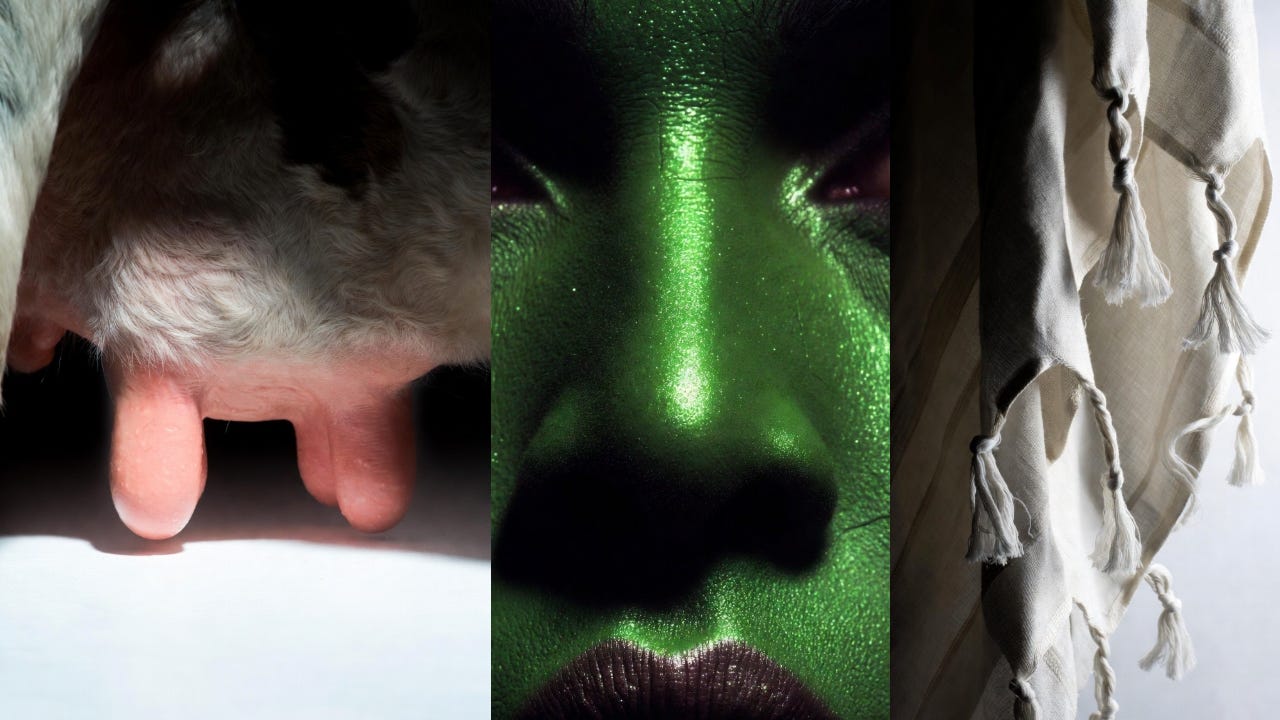
BROADWAY CLOSE-UP: Each of these snapshots represents a close-up of an image from a famous Broadway show. Name what you’re looking at. Answers at the end of the issue, below the Last Blast.

Join The Broadway Maven! Nowhere else online brims with this much Broadway content, and certainly not for so little (Membership is $25 a month for 5-15 compelling classes). Purchase a monthly or an annual plan. Cancel at any time. Sign up here:
Broadway Maven Members get the Friday Blast once a week filled with Members-only goodies. It’s the easiest way to get links for upcoming classes. This week's Friday Blast (for the first and only time in 2026) is FREE to all MARQUEE subscribers, which means you’ll have links to the upcoming classes on Fiddler on the Roof, Dear Evan Hansen, and Gypsy without purchasing a Membership. There will also be recordings of the Flower Drum Song and Come From Away classes; a Broadway Blast on The King and I; a YouTube video about Mel Brooks's funniest lines; and the Archive clips reel of the week on Thoroughly Modern Millie.

• Sunday, July 5 Fiddler on the Roof, Noon and 7 pm ET (different classes, FREE, Register HERE)
• Monday, July 6 Dear Evan Hansen with Mateo Chavez Lewis, Noon ET (link for MARQUEE subscribers in an upcoming Friday Blast)
• Tuesday, July 7 Gypsy with David Benkof and Asher Shectman, Noon and 7 pm ET, different classes ($50 for a 16-part course, register HERE)
• Sunday, July 12 Schmigadoon! with Marc Bonanni, Noon ET (MEMBERS ONLY)
• Tuesday, July 14 A Funny Thing Happened on the Way to the Forum with David Benkof and Asher Shectman, Noon ET ($50 for a 16-part course, register HERE)
• Tuesday, July 14 Evening Primrose with David Benkof and Asher Shectman, 7 pm ET, ($50 for a 16-part course, register HERE)
• Tuesday, July 21 Company with David Benkof and Asher Shectman, Noon and 7 pm ET, ($50 for a 16-part course, register HERE)
• Monday, July 27 The Sound of Music with Ted Chapin, Noon ET (MEMBERS ONLY)
• Tuesday, July 28 Follies with David Benkof and Asher Shectman, Noon ET ($50 for a 16-part course, register HERE)
• Tuesday, July 28 A Little Night Music with David Benkof and Asher Shectman, 7 pm ET, ($50 for a 16-part course, register HERE)

LAST BLAST: The title A Little Night Music has puzzled many Sondheim fans, since the show seems to have little to do with Mozart, or with music at night for that matter. But what if we put quotes around the word “night”? Then it becomes “a little music” for the 1955 movie Smiles of a Summer Night, the Ingmar Bergman film that inspired Sondheim and Wheeler’s musical. “A Little ‘Night’ Music” makes sense as a way of presenting the musical as the movie but with a score. So the title isn’t describing the contents of the musical. It’s describing its relationship to its source.
ANSWERS TO THE QUIZ: The udder of Milky White (Into the Woods); Elphaba’s skin in Wicked; Tevye’s ritual fringes (Fiddler on the Roof)
The Broadway Maven is a vibrant educational community that helps its members think more deeply about musical theater. We offer 5-15 classes a month for just $25. We also foster enthusiasm for Broadway through the FREE weekly Substack newsletter MARQUEE and host an expansive YouTube channel. It’s your home for Broadway appreciation. Contact The Broadway Maven at DavidBenkof@gmail.com.
Comments
Nothing yet. Say the first thing.
Sign in to join the conversation.