

Join The Broadway Maven! Nowhere else online brims with this much Broadway content, and certainly not for so little (Membership is $25 a month for 5-15 compelling classes). Purchase a monthly or an annual plan. Cancel at any time. Sign up here:
New Members who sign up this week will get 10 more Sondheim “Putting it Together” classes by the end of August.
Broadway Maven Members get the Friday Blast once a week filled with Members-only goodies. It’s the easiest way to get links for upcoming classes. In this week’s Friday Blast: links to the upcoming classes on The Sounds of Music, Follies, and A Little Night Music; recordings of BOTH Company classes; a Broadway Blast on Pal Joey and Dear Evan Hansen; a YouTube highlight about censored high school versions; and the Archive clips reel of the week on Evita.
On today’s marquee: A) A guest essay by Barry Kester about the waltzes of Richard Rodgers; B) a poll about people’s favorite Rodgers waltz; C) my capsule review of Newsies at The Muny; and D) a Last Blast about Kiss Me, Kate and Annie Get Your Gun.
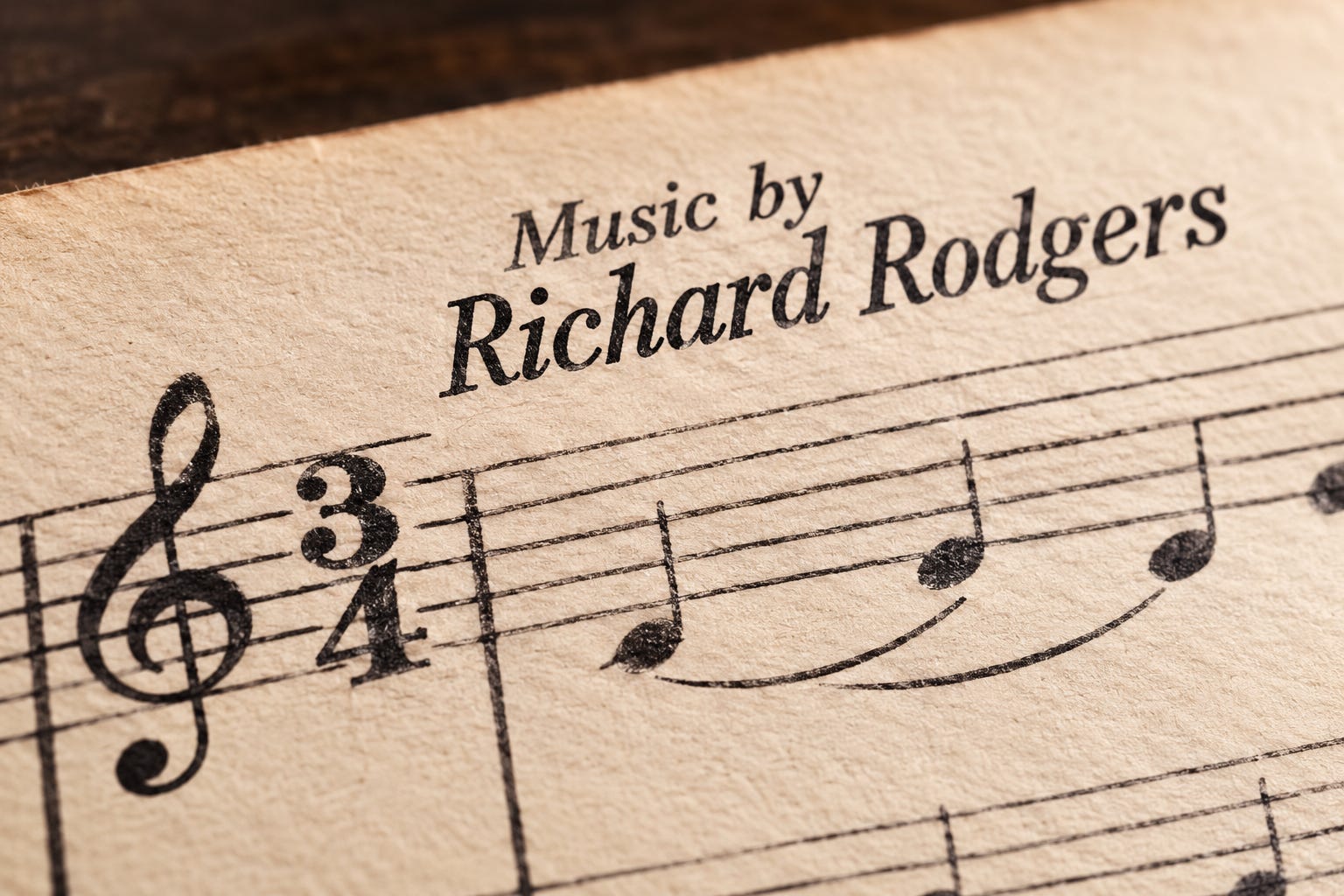
GUEST ESSAY: If you read or listen to someone talk about the music of Richard Rodgers, sooner or later you will come across a reference to a “Rodgers waltz,” often accompanied by the adjective “lovely” or “beautiful.” Seldom will you find a similar reference to any other Broadway composer, for none of them—not Gershwin, Kern, Berlin, Porter, or Loesser—used three-quarter time as frequently or as effectively as Rodgers. How did that come about?
My guess, and it can be no more than that because I can find no record of him ever discussing the matter, is that it goes back to Rodgers’s childhood in the 1900s when he listened to his parents singing and playing songs from the shows they saw on Broadway. Those shows were mostly operettas from Europe, and they contained waltz after waltz after waltz.
It was a Jerome Kern song, “They Didn’t Believe Me,” written in 4/4 time for the 1914 show The Girl from Utah, that took Broadway by storm and simultaneously heralded the demise of 3/4 as its dominant musical time signature.
While Rodgers idolized Kern (“His music pointed the way I wanted to be led”), he alone among his peers always remained comfortable writing in 3/4 time. What he would do, however, is use that time signature in a very American way. Glorious waltzes there were aplenty, but there were also other songs in 3/4 time that, while you might not dance to them, captured every kind of human emotion.
In my own playlist of Rodgers’s best-loved waltzes, there are four written with Larry Hart. “Lover” from the 1932 film Love Me Tonight, which has become a jazz standard; “The Most Beautiful Girl in the World” from Jumbo; and “Falling in Love with Love” from Boys from Syracuse. These are traditional in style, while “Wait Till You See Her” from their final show, By Jupiter, captures perfectly the wonder felt by the singer that his love is reciprocated. It gave us a foretaste of what was to follow.
In fact, his next waltz, the first song he wrote with Oscar Hammerstein II, also captures a sense of wonder—this time that of a beautiful new day dawning in Oklahoma!.
In the Library of Congress sits the first draft of the chorus of “Oh What a Beautiful Mornin’.“ Rodgers knew he had not done justice to Hammerstein’s lyric, so he modified the melody, raised the note for the syllable “Morn” a semitone, and in that moment ceased to be a songwriter and became a musical dramatist. The ethereal “Out of My Dreams” further demonstrates this change.
With the unusual octave leap of State Fair‘s “It’s a Grand Night for Singing,” Rodgers was happy to revert to full Viennese mode.
There are two classic Rodgers waltzes in Carousel. Apart from the famous title waltz which replaced the usual overture, there also is “This Was a Real Nice Clambake,” which charmingly captures that languorous feeling we have after eating and drinking a little too much.
South Pacific’s “A Wonderful Guy” is another example of Rodgers’s dramatic use of triple time. The verse begins quite severely as Nellie Forbush scoffs at her friends’ mocking of her “proud protestations of faith in romance.” Gradually, the mood lightens until the chorus bursts forth with one of the most joyous expressions of love in the entire Broadway canon. In sharp contrast, but still in 3/4, is the angry tirade against racism, “You’ve Got to be Carefully Taught,” immediately followed by Emile de Becque’s bitter lament, “This Nearly Was Mine.”
Gertrude Lawrence’s vocal limitations required Rodgers to compose in a narrow range for her songs in The King and I. That did not prevent his coming up with one of his most popular waltzes, “Hello Young Lovers.”
For Cinderella he was again at his lilting best with “Ten Minutes Ago” and there are two delightful humorous waltzes in Pipe Dream: “On a Lopsided Bus” and “The Happiest House on the Block.”
Just as the Rodgers & Hammerstein partnership began with a waltz inspired by the joys of nature, so in their final show, The Sound of Music, it ended in a similar fashion. After the ever-popular “My Favorite Things,” the last song they wrote together, “Edelweiss” is very different in style. Rodgers knew his partner was dying, and the minor chords in the song may reflect that knowledge.
Following Oscar Hammerstein’s death, Rodgers composed the scores for five more shows. Only the first, No Strings, was successful, and their scores are now seldom heard. But there are still some gems to be found, some of them in 3/4 time, such as:
• “Love Makes the World Go“ from No Strings;
• The title song from Do I Hear a Waltz?;
• “No Song More Pleasing” from Rex;
• “An Old Man” from Two by Two; and
• Fittingly, his very last composition was also a waltz, from I Remember Mama, “Time.”
Earlier Broadway waltzes often existed simply because audiences expected a graceful dance. Rodgers increasingly used them for something different: to reveal character. His waltzes, indeed all his music, rarely interrupted the drama; they enhanced it, expressing emotions that dialogue alone could not reach.
Even as jazz, swing, bebop and eventually rock transformed Broadway’s musical language, Rodgers never abandoned the waltz because he had discovered that its expressive possibilities were timeless. To him, three-quarter time was not a nostalgic relic but simply another dramatic color, capable of conveying innocence, longing, joy, regret, humor, and heartbreak.
Across six decades, changing musical fashions, different lyricists, and enormous shifts in Broadway style, Rodgers never lost his faith in what three-quarter time could express.
English writer Barry Kester has been a fan of the “Golden Age” musicals, particularly those of Rodgers & Hammerstein, his entire life. He is the author of Round in Circles: The Story of Rodgers & Hammerstein’s Carousel.
REVIEW: Well, even The Muny can stumble sometimes. The St. Louis institution, which MARQUEE has called “America’s greatest theater,” produces seven shows a summer, and its current production of Newsies is not its finest work. It’s still pretty good, though, especially for a dance show on the 120-foot Muny stage (three times the normal size). In particular, “King of New York” became an exuberant Newsies tap number in which younger children and Jack’s love interest joined in. To be fair, much of the weakness is baked into the libretto and the score. The show was composer Alan Menken’s first after Howard Ashman’s death, and the loss is palpable. Beyond “King,” there are only three good songs—though they’re admittedly excellent—”Carrying the Banner”; “The World Will Know”; and “Seize the Day.” The purported “I Want” song—”Santa Fe”—is my least favorite in musical theater because it introduces a goal that only vaguely motivates hero Jack, who spends most of the musical organizing a Newsies strike. The show’s race-blind casting was refreshing, and star Jack Roden did a creditable job in a tough role. Newsies closes tonight; tickets are still available at metrotix.com.

• Monday, July 27 The Sound of Music with Ted Chapin, Noon ET (MEMBERS ONLY)
• Tuesday, July 28 Follies with David Benkof and Asher Shectman, Noon ET ($50 for a 16-part course, register HERE)
• Tuesday, July 28 A Little Night Music with David Benkof and Asher Shectman, 7 pm ET, ($50 for a 16-part course, register HERE)
• Tuesday, August 4 Sweeney Todd with David Benkof and Asher Shectman, Noon and 7 pm ET, ($50 for a 16-part course, register HERE)
• Monday, August 10 Introduction to Rodgers & Hammerstein with Ted Chapin, Noon ET (FREE, Registration coming soon)
• Tuesday, August 11 Merrily We Roll Along with David Benkof and Asher Shectman, Noon and 7 pm ET, ($50 for a 16-part course, register HERE)
• Sunday, August 16 Sunday in the Park with George Watch Party, Noon ET (MEMBERS ONLY)
• Monday, August 17 Broadway in the 1970s with UW Prof. David Armstrong, Noon ET (MEMBERS ONLY)
• Tuesday, August 18 Sunday in the Park with George with David Benkof and Asher Shectman, Noon and 7 pm ET, ($50 for a 16-part course, register HERE)

LAST BLAST: Kiss Me, Kate is of course Broadway’s great Taming of the Shrew musical. But when you think about it, Annie Get Your Gun is one, too. Both early Golden Age shows center on romances disrupted by unusually capable women. But there’s a crucial difference. Katherine is difficult. Annie Oakley is delightful. She’s generous, affectionate, and widely admired. The thing that makes her threatening isn’t her personality—it’s her talent. Annie doesn’t need taming because she’s rude or rebellious. She needs taming because she’s better than Frank Butler at being Frank Butler. The musical keeps asking how much Annie must change to make the romance work. A more uncomfortable question is whether Frank is the one who needs the taming.
The Broadway Maven is a vibrant educational community that helps its members think more deeply about musical theater. We offer 5-15 classes a month for just $25. We also foster enthusiasm for Broadway through the FREE weekly Substack newsletter MARQUEE and host an expansive YouTube channel. It’s your home for Broadway appreciation. Contact The Broadway Maven at DavidBenkof@gmail.com.
Comments
Nothing yet. Say the first thing.
Sign in to join the conversation.