

Students ages 16-26: Ever wished you could study Broadway the way others study history or science? Now you can! The Broadway Maven Student Seminar is a deep dive into the composers, songs, and shows that shaped musical theater. Apply today and join a select group of theater enthusiasts!
Completion of this course grants Maven Scholars a $500 stipend; a certificate of achievement; and invitations to two Broadway shows at the Hayes Theatre.
It’s a wide-ranging look at Broadway history, with special attention to the most important shows and theatermakers who shaped musicals from the 1940s to the present. Lectures, discussions, student presentations, guest speakers, and joint viewing of selected essential clips from the Broadway canon.
Full-time students aged 16-26 are invited to apply. If you know any theater kids or college theater obsessives, please forward this E-mail to them.
Maven Scholar Info and Application
On today’s marquee: A) A “stumper” Broadway crossword puzzle, with an easier version for those who need a bit of help; B) a book review of a short analysis of feminist approaches to musicals; C) a StageStreams about what makes Rodgers & Hammerstein distinctive; and D) a Sondheimian Last Blast about Company and Gypsy.

CROSSWORD PUZZLE: Four times a year, MARQUEE publishes a Broadway-focused crossword puzzle by constructors whose work has appeared in The New York Times. This issue’s puzzle is the toughest yet, with a “Thursday-level” gimmick that requires careful attention. To assist those who aren’t puzzle champions, a simpler version is included, and solvers can certainly go back and forth. Happy puzzling!
REVIEW: Triple historicity. Affective dissonance. Reading against the grain.
These may sound like highfalutin academic concepts—and they are—but a 2025 book, Feminist Approaches in Musical Theatre, explains them clearly and shows how they can deepen our understanding not only of gender in musicals, but of musicals themselves.
Written by Paige Allen and Princeton Prof. Stacy Wolf (who sometimes teaches and conducts interviews for The Broadway Maven), the 89-page book (it fit comfortably in my pocket) uses four case studies to demonstrate its methods, but as with the little priest in Sweeney Todd, it left me wanting more.
Refreshingly, the book’s careful, brief analysis of The Music Man, Evita, Fun Home, and Six does not label each show as “feminist” or “non-feminist.” Instead, it uses a set of tools—skills, really—to explore the interaction of gender, text, character, and performance.
My three favorites are those listed above:
• Triple historicity. I’ve already begun using this analytical tool in my teaching. It situates shows chronologically based on when they are set, when they were written, and when they are experienced.
• Affective dissonance. That’s the book’s term for the “love-hate relationship” many feminists have toward musicals that move them and provide meaning while still perpetuating ideas—and ideologies—they don’t accept.
• Reading against the grain. That’s how Allen and Wolf identify interpretations that may not have been intended or even noticed in a show’s initial onstage career. (MARQUEE does this all the time.) Is the ending of The Music Man a pat heterosexual resolution? Would Evita’s maltreatment and dignity be enhanced if played by two performers instead of one?
A compact compass for finding meaning in Broadway musicals that can be applied to expand our understanding of beloved shows. What’s not to like?
Well, there is one thing.
The book doesn’t really have a foil other than some shows it finds problematic. I found that unsatisfying for a volume I expected would help me see the art form afresh. There are (of course) many scholarly approaches beyond those in the book through which one could view a musical, and the book never places its method alongside other scholarly traditions or explains what it can illuminate that those approaches cannot.
I’m not saying Allen and Wolf needed to grapple with anti-feminist readings of Broadway shows (although they do exist). I’m saying there could have been recognition that psychoanalytic, historical, Marxist, formalist, reader-response, and queer approaches to musicals are distinct and arguably incomplete.
Read this book. But don’t be afraid to use its toolkit to understand Broadway (whatever your scholarly orientation) and read more widely, so your analysis of Broadway shows draws upon many scholarly traditions beyond this one.
StageStreams: What makes Rodgers & Hammerstein so distinctive? In this brand-new, thoughtful four-minute video, R&H expert Ted Chapin (a Broadway Maven faculty member) delineates the uniqueness and grandeur of the pair. Since Chapin ran the Rodgers & Hammerstein organization for decades, he knows. How does the pair’s work together differ from that with different collaborators like Lorenz Hart and Jerome Kern? What makes them different than Sondheim, Kander & Ebb, Jerry Herman, and other rivals for greatness in the Broadway canon?

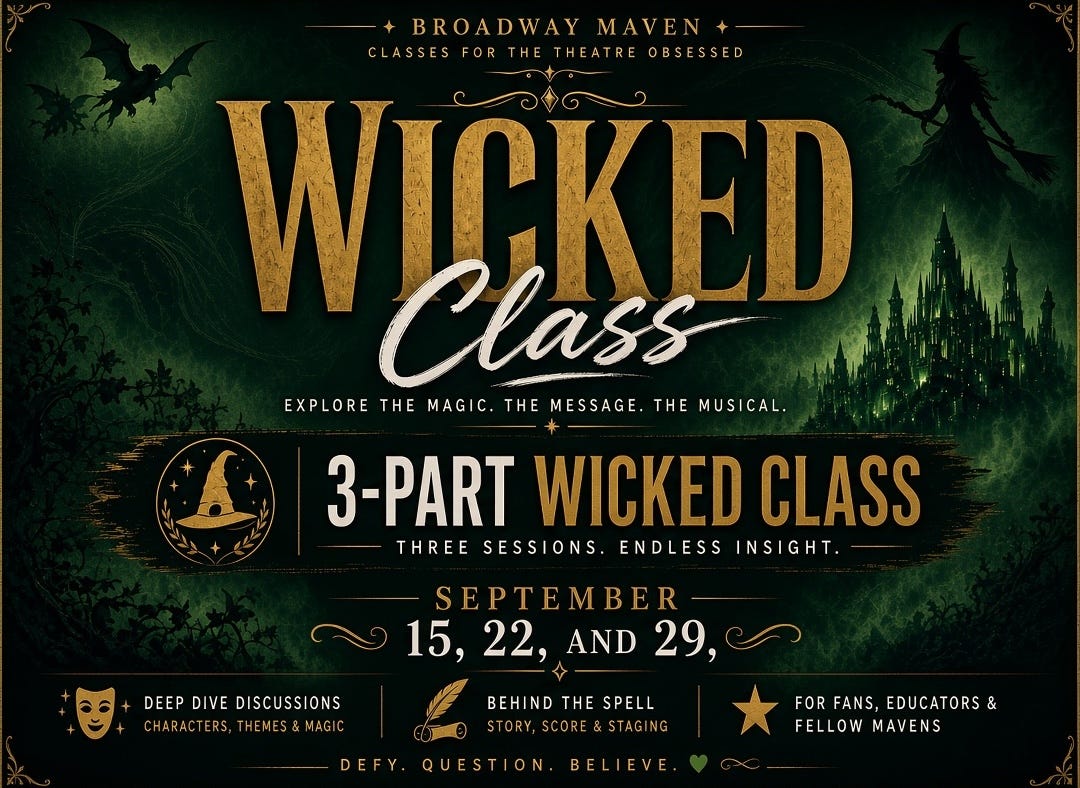
Explore the spellbinding world of Wicked in this three-part series devoted to the Broadway musical that reimagined the Land of Oz. Discover how Wicked turns a familiar tale upside down, explores friendship, identity, prejudice, power, and the cost of challenging authority, and delivers unforgettable songs including “Defying Gravity,” “Popular,” and “For Good.” Each installment offers a deeper look at the creative choices, emotional moments, and enduring appeal that have made Wicked one of Broadway’s most beloved and successful productions.
All who register for this course are able to attend two other Stephen Schwartz classes FREE of charge on Godspell and Pippin.
All five classes are offered Tuesdays in September at 7 pm ET on Zoom, running from September 1 to September 29 (see calendar below). Each class is one hour long and will contain different material. Registration $36 (but the class is FREE for Broadway Maven Members).

Join The Broadway Maven! See nine of our faculty in action in the video above. Nowhere else online brims with this much Broadway content, and certainly not for so little (Membership is $25 a month for 5-15 compelling classes). Purchase a monthly or an annual plan. Cancel at any time. Sign up here:
Broadway Maven Members get the Friday Blast once a week filled with Members-only goodies. It’s the easiest way to get links for upcoming classes. In this week's Friday Blast: links to the upcoming classes on Jule Styne and Godspell; recordings of BOTH Into the Woods classes; a Broadway Blast from the Past on Hair and Oklahoma!; a YouTube quiz on teenage Broadway; and the Archive clips reel of the week on Something Rotten!.
SPECIAL OFFER: Through September 1, new Members who sign up for a year get one month FREE!
One month FREE Broadway Maven Membership

• Monday, August 31 Jule Styne with Steve Bell, 7 pm ET (MEMBERS ONLY)
• Tuesday, September 1 Godspell, 7 pm ET ($36 for five Stephen Schwartz classes, register here)
• Monday, September 7 Cabaret with UW Prof. David Armstrong, Noon ET (MEMBERS ONLY)
• Tuesday, September 8 Pippin, 7 pm ET ($36 for five Stephen Schwartz classes, register here)
• Monday, September 14 Oklahoma! with Ted Chapin, Noon ET (MEMBERS ONLY)
• Tuesday, September 15 Wicked, 7 pm ET ($36 for five Stephen Schwartz classes, register here)
• Tuesday, September 22 Wicked, 7 pm ET ($36 for five Stephen Schwartz classes, register here)

LAST BLAST: In Company, Bobby accidentally calls his one-night stand April “June”—a slip that shows how little he sees her as an individual. She’s so interchangeable with the other women he dates that he doesn’t even remember which month she’s named after. The moment lands harder if you know another Sondheim show: Gypsy. There, June is the blonde ingénue whose departure forces her older sister Louise to take her place—reshaping the act and the family dynamic overnight. June’s exit proves she was never valued for herself, only for the role she filled in her mother’s plan. In Company, Bobby’s slip works the same way, reducing April to a part in his ongoing romantic repertoire—anyone could step in. I don’t know if Sondheim intended the echo, but it’s there: in both shows, “June” is shorthand for a woman defined by her function in someone else’s story, easily replaced when the plot demands it.
The Broadway Maven is a vibrant educational community that helps its members think more deeply about musical theater. We offer 5-15 classes a month for just $25. We also foster enthusiasm for Broadway through the FREE weekly Substack newsletter MARQUEE and host an expansive YouTube channel. It’s your home for Broadway appreciation. Contact The Broadway Maven at DavidBenkof@gmail.com.
Comments
Nothing yet. Say the first thing.
Sign in to join the conversation.