
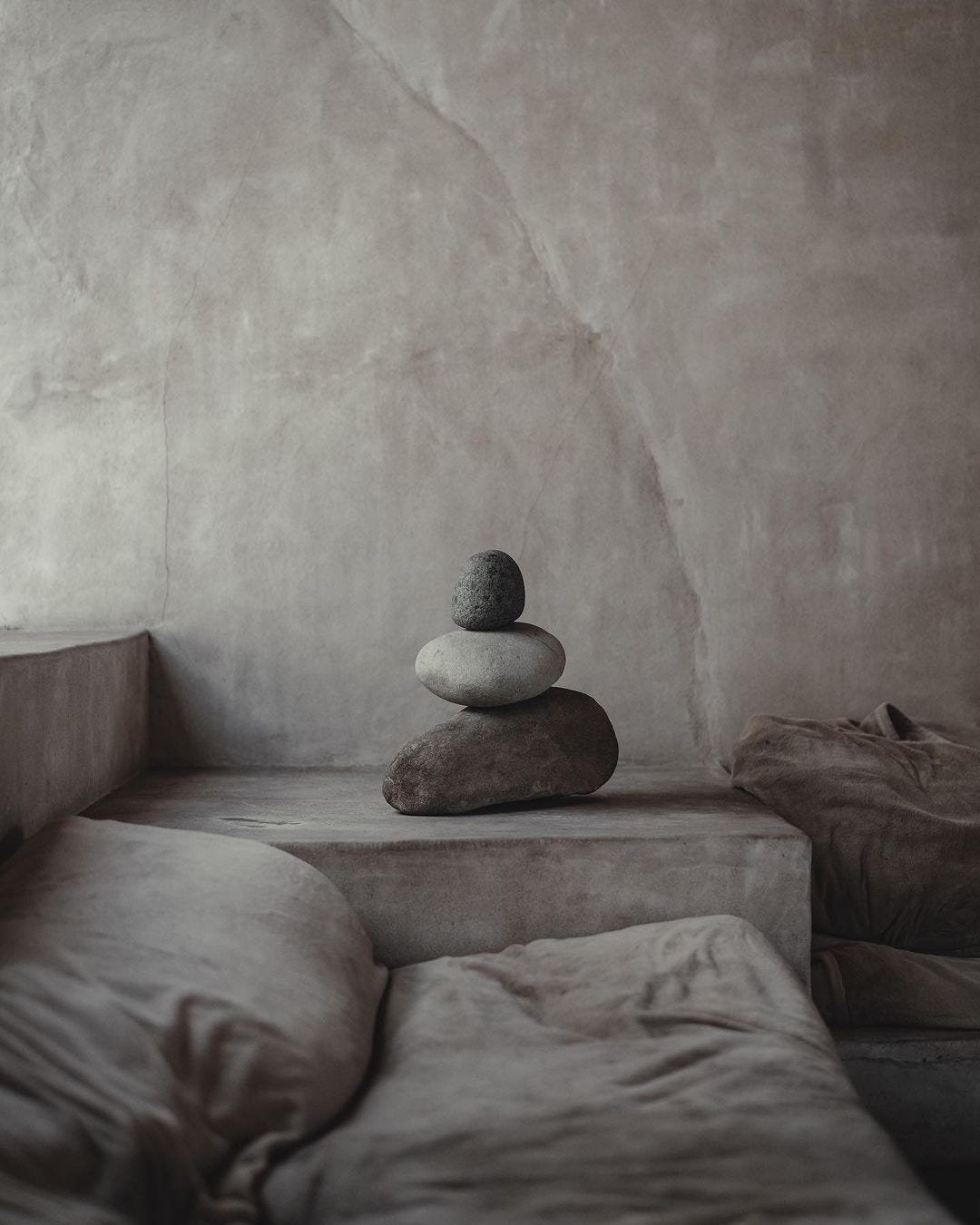
There’s a particular kind of exhaustion that comes not from doing too much, but from deciding too much. What to eat, which route to take, which version of yourself to show up as today. And somewhere in the middle of all that deciding, we also have to figure out how to meditate.
This letter is about something that comes up again and again in our community: the way we can unknowingly bring the noise of too much choice into the one practice that’s meant to quiet it. Two questions from a recent call Portal Members Call landed right on this, and I think you’ll recognise yourself in both of them. I love our monthly calls with students where we explore topics and themes live online, and students can access the videos later also in a library alongside all the courses and meditation teachings. If you want to join me and this community you can here.
The first question is about technique, and the particular kind of mental spinning that can happen when we’re genuinely curious and exploring new practices alongside familiar ones. Both are such honest struggles. And both point toward the same quiet answer. The second is about time, specifically what happens when we treat meditation like another item to tick off before the next thing begins.
Q: I’ve been exploring a meditation practice from MindFit Meditation alongside a prayer I’ve used for a long time. I found myself sitting down and my mind going in two completely different directions. Which one am I doing? How do I work with that?
Oh, I love this question. And yes, the multiple directions you can take and described is so real. One of the things I love about a mantra-based practice is precisely that it removes the choosing. There’s just this. There’s nothing else on the menu. And the moment you open the menu again, the mind gets to work. We live in a time of extraordinary abundance when it comes to meditation. More teachers, more techniques, more apps, more approaches than any generation before us has ever had access to. A dear friend of mine who’s in his seventies talks about this with such wonder. He says that when he wanted to learn, you had to physically travel to India or Europe to study with a teacher. Now you can find a thousand guided meditations on your phone before breakfast. And he’s in awe of it. But he also says: I don’t know how anyone finds anything.
Because abundance can quietly become its own obstacle.
So here’s what I’d invite you to try. For a chapter, it might be three weeks, it might be three months, put one practice down and commit to one. Not because the other practice is wrong, or less than, but to find out what happens when you remove the choice entirely. When you sit down and there’s only one door. Neither practice is better than the other. They’re both using repetition and intention to bring the mind home. The point isn’t which one. The point is that when you’re in it, you’re in it.
What I notice in myself, and I suspect it’s familiar to many of you, is that the mind will use even beautiful spiritual curiosity as material to spin on. I’ve spent forty minutes scrolling for the perfect yoga nidra when I had an hour to practice, critiquing voices, skipping intros, wondering what else might be in the feed. The mind is endlessly creative in finding ways to engage with something rather than surrender to it. Clearing the decks isn’t rigidity. It’s actually a profound act of kindness to yourself. A way of saying: I trust this. I’m here. There’s nothing else to figure out. Try it. See what opens up.
Q: I’ve been working on consistency with my practice, and I’m getting better but meditation often gets squeezed into pockets right before something else. How important is it to have more breathing room, especially at the end?
This is such a good question, and I see a lot of people nodding. The entry in matters, but the exit out matters even more. My strong recommendation is to shorten your actual meditation time in order to protect the integration at the end. So if you have 25 minutes, don’t meditate for 25 minutes. Meditate for 20 or 21, and give yourself those last few minutes to come out slowly and gently.
A timer can help here. I know that in an ideal world we’d move in and out of practice like water, no alarms, no watching the clock. And in monasteries there are bells and gongs for exactly this reason, because even in those environments where meditation is the whole point of the day, time still needs to be held. So if you need a timer, use one. The key is that when it goes off, you’re not jolted out of something deep. You’ve already begun to surface. Think of it like the cool-down after exercise, or the Savasana at the end of a yoga class. It’s not the optional part. It’s where the work integrates.
What tends to happen when we skip this is that the subconscious, which is holding all the awareness of what comes next, never fully lets go during the meditation itself. It’s a bit like trying to sleep when you’re not sure if you set your alarm. Part of you stays awake. The body is there, but the surrender isn’t. So eat into your meditation time if you have to. A shorter, softer, more complete practice is worth so much more than a longer one where you slam in and slam out.
One last thing: if you notice yourself becoming attached to the timer, rigidly timing practice even when you have a spacious Sunday morning and nowhere to be, that’s worth checking in on. A tool that helps you settle can quietly become another way the mind keeps everything controlled and contained. The ego is very good at this. It will happily work with your best intentions.
With love,
Jac x
I have a July Online 3 sessions over 3 days, Global Integrated Meditation Course happening, where the first session it is just you and I, and I walk you through the practice and give you your individual mantra. Then we will be in a small group next two days, each 2.5 hours a session, where we will study the technique, the neurosience and somatics, build your own flexible, adaptable personal practice, and you will graduate knowing exactly how to meditate on your own, with ongoing support from me, and access to a huge online library of talks, resources and practices. We also gift each student the opportunity to resit the course if they wish, in person or online. If a group course doesn’t sound a fit, or you can’t make the times work, I also offer private courses for 1 or more people, custom fit.
From one of our students Anna, “It has been a game changer and I wish someone had introduced me to Integrated Meditation many years ago. It has made me happier, a better mother and partner (my husband will strongly attest to this) and a better human. I have shared this journey with many friends and colleagues who have now also taken up the opportunity with Jacqui to invest in a better life. One friend messaged the other day to say thanks and “I thought stress and frustration and anger were just (a big) part of life, but there not when you have meditation in your back pocket...” It has worked differently for all, the only similar outcome is happiness, clarity and the opportunity to enjoy and be present. I will continue to meditate now forever as the benefits of being clear, creative, present and whole mean I am the best version of me and that I generally can get everything into my day as I don’t waste time stressing or obsessing over issues, other people etc..Thanks Jacqui and the Broad Place for helping make the world a better place.”
Comments
Nothing yet. Say the first thing.
Sign in to join the conversation.