
I received a HUGELY validating compliment from a senior UX professional last week. We were wrapping up a half hour session reviewing the newest version of Zenmo, the app I’m building with my friend Ru that helps people understand themselves using color.
Sitting next to her as she idly moused around on my laptop, I began to read out the notes I had taken to confirm that I was picking up what she was putting down.
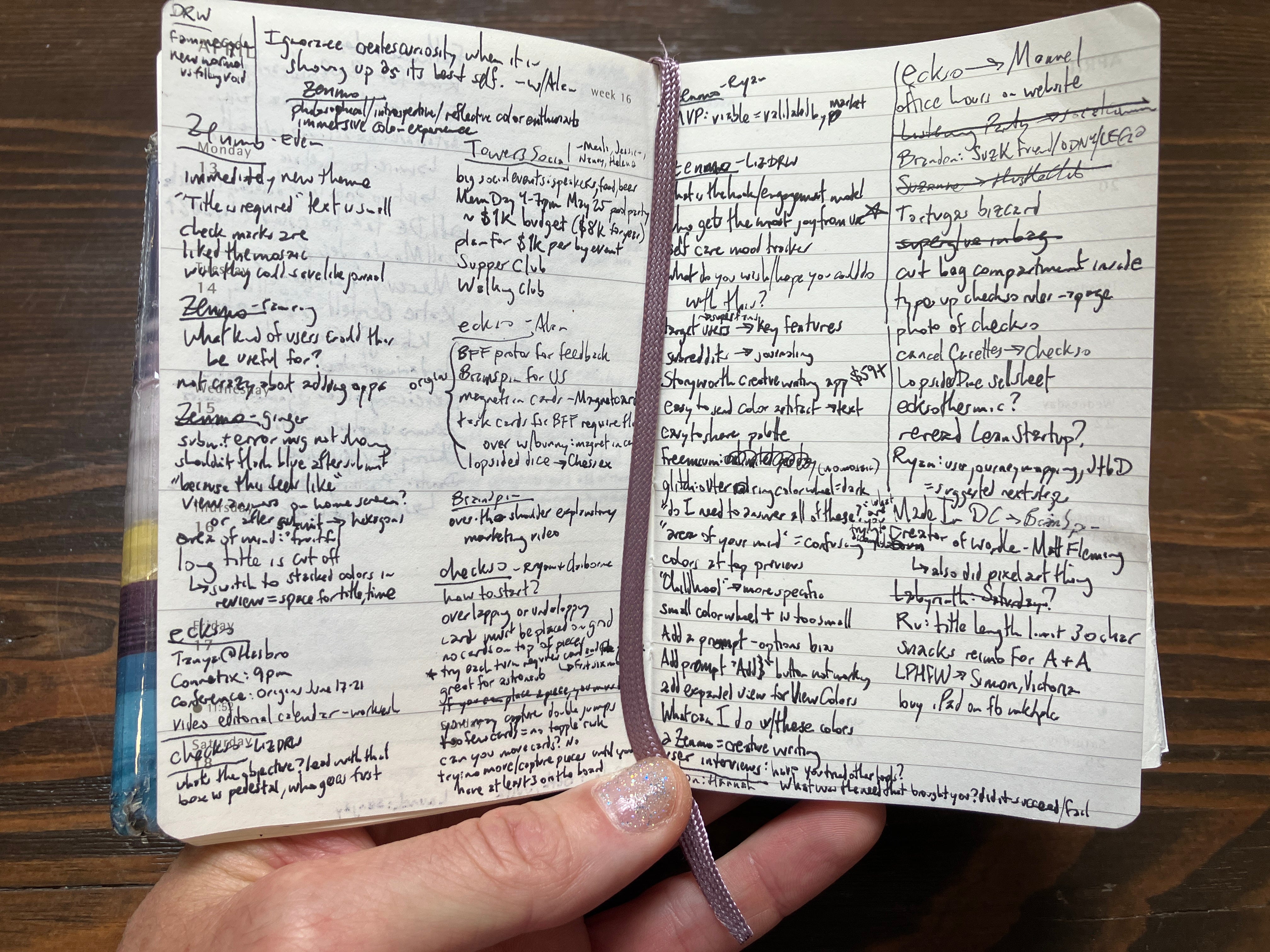
“You thought the ‘area of your mind’ prompt was confusing,” I recited as I went over my tiny handwritten scribbles.1 “You suggested I check out subreddits on journaling.”
After I’d gone through them all, I asked one final question. “Was there anything else?”
“You’re good at user testing,” she said.
I blushed.2
Though I know that it’s true (hashtag modesty), my user testing skills are not natural gifts. They are muscles I have built through dedicated effort: cultivating curiosity, practicing receptivity, requesting confirmation & clarification, and honing my ever-necessary resilience skills, to name a few.
Don’t get me wrong, I love user testing. It’s exciting, it’s fun, and I always learn something invaluable for whatever my project is.
Still, it makes me nervous.
The tricky part is getting started. When my plan involves bringing unfinished creations out into the field, e.g. a coffee shop, and inviting strangers to pick it apart, it’s easy to think of reasons not to put myself out there:
My UX isn’t smooth enough yet.
One of the buttons has a glitch and won’t load.
Nobody wants to be interrupted while they’re drinking coffee.
The people at that coffee shop aren’t our target audience anyway.
I’ll probably stumble over my words introducing myself.
What am I going to do with my bag while they’re using my laptop?
It would be better to use an iPad for testing than a laptop.
It would have to be the exact right-sized iPad with a keyboard and a stylus.
I already know what we need to do to make it better anyway.
My collar’s too dirty.

It’s only natural that user testing makes us nervous. Releasing imperfect work requires taking a risk and exposing something fragile with no guarantee of how our audience is going to react. In fact, this is what makes user testing such an incredibly powerful advantage for creating value: most people never do it.
If you, like me, truly aspire to bravery in innovation, you gotta work those muscles. After all, “If you know how it’s gonna turn out,” says Brené Brown, “it’s not courage.”3
Walk into uncertainty. Make yourself vulnerable. Embrace the discomfort.
You got this! [he said, pointing at the mirror as he pressed submit on the very Substack post you’re reading now 😉]
P.S. If you’re wondering whether I’d like to hear YOUR insights or suggestions on my work, the answer is (deep breath) yes, please! Feel free to reply, comment below, or even sign up for a one-on-one.4
The reason I write so tiny: I take notes on user tests in a softcover Moleskine planner that fits in my back pocket. I carry it with me at all times. By writing in miniscule, I am able to capture my thoughts and observations in one reliable place. Each two-page spread of the notebook is preprinted with spaces for the days of one week (I write over top of them, but they’re there), so by containing my notes within that week’s spread I can track them chronologically. If I ever need more space, there are blank index cards tucked into the back cover.
Zenmo in the hooooouse! 😊 See what I did there? Many animals, including humans, naturally use color to communicate. Chameleons and octopuses are perhaps the most famous; many more are featured in the excellent docuseries Life in Color with David Attenborough.
There’s a nice chunk of Brown’s interview with Lewis Howes excerpted in this episode of the Resilient Mind podcast.
See item #2 on my to-do list in the photo.
No posts
Comments
Nothing yet. Say the first thing.
Sign in to join the conversation.