
When Tim Berners-Lee invented the World Wide Web (WWW) at CERN in 1989 we had no idea where this invention was going to take us. The first web browser and server were developed in 1990, then Berners-Lee defined the concepts of HTML (Hypertext Markup Language), HTTP (Hypertext Transfer Protocol), and URLs (Uniform Resource Locator). In 1991 he launched the first ever website, the URL for which was http://info.cern.ch. The project targeted the problem of information management and information sharing. CERN had lots of different computer systems all of which were incompatible with each other. The WWW would finally solve the incompatibility issues across the globe of data and give us access to a large ‘universe’ of documents. The Enquire project was the precursor to the World Wide Web, designed to help researchers manage information by allowing random associations ("links") between unrelated items on a computer, creating a "web" of data.
Tim Berners-Lee was awarded a first in Physics at The Queen’s College, Oxford in 1976. He went on to work in telecommunications, then invented type setting software for printers. He worked as a contractor at CERN for a short period in 1980, then returned as a fellow in 1984. By this point he had established hypertext, and by joining it to the Transmission Control Protocol (TCP) and Domain Name System (DNS) he developed the World Wide Web.
The invention of the World Wide Web has been recognised as probably the most defining moment of the 21st century, with some believing the invention has been more prominent even than the world wars, or the moon landings.
The first public browser became available for use on 6th August 1991, which makes the WWW as a public tool nearly 35 years old. Berners-Lee was not the only scientist involved in the development. A list of 23 people are detailed on the very first website at CERN as being contributors to the project, but there were many more besides as the World Wide Web has evolved. As individuals these contributors were also involved in a wide range of other projects including the Macintosh (Apple) and Windows browsers.
The project was documented by Berners-Lee, Robert Cailliau, Jean-François Groff, and Bernd Pollermann in the Paper ‘World-Wide Web: The Information Universe’ (1992). The paper painted a picture of being able to read a document that was then linked to many other reference documents, and documents beyond those. It envisaged every single bit of digital information being linked in to this global web, enabling the user to look up and access information on literally any topic they could dream of. There are two principles by which the system operated. First of all to interlink information/knowledge using hypertext, and the second was text retrieval, which is facilitated through web servers, web browsers and the click of a mouse on an index link. According to the paper, Xanadu was the first ambitious hypertext project, but most of these projects were limited to a ‘local or distributed file system’. By combining hypertext, information retrieval and wide area networking (as apposed to local) this would allow for the World Wide Web.
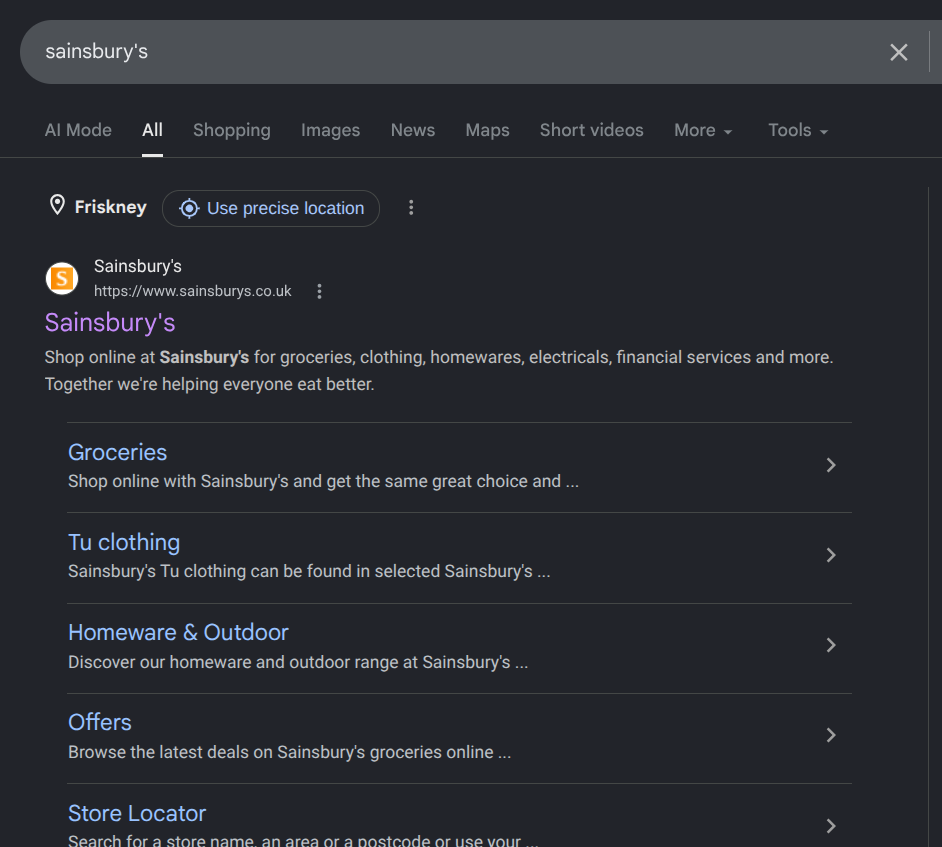
The system uses hypertext and index searches in a complimentary fashion. Neither can replace the other. An index search leads to a collection of links, that are then accessed through hypertext. We access the web with a web browser. The browser allows you to type in the web address (URL) of the website you want to access, OR to search up the website in the index. For example, instead of typing the full URL for Sainsbury’s the British supermarket as https://www.sainsburys.co.uk/, the web browser allows you to input a simple term ‘Sainsbury’s’ and the web browser will offer up a list of links that most closely match the term. As web browsers have developed, so too has the information served up to link through to. Below we can see that the Sainsbury’s link also has links to different ‘departments’ in the now online store.
Comments
Nothing yet. Say the first thing.
Sign in to join the conversation.