
Notes:
Happy new year, and welcome back! We’re starting things with a new guest reviewer. We intend to return to our previous weekly schedule, starting next week (February 3rd, 2026).
This is an older review, but a majority of the books we review will be advanced review copies (ARCs) given to our parent companies, everafterbooks.uk and theubergroup.org.
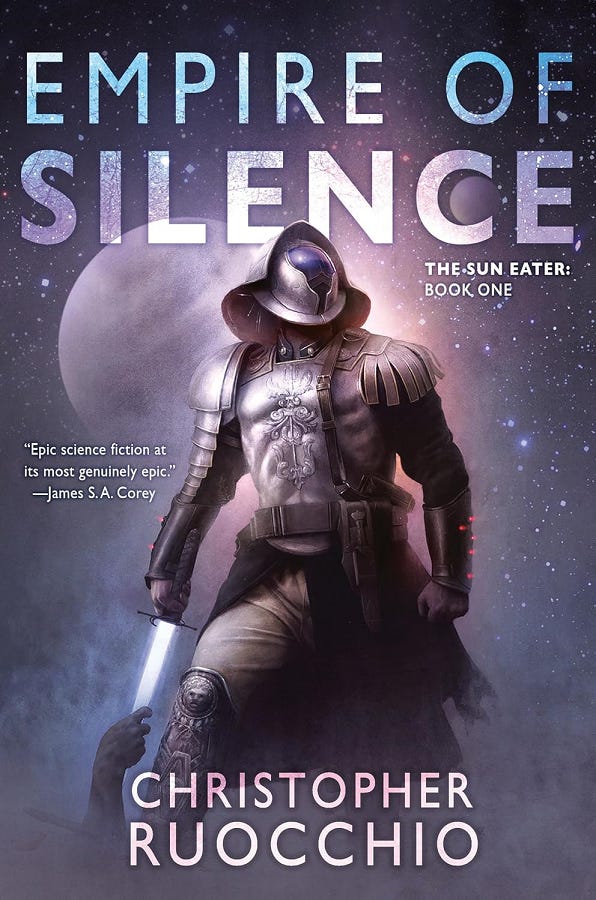
The most notable feature of debut science mantasy Empire of Silence is that its author, Christopher Ruocchio, admires Jordan Peterson and recommends him to writers of “epic fiction.” I resent the little of Peterson I’ve learned of and retained; if he did influence Empire, then it speaks quite lowly of him as an intellectual and writer.
Empire is the bildungsroman autobiographical recounting of its protagonist, Hadrian Marlowe. An extremely white (“pale as I was myself—a [space] sailor’s pallor, though so white and unblemished”) genetically engineered übermensch scion of Space Roman nobility, he will commit genocide on the alien Cielcin “without apology,” leading to their subjugation alongside his empire’s 48 other slave races.
Ruocchio’s debut setting is a derivative patchwork. A reversion to feudalism for its primary polity, the Sollan Empire, a resurgence of hand-to-hand combat in warfare due to personal force fields, and a ban against certain technologies/artificial intelligence are from Dune; the Empire’s ludicrously powerful state religion and its Inquisition, with the power to commit torture and planetary genocide, is from Warhammer 40k. Empire’s framing device, that of being an English translation of the protagonist’s recounting, was stolen from Gene Wolfe’s Book of the New Sun; the protagonist being an upper-crust polyglot shithead makes him the spiritual successor to Kvothe, the protagonist of Patrick Rothfuss’s The Kingkiller Neckbeard Chronicle.
True originality is rare, though I profess not to have seen such a hodgepodge assortment of unoriginality in a bestseller since Christopher Paolini’s Eragon. (Paolini and Ruocchio were traditionally published at 20 and 22.) They also share a love of filling their bricks ( 503 and 786 pages respectively) with overwrought, faux-poetic, sometimes eyebrow-raising prose, an example of Empire’s below:
The weight of it [the lightsaber knockoff] was a kind of poetry. Its shining blade shimmered in the light of the sun, sending silver highlights flashing. Extended, the balance was so exquisite that it felt more than a part of me and less than weightless.
I will spare readers samples of Marlowe’s unprompted “philosophical” monologues for the sake of my sanity and this review’s succinctness.
Empire largely follows Marlowe’s inconsequential meandering through several locales, engaging in activities unrelated to his infamous and allegedly interesting deeds with nominal characters largely defined by their orbit around him. The Cielcin practically crash near his locale and the plot roughly 4/5ths of the way through the book. Marlowe, the only human able to speak their language in the entire solar system, convinces them to surrender and translates the confessions tortured out of them by the Inquisition. He sets off to investigate the extracted information in the hope it will lead to peace between their peoples; the story’s foregone conclusion robs readers of the hypothetical drama and suspense surrounding his chances of success.
Marlowe’s trials over the years have little effect on him; he’s most affected whenever his presumed love interest calls him a “barbarian.” She’s right - he’s a noble of Space Rome, seemingly only disturbed by the violence and subjugation necessary to maintain it whenever personally witnessing it, and cares less for his empire’s enslavement of 48 alien races - but given his fate as an unapologetic genocidal mass murderer, I’ll assume it doesn’t stick.
Harlan’s story - that of a youth initially seeking peace with an alien Other who will eventually commit unapologetic genocide, leading to their enslavement by eugenicist Space Rome 40k - holds no appeal to me. Empire’s banal setting, insipid protagonist, and writing that makes Twilight’s Bella Swan narration look restrained are similarly unengaging. Some obviously find merit in Sun Eater, given its status as a bestseller and popularity on BookTok; I can only hope that I’ll forget it and Jordan Peterson’s existence someday.
No posts
Comments
Nothing yet. Say the first thing.
Sign in to join the conversation.