
Notes:
This is an older review, but a majority of the books we review will be advanced review copies (ARCs) given to our parent companies, everafterbooks.uk and theubergroup.org.
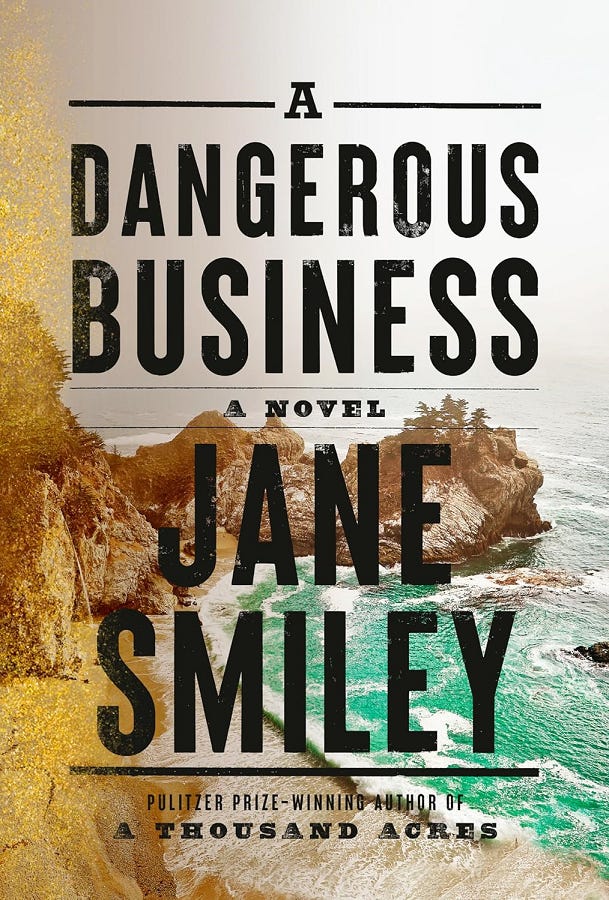
The coolest thing I noticed about A Dangerous Business by Jane Smiley (2022) is how innocent and girlish the narrator’s voice remains even when talking about very dark subjects, like human trafficking and murder.
The protagonist, Eliza “Ripple” (a false name she assumes when working as a prostitute), is sold by her fundamentalist Christian parents in small-town Michigan as a child bride to an abusive man twice her age, who promptly takes her to Gold Rush California to act as his servant and sex slave. To Eliza’s relief, her abusive husband is soon killed in a shoot-out, leaving her free... and with only one option for supporting herself. On one hand, the Madame who employs her is kind and protective, and most of her clients aren’t nearly as bad as her late husband. On the other hand, girls like her keep turning up dead in ravines around town, and who in the wild west gives a damn about the fate of a prostitute?
I don’t know if you can get a better premise, but what’s fascinating to me above all is the voice. Eliza is an inexperienced teenager, and she sounds like one, despite a life that would make a lot of people hard very quickly. She’s lost, she doesn’t know everything, she’s not jaded, and she’s not gross. The very few sex workers who are brave enough to talk about their experiences with the public are the older, experienced, and fearless ones, but Eliza is very much afraid. Her presence gives voice to the untold millions of girls the world over who are forced into the world’s oldest profession every year. I can’t think of any other protagonists out there solving murder mysteries who sound like her.
The book loosely follows a standard mystery arc, but is not slave to it. A lot of well-justified time is spent just inside her head, feeling her feelings and living her experiences. And they are fascinating. They don’t write off the existence of sex workers who choose their profession voluntarily. They don’t ignore the trans and genderqueer sex workers, nor the ones who serve female clients--Eliza’s best friend Jane is both. And they don’t write off men who visit prostitutes as inherently villainous. Some are sweet little boys in search of a first experience; others have consensual arrangements with their wives; still others are sailors and ranchers in a universe where men drastically outnumber women, and consider themselves lucky to marry a girl they met in a brothel. Humanity has a wide variety of people in it of all sexes and genders, and it’s a fascinating, refreshing cross section of human behavior that will be instantly recognizable to anyone who has worked in the trade.
I’d call it a literary western with a dash of historical mystery, but don’t be afraid if you associate the word “literary” with “overly dense.” The book is both short and compelling, and the prose goes down like water. By the same token, it is neither vapid nor formulaic as some westerns and mysteries can be. The narrator, Thérèse Plummer, is excellent. I’m pickier than most about narrators, and will stop an otherwise compelling book if the narrator is clunky, or god forbid, AI. But there’s a reason Thérèse has been called for hundreds upon hundreds of titles - one could listen to her for hours. If you have a long drive coming up, I couldn’t recommend this more highly.
No posts
Comments
Nothing yet. Say the first thing.
Sign in to join the conversation.