

“Revered in some quarters, reviled in others, Marm Mandelbaum, as she was known, towered over the city as an earthy, expansive, diamond-encrusted presence: self-made entrepreneur, generous philanthropist, thieves’ mentor and gracious society hostess who plied her illicit trade largely in the open.” ~ Margalit Fox
A middle-aged man, boasting a fitted jacket and a tweed deerstalker hat perched precipitously atop his head, pulls a drag on a well-worn pipe. Smoke furls in front of him as he leans against the brick facade of a building. Patiently he bides his time, his alert gaze trained on a dwelling on the corner of Rivington and Clinton Streets in New York City’s Thirteenth Ward. His target? One of the city's most infamous crime bosses: Fredericka Mandelbaum. In her biography The Talented Mrs. Mandelbaum, author and former journalist Margalit Fox contextualizes Mandelbaum’s place in true crime history as a powerful and notorious - and incredibly successful - ne’er-do-well.

19th-century New York City stood on the cusp of modernization. Although the Industrial Revolution didn't fully materialize in the U.S. until the 1920s, the influx of immigrants onto America's shores and the coalescence of people into population hubs such as New York City, Los Angeles, and Chicago prompted a mass shift in the cultivation of society, politics, the economy, and culture.
Corruption especially pockmarked urban centers, where bribes, collateral, and contraband exchanged hands in return for lack of oversight, special favors, or simply turning a blind eye. In New York, the political organization Tammany Hall set the Gilded Age standard for corruption.

Founded in 1797 by William Mooney, Tammany Hall operated as the Democratic political machine in local politics, especially through its embrace and promotion of immigrants and political patronage. Tammany Hall members climbed into the highest of government and civil echelons - judges, policemen, politicians. From their lofty and ambitious towers, many members of the Tammany syndicate rubbed elbows with the burgeoning underground, the fragile boundary of which Mrs. Fredericka Mandelbaum straddled.
So, who was Fredericka Mandelbaum?
“Revered in some quarters, reviled in others, Marm Mandelbaum, as she was known, towered over the city as an earthy, expansive, diamond-encrusted presence: self-made entrepreneur, generous philanthropist, thieves’ mentor and gracious society hostess who plied her illicit trade largely in the open.”1
Born Frederike Weisner in 1825, the future crime marm came to America from Germany in 1850 with her husband Wolf Mandelbaum. She started small, operating a simple peddling business before progressing to more lucrative fencing. By 1884 - when she departed New York due to pending criminal charges - an estimated range of $1 million to $5 million worth of stolen goods passed through her store, comprising silks, sealskins, bonds, and more.2 Mandelbaum also dabbled in bank robberies, helping orchestrate the 1869 Ocean National Bank robbery and the 1878 Manhattan Savings Institution robbery. Her reign lasted well over three decades, abetted by two primary factors: her crooked lawyers and her extensive connections amongst the police and City Hall.
Alas, however, all good things must come to an end. On July 18, 1884, Gustav Frank, an undercover Pinkerton detective who had wormed his way into Marm’s confidence, served a search warrant for her property and arrest warrants for her, her son, and an accomplice. Frank advised her to come clean, and in return, Mandelbaum “whirled and punched him in the face.”3
This “pouchy-faced, apple-cheeked, and beetle-browed” Jewish woman of “Falstaffian girth” ultimately barked the last laugh. Rather than appearing in court as expected, Mandelbaum absconded to Canada and remained there for the rest of her life. She operated similar fencing operations, and without an extradition agreement between Canada and its southern neighbor, New York’s first crime boss avoided punishment save that of exile. Fredericka Mandelbaum died of Bright's Disease on February 26, 1894, at the age of 68.
The Talented Mrs. Mandelbaum focuses less, perhaps, on the intricacies of her life and rather on how her entrepreneurial transgressions and largesse solidified her place in American history and up-ended the established strata in which women, immigrants, and Jews (clearly not mutually exclusive) moved. This larger-than-life figure operated in a perfect storm of opportunity - organized crime hadn't yet reached its zenith in America and Mandelbaum’s Jewish background encouraged women's work outside the home as a matter of principle and duty.
Fox grounds Mandelbaum’s story within the parallel rise of organized crime and the establishment of a permanent police force, two developments that sometimes evolved into a covertly symbiotic relationship. She also introduces the Pinkertons, the private detective agency that ultimately brought Mandelbaum down, casting them as a foil to the more corrupt and disorganized Metropolitan Police. It's a fascinating and apt comparison, and one might picture Gustav Frank as a Sherlockian protégé. The Metropolitan Police slowly formed into a more effective and cohesive unit as the century wore on, but their ineptitude and penchant for bribes ensured Mandelbaum’s lengthy tenure.
Fox’s background as a journalist for The New York Times and other publications infuses The Talented Mrs. Mandelbaum with meticulous research, accurate detail, and narrative flair. The end result becomes an in-depth but enjoyable jaunt through the mid-19th-century burgeoning New York underground alongside a remarkable antiheroine you (almost) want to cheer for.
Thank you to Harper Collins for a copy of this book via NetGalley!
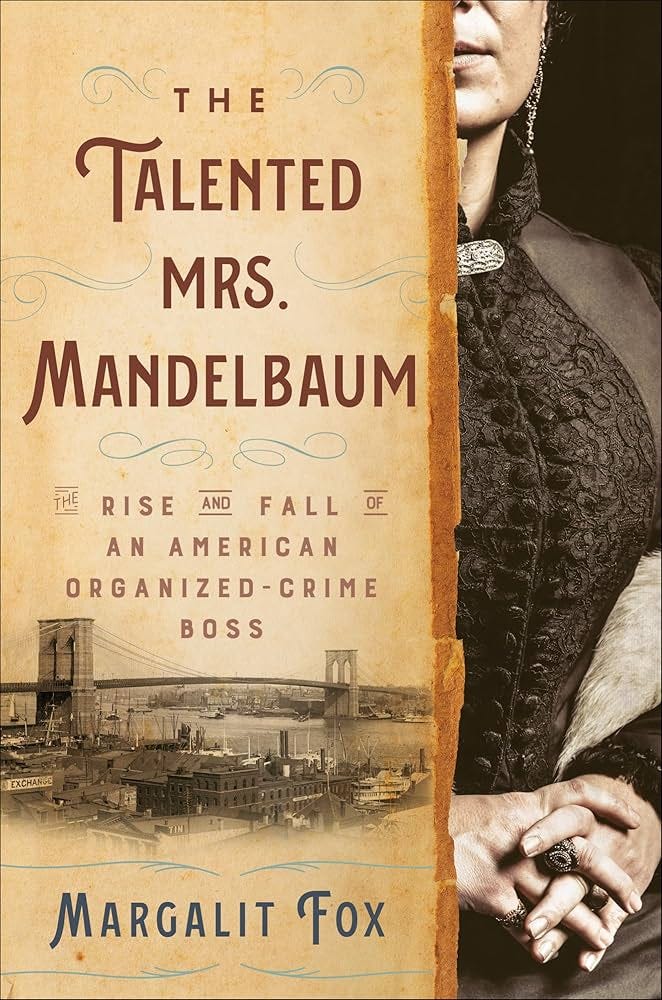
Title: The Talented Mrs. Mandelbaum
Author: Margalit Fox
Publisher: Penguin Random House
Publication Date: 2024
Page Count: 336pp
Featured image: Interior view of Tammany Hall decorated for the National Convention July 4th, 1868, W. C. Rogers & Co., lithograph, 1868 (The New York Public Library, 809922)
Margalit Fox, “Prologue”, The Talented Mrs. Mandelbaum (New York: Random House Publishing, 2025).
Comments
Nothing yet. Say the first thing.
Sign in to join the conversation.