
First, a special thanks to my paying subscribers—Substack has started a new program which will subsidize newsletters that are bestsellers. So I’m running a promotion of a free book for any new paid subscriptions as The Bob is just a handful of readers away.
Speaking of books, I had the good fortune of having a conversation with two friends, who each have a new book out. And both happen to be two of the best cartoonists today, responsible for some of our generation’s most iconic cartoons.
Nick Downes’ first sales to the New Yorker were cartoon ideas, which were then drawn up by the legendary Charles Addams. Eventually, he was able to get his own work into the magazine. He has a line of best-selling greeting cards, has published four cartoon collections and has sold innumerable cartoons to a wide variety of markets both here and abroad. In the UK, he began by contributing to Punch magazine, and then to other British publications such as Private Eye, The Spectator and The Oldie.
Robert Leighton is a cartoonist and also a puzzle master, having started his career as an editor at Games Magazine and later co-founded the puzzle-writing company Puzzability. In addition to The New Yorker, Robert’s cartoons appear regularly in The Wall Street Journal, Airmail, and Alta.
BOB ECKSTEIN: Robert, you just drove across the country. Can we first hear a road-trip story from you?
ROBERT LEIGHTON:1 I stayed in San Francisco for five weeks before driving down to LA. I knew they had a museum of cartoon art [Cartoon Art Museum] down at the pier but I figured I had plenty of time to check it out. I had been in town for a couple of weeks and finally one afternoon I said I should look it up and see what exhibits they have. I think it was late afternoon when I looked, and it turned out that they were going to have a panel of West Coast New Yorker cartoonists and cover artists about two hours from then. So I raced over there, saw the discussion, and had a chance to hang out with Tom Toro, Lonnie Millsap, and Mike Twohy.
BE: I remember New Yorker cartoonist Peter Steiner once stating that his famous cartoon, “On the internet, nobody knows you’re a dog,” was just another drawing for him that happened to take off. Do you feel the same for your most renowned cartoons or did you realize you had something special?
RL: Nah, for the most part I can’t tell. When I get an O.K., [term in the biz for a Cartoon Editor deciding to buy your cartoon] there’s an attachment of the cartoon they bought, but I can’t see it until I click on it. So I go back to my batch and I try to predict which one it’ll be. I’m very rarely right.2
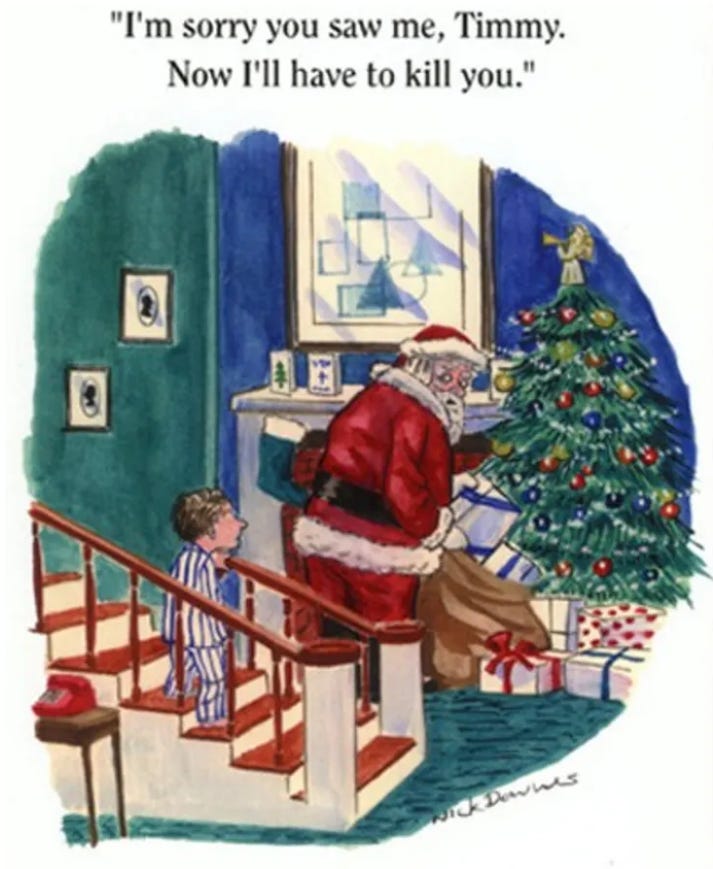
NICK DOWNES: The cartoon of the kid coming downstairs Christmas morning and spotting Santa, and Santa saying, “I’m sorry you saw me, Timmy. Now I’ll have to kill you,”began as a joke Xmas card for a few friends. I remember taking it to a local printer to make maybe twenty five cards. He looked at the drawing and then at me and said, “I don’t think that’s very nice.” I said, “Well, okay, that’s your opinion. How much to print the cards?” “I’m not going to print this card. It’s offensive, and I’m not going to print it!” I knew I had something then. Sam Gross later bought it for National Lampoon and I did a color version for Noble Works cards, where it’s been selling steadily for over thirty years.
RL: The one sort of exception is a cartoon I did with a reference to Escher and optical illusions. It’s not that I imagined them buying it. In fact, it was rejected the first time. But at that time I was working in an office with my two puzzle-writing partners. Every Tuesday I would fax my cartoons in around noon, but that was my thing and I never ran the cartoons past them first. But that Escher one was such a personal statement, it was closer to my puzzle side than my cartoon side, so after I faxed that one I showed it to each of them—I thought they would appreciate it even if nobody else did. I think that’s the only time I showed them a cartoon like that. And that became, like, my best-known one.
You asked me for a story about our cross-country trip, but here’s another one. We made friends along our way, and one new friend invited us to a small dinner party while we were in town. And it turned out that the other couple at the party had adopted my line, “Escher! Get your ass up here!” to call to each other when one of them was upstairs and the other down. They’d been using it for years.
BE: Is there anything better than that? It would be a cool ice-breaker talking up a girl at a party and you point out your cartoon coincidentally on the host’s refrigerator door.
My personal goal IS to come up with something great but that approach often leads to inferior efforts. My best cartoons come from relaxed moments. But there is something romantic with the notion of looking for the perfect cartoon, à la Moody Blues chasing the perfect chord. Is that your thinking? Could you share your mindset and thoughts on expectations?
RL: I don’t think about it that way. I guess I just trust my process. Some days will go well and some days nothing will happen. I did a cartoon once of a guy who is trying to paint a picture. He’s already hung the frame and the canvas on the wall of a museum, with the little velvet ropes around him. And he can’t get started. His wife is saying “Why do you insist on putting yourself under such pressure?” I mean, maybe that’s meant to be me, since I thought of it, but I never actually feel like that. Maybe it’s something I’ve noticed in others, I’m not sure.
ND: If I don’t jot down an idea right away it evaporates and leaves only the memory that I had a great idea. Why you can’t remember the idea, but always that you had an idea, is one of the mind’s cruel pranks. If I revisit those gags that I did manage to write down, and they still hold up, I draw them. I do trust my comedic instinct completely.
BE: Robert, your new book. What is the Rube Goldberg Puzzle Book?
RL: It’s a combination of his cartoons crossed with my puzzles. People hear “Rube Goldberg invention” and almost nobody realizes that he was a cartoonist, not an actual inventor. I had access to a ton of his work—the inventions of course, but so much more than that. I used his drawings and ideas as a jumping-off point for the kinds of visual and verbal puzzles I like to create. In solving them, you also get a short overview of his career. The Reuben awards given to cartoonists are named after him.
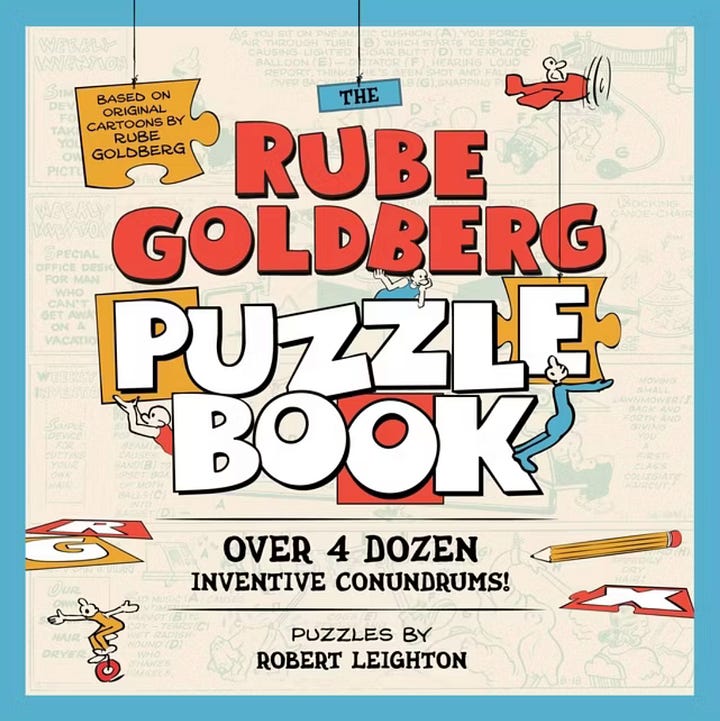
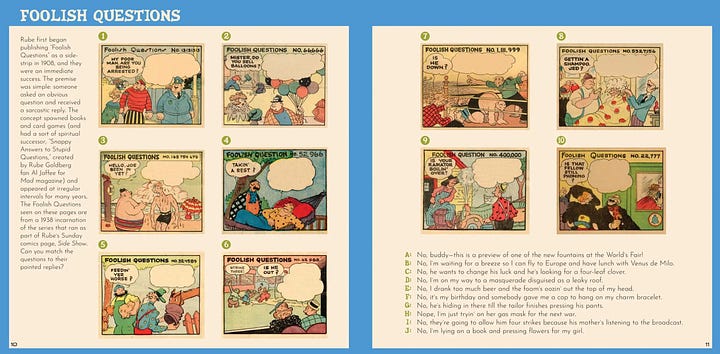
Robert’s new book, The Rube Goldberg Puzzle Book, uses Goldberg’s wild cartoons and outlandish inventions to create over four dozen one-of-a-kind visual and verbal puzzles. Click HERE to get to Robert’s website. To buy his new book, click HERE.
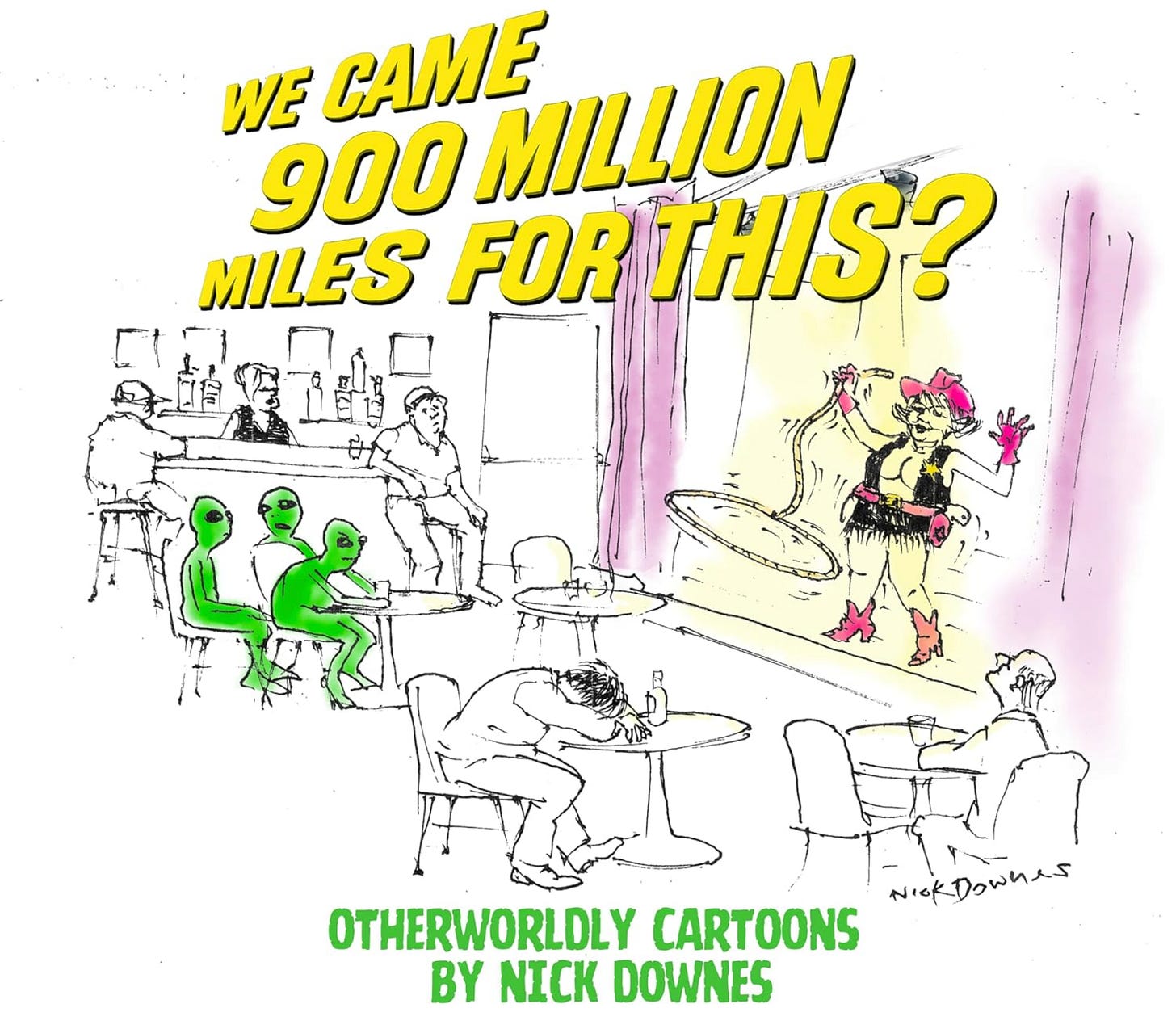
Nick’s new book, We Came 900 Million Miles for This?: Otherworldly Cartoons is a master class in single-panel gag cartooning. Published by Humorist Books, it contains cartoons originally appearing in The New Yorker, National Lampoon, The Wall Street Journal, Playboy, and Asimov’s Science Fiction. Click on title or book cover to purchase.
BE: Nick, you kind of seen it all. What did you see?
Comments
Nothing yet. Say the first thing.
Sign in to join the conversation.