
Happy Monday, friends!
Aave just took a body blow that goes way beyond “one protocol got hacked.”
A cross‑chain rsETH exploit has left a nine‑figure bad‑debt hole sitting in what was supposed to be DeFi’s safest money market.
Now the entire space has to answer a brutal question: when blue‑chip DeFi breaks, who actually pays?
Btw if you want daily updates from me (posting like 10x per day), then check out my free TG channel: https://t.me/cryptogoodreads

Over the weekend, Aave, the “blue chip” DeFi protocol woke up with a hole in its balance sheet.
A bridge exploit on KelpDAO’s rsETH, routed through its LayerZero omnichain app, allowed an attacker to mint a massive amount of unbacked rsETH and dump it into Aave as collateral. On the other side, they borrowed real WETH and walked away. The result: Aave now has a very real pile of bad debt sitting on its core WETH markets.
On paper, the contracts “worked.” In practice, DeFi just discovered that protocol‑level solvency is downstream of bridge design, governance incentives, and risk management, and that depositors may end up as the backstop.
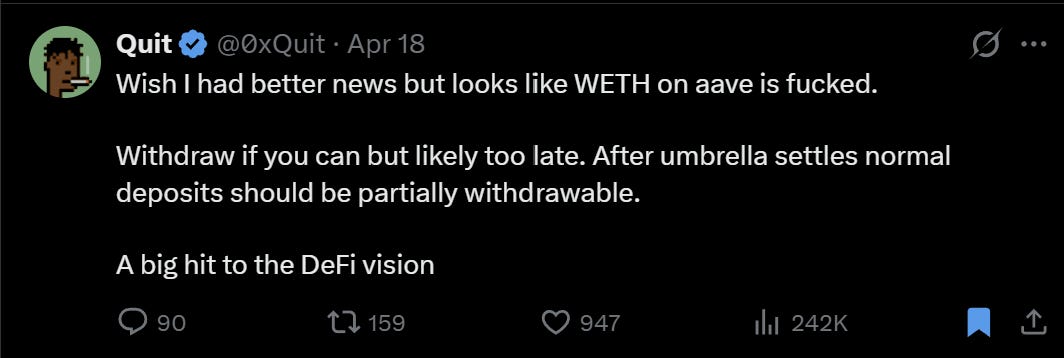
Kelp’s rsETH LayerZero app was compromised at the messaging layer.
The attacker was able to convince the bridge to mint/release rsETH with no real deposit behind it.
That unbacked rsETH was deposited into Aave V3 as collateral.
Against that collateral, the attacker borrowed a huge stack of WETH (and some other assets) and disappeared.
Once the exploit was known, rsETH collateral was effectively toxic, and liquidations could not cleanly restore solvency.
Mechanically, Aave ended up with:
WETH liabilities (users’ deposits)
Backed by rsETH collateral, which the market no longer “accepts”
That difference is bad debt. Let’s explain this further.
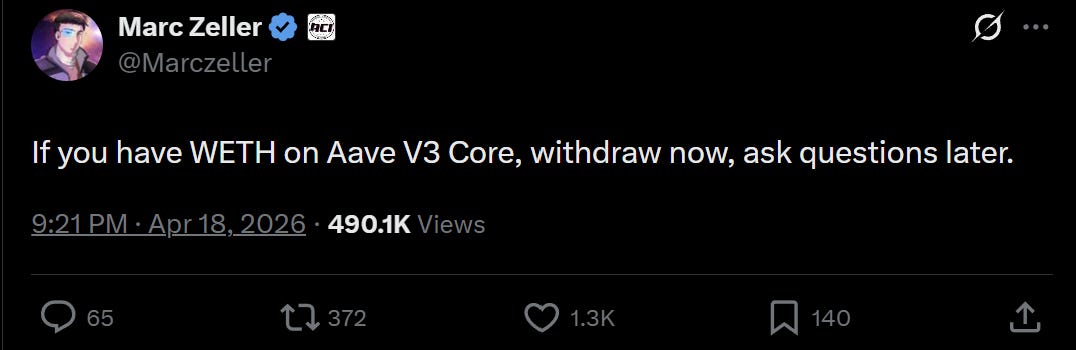
This isn’t just “one protocol misconfigured a bridge.”
“Trust the math, not the people.”
Here, the math did exactly what it was told to do. The failure was in how multiple systems were composed: a bridged LST with aggressive collateral parameters, wired into a money market whose risk managers and core contributors had been heading for the exits.DeFi as “infrastructure,” not “app.”
Aave is not some random farm. It’s where treasuries, funds, whales, and normies park ETH for yield. When that venue suddenly has a large bad‑debt hole, it undermines the idea that DeFi has graduated into safe, boring financial plumbing.
Okay, some more about this: since it was known that AAVE had bad debt, normal people who had money on AAVE in ETH/stablecoins rushed to withdraw, which pushed utilization on the WETH pool up to 100%. At 100% utilization, there is no spare liquidity left in the pool, so even if your deposit is “there” on paper, there’s nothing available for you to pull out until borrowers repay or new deposits come in. On top of that, Aave froze rsETH markets and some related markets as a defensive measure, which limited movements and added to the perception that funds were stuck.
The rsETH‑backed loans that created the hole couldn’t be liquidated properly, leaving Aave with bad debt in the WETH pool and no automatic way to refill the missing liquidity.
Until governance and the backstop mechanisms resolve that bad debt, withdrawals from certain pools are effectively gated by how much fresh liquidity is willing to come back in versus how much wants to leave.But why is this so bad?
When WETH utilization hit 100% and withdrawals were effectively blocked, many depositors realized they were trapped in the pool but still had borrowing power against their positions.
To avoid being the last ones left holding all the protocol risk, they started maxing out their available credit lines, borrowing as much stablecoins/ETH as they could against their collateral.
The logic is: “If I can’t get my deposit out, I’ll at least pull value out via loans,” turning themselves from net lenders into net borrowers.
This rush to borrow on top of already‑maxed utilization pushed the pool even deeper into stress, because it drained any marginal liquidity that might have come back in.
It also increases systemic risk: more leverage in a pool that already has bad debt makes any eventual unwind or recapitalization more painful for whoever ends up paying for the shortfall.
Because people were stuck in Aave’s pools, many maxed out their borrowing instead, pulling as much value as possible out of the system via loans. This turned trapped depositors into highly leveraged borrowers on a protocol that already had a bad‑debt hole.
That behavior deepened the liquidity crisis: utilization in key pools (WETH, USDC, USDT) hit or stayed near 100%, withdrawals were blocked for billions in assets, and any small inflow of new liquidity got vacuumed out instantly.
Confidence shock then radiated outward: whales and treasuries yanked over 5–8 billion dollars from Aave, AAVE’s price sold off hard, and DeFi‑wide TVL dropped as people derisked from similar lending/bridge setups (Morpho, Sky, Fluid, Kamino ++)
Other protocols that integrated rsETH or relied on LayerZero routes reacted by pausing bridges, freezing markets, or tightening parameters, which spreads the liquidity squeeze and makes cross‑protocol capital less mobile.
If users and institutions now treat “blue chip” DeFi money markets as structurally risky, the cost of capital across DeFi goes up: lower deposits, higher rates, stricter collateral, and a persistent discount on anything that depends on bridged assets or stacked LST collateral.
“Code is law” vs “governance is politics.”
The exploit itself was fast; the conditions that made it lethal were built over months through governance:higher LTVs for rsETH,
thinner safety buffers,
a push to attract size,
and a simultaneous exodus of risk and governance contributors.
Aave’s situation looks like this:
Some users deposited WETH into Aave to earn yield.
The attacker borrowed that WETH out, posting rsETH that should have been sound but was actually printed via the exploit.
After the exploit, the rsETH can’t be liquidated at par, so the protocol has WETH “missing” compared to what it owes depositors.
That shortfall is the bad debt. It will be locked to specific pools/markets and may move around a bit depending on liquidations and recovery, but conceptually:
The WETH pool is under‑collateralized.
The value of claims by depositors is higher than the value of the assets left in the system.
Historically, when this happened in other DeFi protocols, there were three levers:
Treasury / token dilution (protocol absorbs the loss).
Depositor haircuts (users absorb the loss).
Some mix of the two, possibly layered with a “recovery token” narrative.
Aave, however, changed how its backstop works over the last couple of years, and that’s where it gets ugly.

0xngmi@0xngmi
Let's run the numbers on potential scenarios Imo there's 3 potential actions for kelpDAO to take: - Socialize losses among all users - Rug rsETH holders on L2s - Try to return to holders before hack by using a pre-hack snapshot (very hard to do) If they socialize losses among
10:17 PM · Apr 19, 2026 · 59.7K Views
37 Replies · 24 Reposts · 357 Likes
The heart of the drama is simple: Who actually underwrites Aave’s solvency now?
In the “classic” Aave model:
AAVE token stakers in the Safety Module backed the protocol.
In a shortfall event, a portion of staked AAVE could be slashed and sold to recapitalize the protocol.
In exchange, stakers earned yield and governance power.
This was the implicit deal: depositors provided liquidity and got yield; token stakers took tail risk and got paid to underwrite it.
Over time, as Aave migrated to new architectures and products:
The original Safety Module’s slashing mechanism was effectively neutered.
Risk coverage moved to new “umbrella” structures tied directly to specific assets and markets (like aWETH).
In some of these new structures, the primary capital at risk is not AAVE staked by tokenholders, but the assets of depositors themselves.
So now, for the affected WETH markets, the de facto order of pain looks closer to:
Depositors in those pools – either through frozen liquidity, haircuts, or forced participation in recap schemes.
Potential protocol‑level backstops – if governance chooses to tap treasury or design a recapitalization plan.
AAVE holders – only to the extent the new system actually slashes or dilutes them, which today looks far less direct than it used to.
That is a very different social contract.
If you deposited ETH on Aave, thinking “AAVE stakers back me,” you may discover you were actually the backstop. That realization alone is damaging to DeFi’s credibility because it means the advertised risk model and the actual risk model diverged over time via governance complexity.
You might think, " Oh, it’s just a $300m exploit. We will get past this”. But this has severe consequences.
For serious capital, this episode forces a repricing of DeFi risk on multiple axes:
Blue‑chip ≠ low risk.
Size, age, and brand do not guarantee conservative risk management. In fact, they can encourage governance to chase yield and market share with thinner buffers because “the brand will carry it.”Bridges and LST stacks are systemic.
A single compromised app at the omnichain layer cascaded into a money market insolvency. Any protocol that treats bridged receipts of receipts as pristine collateral is now under scrutiny.Deposit risk must be modeled explicitly.
If depositors are now closer to first loss than tokenholders, then yields on “safe” pools are mispriced. Capital that treated Aave deposits like a blockchain savings account has to revisit that thesis.
In traditional finance, this is akin to discovering that your “insured” bank deposits are actually junior to some exotic structured note the bank sold itself last year.

inno@inno_ox
immediate effects 24h after AAVE/KelpDAO exploit: > total defi TVL dropped over $10B in 24h > aave TVL lost $6.6B: largest single-day withdrawal in defi history > aave token dropped from $118 down to $90 > bad debt on aave: ~$196M > wETH utilization on aave hit 100%, protocol


inno @inno_ox
AAVE just ate $236M in bad debt from KelpDAO exploit. here's how (simplified): > kelpDAO issues rsETH. deposit eth, get rsETH, earn yield. > attacker exploited kelp's cross-chain bridge and printed 116,500 rsETH ($293M) out of thin air. > dumped it on AAVE as collateral, https://t.co/qobbKsVHbg
5:00 PM · Apr 19, 2026 · 7.48K Views
15 Replies · 3 Reposts · 52 Likes
Governance now has to answer three hard questions, and the answers will define how damaged DeFi’s reputation is coming out of this:
Do depositors get made whole?
Full make‑whole via treasury/token dilution = protects user trust but hits AAVE holders and future economics.
Partial make‑whole with haircuts = long‑term scar on Aave’s brand, but “fair” if you argue depositors implicitly accepted protocol risk.
Will AAVE actually be used as a backstop, or is that narrative dead?
If AAVE is never meaningfully slashed in a nine‑figure event, it’s hard to argue it still functions as true risk capital.
If it is used, Aave survives as a credible system where tokenholders really are the underwriters.
Does the industry learn the right lesson about bridges and LSTs?
The lazy lesson: “don’t use LayerZero/bridges/LSTs.”
The real lesson: if your collateral layer depends on cross‑chain messaging and aggressive LTVs, you’re running systemic risk and should be priced like it.
Whatever path Aave picks, it will set a precedent. Other money markets and LST protocols are watching closely, because this is the first big, modern, omnichain‑era solvency crisis.
The rsETH–Aave incident matters because it exposes the gap between DeFi’s story and DeFi’s reality:
DeFi sells itself as transparent and rules‑based.
In practice, the most important question is who eats the loss? still comes down to politics, incentives, and governance votes.
Bad debt is now on the table. Someone will pay.
The only real open issue is whether it’s the people who were told they were underwriting the system (AAVE holders) or the people who thought they were just parking ETH for yield (depositors).
…
Until next time,
Ciao.
Comments
Nothing yet. Say the first thing.
Sign in to join the conversation.