

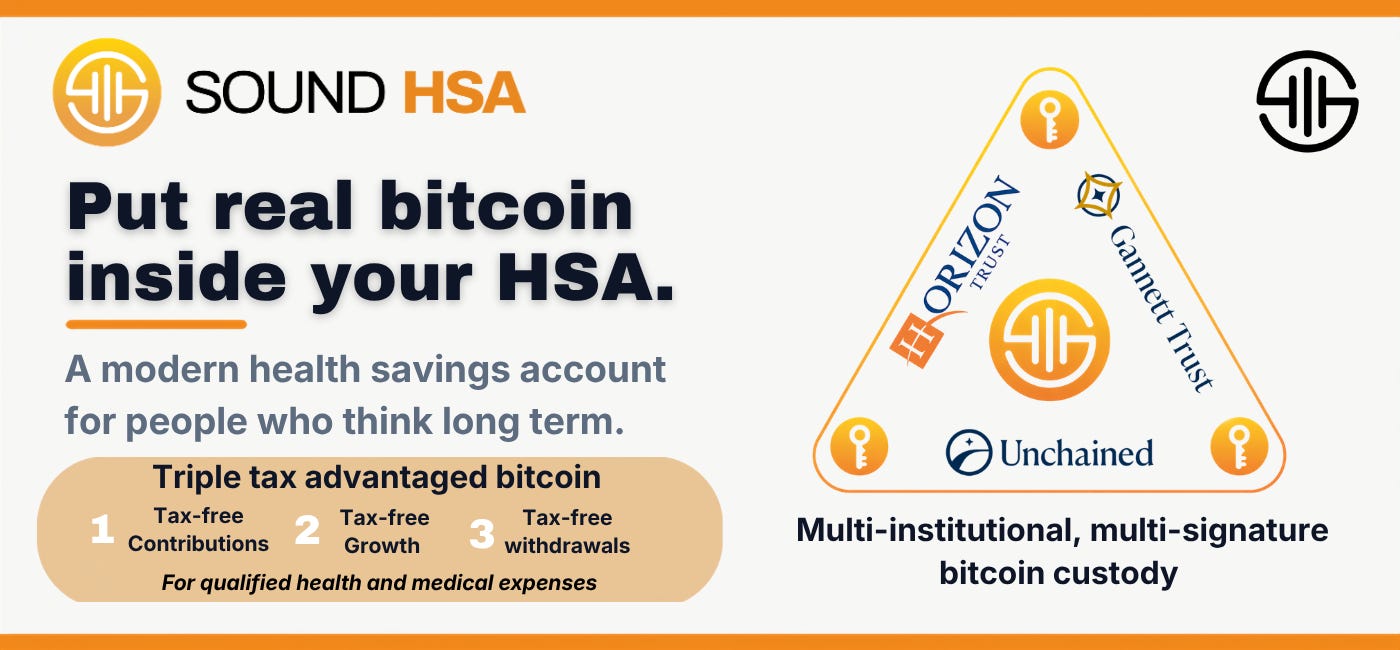
Use code TBL to waive the $50 setup fee to open your account today!
Learn more at SOUNDHSA.com
Dear Readers,
Greetings from the spectacular once-dominant maritime republic Venice, Italy! My family and I are enjoying some time out of the country before the whirlwind of the school year begins in a few weeks. On this trip, and all trips to Europe, I stuff as much history as I can without boring our daughter (thankfully, my wife enjoys the historical walking tours and museums almost as much as I do).
Extremely loyal and long-time readers might remember that a few years ago I was able to see the original site of the Bank of Amsterdam where second-layer money was monopolized by the state for the first time and visit the site of the original Antwerp Bourse where money markets found a life and second-layer money such as bills of exchange and promissory notes started trading as a hybrid currency-asset.
A few days ago, I was lucky to experience yet another aspect of Layered Money in the flesh. We visited the Bode Museum, which plays host to one of the world’s greatest coin collections. There, we saw the Fiorino d’Oro (gold Florin) as well as coins from the beginning of the Byzantine Empire during Justinian’s rule, the Roman Empire, Ancient Greece, and some dating all the way back to the 5th century BC.
I will admit that I was disappointed to learn that 7th century BC coins from Ancient Lydia, largely believed to the the first coinage ever for humanity, were or were not being held underground and not on display. I say “were or were not” because while the internet suggested those coins did exist somewhere in the museum, a language barrier and staff who were generally less enthusiastic ancient coin fanatics (albeit friendly!) prevented me from that historical Holy Grail.
Nevertheless, the Egyptian tablets within the Neues Museum and the array of coins on display in the Bode Museum combined to thrill my historical senses and reinforced the credit system thesis I have been building on for the past three years or so:
Precious metals serve as monetary assets, while credit allows those who seek power to seize it, amass it, and exercise it.
If we strip the word “monetary” from the “monetary assets” descriptor for gold, we view gold simply as an asset.
Despite gold’s tremendous run over the past couple of years, the preferred asset, globally, remains shares in S&P 500 companies. In other words, stocks have been and still are much more popular than gold as the chosen asset by large money. Global portfolio allocations between these two aren’t comparable, with the market cap of all equities a transparent and wholly owned sum in portfolios (approaching $100 trillion in the US), while the market cap of gold remains more of a translucent figure. Estimates are in the $30-40 trillion range, but who really knows how much above-ground gold is held in vaults? Only $5 trillion of gold is held by central banks, and under $1 trillion is held via ETFs.
Bitcoin’s comps are $100 trillion in equities and let’s call it somewhere between $5-$15 trillion of gold that could be considered a portfolio asset, even though I can argue that the figure is drastically lower, per the previous bullet point. That means that global fixed income (well north of $100 trillion) and global real estate (in the hundreds of trillions, let’s call it $400 trillion) are not really comps, but context.
Bitcoin’s age of 17 versus gold’s age of 3,000 years in coin form (much longer when thought of in jewelry terms) is the true delta we love to ponder at The Bitcoin Layer. Bitcoin reached $1 trillion in market cap a few years ago, and in some ways I can even say that as a portfolio asset it is approaching gold, since gold is mostly held outside of the traditional portfolio context. A lot of this becomes semantics, but I hope you can see the delta that truly matters here and why that delta closing underpins everything I have thought about bitcoin since I first truly became orange pilled during 2016, up until the writing of Layered Money, and beyond.
In today’s letter, I’ll discuss the current bitcoin market balance, a crucial TBL Liquidity update, and some global macro context for my views.
Comments
Nothing yet. Say the first thing.
Sign in to join the conversation.