
by Lenore T. Rose
Southern Illinois is not an abstraction. It is farmland, family farms, small towns, last-generation homesteads and main streets with shuttered storefronts. It is the soil that feeds millions and the communities that have anchored this nation for generations — only to watch those foundations slowly erode.
Yet year after year, politicians arise in Washington making promises that sound good on paper but produce little — if anything — on the ground. Mike Bost, the U.S. Representative for much of Southern Illinois’s 12th District, is one of them. His rhetoric about supporting farmers and rural communities has not translated into leadership that protects the economic heart of this region. The problem isn’t local farmers; it’s the policy outcomes of the national leadership he votes with.

MIKE BOST SAYS THIS ABOUT TOWN HALLS ““You know the cleansing that the Orientals used to do where you’d put one person out in front and 900 people yell at them?" IN OTHER WORDS, HE DOESN’T GIVE TWO SHITS ABOUT YOUR OPINION OR WHAT YOU WANT IN YOUR COMMUNITY. read more: https://www.nbcnews.com/news/asian-america/illinois-rep-criticized-after-comparing-town-halls-cleansing-orientals-used-n728816
This article draws on reporting and official statements from 2025–2026 to lay out a simple causal chain: policy choice → market disruption → economic trauma → community impact.
Trade policy matters deeply to Illinois farmers because soybeans and corn are not just crops — they are the basis of rural income, feed local jobs, and support Main Street businesses in places like Metropolis, West Frankfort, Carbondale and Herrin.
But in recent years, the U.S. has pursued tariff strategies that have disrupted global agricultural trade. China — historically the largest buyer of U.S. soybeans — has not purchased American soybeans amid continuing trade tensions, even during harvest seasons when demand should be highest. A soybean farmer from Greenville, Illinois explained to national reporters that when harvest comes, the answer from Chinese buyers has been “crickets,” leaving farmers watching the clock “tick-tocking away” as losses mount.
Meanwhile, Reuters reported that U.S. soybean growers ostracized by lost Chinese markets are scrambling to find buyers in unlikely corners of the globe, such as Nigeria or Vietnam, just to keep the product moving.
This isn’t theoretical market disruption — it is a concrete shift in global demand that reduces prices and turns once-productive fields into burdensome stocks. It also means that millions of rural voters fell for the language - the words and rhetoric that the current admin is going to fight for them. What they found is their main source of income is that the glue of rural communities was ripped out under their feet.
In late 2025, the USDA announced $12 billion in “Farmer Bridge Assistance” to help row-crop producers weather trade losses. But the director of the Illinois Department of Agriculture, Jerry Costello II, bluntly stated this amount won’t come close to covering the losses farmers have suffered from lower commodity prices, lost markets, and rising input costs — and that these tariffs are crushing farmers again.
This matters in Illinois more than many realize. Agriculture accounts for an estimated $26.4 billion in annual economic impact in the state, with soybeans and corn at the center of that value chain.
So here’s the reality: the federal government acknowledges the damage and throws cash at it after the fact, but does not address the chains of causation. It’s akin to paying medical bills after a preventable injury.
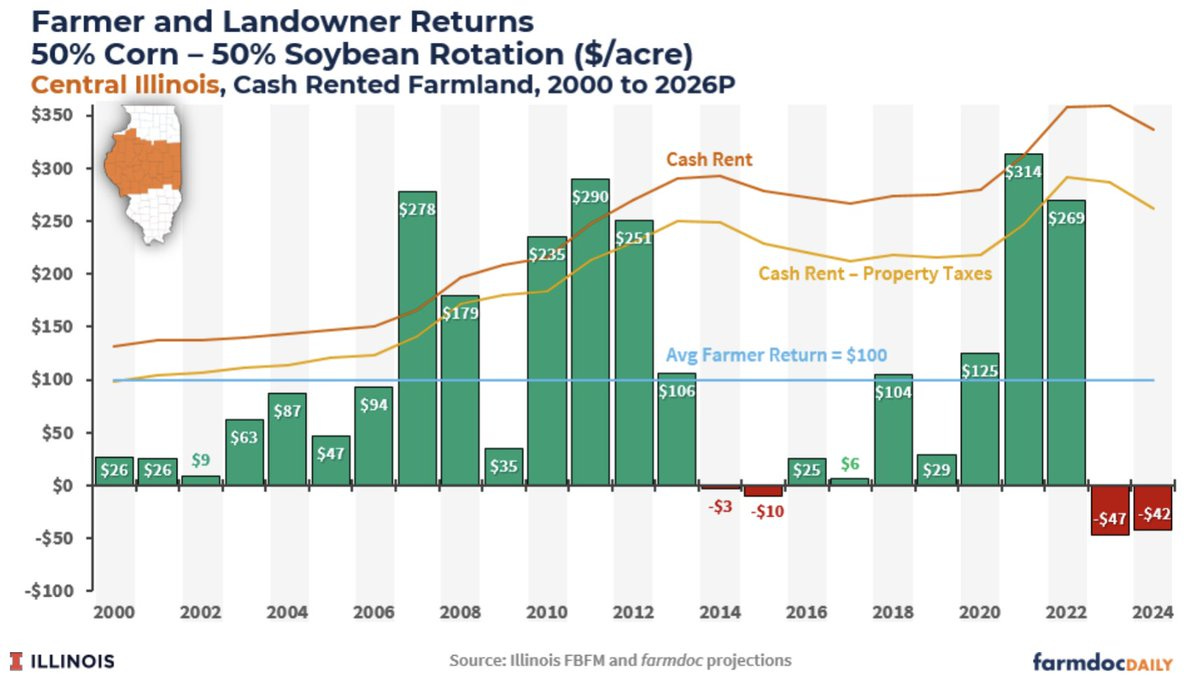
Graph of farm returns. Of the $27 Billion dollars lost in 2025 due to Trump tariffs and negotiations - over 1/3 of this loss comes from Illinois farmers. And Bost refuses to show up and hear what farmers have to say…
The current admin has been far more concerned about running to the aid of countries like Argentina and Venezuela than providing aid to its people - the backbone of the US. Today, despite promises from local officials like Mike Bost and Mary Miller, they tend to want to be supporters of a sycophantic ideology and actions rather than fighting - yes standing up and fighting like they promised - for the farmers and economic prosperity of Southern Illinois.
Today, the admin turns their back on rural communities and farms, but in the instigation of military invasions, the same admin will turn to these communities to take their sons and daughters to put them in harm’s way. In other words, rural communities and populations have no value except to spill their blood for the goals of the elite.
Illinois deserves better -our farmers, our immigrants, our democrats, our republicans and even independents - we all deserve better. However, it is the same rural communities who have their faith and respect for authority used against them so they will turn on their neighbors and not see the harm that is coming from DC and the lack of real ‘America First’ policies.
If it was ‘America First’ then our farmers, our children, our education and our healthcare would come before Venezuela, Argentina, and even the insane notion of ‘stealing’ Greenland.
Rural economies are always the first to pay for bad leadership choices and the first to lose their children to military engagements designed to benefit the elite and not those who hold the rifle in the war for elites.To visualize how this damage spreads through rural communities, consider this causal sequence:
Soybeans are heavily dependent on exports. China alone once bought a massive share of U.S. soybeans — and that market simply vanished for many farmers. This isn’t an abstract loss — it directly lowers commodity prices and inventory movement.Southern Illinois grows a lot of soybeans - that are not being exported.
Tariff checks? That was just lies, manipulation of the time and support of rural voters. Rebate check? We as Americans have heard so many numbers of the money raised by tariffs, but that money is nowhere to be seen. We also have someone at the helm who is so poorly educated that he can’t comprehend that the money he promised the American people, the rural farmers and communities from these tariffs - was money we paid. Trump only found a way to deny you, manipulate your faith, and then get you to pay your hard earned dollars to support him taking more from you - think healthcare, bad foreign deals, and denying federal tax dollars that belongs to the states - and now, you never hear of the money from Tariffs. Where did it go? It did not go to support rural communities.
A University of Illinois analysis places current grain farm income at its lowest in decades, driven by low prices and operating costs that remain stubbornly high. Farmers may grow good yields, but if the market won’t pay a price above production cost, the business is unsustainable.
Be sure to note the falling prices is the amount being paid to our farmers all while the grocery shelves in all departments are skyrocketing.
Even if a farm hasn’t declared bankruptcy, that doesn’t make the problem disappear. Low margins mean less spending on equipment, repairs, land, and labor. Debt rises. The ability of new farmers to enter decreases. Land values stagnate or fall. Families are squeezed between legacy costs and uncertain futures.
In rural areas, a thriving farm supports more than tractors and combines — it supports:
grain elevators and co-ops,
local feed stores,
mechanics and welders,
grocery stores and diners,
property taxes that fund schools, and services.
When farmers spend less, everyone else earns less. Population declines. Young people leave for cities. Main Street businesses close. This pattern has been visible in rural Illinois for years, particularly in counties where farming makes up a large share of economic activity and jobs.
The money made by farmers, their employees, and spent by their families is a large portion of what keeps rural grocery stores, hardware stores, gas stations, restaurants afloat – the same businesses which provide the majority of employment in these rural areas. It is hard to not see this, as you watch the homeless numbers growing and wandering about your communities all while doors are closed and boarded on Main Street businesses in small towns across the USA.
Many towns lack economic diversity. The loss of coal employment decades earlier already hollowed out Southern Illinois; now agriculture’s decline accelerates the rural exodus. Bost stays in DC, lives the high life as he subjucates his position to the whims of Trump. He simply doesn’t want to hear what any constituent or farmer has to say or what they want to happen in Southern Illinois.
This is a reminder that under Bost leadership, southern Illinois remains the “welfare” section of the state - primarily funded by tax dollars in northern Illinois communities. Bost turns his back on farmers and has done little to change this, has done little to demonstrate working with corporations to bring big business to southern Illinois and when his people are hurting the most, he refuses to even speak to them.
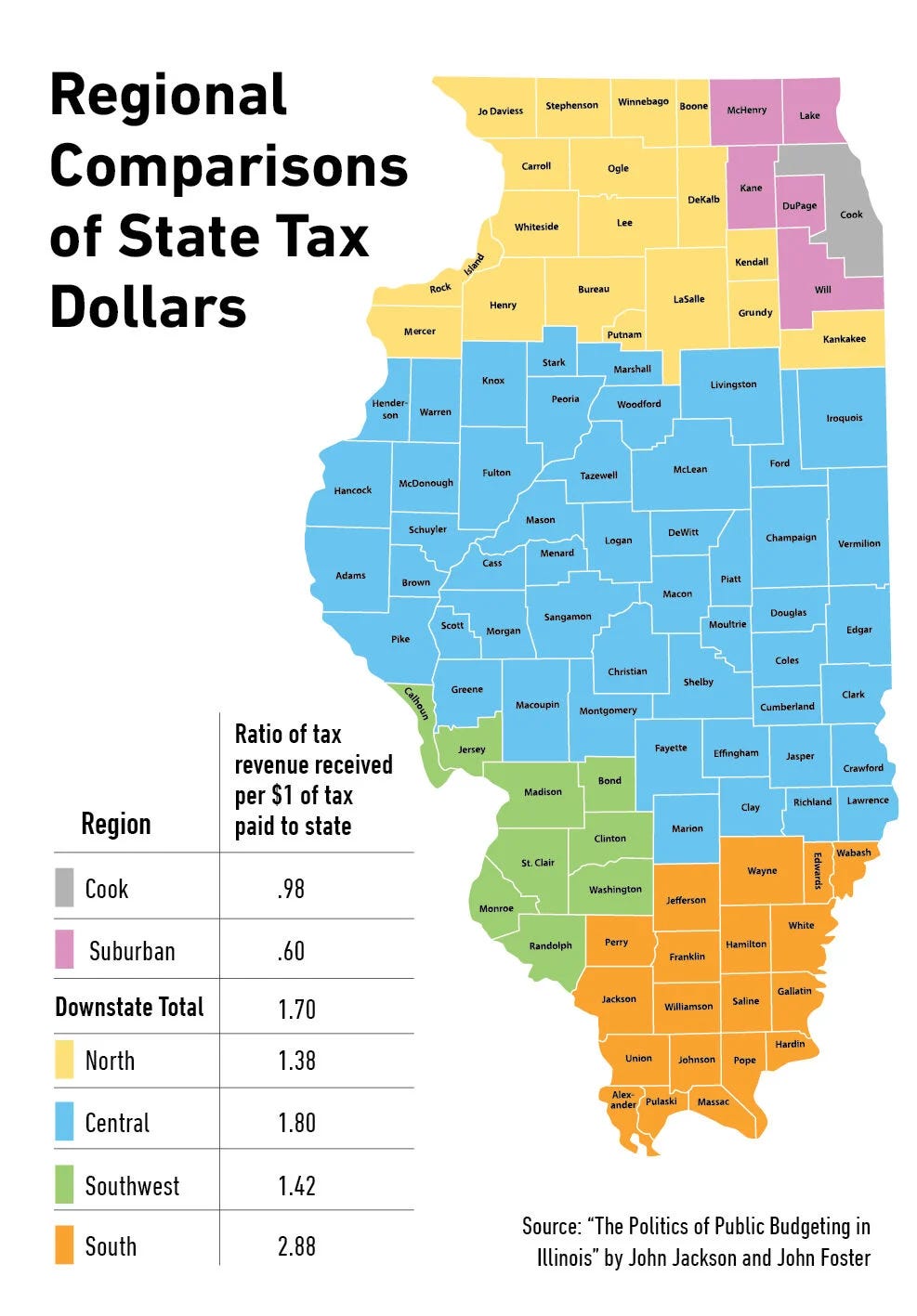
Image showing the tax revenue disbursement across segments of Illinois. South Illinois recieves the highest revenue from state taxes collected statewide.
Southern Illinois is unique. Unlike areas near Chicago or Champaign-Urbana, its economy is agriculture and what grows around agriculture: processors, truckers, feedlots, local retailers, schools, and hospitals.
When farm income falters, those downstream industries feel it.
Fewer farm dollars mean fewer local jobs outside of agriculture.
Reduced property values mean less revenue for schools and local governments.
Shrinking commercial activity means business closures and fewer tax dollars.
Families under financial stress see higher food insecurity and greater need for SNAP and other social services.
In many rural counties across Illinois, population decline is measurable and persistent.
This dynamic is not new — it has been building for decades — but it is being intensified by current policies, not alleviated.
This brings us to representation.
Mike Bost rode to office on a platform that professes support for agriculture, rural development, and economic opportunity. But consistent patterns in Washington tell a different story:
He votes with party leadership on major national policies, including support for the trade framework that coincided with export losses.
He offers routine appropriations or grant advocacy — the standard baseline work any Congressman does — but little in the way of proactive reform that addresses root causes of the rural economic collapse.
That’s the difference between representing a community and maintaining the status quo of party alignment.
One can secure local infrastructure grants or letters of support (the normal work of a legislator) — and that’s certainly better than nothing — but that does not constitute leadership when the agricultural backbone of the district is weakening under national policy decisions.
If his bills never come to fruition, if there is no real FIGHT for the needs of farmers and businesses of Southern Illinois and he refuses to even show his face for town halls - perhaps it is time Southern Illinois consider “who” they are voting for and ignore voting “by party.” Make sure the individual - regardless of political party - represents you and your community and is willing to show up, do the work, and answer to you directly. If they can’t face you, then they know they are doing nothing for you.
Listen to the farmers themselves.
The soybean grower in Southern Illinois — a region where harvest should bring relief — instead describes anxiety and loss of market demand. This isn’t theory; it’s the lived reality for people who stood in the fields they own, only to watch buyers disappear.
These are the same counties that once supported industry and coal, only to see mines close and jobs vanish. Years later, the infusions of federal aid — even when they come — are too often patches, not sustainable policy solutions.
Farm families are not just facing lost income — they are seeing:
shrinking access to healthcare,
fewer opportunities for the next generation,
rising need for SNAP support in places where hunger was once rare,
and declining local services as tax bases shrink.
VI. The Choice Facing Southern Illinois
Southern Illinois is at a crossroads. Its fate should not be left to national policies that treat farmers as political afterthoughts until it’s time for campaign photos.
What the region needs is not just funding after failure, but leadership that champions long-term market access, real trade negotiations that protect — not sacrifice — agriculture, and economic diversification that brings jobs and investment outside of boom-and-bust commodity cycles.
Until that happens, the political talk of “supporting farmers” is just that: talk. Farmers, workers, and voters need to understand that it is all messaging, rhetoric, and well, let’s put it bluntly, bullshit in order to gain your vote. Actions speak louder than words, and here, the direct actions of Mike Bost is that he voted for and supported bills and policies of an administration who doesn’t care about farmers or the healthy distribution of food across the globe.
What do you expect cutting food stamps and other healthy food programs would do? Those dollars are spent on food grown by farmers. An administration that cares more about golden ballrooms than feeding school children doesn’t give two shits about farmers. Bost enjoys the celebrity, the premium health coverage, the lifestyle of DC - he said he would fight for you, but it looks like he only fought to stay in power. He takes credit for writing bills that actually end up going nowhere. If the bill never came to pass, then gloating about your accomplishment is empty.
The soil here still has potential. The people still have grit. But words without tangible, strategic policy results leave communities depleted, generations wandering for work, and family farms disappearing.
Amid all of this, the question voters must ask of Mike Bost — and every representative — is simple:
Is this leadership — or just another Washington soundtrack of promises unmet in the fields that feed America?
CBS News — “U.S. soybean farmers struggle as China cuts purchases amid trade tensions”
Reports on soybean farmers in Illinois and the Midwest facing lost Chinese markets, lower prices, and storing crops due to lack of buyers.
https://www.cbsnews.com/news/soybean-farmers-china-trump-trade-war/Reuters — “U.S. soybean farmers deserted by big buyer China scramble for other importers”
Documents how U.S. farmers are forced to seek new foreign buyers after China reduced purchases, leading to oversupply and falling prices.
https://www.reuters.com/world/china/us-soybean-farmers-deserted-by-big-buyer-china-scramble-other-importers-2025-10-03/Wisconsin Watch / Midwest collaborative — “China invests billions in Latin America, sidelining U.S. farmers”
Explains how China is building long-term soybean supply chains in Brazil and Latin America, permanently reducing U.S. export market share.
https://wisconsinwatch.org/2026/01/us-farmers-soybean-china-brazil-latin-america-agriculture-tariffs-exports-midwest/
Capitol News Illinois — “Illinois ag director says trade policies are ‘crushing’ farmers”
Illinois Department of Agriculture Director Jerry Costello II states that tariff-related trade disruptions are severely harming farmers and that federal aid does not cover losses.
https://capitolnewsillinois.com/news/illinois-ag-director-says-trump-trade-policies-are-crushing-farmers/State of Illinois — Executive Order supporting farmers amid trade impacts
Acknowledges negative impacts of federal trade policy on Illinois agriculture and authorizes state-level mitigation efforts.
https://www.illinois.gov/government/executive-orders/executive-order.executive-order-2025-07.2025.html
University of Illinois FarmDoc Daily — “The Current Grain Farm Financial Position in a Longer-Term Perspective
Shows declining farm income, low commodity prices, and high operating costs placing grain farms under financial stress.
https://farmdocdaily.illinois.edu/2025/12/the-current-grain-farm-financial-position-in-a-longer-term-perspective.html
Investigate Midwest — “Rural Illinois’ food economy depends on immigrants
Documents shrinking rural populations, business closures, and reduced economic activity in farm-dependent communities.
https://investigatemidwest.org/2025/09/17/rural-illinois-food-economy-depends-on-immigrants/Wikipedia — Southern Illinois regional economy and coal decline
Summarizes the long-term decline of coal employment and limited economic diversification in Southern Illinois.
https://en.wikipedia.org/wiki/Southern_Illinois
Comments
Nothing yet. Say the first thing.
Sign in to join the conversation.