
In the first season finale of Cursed Films, the Shudder docu-series about “the myths and legends behind some of Hollywood's notoriously cursed horror film productions,” showrunner Jay Cheel examines the egregious individual, organizational, and legal failures that left three actors dead on the 1982 set of Twilight Zone: The Movie.
Modeled on Rod Serling’s groundbreaking 1960s television show, Twilight Zone: The Movie was an anthology film comprising four separate segments, each of them helmed by a different celebrated director: Steven Spielberg, Joe Dante, George Miller, and John Landis. The deaths of TV veteran Vic Morrow and two child actors, Myca Dinh Le and Renee Shin-Yi Chen, occurred as the result of a helicopter crash during the shooting of Landis’s segment. Landis, based on court testimony from the eventual manslaughter trial, had allegedly responded to escalating crew concerns about the dangers posed by his sequence by saying, “You ain’t seen nothing yet.” A few hours later, a spinning helicopter blade decapitated and killed his leading man.
The production of Christopher Nolan’s The Dark Knight isn’t usually discussed in the whispery, superstitious tones reserved for the consensus “cursed films” from Hollywood history, despite its direct connection with one death and a more tenuous association with another. Before Heath Ledger’s passing, 41-year-old special effects technician Conway Wickliffe died after a 4x4 crash during a test shoot for one of the film’s car chase sequences. But whereas these sorts of tragedies had led other “cursed films” to become box office bombs or workplace cautionary tales, the industry-reshaping commercial and critical success that accompanied The Dark Knight’s release, in July of 2008, quickly hoisted the film onto the high pedestal of the instant-classic. These triumphs carried over from the summer into award season, and were fueled in no small part by the indelible ballistic intensity—and the subsequent animating pathos—of Ledger’s performance as The Joker.
Very much unlike the on-set deaths mentioned earlier, Ledger’s untimely death, by an accidental overdose of prescription pills, happened hundreds of miles away from any of The Dark Knight’s shooting locations, and two months after its production concluded. No reasonable person would ever hold Nolan, or the members of his cast or crew, at fault to the slightest degree. To reinforce that point, the entire production’s handling of the circumstances, the sudden and shocking loss of an otherwise healthy, exceptionally talented colleague with a wife and young children, was considered, reverential, sincere, and, as time has borne out, lasting. Fifteen years after the tragedy, when Nolan won the Golden Globe for Best Director for Oppenheimer, he took the opportunity to note, his voice wavering with emotion, that he’d hadn’t stepped foot on that stage since he’d accepted a posthumous Globe on Ledger’s behalf.
“That was complicated and challenging for me,” Nolan said during the 2023 acceptance speech. “…I thought it would be simpler accepting for myself, but as a director, of course, you stand here and suddenly realize, ‘I can only accept this on behalf of people.’ As directors, we bring people together and we try to get them to give…their best.”
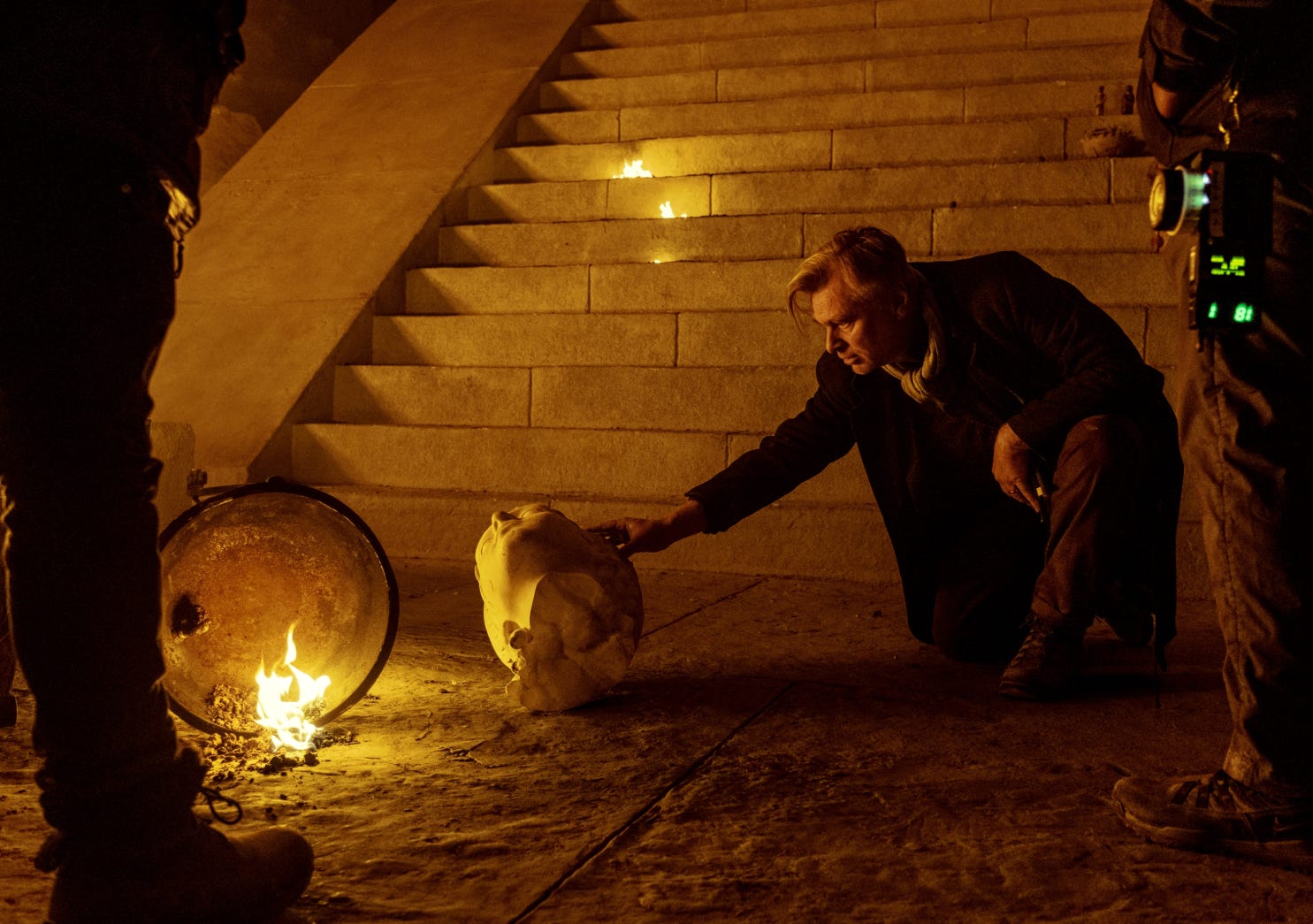
Despite the differences in their historical periods, geographic settings, and contrasting levels of realism and fantasticality, Oppenheimer and Nolan’s most recent blockbuster, The Odyssey, share the same central dramatic preoccupation: an overwhelming sense of guilt experienced by their Christopher Nolan-y protagonist. In both films, Nolan’s directorial proxy harnesses a combination of artful problem-solving and technological knowhow to accomplish a selfless, self-aggrandizing, and seemingly impossible feat. Odysseus ends the Trojan War, Oppenheimer ends World War II, and then both characters find themselves painfully conflicted and confused about the ethics of their own methods, their deservingness of commemoration, and the (likely disastrous) fallout of the very achievement that won them accolades and renown to begin with. The conflict: Look what I did! But wait, what have I done?
Critics and Reddit commenters alike have viewed Oppenheimer’s wrestling with the implications of the atomic bomb as a vehicle for Nolan to vent his own frustrations about the pivotal role he played, through The Dark Knight, in elevating the superhero movie into a prestige art-form and setting the stage for the rise of the MCU and “DCEU.” In a 2024 article for The Inverse, Haoi-Tran Bui writes that, “It may seem odd to compare the making of the atomic bomb — one of humanity’s most horrifying achievements — to a Batman movie. …But Oppenheimer’s soul-searching (and soul-damning narrative) certainly seems to apply to Nolan in some form.” HereQueerAndGreat, contributing to the r/fantheories subreddit, interpreted the film similarly: “while inspiring a bunch of mediocre movies is hardly comparable to inventing the atomic bomb, nolan probably identifies with oppenheimer's "i've created a monster" mentality. as such, he likely made oppenheimer as a way of coming to terms with and accepting his legacy.”
While he isn’t often regarded as an “actor’s director,” Nolan did direct Heath Ledger to deliver what is widely regarded as not just the best performance of the actor’s cut-short career, but one of the best performances of this century, inside or outside of a superhero movie. And Nolan helped create that monster. Alongside his brother, Johnathon, Nolan co-wrote the screenplay that sketched out Ledger’s anarchic and volatile version of the Joker, and although Nolan gave effusive credit to Ledger for his proactive approach to developing the role, the director must’ve overseen his actor’s preparations in some capacity. Supposedly, Ledger spent six weeks locked in a hotel room in order to experiment with line deliveries, makeup, costumes, and various knife and weapon pairings. On screen, the results speak for themselves: You almost can’t call what Ledger does “acting,” because it appears the man has actually gone mad.
Guilt, as a psychological phenomenon, operates independently from any conscious narrative we can form about responsibility, and if humans are what they repeatedly do, Nolan has exhibited a clear obsessive pattern with Oppenheimer and The Odyssey. Even more so than Oppenheimer, in which Nolan (rightfully) opted not to depict the deaths of Japanese civilians in Hiroshima and Nagasaki, The Odyssey is about a defiant, uncompromising leader whose poor decision-making breaches the social contract and leads his men away from home and safety, toward death. When they depart the beaches of Troy, Odysseus literally chooses to sail in the wrong direction. “I’ve followed Agamemnon long enough,” he says, before commanding his crew to open their sails to the winds of catastrophe.
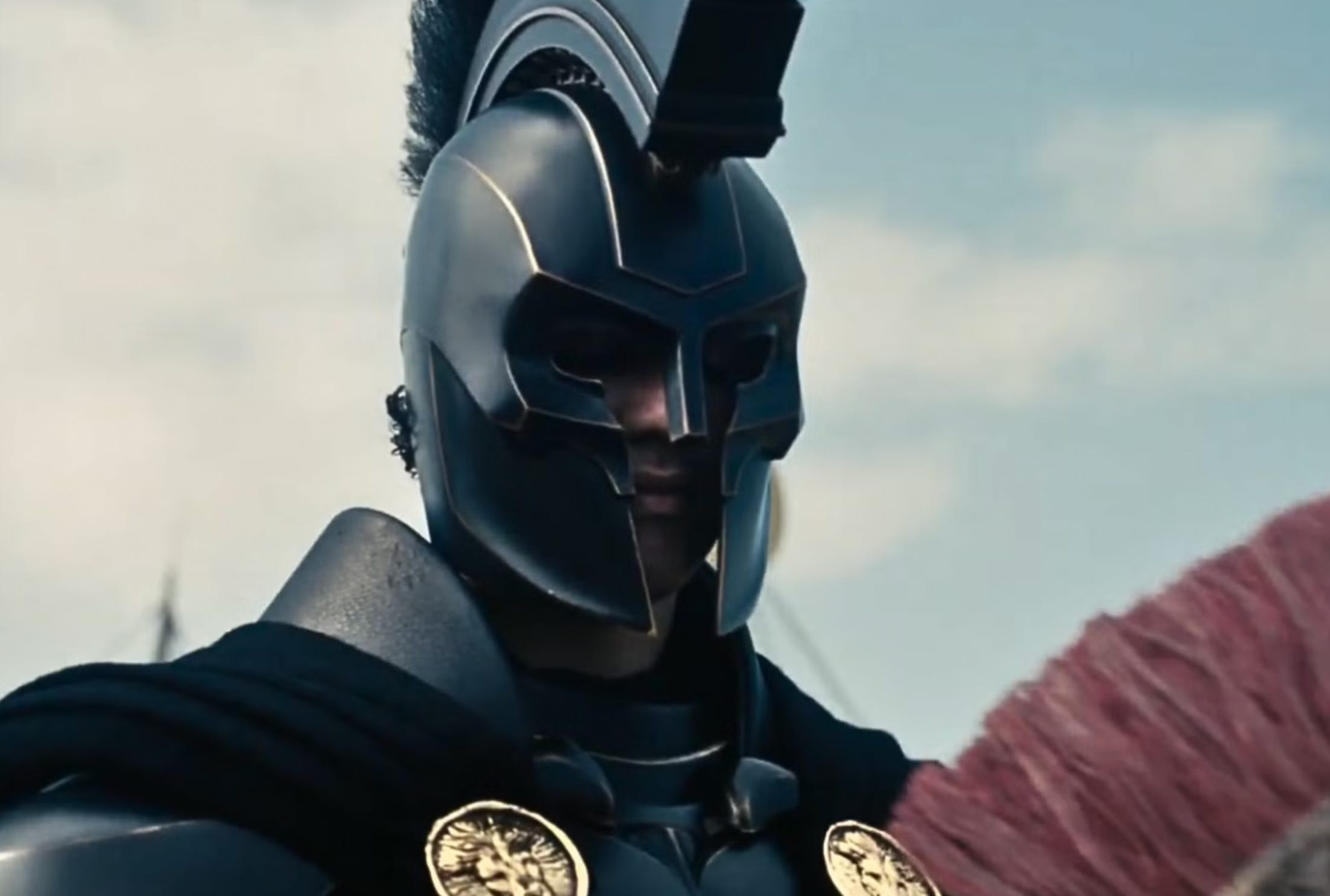
Fittingly, the first voice who Nolan directs to evoke the Muse and tell the audience of Odysseus’s exploits belongs to Travis Scott, the presumably guilt-racked rapper whose 2021 AstroWorld Festival left 10 fans dead, 25 hospitalized, and more than 300 injured. Two and a half hours later, The Odyssey climaxes with a fight sequence whose arrangement and aesthetics—a lone attacker shooting unarmed victims in a barricaded room—mirror what may be the darkest moment of Nolan’s career: the mass shooting that occurred in a Colorado movie theater during a midnight showing of The Dark Knight Rises. As much as there’s something to be gleaned about Nolan from these choices, the response tells us something about audiences, too. Given these depressing aspects of his legacy, why would anyone think that his peripheral influence on the green-lighting of Ant-Man is what keeps Nolan awake at night?
The evidence suggests that Christopher Nolan isn’t a complicated enough artist for any of these resonances to be intentional. Since the release of The Dark Knight, he has consistently characterized himself as the pleasure-to-work-with opposite of the previous generation of auteurs, like Kubrick and Herzog, whose reputations partly depended on a willingness to push themselves and their actors to the edge of nervous breakdown (and sometimes beyond that). In Herzog’s case, he’d descend into madness right alongside his actors: When Klaus Kinski threatened to abandon the jungle production of Aguirre, the Wrath of God, Herzog pulled out a gun and threatened to kill the actor, then himself, unless Kinski agreed to finish the movie. Nolan, meanwhile, in the manner of a repressed guilty person, has dedicated the intervening years, nearly two decades, to establishing himself as the ultimate dispassionate gear-head director, a filmmaker-as-project-manager whose interests reside more in pushing forward the medium of cinema than testing the physical, mental, and emotional limits of his actors (and himself).
It is an uncomfortable but instructive fact that, despite Cillian Murphy winning the Oscar for Best Actor, Heath Ledger’s performance as the Joker remains the peak of Nolan’s work as a dramatic collaborator. Whether you watch The Dark Knight on your iPhone or in an IMAX theater, the performance’s sheer visceral power remains awesome and unchanged. It’s art, an instance of pure self-expression that’s genuinely risky and challenging and complicated, which is to say it’s everything that every subsequent Nolan movie merely pretends to be. Christopher Nolan has proven he can compel his actors to sing like that, to explore creative terrain that is strange and scary, even dangerous. The director should consider venturing there again soon. Until that happens, he’s just tinkering with the specs on his big cameras.
Comments
Nothing yet. Say the first thing.
Sign in to join the conversation.