
After a short summer break, the F**king Monday column is back! In the roundup today:
I had the odd experience the other day looking at a pair of sneakers on Amazon and deciding they were just out of my price range. I searched for some more shoes and after a few minutes decided I’d bite the bullet and fork out a few extra dollars for the original pair. Much to my delight, the price had dropped to within my budget.
This was no doubt because Amazon tracks my every move, and its algorithm cleverly figured out what I would be prepared to pay for the shoes. While in this instance it benefited my wallet, the dynamic pricing model has far more insidious implications.
Stephanie T. Nguyen, the former chief technologist at the FTC, wrote in the New York Times this weekend about what she calls “surveillance pricing” where companies use your location, browsing history, purchase habits etc to estimate the inverse, or the absolute maximum an individual is willing to pay.
This is essentially enshittification applied to pricing. The internet economy began by using technology to make shopping cheaper, easier and more transparent. Now that the infrastructure is entrenched and companies possess enormous amounts of data about us, that same technology is increasingly being used to extract as much money from each individual customer as possible.
A coupon is public and available to anyone. Surveillance pricing means you may have no idea that someone else is being charged less for exactly the same thing.
Nguyen cites travel sites varying prices by location and a former Washington Post reporter who discovered that the more frequently he visited Starbucks, the fewer discounts he received. The Post itself is facing a lawsuit alleging that it used reader data to charge loyal subscribers more.
Her solution is simple: companies should be required to publish a genuine base price. Discounts would still be allowed, but businesses couldn’t secretly charge you more because an algorithm has decided you’ll tolerate it.
A Republican controlled Congress is unlikely to pass a federal law, so in the mean time, you might want to try playing the companies at their own game. If you want to purchase something and think it’s mis-priced, search for other similar products that are cheaper. Then come back and you might be pleasantly surprised. No guarantees of course, but my shiny new shoes look pretty great.
A quick message to readers: if you’re enjoying The Banter, you can get a two-month free trial and experience everything membership includes. You’ll get access to all Members Only articles, the Members’ Mailbag column, and exclusive member chat threads.
The Banter takes a lot of time and work to keep going, and paid memberships are what make it possible for us to continue doing it independently. The free trial is an easy way to see whether membership is worth it for you:
The rest of the world should study Canada’s prime minister Mark Carney for lessons in realpolitik — and courage.
Trade talks between Canada and the U.S. dramatically collapsed over the weekend, with Carney walking away from a deal that Trump had claimed was basically “done” just days earlier. The economic implications of the fallout are serious given how deeply interconnected the two countries economies are, but the geopolitical implications are even more profound.
Carney’s decision to walk away is a message, not only to Trump, but the rest of the world. America might be the world’s most powerful country, but that power is not absolute. More than that, it can be successfully challenged.
Because Trump is, by instinct, a bully, he has a very limited understanding of power. Just as a smaller, weaker military power has refused to submit to Trump’s demands over the Strait of Hormuz, a smaller, weaker economy has now refused to submit to Trump’s economic demands. This does not compute in Trump’s mind, because in his view, strong always defeats weak. Carney knows this, and has called Trump’s bluff.
Carney’s gambit is the same as Iran’s — while the U.S. can do far greater damage, if Canada is willing to endure more, it can win. Because the U.S. is viewed as the aggressor in this conflict, Carney’s popularity will soar in Canada, while Trump’s will plummet at home. This is yet another idiotic trade war no one wanted, further damaging already struggling families in America.
That is the lesson other countries should take from Carney. Trump’s power depends on the assumption that everyone else will panic when he threatens them, and then submit. If enough governments decide that short-term pain is preferable to permanent submission, the coercive power of the United States begins to diminish very quickly.
The lesson, then, is simple — and one every child learns at school. You might not be able to beat up the bully, but if you make bullying costly enough, eventually they’ll leave you alone.
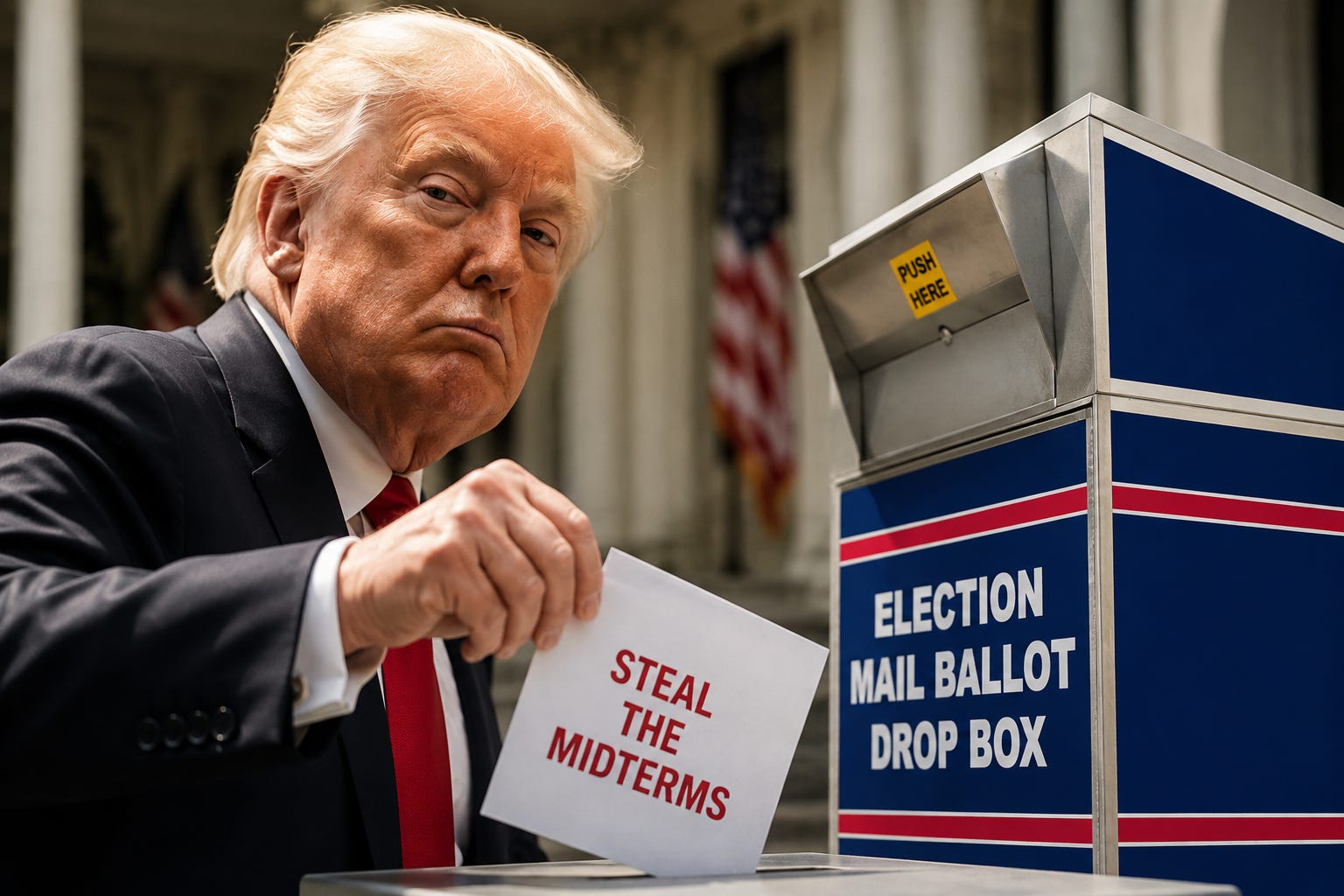
George Chidi has written a very ominous piece in the Guardian warning that Trump’s not-so veiled attempts to steal the midterms are rapidly taking shape.
Chidi argues that election-law specialists, democracy advocates, and a former Trump White House lawyer are deeply concerned about a pattern of moves they believe show Trump want to subvert the midterm elections in November.
Here’s the outline of what has happened in recent weeks: Trump used a July primetime address to repeat false claims about the 2020 election and warn of foreign manipulation, Steve Bannon then openly predicted Trump would declare a national security emergency around the midterms, and Trump himself declined to rule the idea out when asked directly.
The most troubling part:
After Trump’s TV address, a White House “Government Transparency Task Force” – composed of members of the office of the director of national intelligence, the National Security Agency, the Central Intelligence Agency and the Department of Homeland Security (DHS) – began releasing declassified “election integrity” documents on the White House website.
The first tranche included declassified intelligence memos which described electronic voting machine vulnerabilities, foreign access to state voter registration data and foreign digital manipulation strategies. Much of the material was already known to the public and amounted to a US intelligence assessment that found no evidence Beijing altered the 2020 vote, which Trump lost.
This is pretty substantial evidence that Trump is using the power of the state to manufacture a crisis. Having tried to steal the 2020 election, Trump knows the best way to hide his efforts is to claim the other side is doing it. He almost got away with it the first time around, so he is using the same tactic again — only this time with the machinery of the federal government behind it.
I’ve been writing for years that Trump will attempt to stay in power beyond 2028. This looks to me like a dry run.
If you’re interested, here’s a video I made earlier this year on exactly how he might do it:
Read the latest for Banter Members and get a two month free trial on a Banter Membership:
Comments
Nothing yet. Say the first thing.
Sign in to join the conversation.