
Sometimes you write, sometimes you don’t. But for the most part, when May comes, I do. Many of my novels came to life around this time of year, when the Stockholm days have almost entirely pushed the night aside and the darkness scarcely dares call itself darkness any more, since it is never really allowed to take over completely.
In the bipolar country where I live, this means that one suddenly sees men and women in swimwear in the park, the same people who only a few weeks earlier were wearing coats and tightly wrapped scarves. And it changes our way of being too. From introversion to extraversion.
It is not always easy being Swedish when you are sensitive to weather and light, but one thing is certain: we know what it means to seize the moment. So I do just that and write at least one new story every day, because it becomes so easy when you have just emerged from a long, painful winter. It’s payback time, and God knows we know how to make the most of it.
This time I take you to a labyrinthine train station in Moldova, guide you through an unexpected, perhaps obscene inheritance, and finally give you a glimpse of what it is like to calculate scores in figure skating.
The theme of the dispatch? I think Josef K. would have had no trouble recognising it.
Welcome away ꩜
Has The Bagatelles become part of your routine?
Join the small inner circle that keeps these letters alive.
It costs $5/month, or $2.50/month if you choose the yearly option.
These are the lowest prices Substack allows.
This is what you get access to in the inner circle:
My newest bagatelles first, shared privately in the readers’ chat.
Access to the readers’ chat, where you can discuss the pieces with me and other readers.
All long-form writing, including my blog from living in Ingmar Bergman’s house, all chapters of Naïveté Travels, the story Paradise City and the short story Atlas. And more.
Three full novels in separate publications: Zenopolis, BARDO NOIR and The Last Siamese. I’ll add you manually.
All bagatelles placed behind the paywall (which I use as a filter, so I don’t have to share everything with the world).
And you’ll be supporting my work, helping me keep sharing my fiction with readers in more than 100 countries

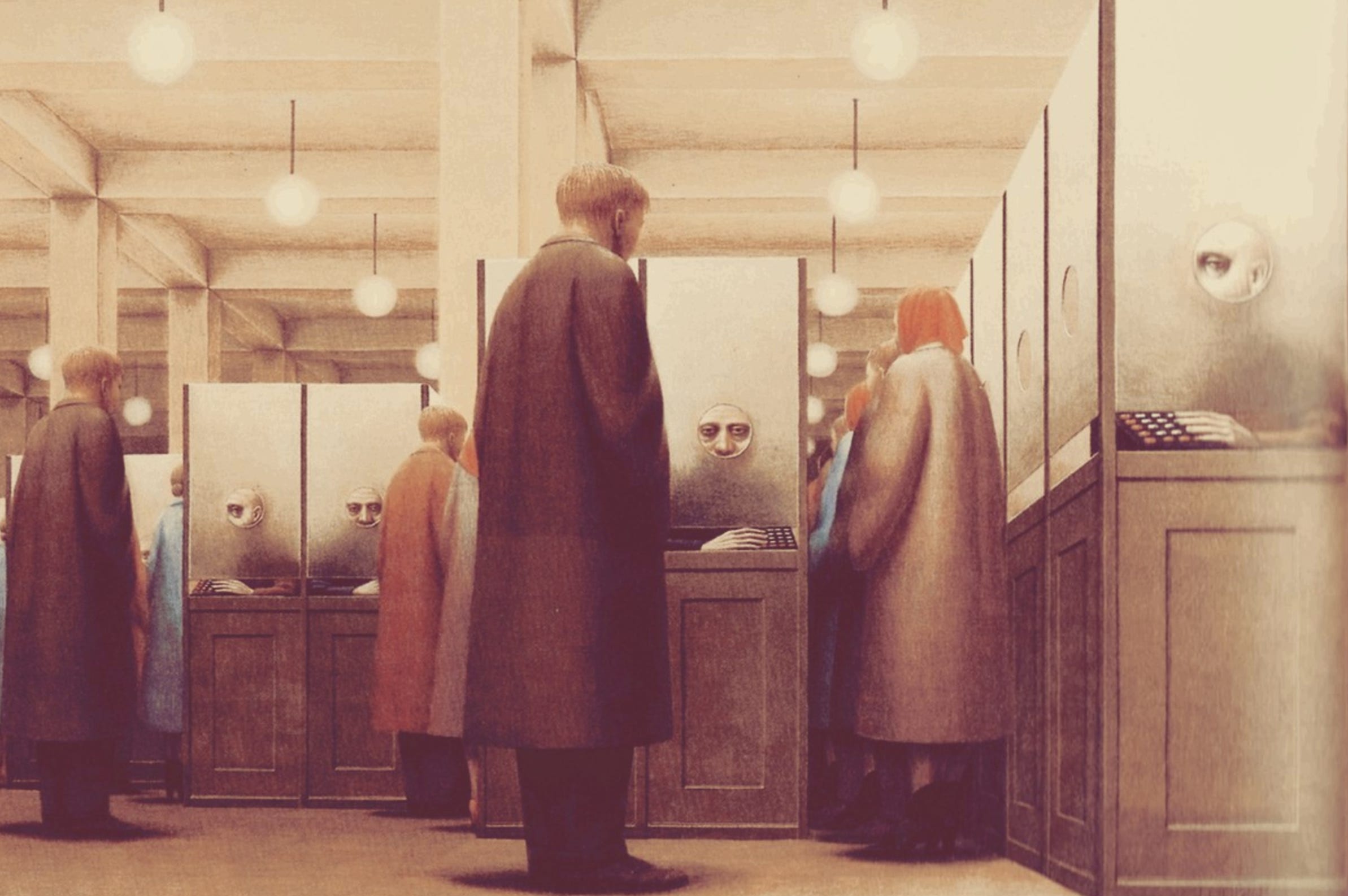
At the railway station in Chișinău, I joined a queue and waited my way to the front to ask for a ticket to Odessa, only to be brusquely referred, with an eye-roll, to counter 27, as though the same question were asked a dozen times a day, and as though I could not possibly expect to buy an international journey from any of the first 26 counters.
The ticket windows were numbered in an unnecessarily long row, given that virtually every journey from here went either to Tiraspol or Bălți, but the building had been erected during the communist years and the logic of that era had come with it. Employment above all. The woman at the counter was therefore not particularly accommodating, so I tried counter 5 instead, which had no queue, and asked the man there, who was sitting counting tokens for some dice game I had no intention of trying to interpret. He too gave me an irritated look, as if I had just toppled his pick-up sticks, and muttered: “International travel, 27.” But there are only 26 counters here, I noted, slightly desperate, gesturing across the station hall, because time was passing and the train would leave the platform with or without me, and then I would be stuck in this sooty city for at least another twenty-four hours, and considering the state in which I had left the hotel room, it would be best for me to get out of here as quickly as possible. But my problems were mine, and evidently not the station staff’s.
For several hours I searched for counter 27, via all the other ticket windows, but nobody knew exactly where this mythical gateway to foreign lands was located. I asked around wherever there were people. The tobacco seller claimed it had been moved after the damp damage in the concrete ceiling. The sweeper pointed out that before that, you needed a special code, Gagarin, to be granted access at all, but that was a long time ago, and besides, the code was top secret. The lad who used to sit at that counter later became a decent poet, the newspaper distributor told me, after all the reading he had managed to do during working hours, but that information was of no use to me now, as the hours passed and who knew whether the hotel cleaner might not call the police. Was that sort of thing illegal in this country? Entirely possible.
Then at last I saw a small arrow on the floor, pointing towards the urinal, then an A4 sheet with another hand-drawn arrow, and I followed the direction down towards the basement level, where there was an Orthodox prayer room that did appear to be in use, and also a rest room that seemed altogether too well used by shady elements who could hardly be ending their working days by reciting the commandments of God, and at the far end, by the boiler, there was another arrow, a childish sticker pointing towards a ladder and yes, I climbed all the way down and found myself in a bunker-like system that had surely been in use long before the station was built, back when world wars were raging above.
At the far end of the corridor with the flickering fluorescent lights, there actually was counter 27, the number written on a folded sheet of paper, with the addition: International travel. But nobody was sitting there to take my order, which of course was not so surprising, given how inaccessible the place was, and therefore how poor the prospects were for encountering other human beings. I sat down on the wooden chair behind the folding table and waited, because now at least I was in the right place, and there was nothing more I could do anyway, and I had grown rather tenderised by all the searching.
A few minutes later I heard a clatter over by the ladder, and an unknown body climbed down into the bunker system to keep me company. Slowly but surely this person approached, whose sluggish steps led me to assume that this was unlikely to be a swift affair. My companion turned out to be a backpacker guy, of course, one of my kind. In Greek English filtered through some sort of peculiar Low German dialect, the stranger managed to ask: “Is it here I can buy tickets to Prague?” I looked around and caught sight of a scratched larchwood hutch, odd that I had not noticed it before, and when I opened it, there lay tickets arranged in alphabetical order, to almost every destination on the planet. Under P I soon found the one he was after, first class as well. I handed it to the lad and accepted his notes and coins, weighing them in my palm, staring him in the eye, and decided to keep the change. Then he went back up towards the higher levels, while I put my feet up on the table and searched my breast pocket for a packet of cigarettes. Not that I really smoked, but it just felt right in the moment. It was hardly going to get busy here.
The executor of the will observed that, broadly speaking, the father had left behind only two assets of any significance: first, a unique Märklin Spur 0 collection from the 1920s, containing an Austrian station building, twenty-six clockwork locomotives in mint condition, fourteen electric locomotives, eighty-seven lithographed tinplate carriages, bridges, viaducts, semaphore signals, points and enough track to offer a journey all the way round the block; and then, of course, the swingers’ club he had run with great success for decades. The value of the two was judged to be roughly the same.
The will contained precise instructions. The train collection was neither to be broken up nor sold to collectors, and the club was not to change its nature. The sons still had a choice, the executor observed when they gathered around the table for the review of the estate: namely, either to accept the inheritance, or to leave the premises empty-handed.
The summer cottage in the archipelago had been made over to the Hungarian dental nurse, also the father’s mistress, a legally watertight arrangement. The liquid assets, which had once been substantial enough to buy a defunct adventure park on a whim, the father had withdrawn in bundles of banknotes and distributed as lavish tips during his final years of milder dementia. Among other things, he had made a waitress both rich and written about in the local newspaper, and in addition refurbished the establishment where she worked to resemble a Bavarian beer hall. The attic flat in town he had sold many years earlier in order to pursue a caravan life, and the caravan itself was, as everyone knew, lying at the bottom of Lake Fryken. Hence this meeting, the executor summed up, without altering his tone.
It ought to have seemed natural to let the model trains pass to Olof, the slightly nerdy and prudish physicist, and thereby sign the club over to Ragnar, the bohemian and extravagant motorcycle mechanic, but the will ordained the reverse. Their father’s principle of upbringing followed the proverb “what does not harm you hardens you”, which apparently also applied from the realm of the dead. The brothers could have spoken at length about this, but in adulthood they almost never met, and on those occasions the conversations remained at the level of small talk.
The sons had certainly been hardened, as children of the scabrous sex director, whose business attracted all manner of herpes-ridden pervs with neither university credits nor table manners. From time to time a certain amount of tourism was generated in the town by suspicious German gangs with television crews, and more than once the neighbours complained about loud howls and used condoms, which had not even been properly sorted for recycling. But the enterprise put food on the table, as people say, and the father had been careful not to bring his work home with him. Their mother did not say much, mostly satisfied at having drawn the winning ticket of not having to work.
Furthermore, the executor explained, I shall guarantee that you sons honour the inheritance. You may sign here, he said, pointing to the dotted line at the bottom of the fifth page of the booklet.
There was nothing to do but obey.
For many long weeks Ragnar stared at the boxes where they stood unpacked in the middle of the villa. As if they might suddenly spring open by themselves, with a surprise and a revelation. His partner said nothing about their placement outside the guest toilet, mostly pleased to own something so expensive for the first time in her life. She boasted about the inheritance when guests came over, and they too had never come close to anything so expensive, so they later came to boast about it second-hand.
The value, however, began to fall on the night, in the wolf hour, when Ragnar decided to take command of the situation. He tore open the untouched packages with their Gothic Märklin logos and began laying buffer stops and centre-rail track across the vinyl flooring. The collection came to life, with carriages, spring-driven locomotives, remote-controlled points and hand-painted semaphore signals. There were both bridges and viaducts, so the thresholds caused no difficulty. He built as if in a trance, and when the rest of the family had woken, they had to tiptoe over the rails to reach the kitchen. In front of the dishwasher stood the Central-Bahnhof, with ticket window, platform roof and a clock face that had stopped at 17:12. Not especially practical, but no one ever questioned Ragnar.
When the line was complete, he sent off the first locomotive. It chuffed away, if not towards Verona or Innsbruck, then at least towards the hall. The sewing-machine sound of the striving engines soothed his mind. The whole procedure reminded him of taking an antique Chinese porcelain service down from a display cabinet and using it to serve tea, then focusing entirely and fully on the drink itself. A transformation into an object of use, from observer to user. And more than anything else: into the protagonist of your own life.
When he checked his mobile after setting several parallel departures in motion around the home, he discovered several missed calls from Olof. His timid brother normally never used the telephone function, it was almost surprising that he had even discovered it existed, and at most sent a text message on birthdays and anniversaries. Now he had called several times during the night leading into Saturday. He had also left several voicemails.
But Ragnar did not call back.
Let us say you have become someone’s parent, perhaps imagining that it would be cosy to become one of those blissfully meandering couples with a sleeping little creature in a stroller, never suspecting that twelve years later you would be ordered to count points at your daughter’s club figure-skating championship.
It is not the sort of thing they talk about much at the baby clinic, that one Saturday you might be placed in a well-heated conference room outside the ice rink with a trio of other parents in order to compile the judges’ scores in SkateCal for girls of varying ages, from young to older, and thereby be responsible for the ranking, in these forms you have been set to fill in.
You are given a brief introduction to the work, very brisk, because the coach has other things to do, and you are adults with jobs, so you know this sort of thing, but all right: after the programme has been performed, the judges send numbers via WhatsApp to the parent group, who then eagerly fill in the form, add everything up and stack the papers in a pile with the winner on top. It is not really that complicated: each jump requires a code, the competitor may fall, which means deductions, different per class of course, and then there is an overall assessment through which every point towards the end has to be filtered, and do not forget either to enter the correct coefficient.
You do not understand how this is supposed to work, no more than you could have learnt C++ during a coffee break or Claude Code by hearsay. If this were at work, you might call in the union or ask your manager for simpler tasks better suited to your IQ, but here it is a matter of five minutes’ total learning time before the code snippets from the judges arrive on your phones with their S: 4.0, P 4.0, C, 3.75. Interspersed with first 2L7 + 1A + 2T and FSSp3, sometimes marked with << in the corner or sometimes just a three, or a one, and it has to be quick because soon it is Rafaela’s turn, and Ester’s, whose verdict from those who know better reads: Well done. Really lovely arms and expression. Good spins! These phrases are to be entered at the bottom of the paper, but they are only words unless you parents, via the formula on the website, together with algorithm-swift mental arithmetic and patience, succeed in producing the final result, the judgement you are to deliver, even though, as is known, you have only glanced at the relevant statute book for a few minutes.
Fortunately, the others know more than you do. One father has even done this before, the previous evening, so the knowledge is fresh. The stress eases a little, even though everything moves at hyper-speed: Elvira, Majken, Li, Olivia, and do not forget Cornelia, who gets an S of 4.5 and apparently that is excellent, assuming higher numbers are better than low ones, and you do not know that, and are those figures actually supposed to be counted first or last, and does it make any difference? Probably a difference.
This goes on for an hour or so, then another, and you realise that in all your decades of working life you have never encountered a task under such pressure, because you do not work with things like feelings. What do you actually work with, that prevents you from doing things that matter to other people?
You know nothing about figure skating. Nothing at all, you realise.
You try to do what you can do, namely delegate tasks to others, the arithmetical geniuses who quickly grasp the concept and add paper to paper in the pile, which you sort by final score, that much you can manage. Someone has to project-manage, you think, keep everything in order. If no one cares about the whole, everything might collapse, lead to double work, triple work, or someone being forgotten entirely. What would that look like, an awards ceremony where one or two girls do not even get to find out how it went? Weeping and wailing and furious leaders, but at least no deduction from your salary, since this is happening pro bono, because parenthood is compatible only with expenses, but one cannot say that, so you do not say it.
Besides, it is going well like this, you have time to think amid the stream of messages, with you handing out papers with names already filled in and comments that your fellow parents complete with code snippets and notes about deviations, while several others document the whole thing on the whiteboard.
It works, like a miracle, the stacks grow and are organised, there is no time for analysis of why and how it happens, because it is happening.
Until someone has to leave to watch their daughter’s performance, then someone else leaves for the same reason. And someone else.
You are alone in the room.
JC, 2S +2TF. FSSp (n)1, Stsq1, 1A+1A+2Lo+CCOSP (no, crossed out). -4, -5, -2, +1. S: 1.5, P: 1.75. C: 1.75. Not very good numbers, or perhaps absolutely excellent ones. And the pictures keep rattling into your phone. It never ends. You sit on a wooden chair by the coffee machine and stare down at the screen, like a drugged bingo caller, with no idea how you would begin even if you were to pretend to begin, what means what, how SkateCal means, is, or works, and least of all what it wants. Girl’s name after girl’s name. Protocol after protocol. You simply look. Nothing is filled in. Because no one returns.
Perhaps they thought this was enough, there were so many others working too, everyone thought, in other words, it is a simple thing after all to help out a little extra at the weekend with the girls’ competitions, nothing to get worked up about, and besides you are all doing this to show goodwill, and then it was just you left, whose daughter’s performance had already taken place yesterday. You could just as well have skipped the whole thing, but duty called, because your name (that is: the daughter’s name + dad) was in the notice.
You could just as well have become the announcer, but.
Cut.
This does not happen, of course. Not in this way. You wake in the middle of the night with a heart ticking as quickly as a fledgling’s. Your unconscious has views on your emotional world’s overreaction, and since you have somehow become stuck in a space between dream and waking, it can reach you without a filter. Certainly, parts of this episode really did take place, but the interesting thing, the unconscious thinks, is the hysterical stress you experienced at being the one who had accidentally given a child a possibly lower score simply because you had keyed in the composition figures beforehand rather than afterwards. The unconscious should not really have been surprised at all, since it knows better than anyone that the event is related to a memory from when, as a young adult, you got an extra job magnetising all the school library’s books and spent several days on the task, only to be told in the end that you had done everything wrong, whereupon the job had to be redone by someone else, someone who understood better.
There is, so to speak, a trigger.
You need to talk about this, you and even more you. And right here, at 03:50 in the night, you can reach one another, have a real conversation, as long as you do not reach for the phone or begin dressing fear in logic. “Who are you?” you ask, and the answer comes wordlessly, with an association to the arms of an octopus, which you understand exactly. “And who am I?” Here too only words without letters are needed, explaining that you are the tip of the iceberg you, and therefore see exactly what you need in order to understand decisions already made. It is as if you are never quite you, you feel now, as if you have been pushed onto the stage with a script in your hand, written by all that mass beneath the surface of consciousness that you never see, but with which you can now at least converse, as long as you do not wake any more than you already have.
“What do I learn from this?” you ask, and soon receive a new wordless wave meaning that it is your job to understand and interpret, because that is how things work here. You as a Rubik’s Cube. On the other hand, that is how it is for everyone. Then, despite everything, you reach for your phone, hoping to fill your brain with other people’s words and pictures, and the conversation dies, but what remains of the dream, the conversation and yesterday is instead a persistent, sweaty and all-encompassing stress. You almost die of shame, you feel, even though what happened is not the end of the world, but it still feels that way. It is as if you had got every answer wrong on the national exam, and worse besides, with accompanying deaths and promissory notes, and inherited guilt on top of that. And it is not the end of the world, you know that. But it feels that way. It feels that way. It feels that way.
Like standing naked in front of the whole class.
You scroll and scroll yourself clean, yet still think that perhaps a girl is lying awake at the same moment as you are trying to free yourself from the stress, awake because the young figure skater, after a flawless competition, has unjustly been named the loser. She is having a conversation with her unconscious about the matter, which does not know either about the injustice within the injustice, about what this would come to mean for the so-called identity. Nothing good, of course. It is not in her nature to lose, winner that she really is.
But perhaps she will get used to it.
Thank you for reading.
– Jörgen Löwenfeldt ✦ jorgenlowenfeldt.se
This dispatch went out to readers across more than ninety countries. If it resonated with you, consider sharing it with a friend who might feel the same, leaving a comment, or recommending it on your own Substack.
A warm thank you to the sponsors of The Bagatelles. Your belief in my work keeps me going, and as a paid subscriber you have access to all long-form content, including the novel Zenopolis, all chapters of Naïveté Travels, and the first season of Bardo Noir.
Do you have any feedback, ideas, or questions? I answer selected questions in dedicated Q&A dispatches: Send them through this form.
You might enjoy this one:
Indoor Moss Garden
·
Apr 24
I have been travelling lately, being greeted by a mayor in Kulu, Turkey, celebrating the memory of Ola in Norrköping, Sweden, and scouting football players in Turku, Finland. Just a few days ago, I went to spring-lit Uppsala and, together with my colleagues,
✦✧ Looking for the archive? You can find every post here.
Comments
Nothing yet. Say the first thing.
Sign in to join the conversation.