
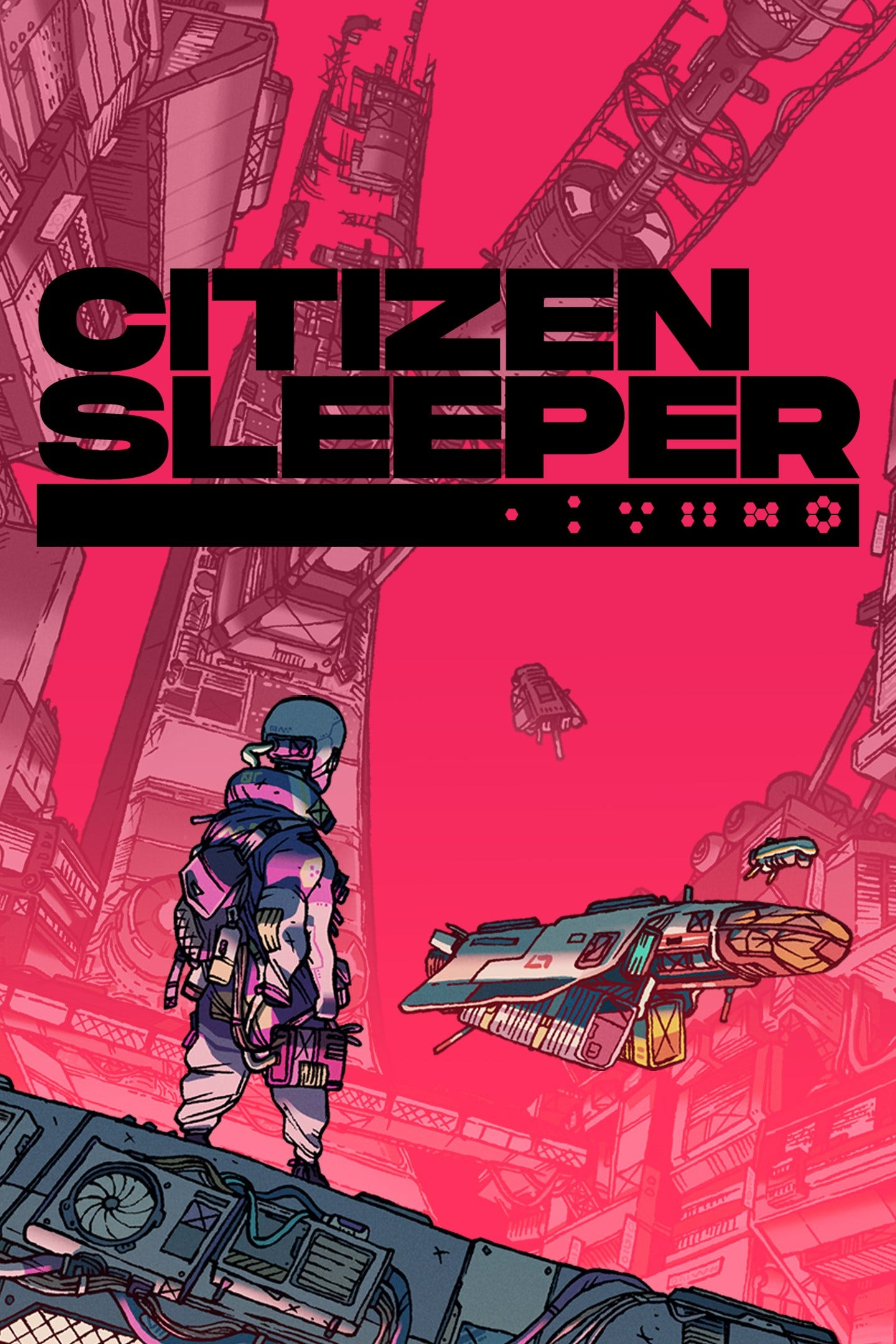
Title: Citizen Sleeper
Genre: RPG (Story & Mechanics), Board Game (Mechanics)
Platforms: PC, Mac, PlayStation, Switch, Xbox
Demographic: Adult (General Audiences)
Length: 6 1/2 Hours (Main Story)
Content Advisory: This work contains themes of death, violence, corporate servitude & enslavement, colonisation, et. al.
Representation: Queer, Trans & Nonbinary, and POC characters.
Links: Official Website
Citizen Sleeper is a game I've been aware of for a while, but it really came onto my radar through the TTRPG community. Specifically, Man Alone's wonderfully rambling video about the two TTRPG entries in the franchise Citizen Sleeper: Spindlejack and Cycles of the Eye. And boy am I glad I picked up the original before diving further into the larger world of Citizen Sleeper, cause this one is a masterpiece of hope, resilience, and tragedy all in one package.
Set in a post-earth sci-fi setting, you are a Sleeper. A robot built from an emulated human mind that was sold to a corporation as slave labour. Escaping this life and Essen-Arp, the corporation that owns you, you end up on Erlin's Eye (The Eye), an old, run-down station formerly controlled by the Solheim Corporation and abandoned when its corporate owners collapsed. It is home to many people and factions that have scraped out a life in the desolate Helios system after it was abandoned. And should you choose it, it will become your home too, Sleeper.
The primary objective in this game is survival. As a property of Essen-Arp, they have built a failsafe to ensure that their proprietary technology becomes worthless should it be lost. Your body is actively failing and killing you unless you regularly inject Stabiliser. You are also being actively hunted by agents of Essen-Arp intent on retrieving their property and collecting the reward for doing so. To survive, you must make connections, and in doing so, not only are you able to endure and thrive amongst the citizens of The Eye, but discover its deeper secrets as well.
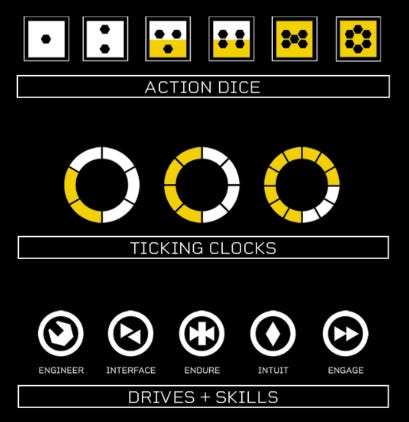
Each Cycle, you must spend your Action Dice to gain resources and connections. Which you will use to ensure a steady supply of Stabiliser, Energy, and Cryo (money) to ensure you endure on The Eye. The number of Action Dice you have access to also goes down as your body fails and your Condition meter depletes. Starting with a maximum of five actions per Cycle, you slowly lose dice as your energy and body’s condition depletes over time or with failed rolls. To unlock new resources, you must complete quests or Drives. Drives are clocks that are completed either on successful or unsuccessful dice rolls or after several cycles. For those familiar with TTRPGs, these mechanics will be very familiar. However, the day-to-day action economy tends to lead more towards a resource management board game than an RPG.
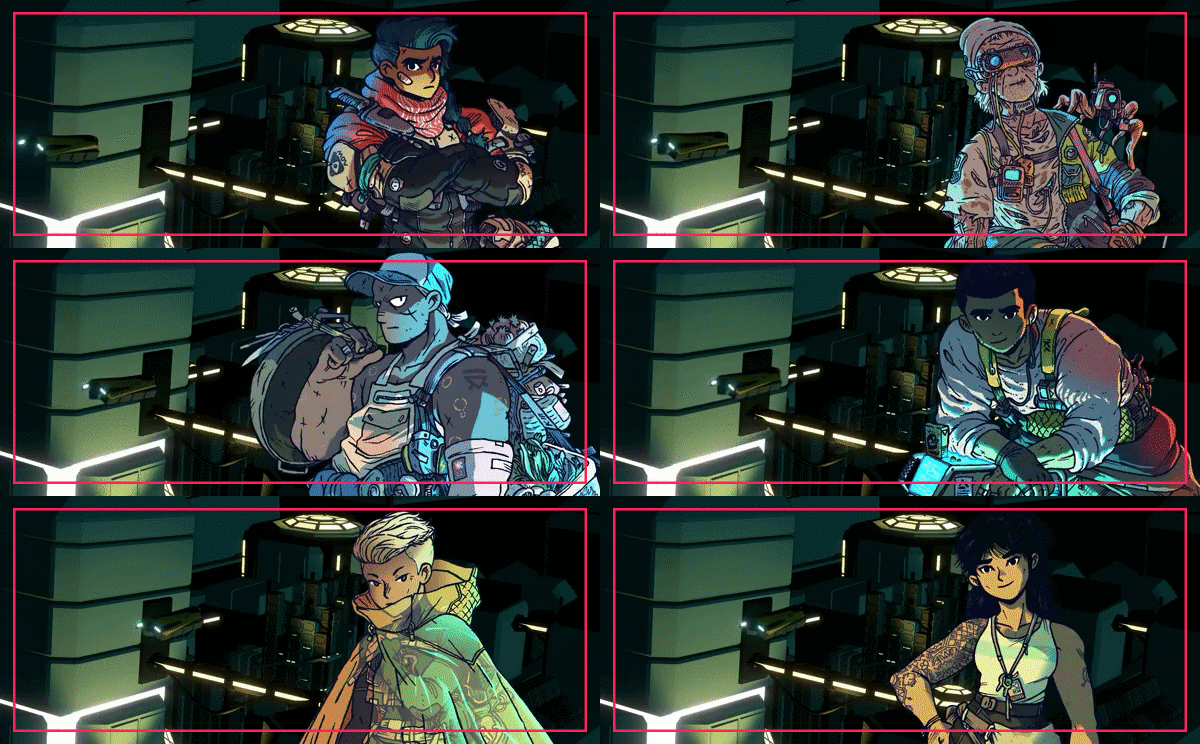
Story-wise, Citizen Sleeper is very much a traditional RPG each new person you meet forming a connection with you as you unravel their story. It very much feels like an episodic anime - in a good way - where each Drive storyline gives you this larger connection to The Eye and understanding your place within humanity, but with very little crossover between the stories. Characters pop in and out as needed, but for the most part, when you start a new Drive, you are mostly dealing with a new set of characters and their struggles. This allows for deep emotional connections between yourself and the current character of the moment, but often makes The Eye feel like a facsimile of a society rather than a truly interconnected place. It also means that some characters just disappear from the narrative after their storyline is complete, even when it would make sense that they reappear or that The Eye would be drastically changed by the actions of their story.
The episodic feeling of the story, as well as the fact that the game now consists of the base game + 3 added DLC, also means that it’s possible to complete storylines in the "wrong" order or to abruptly end the game after a Drive. "Wrong" as in an order that does not make narrative sense for the decisions, encounters, and story you have already experienced. I only really encountered the story feeling out of order once during my single playthrough during the later part of the story. Where a character already revealed to be something they were not reverted to an early interaction style after completing a different Drive. But, nonetheless, it was jarring. As much as when I first encountered one of the three original endings to the base game, where, after completing a Drive, the credits just abruptly rolled despite feeling as though I had many more paths to explore.
The story itself, though, is amazing. An utter masterpiece of hope, resilience, humanity, and tragedy balled into one. Tonally, if you like The Knight and the Butcherbird by Alix E. Harrow. Which I read and reviewed early this year as well. Then this feels like an excellent comparison piece that explores similar themes of corporate dystopia, identity and humanity, as well as resilience and adaptation against the odds.
It is a story where there is beauty in hope and endurance. And through the communities we create to lift each other up. You are a tiny cog in a wheel in a grand universe that keeps spinning regardless of whether you live or die, but it is the little things that make it worth living. The friendships, the favourite haunts, the things you build with your own hands, and the paths you cleave. At the end, you find you have a home, community, and everything you could ever want for, despite your struggles.
Each character you interact with gives you a slice into this rich and expansive world, while also becoming personally connected to your Sleeper. And I found myself at times going back to places for resources, not because that was the most optimal play for that round, but because of the story and connection I had made with the characters there. Those connections in the vast universe is what makes life worth living despite the struggle, and Citizen Sleeper highlights this reality perfectly; humanity is not money, fame, or material goods, but the community we build.
Citizen Sleeper has quickly become one of my favourite pieces of media I have experienced this year, and I cannot wait to jump into the wider franchise of Citizen Sleeper with Citizen Sleeper 2: Starward Vector, or its TTRPG spinoffs. Because the world gives me so much more yearning to explore it, and there is so much more that you can expand upon the action economy of this format, which can make an even richer experience.
Thank you for reading this review of Citizen Sleeper by Jump Over the Age (Fellow Traveller, 2022). Consider subscribing to my future reviews of mainly comics, manga, and SFF fiction and articles relating to writing and pop culture. Or consider buying me a Kofi so I can continue to deliver you new content.

Comments
Nothing yet. Say the first thing.
Sign in to join the conversation.