
France was supposed to be different. Instead, its autism rates are now rising sharply, mirroring patterns seen across the rest of the west. What happened, and what questions are researchers still reluctant to ask?
You will have seen the mugs, cards and posters. They can be found in every gift shop across the land. They declare we should Keep Calm and Carry On!

Reflecting the origins of the slogan in government-backed propaganda to foster support for the Second World War, the call to ‘keep calm’ was designed to shut people up.
This slogan comes to mind every time there is a new announcement about the autism rates. The numbers go up and we are told to ‘Keep Calm - There is nothing to see!’
Any rise in the rate is just the product of better awareness, broader criteria and greater inclusion.
The same propaganda is repeated in one country after another, in one journal article after another, in one news outlet after another, year after year.
This is despite the obvious fact that public services are buckling under the strain of trying to diagnose, educate and fund rising numbers of people with lifelong neurodevelopmental disorders like autism and ADHD.
The latest example concerns the data for France.
When our son was diagnosed with severe (or profound) autism in early 2008, I remember being told that France had much lower rates of autism than the UK. It was seen as the outlier in Europe.
People speculated that it was something to do with the quality of the food and the practice of psychoanalysis (with the implication that this involved misdiagnosing people as having psychological trauma rather than autism), but the rates were always the ‘best’. There was a popular notion that France didn’t have the neurodevelopmental disorders that were plaguing the West.
That is no longer the case.
A new academic paper reports that rates are going up, dramatically, even in France.
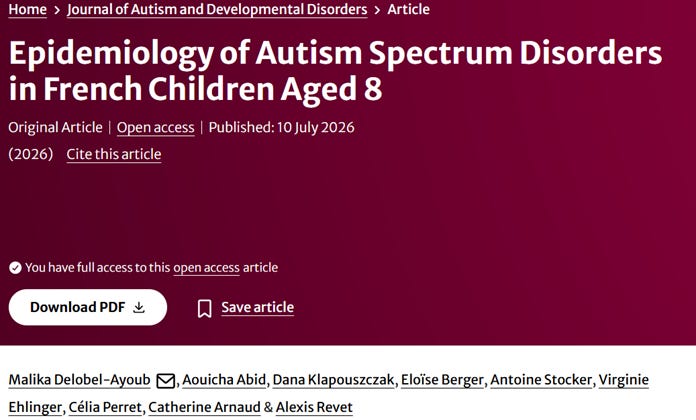
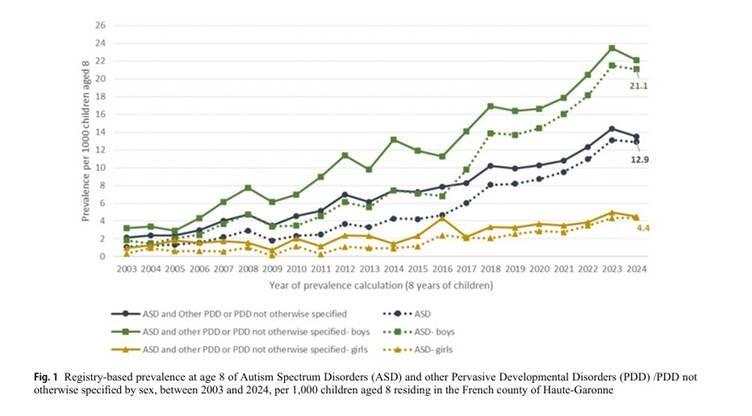
This study, published in the Journal of Autism and Developmental Disorders, reports on a longitudinal data set collected in the county of Haute-Garonne, which includes the city of Toulouse, in the southwest of France. The region has a registry that systematically records all children born since 1995 during the calendar year in which the child reaches the age of 8 (regardless of their place of birth) who have been diagnosed with autism by a healthcare professional no later than the year they turn 8.
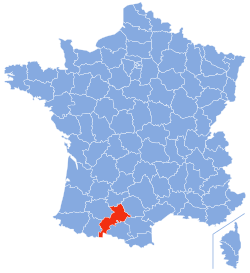
The Haute-Garonne region in France
The authors of the paper have looked at the autism rates, noting that what used to be a very low level of incidence – 2.1 per 1,000 children (0.21% or 1 in 500) in 2003 – had risen to 13.5 per 1,000 (1.35% or 1 in 74) in 2024. This is an increase of more than 500% in just 20 years.
Imagine if cancer rates had gone up by 500% in just twenty years. People would be turning the air blue with cries of ‘sacré bleu’ and demanding something was done.
However, as ever when it comes to autism, the paper is more ‘rien à voir’ than ‘sacré bleu’.
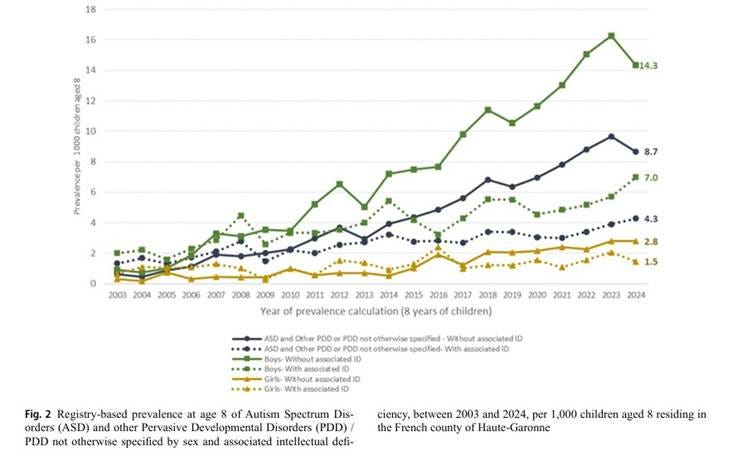
The data indicate that most of the rise has been in children who don’t have learning disabilities or intellectual impairment. They don’t have the kind of ‘classic autism’ that might be a threat. However, this rather downplays some important details that are buried in the statistical meat of the paper.
First, the number of cases with learning difficulties or intellectual impairments or what we would call ‘classic autism’ has more than doubled over this time. Rates have risen from 1.7 per 1,000 (0.17% or 1 in 588) in 2003 to 4.3 per 1,000 (0.43% or 1 in 223) in 2024, a rise of 153%. We can assume that this is an accurate representation of the numbers with ‘classic autism’.
Second, the children with more profound intellectual disability were found to have higher levels of sleep disorders (14% of cases) and eating disorders (just over 20% of cases) which reflects the pattern of comorbidities associated with this group in other locations as well.
Third, it is important to remember that all the other children with a diagnosis must have evidence of lasting impairment in their social skills, communication capacity and flexibility of thought. This is not nothing – just ask people who have what used to be called Aspergers or high-functioning autism.
Fourth, as many as 1 in 5 of these higher functioning children had been given an additional diagnosis of ADHD as well as autism, adding to the impairments and their likely need for support.
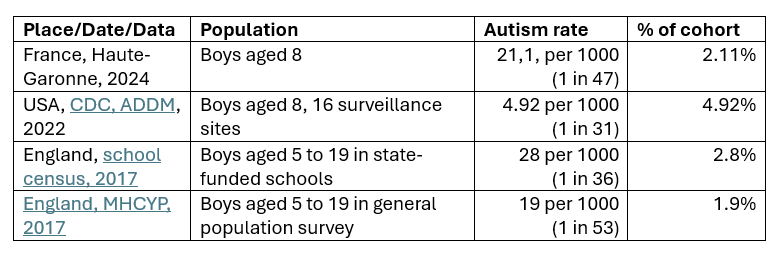
Fifth, the ratio of boys to girls was as high as 5:1 in 2024 suggesting that it is young men who remain more vulnerable to neurological disorders, despite the emphasis on ‘catch-up’ diagnosis for women and girls that has been going on in many parts of the world. As many as 2.11% of boys aged 8 (1 in 47) were diagnosed with autism in 2024, which is shockingly high, especially for France where the rates were always much lower than those found in other parts of the world.
This data puts France in the middle of the rates for boys aged 8 as reported for the United States (although the rate is for 2022 and is likely to be higher now) and England (where the data is almost a decade out of date and likely to be much higher now).
Comparison of the autism prevalence rates for boys (aged 8) in the Haute-Garonne, France, with those in the USA and England
When they looked at the 625 children most recently diagnosed with autism in Haute-Garrone - children born between 2014 and 2016, who turned 8 in the final year of the registry entries - the authors of the French study tried to identify any possible biological explanations for what had occurred.
Although these characteristics will overlap in some children, thereby compounding the likely effects, roughly 10% were born prematurely, and the same rate had a low birth weight (< 2500g). Double that number (22%) were born by caesarean section and 10% had been hospitalized in a neonatal unit.
There was a statistically significant relationship between having an older father and autism, but this association with age was not found in the mothers as well.
A genetic syndrome or chromosomal abnormality was found in 30 children (5%), with a possible link to autism in half of these cases. A malformation was found in 27 children, or 4% of cases (including cardiac malformation in 11 cases, cerebral malformation in six cases, and hypospadias in five cases).
Clearly, for a subset of children, there were obvious biological factors that underpinned the later diagnosis of autism, including risks associated with early birth, low birth weight, caesarean section and hospital care that I’ve covered before.
However, while they don’t mention it, and would never get published if they did, it is interesting to think about the immunological consequences of any vaccinations given to the mothers and their children over this time.
France has long had mandatory vaccines for Diphtheria (from 1938), Tetanus (from 1940) and Polio (from 1964). The government also mandated compulsory TB vaccination via BCG, between 1950 and 2007. We can assume that the parents and children in the Haute-Garonne study had this package of vaccinations as a minimum, although others were widely encouraged.
However, since January 2018, the French government has adopted a compulsory childhood vaccination schedule that looks very much like the rest of the west, moving from 3 to 11 vaccines (some of which are given more than once). They have added Pertussis (whooping cough), Haemophilus influenzae type b, Hepatitis B, Pneumococcal disease, Measles, Mumps, Rubella (given as ROR or MMR), and Meningococcal C disease to the established DTP (Diphtheria, Tetanus and Polio).
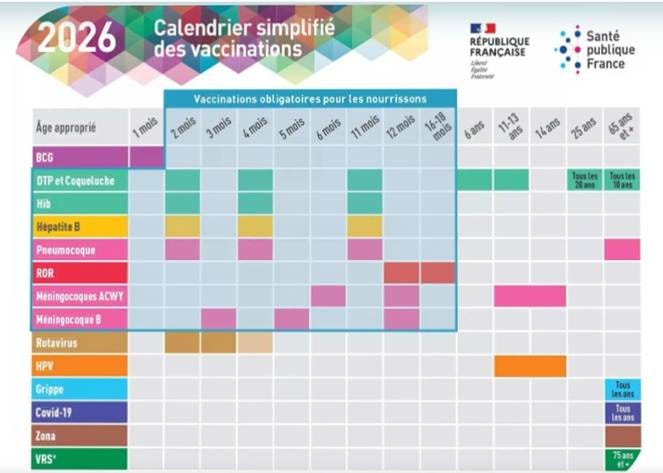
French parents are forced to complete this schedule if their child is to attend nursery, school or university and not surprisingly, compliance rates are reportedly high.
Thus, there is something of a natural experiment underway in France.
Autism rates were already going up but pressure on the immune system – caused by the growing vaccination schedule - might be getting much worse amongst the cohorts to come.
The European country which had the lowest autism rates might well be moving towards the top of the list and in this regard, the Haute-Garonne registry data represent political dynamite.
The entries collected for this year – 2026 – include the first cohort of 8-year-olds who have been through the period of mandatory vaccination for 11 rather than 3 diseases.
Repeating the study would be a great thing to do.
If the autism rates are found to have gone down, we can’t blame the burgeoning vaccine schedule, and conspiracy theorists can be put in the stocks. I will be very happy to eat humble pie.
If they have gone up, again, we have no choice but to repeat our demand for answers to the autism crisis - including scrutiny of the impact of the vaccination programme on the neurodevelopmental health of the next generation.
We certainly can’t keep calm and carry on.
The comfort blanket of complacency must eventually start to wear thin, and we can usually rely on the French to revolt before the rest of us do.
Comments
Nothing yet. Say the first thing.
Sign in to join the conversation.