
Big week on the edit desk. Deep in the trenches on a high-energy thriller series and finishing up a self-help title for a motivational speaker whose “High-Identity” voice is the kind of thing no AI is touching anytime soon.
But it’s Friday, so here’s your audiobook rundown. Audible is opening a bookless bookstore in Manhattan. Amazon just made a massive move in the Middle East. And there’s something about platform safety that every producer and rights holder should know about.
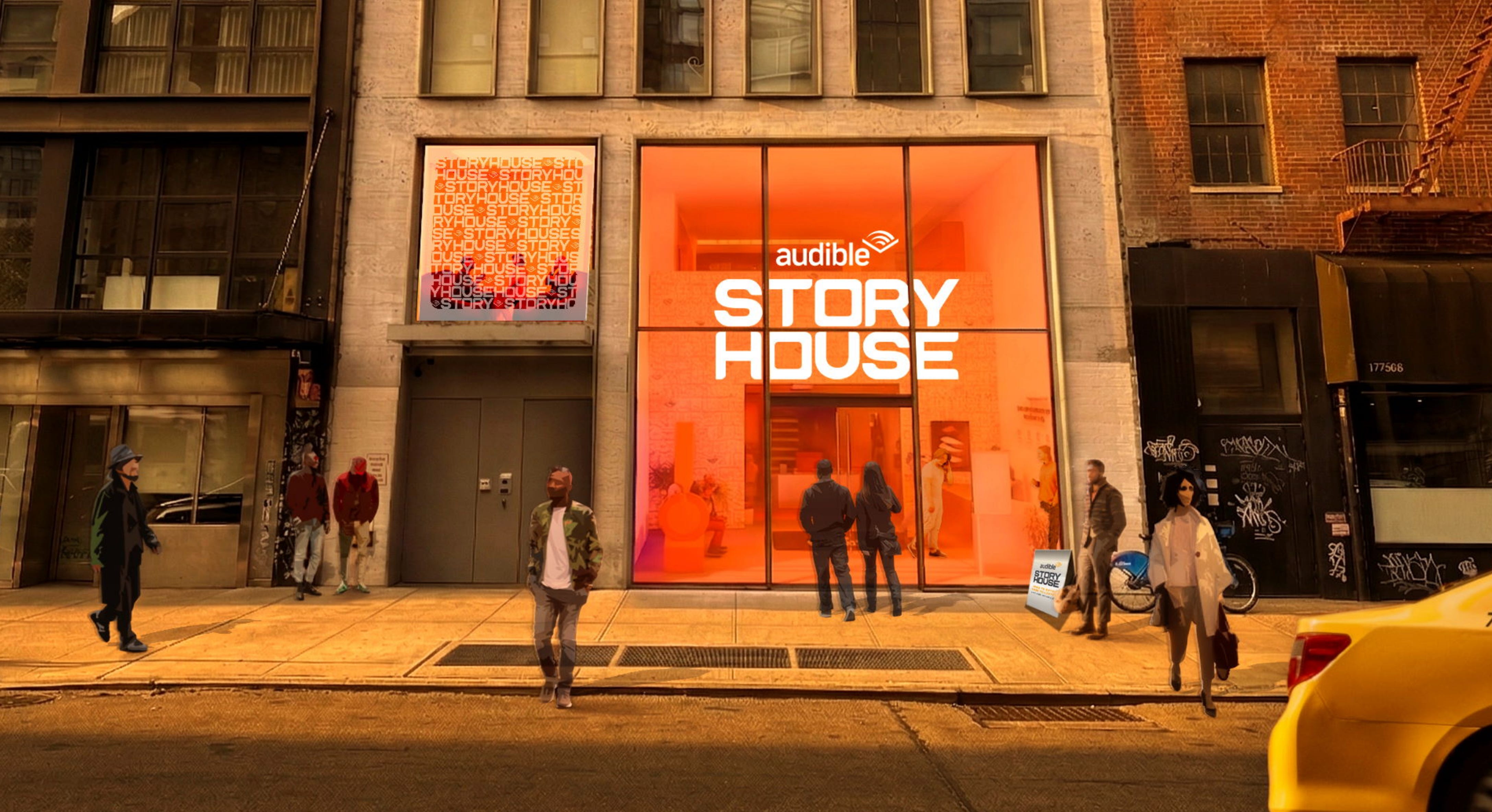
Audible is doing something radical on the Bowery this May. They are launching Story House, a permanent physical space in NYC that they are calling a “bookless bookstore.” No shelves, no dust—just pure audio.
What’s inside:
Listening Lounges: 7 distinct spaces with Dolby Atmos sound and Sony high-performance headphones.
The “Story Tile” System: You browse audiobooks physically, using tiles that map 1:1 to your digital subscription.
Performance Space: A hub for live tapings, talks with narrators, and immersive events.
Why this matters strategically:
Brand Moat vs. AI Slop: Spending Manhattan real estate money is Audible's way of planting a flag — they're a cultural institution, not just a delivery pipe. It's a direct signal that premium, human-made audio is worth protecting from the synthetic content flooding the low end of the market.
Soft Power: Story House is positioning itself as the prestige stage for audiobook premieres. If you want your title to feel like an event, this is where it will need to happen.
The Data Funnel: That free coffee at the Land to Sea pop-up isn't just hospitality — every person who walks through the door is a data point. Audible is using the physical space to learn what romance fans versus true crime fans respond to, then feeding that back into their digital commissioning decisions.
My Take: I genuinely want to check this place out — seven Dolby Atmos listening lounges on the Bowery sounds like a good Friday. And credit where it's due: this is a real investment in promoting authors and the craft. My hope is that if they're willing to spend Manhattan real estate money on the experience, they're also planning to invest more in the people actually making the content.
What do you think — is Audible's investment in physical spaces a sign they're serious about content creators, or just a brand play?

While the West focuses on NYC, Amazon just ran a massive power play in the Middle East with the launch of the Digital Arabic Library. In partnership with the Abu Dhabi Arabic Language Centre, they’ve dropped a unified storefront that makes Arabic-language listening feel as frictionless as a Kindle in English.
The Numbers:
38,000+ Titles: Including 33,000 eBooks and 5,000 Audible audiobooks.
The Sampler: 1,000 titles are being offered for free to act as an on-ramp for the “Silent 70%” of the Arabic-speaking world.
On paper, this is widening access for a region long underserved by global platforms. But Amazon didn’t do this out of generosity — they just opened a new market on their terms. Arabic-speaking authors and narrators are about to find out exactly what “global standard” means in their contracts.
The Upside: It incentivizes Arabic-first production and builds careers for a new generation of narrators.
The Downside: One giant platform now dictates the bargaining structure, leaving local publishers dependent on payout formulas they didn’t design and can’t negotiate.
The Under-35 Takeover: New UK data via Good e-Reader shows that 52% of audiobook listeners are now under the age of 35. These are high-frequency consumers who treat audiobooks like a social feed. Which explains exactly why Spotify's discovery-first, UI-heavy strategy is working, even if the mainstream press hasn't quite caught up to that yet.
The Audies’ Arms Race: The Audio Publishers Association reports a 42% surge in Audie Award submissions over the last five years. Even as AI narration floods the low end of the market, the industry is doubling down on prestige productions. Full-cast dramas, Atmos mixing, the works. The top tier is getting more expensive, more human, and harder to break into.
The sepia-toned covers, the “Staff Picks” badges, the “Best Seller” labels — audiobook platforms are designed to feel like curated libraries.
They’re not. Most of the catalog comes in through self-service distribution that has more in common with a podcast host than a traditional publisher. We’ve inherited the podcast moderation problem, and more people need to be talking about it.
Last year, a Reddit user described finding what they believed was a recording of actual child abuse inside an Audible title. When they went to report it, there was no in-app button. No flag. They called customer service and were basically told that was their only option.
That’s a safety failure. But it’s an economic one too.
Pirates have also been downloading popular nonfiction titles, repackaging them as bogus “courses,” and re-uploading them under fake names. Unless the original author catches it and spends days navigating a DMCA response, the platform keeps collecting royalties on stolen content.
Here’s why this keeps happening. You can scan a blog post for problems in seconds — you can’t skim a 10-hour audiobook without paying someone to actually listen to it, and platforms have decided that’s not their problem.
Section 230 gives them enormous cover to these platforms, so it’s easy to get a title in and surprisingly hard to get a bad one out. The de facto trust and safety team for this industry right now is listeners and rights holders doing the work for free, while platforms treat moderation failures as a PR headache rather than an issue they want to solve.
We keep hearing this market is heading toward $70 billion. That’s great. But right now we’re building that growth on the bare minimum of safety infrastructure.
In-app reporting, transparent removal timelines, consequences for repeat pirate uploaders — none of this is complicated. It just requires platforms to treat it as a priority instead of an afterthought.
The "library vibe" is a UI choice, not a quality guarantee. These platforms have the resources to build real moderation infrastructure — they're just choosing not to. A $70 billion market that can't protect its own content creators or its listeners isn't as healthy as the numbers suggest.
The audiobook market is growing fast, the technology is impressive, and the business is more complex than it’s ever been. Whether it’s platform safety, AI narration, or Amazon setting the terms in new markets — the people who make this industry work deserve better infrastructure, better protections, and a bigger seat at the table. That’s what this newsletter is about.
And if you’re working on a title and need a production team that actually understands all of this — we do that too.
See you next week! Enjoy the weekend and happy listening.
No posts
Comments
Nothing yet. Say the first thing.
Sign in to join the conversation.