
After spending several trips visiting places we already knew well, that had become tried and true escapes, Tibi and I decided in mid-2025 that it was time to check off a new country from our list. We were ready for the exciting discomfort that comes from traveling somewhere unknown, where the culture and even the language makes one work a little bit to feel “let in.” For this trip, we were looking for a spot to ring in the new year, and we thought a big city like Tokyo must be a hopping spot for such an occasion, so we opted for Japan, a place we’ve long wanted to visit.
Our desire to be surprised by a new place was fulfilled even before arriving in the Land of the Rising Sun. After booking our trip and trying to find a fun place to celebrate New Year’s Eve, we came to learn that Japan is not necessarily the most rollicking country for a traditional New Year celebration. Rather, for the Japanese, New Year is a family holiday, more sacred than profane. Japanese young people return to their parents’ homes and spend this quiet period together, visiting temples and reciting prayers for luck and prosperity in the coming year.
Our time in Japan ultimately reflected these contradictory approaches to life: sometimes quiet and meditative, other times celebratory and joyful. Equal parts impulsive and reflective. Even the two cities that would serve as bases during our two weeks in Japan mirrored this dichotomy: Tokyo, with all the verve of a big capital city, packed with restaurants and markets, bars and clubs, laden with choice; and Kyoto, the ancient capital with its plethora of temples and more quiet, conservative, traditional approach to life.
We arrived in Tokyo when it was already evening, having survived the 14-hour flight by binging Heated Rivalry—the best possible start to a vacation. As night had already fallen, there was little to see of the city as we drove in. The streets were strangely quiet for a capital, as everyone had already traveled home for the holidays, with New Year’s Eve only one night away. We checked into the Tokyo Hilton, which is, of course, eerily similar to every other Hilton in the world, then set out for a late dinner at some close-by hub of activity. We ventured to a tempura place that was supposed to be excellent, but it was just after 9 pm, and it, along with many other restaurants, was already closed. (This was another reality to which we would need to adjust: the Japanese, it turns out, are early eaters.)
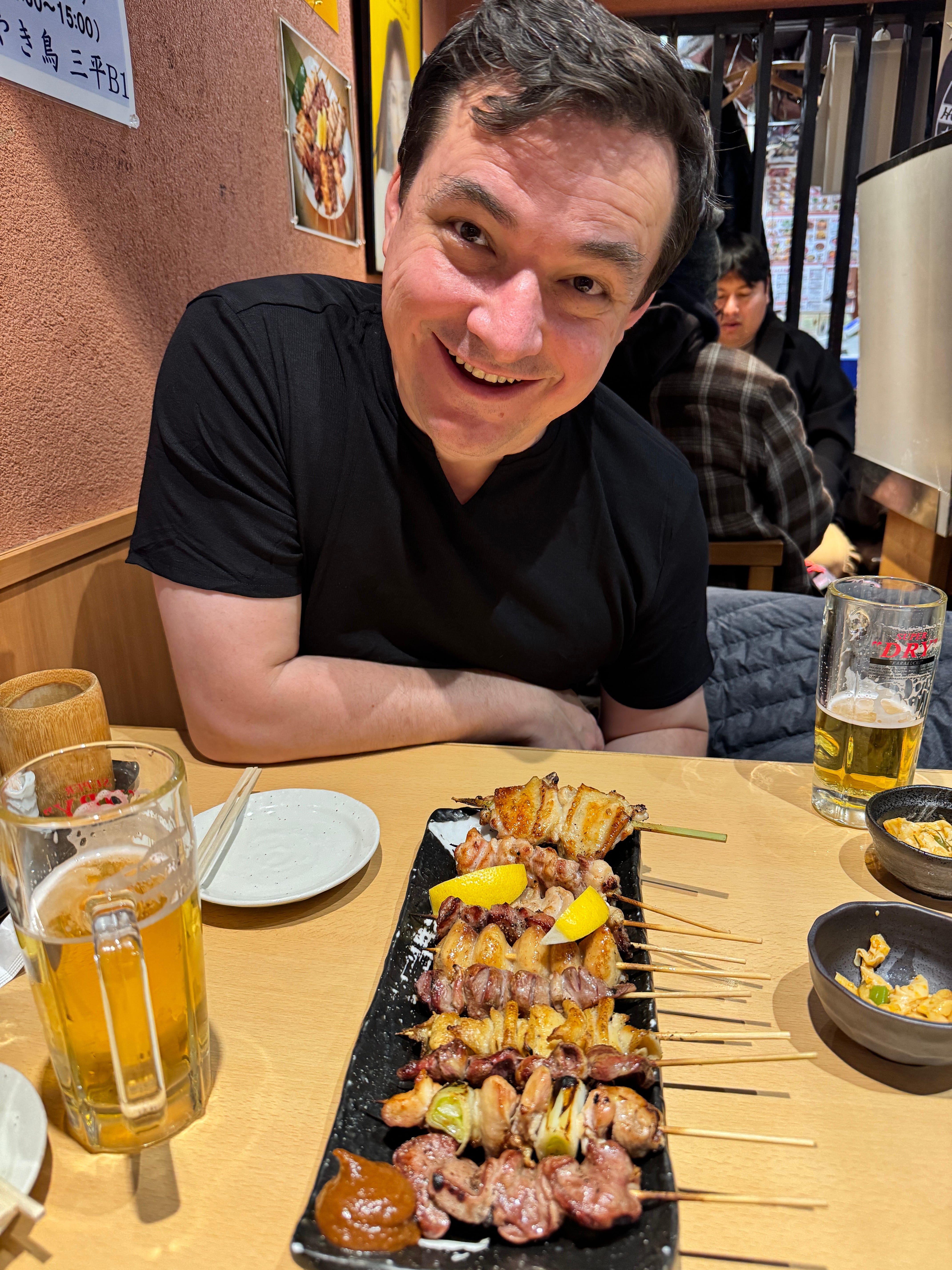
We found what looked to be a bustling izakaya—or small bar with food—close by and descended the stairs into a room full of Tokyoites, chatting loudly over beers and yakitori—grilled skewers with countless varieties of meats, seafood, and veggies. This really wasn’t tourist season, which was amazing, as Tibi and I always love finding places where we’re the odd ones out. The waiters were the first of so many throughout our trip who spoke no English at all yet were so kind and patient as we ordered a mixed plate of skewers and some beers. They came to the table after not much time at all, and though we were left to guess which parts of the cow or chicken we were eating, the skewers were delicious, going down perfectly with the mild, cold beer. This, too, would become a common theme throughout our trip: incredible food, much of which we had to work to figure out what it even was.
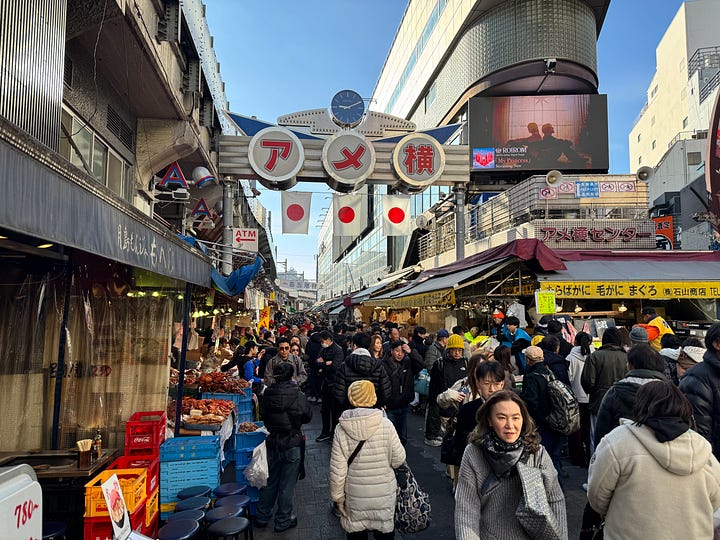
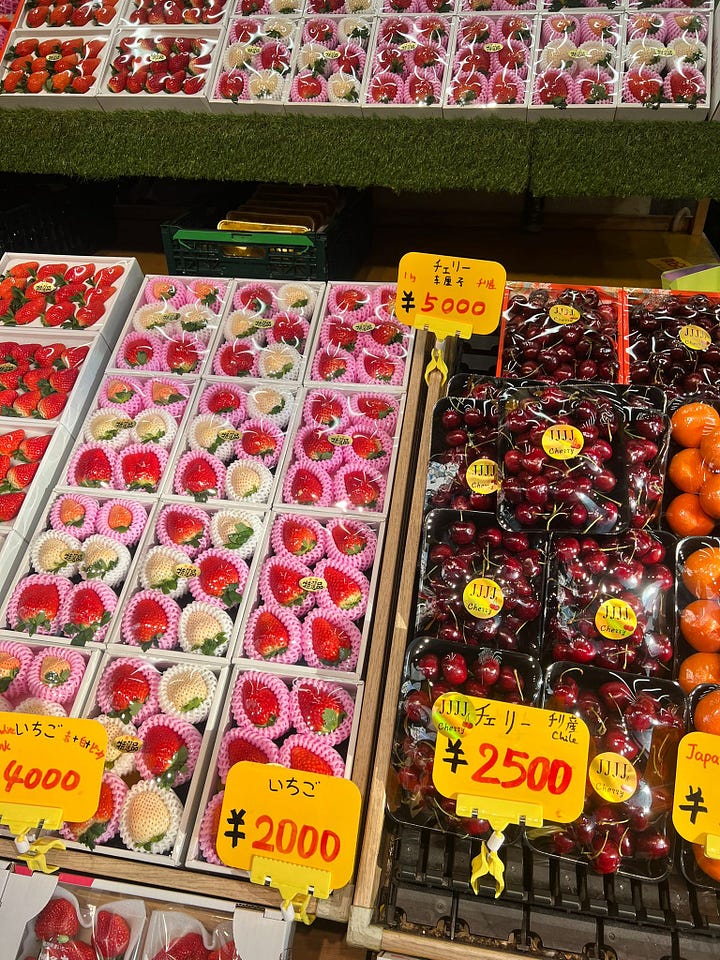
The next day was New Year’s Eve, which is apparently the day to visit Tokyo’s Asakusa Market, a small outdoor string of shops and stands stationed underneath some elevated railway lines. What started decades ago as a sweets market where Korean immigrants sold homemade candies now sells pretty much everything. People lined up to buy food for their New Year’s Eve dinners at home, including massive crabs and perfectly red and white strawberries, sold individually, each wrapped with paper and placed in beautiful boxes.
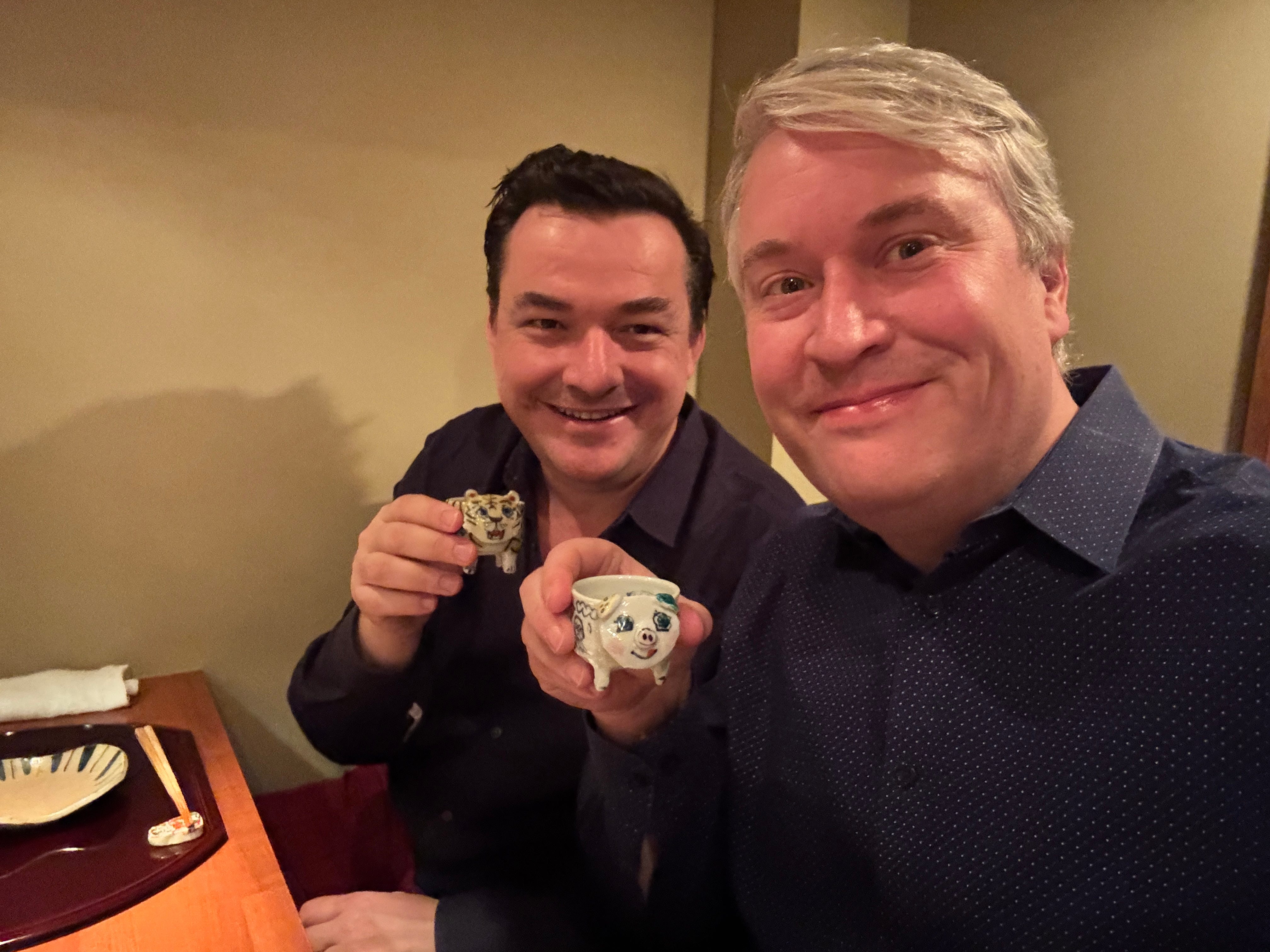
We started our New Year’s evening with dinner at an incredible, tiny restaurant in Ginza called Kabukizaura Masashi (FEAST SCORE: 51 – Must Go). To call the restaurant “comfy” would be an understatement. It is located down a dark, quiet alley on the ground floor of an apartment building and consists of one counter that seats eight people. While the bar is often the dregs of seating in the U.S.—the place you only opt to sit when no tables are available—in Japan, it is the place to be, as it allows you to watch all the action as the food is prepared for you. Behind the counter was the chef, Masashi, a youngish man in a white Japanese chef’s coat and headband, and his wife, Ayaka, who acts as hostess, server, and sake sommelier. There’s no menu. Rather, the meal is served omakase-style: a multi-course, chef’s choice journey that guides you through an array of flavors and cooking techniques, all paired with incredible sakes curated by Ayaka. We had what is surely one of the best meals of our lives, each course prepared with precision and care. And the evening was made even more entertaining by our neighbors, a trio of Australian women—a mother, her 20-something daughter, and the daughter’s unfortunate friend—who had been traveling together across Japan for several weeks. The daughter drank too much sake and ended up starting a fight with her mother about nothing at all, while the friend kept trying to calm the situation by reminding them of all the amazing experiences they’d just had. It was no use. Three weeks of non-stop contact between mother and daughter had left them exhausted and unable to pretend anymore. They may not have enjoyed their meal as much as we did, but from our perspective, we got dinner and a show.
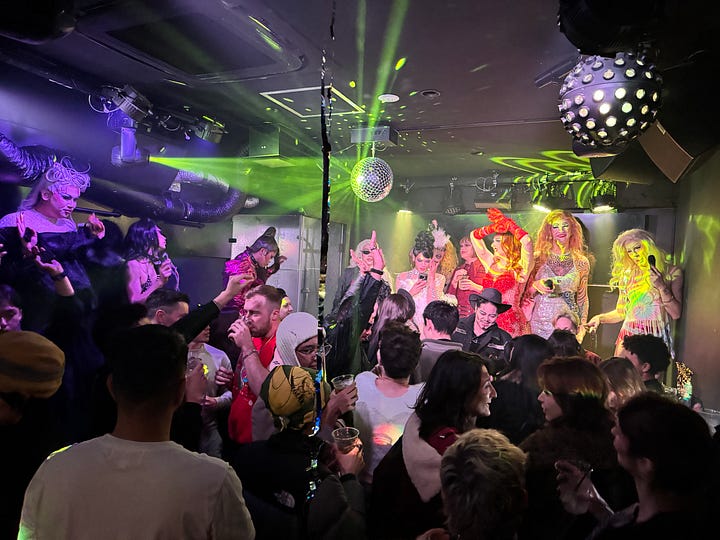
We had explored online several options for places to ring in the actual new year at midnight, but most were overpriced parties in hotel bars. Instead, we found a gay bar in Shinjuku Ni-chōme that had a drag show planned, and decided we’d try that. The bar, like every other place in Tokyo, was small—maybe large enough for 50 people packed shoulder to shoulder, with a tiny sliver of a stage up front (complete with a glass shower stall?) where the drag queens could perform. Despite our fatigue from jetlag, we had a rollicking time watching the pretty average drag queens perform as we sipped watery cocktails and, as midnight approached, an overpriced bottle of champagne. The winner of our favorite drag performer was an Australian immigrant who wore cut out faces of Japan’s new ultra-conservative prime minister on her breast plate. She called herself JaPam. (Nothing beats a good drag pun!) Again, we were surrounded mostly by locals, most of whom were much younger than us. (I keep forgetting that we’re middle-aged now. It’s so strange!) At one point, another middle-aged Japanese man came up to me and, in very broken English, asked what I was doing there and if I knew this was a bar for “homosexuals.” I told him I did, and he assumed I didn’t understand, so he repeated himself, that this was a “homosexual bar.” Yes, I thought, the dozen men dressed as women over there kind of give it away. When he insisted again, I said, “Yes, I know. This is my husband,” pointing to Tibi. The man basically flipped out. He couldn’t believe I was married. He told his partner, and they started pelting us with questions about what it’s like to be gay in the U.S. It revealed how much more difficult the situation is in Japan. It was a beautiful moment of communion, but also a depressing one. How bad must it be that he couldn’t even conceive of two foreign tourists visiting this bar intentionally?

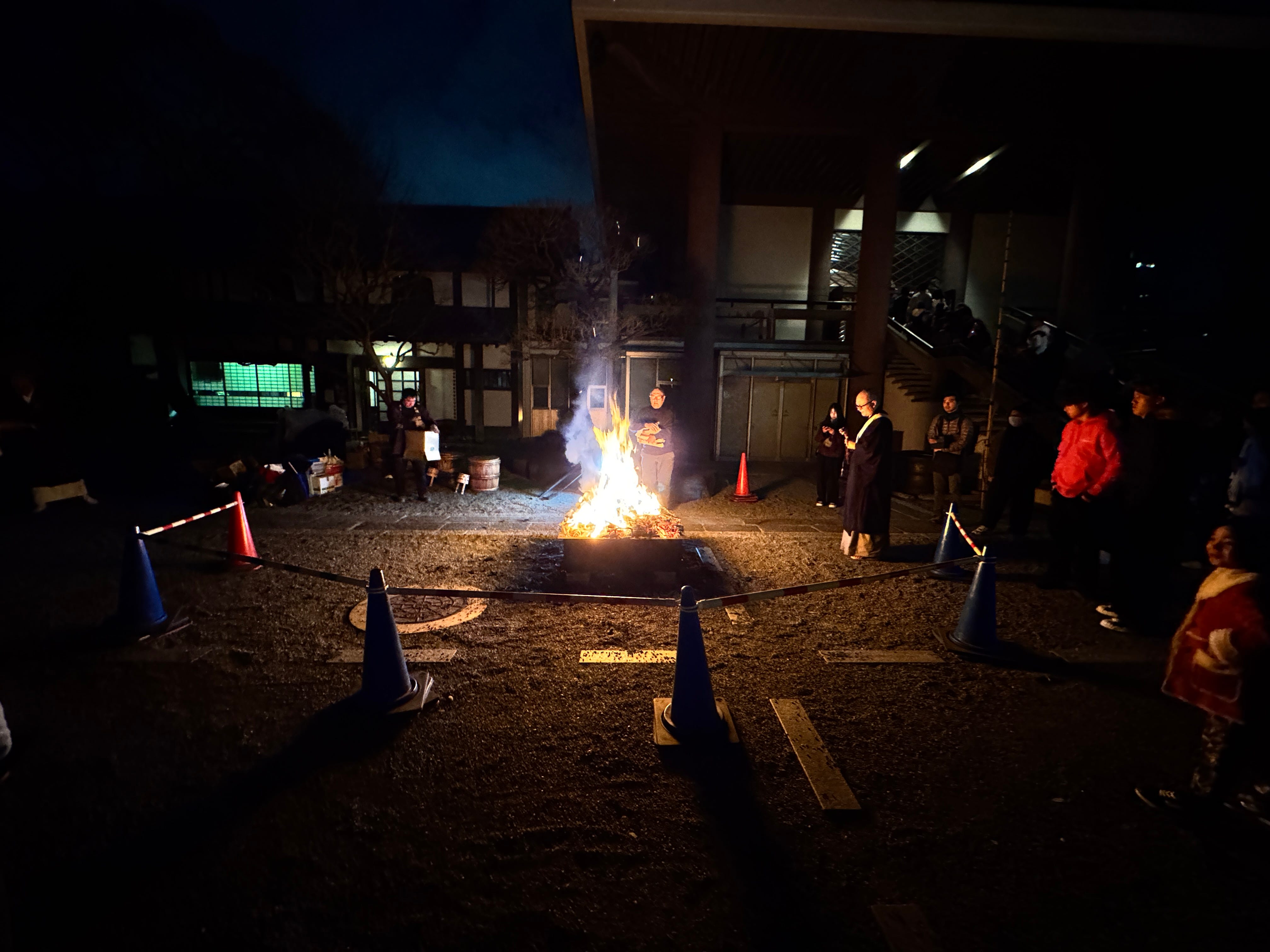
We stayed up until midnight, but only barely. The dozen drag queens counted us down to 2026. We cheered and finished our champagne, then ambled slowly back to our hotel. On the way, we passed a temple, worn and wooden, tucked behind some modern office buildings. Hoards of locals were lining up inside the temple grounds to ring the temple bell, which sounded resonantly yet calmingly every few seconds. Buddhist monks stood around a blazing fire, chanting blessings as they burned offerings, charms, and prayers in the hopes of an auspicious year. It was like taking a step back in time, off the concrete of the Tokyo sidewalks onto the dirt paths of the temple. We went from the whoops and hollers of drag queens and their subjects to the prayerful quiet of temple bells and the crackling of ritual fires. How glorious that these two worlds exist just steps from each other. Two very different forms of communitas. Life is beautiful, indeed.
To be continued…
Comments
Nothing yet. Say the first thing.
Sign in to join the conversation.